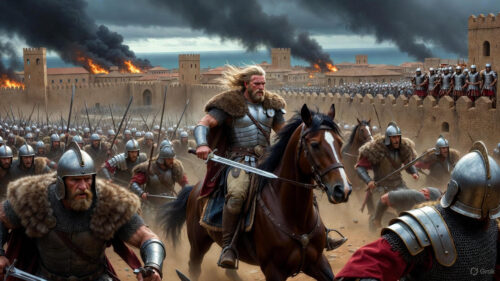

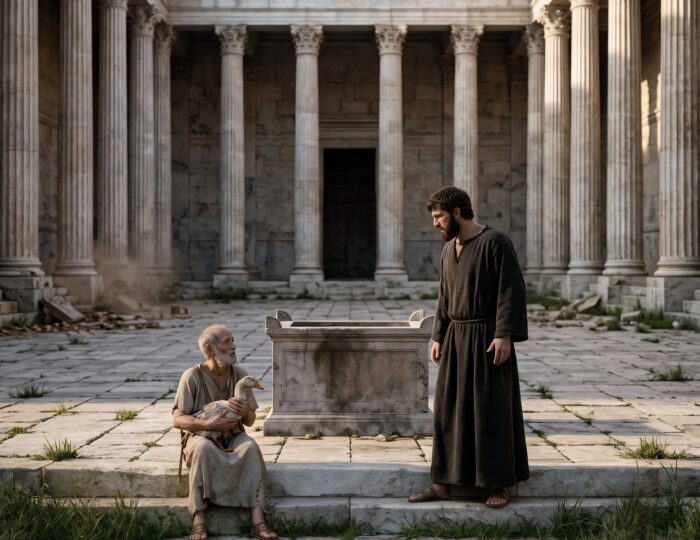
On the night of October 22, 362 AD, an imperial catastrophe unfolded in a fragrant laurel grove five miles south of Antioch. The sanctuary of Apollo at Daphne—one of the most opulent, revered, and culturally resonant shrines in the entire Mediterranean world—burst into an inferno so ferocious that it melted gold offerings, cracked marble columns into powdery lime, and reduced a colossal forty-foot statue of Apollo holding a golden lyre into a heap of blackened ash.
The man watching the sky glow crimson from his imperial palace window was Flavius Claudius Julianus, known to history as Emperor Julian the Apostate. He was thirty-one years old, possessed of absolute dominion over the Roman world, intellectually ferocious, and completely consumed by a singular, obsessive mission: to turn back the clock of human civilization.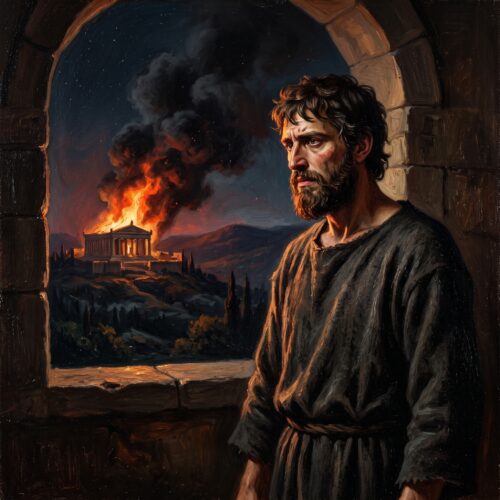
Julian had spent the previous eighteen months trying to single-handedly undo the Christian revolution set into motion by his uncle, Constantine the Great. He wanted to resurrect the classical pagan world of Homer, Plato, and blood sacrifices, restoring what he believed was the true golden age of Rome. Daphne was meant to be the crown jewel of this grand revival. Instead, on October 22, it became a smoldering graveyard of imperial vanity.
The events that took place at Daphne on that October night offer a masterclass in the psychology of stubborn delusion, bureaucratic obsession, and the peril of trying to rebuild a future out of dead parts. History remembers the fire as a footnote in late antiquity, but the psychological machinery behind it mirrors the exact mistakes modern people make when their personal grand plans crash into cold reality.
The Grove of Daphne: The Playground of the Ancient Levant
To understand why this fire mattered so deeply, one must first picture Daphne. It was not a somber, dusty ruin. In the fourth century, Antioch was the third-greatest metropolis in the Roman Empire, boasting paved streets illuminated by oil lamps at night, running water piped into private homes, and a raucous, cosmopolitan population of over four hundred thousand people. Antioch was wealthy, skeptical, irreverent, and thoroughly addicted to pleasure.
Five miles outside the bustling city gates lay Daphne, an alpine oasis fed by gushing natural springs, dense groves of ancient cypresses, and towering bay laurels. Legend claimed that Daphne was the exact spot where the nymph Daphne, pursued by the lustful sun god Apollo, pleaded with the earth to swallow her and was transformed into the first laurel tree.
Because of this myth, the Seleucid king Antiochus IV Epiphanes had built an astonishing temple on the site in the second century BC. At its core stood a statue of Apollo crafted by the legendary Athenian sculptor Bryaxis. The god was rendered in ivory and wood, draped in a cascading robe of hammered gold, with eyes made of rare gems. In his left hand rested a lyre, and in his right, he tilted a golden patera, eternally pouring a libation onto the sacred earth.
Surrounding the temple were Olympic-scale athletic arenas, public baths supplied by ice-cold mountain streams, and palatial pleasure villas. Daphne was so famous for its sensual indulgence and hedonistic parties that Roman satirists had coined the phrase moribus Daphnicis—to live according to the morals of Daphne—which was a polite way of saying someone spent their life drinking sweet Syrian wine, listening to flute girls, and ignoring all moral duties.
By the mid-fourth century, however, Antioch had changed. Christianity had swept the city. Decades earlier, the Roman Caesar Gallus—Julian’s half-brother—had decided to clean up Daphne’s scandalous reputation by exhuming the bones of Saint Babylas, a revered local bishop martyred during the persecutions of Emperor Decius, and reburying them directly across from the Temple of Apollo.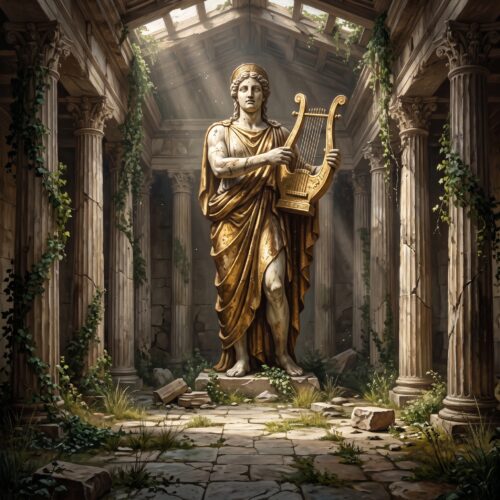
The move was a deliberate spiritual land grab. The local Christian community flocked to the new martyrium of Babylas. Apollo was starved of worshippers, and the grand temple fell into neglect. Grass sprouted between the marble pavers, dust coated the golden lyre of the god, and the once-famed oracular spring dried up, silenced, the locals said, because the bones of the martyr made the pagan demon unable to speak.
Enter the Imperial Nostalgist
In July 362 AD, Emperor Julian marched into Antioch.
Julian was a complex, contradictory, and deeply stubborn intellectual. Spared as a child from the bloody dynastic purges that wiped out most of his family, he had grown up under house arrest, immersed in classical Greek philosophy, Neoplatonic mysticism, and secret pagan rites. When he became sole Emperor in 361 AD after the death of Constantius II, he threw off the Christian facade he had worn for survival and declared an empire-wide pagan renaissance.
Julian did not want to execute Christians; he knew martyrdom only bred zealots. Instead, he sought to beat Christianity at its own game. He issued edicts forbidding Christian teachers from teaching classical literature, arguing that if they did not believe in the gods of Homer, they had no right to make money teaching them. He attempted to build a centralized pagan church hierarchy modeled directly on Christian bishoprics, complete with pagan charities, ascetic codes for priests, and organized relief funds for the poor. He was trying to reverse-engineer a spiritual movement by bureaucratic decree.
Antioch was supposed to be the launchpad for his grand campaign against the Sassanid Persian Empire, but it was also supposed to be his cultural showcase. Julian envisioned entering Antioch to thunderous applause from fellow Hellenes who shared his philosophical devotion to the gods.
The reality hit him like a bucket of ice water.
Antioch could not stand him. Julian fancied himself a philosopher-king in the mold of Marcus Aurelius. He wore rough, unadorned wool robes, refused to shave, ate cheap gruel, slept on a hard cot, and boasted in writing about his long, unkempt beard infested with lice. The wealthy, fashion-conscious, theater-loving citizens of Antioch found their new emperor bizarre, hypocritical, and irritatingly self-righteous. When Julian attended the local races, he sat with a book in his lap, visibly annoyed by the spectacle. When he sacrificed dozens of white oxen in the marketplace, the citizens complained about the unbearable stench and mocked him as a butcher rather than a monarch.
The Goose That Broke the Emperor’s Heart
Julian documented his own humiliation in one of the strangest pieces of political satire surviving from antiquity: a self-effacing essay titled Misopogon (“The Beard-Hater”). In it, Julian describes his grand pilgrimage to Daphne on the day of Apollo’s annual festival in late summer 362 AD.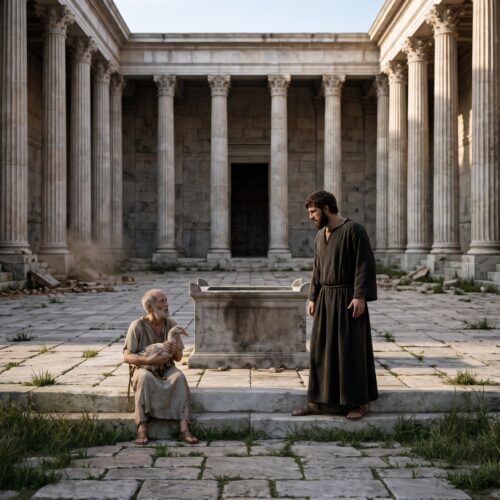
Julian anticipated a spectacle of epic proportions. He imagined long processions of priests dressed in spotless white linen, youth choruses singing solemn hymns, choirs, incense filling the valley, and a line of prize heifers waiting for the sacred knife. He brought with him his entire imperial retinue, expecting to join a city overflowing with religious fervor.
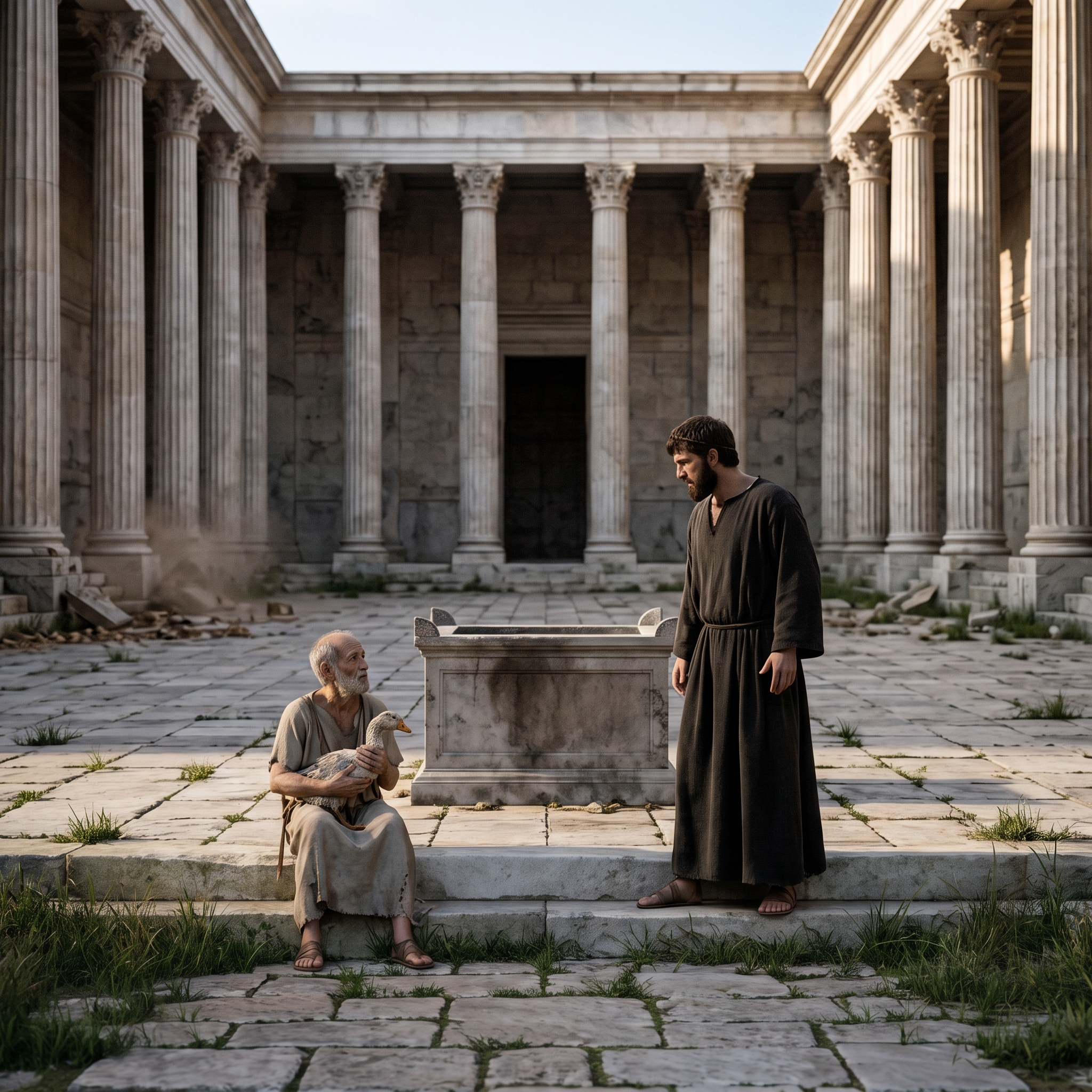
Instead, when Julian stepped into the courtyard of the temple, the complex was dead quiet. There was no crowd. There was no incense. There was no choir.
The emperor wandered into the inner sanctum, where he found a single, lonely old priest sitting near the cold altar. Julian looked around in bewilderment and asked the priest what magnificent sacrifice the mighty metropolis of Antioch had sent to honor the god on his holy day.
The priest blinked at the Emperor of Rome and replied that the city had sent nothing. In fact, the priest had brought a single goose from his own backyard, and that was the entire festival.
Julian was furious. He unleashed a savage lecture on the local magistrates, castigating them for spending tens of thousands of gold solidi on lavish private feasts, banquets, and stage actors while offering Apollo nothing more than a bird that sounded like a broken horn.
Julian decided that if the city would not revere Apollo, the empire would force them to. He immediately concluded that the problem was the presence of Saint Babylas across the street. The pagan oracle refused to speak because it was gagged by the corpse of a Christian bishop.
In mid-October 362 AD, Julian issued an imperial order: the Christians of Antioch must dig up Saint Babylas and haul his bones out of Daphne.
The Procession and the Spark
The eviction of Babylas was carried out, but it did not go the way Julian imagined.
Rather than slinking away in defeat, the Christian population of Antioch turned the removal of the martyr into a thunderous victory march. Thousands of citizens gathered at Daphne, lifted the wooden casket of Babylas onto an open chariot, and walked the five miles back into Antioch in broad daylight.
Along the entire road, the crowd sang David’s psalms at the top of their lungs, screaming in unison the verses that taunted idols: “Confounded be all they that serve graven images, that boast themselves of idols!” The sound echoed across the hills of Daphne, directly through the porticoes of Julian’s beloved Temple of Apollo. Julian was incandescent with rage, viewing the entire performance as treason wrapped in liturgy.
Then came October 22.
In the dead of night, while Julian was pacing his rooms in the Antioch palace, smoke began curling from the pediment of Apollo’s temple. Within minutes, dry cedar beams installed centuries earlier during the Seleucid dynasty caught fire. The fire spread through the wooden rafters beneath the marble-tiled roof with terrifying speed.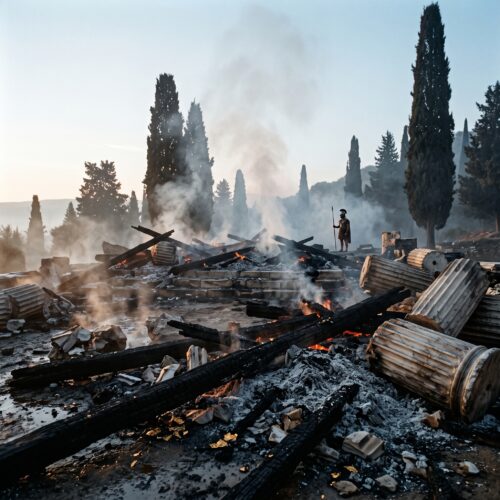
Local farmers and guards rushed toward the temple, but the heat was unbearable. The roof collapsed downward into the cella, raining burning timber, molten lead, and shattered stone directly onto the forty-foot statue of Apollo. The wooden framework beneath the gold and ivory plating turned into an incinerator. By dawn, the celebrated shrine of Daphne was an open, smoking pit of rubble. The statue that had symbolized the Hellenic spirit for half a millennium was gone.
The Paranoid Spiral
When news reached Julian at dawn on October 22, his reaction was instantaneous and unhinged. He refused to entertain the possibility of an accident. In his mind, there were only two possibilities: either the Christians of Antioch had planted an incendiary device in revenge for the exile of Babylas, or the magistrates of the city had conspired to humiliate him.
He immediately ordered the Great Church of Antioch—the monumental golden-domed octagonal basilica built by Constantine—shut down. He stripped it of all its gold plate, sacred vessels, and imperial endowments, ordering them hauled directly into the palace treasury.
Next, he arrested the priest of Apollo—the very man who had offered the solitary goose—and subjected him to brutal interrogation on the rack. The priest, half out of his mind with pain, wept and repeated the same thing over and over: no one had entered the temple after sunset. He knew nothing of any plot.
Julian’s secret police rounded up Christian suspects and brought them to the imperial torture chambers. Yet despite weeks of horrific interrogations, not a single person confessed to setting the fire. No plot was uncovered. No cabal was found.
Meanwhile, witnesses began whispering an alternative explanation that sent the pagans into despair and the Christians into hysterics. Several night watchmen and local shepherds reported seeing a brilliant streak of fire drop straight out of the sky into the center of the roof just before midnight. A freak autumn thunderstorm had rolled over Mount Silpius, and a single, direct lightning strike had hit the wooden pediment of the temple.
The famous pagan rhetorician Libanius, Julian’s close personal friend, wrote a devastating lamentation over the ruins, crying out that the sun itself had hidden its rays in mourning. But even Libanius could not hide the bitter truth: whether the fire was set by Christian arsonists or a random bolt of lightning, the theological optics were disastrous for Julian. If it was arson, Julian’s gods were powerless to protect their own house; if it was lightning, the heavens themselves had just dropped an artillery shell directly onto Apollo’s head.
The Unraveling of an Impossible Dream
The fire at Daphne on October 22 broke something inside Julian.
Prior to that night, Julian had maintained a veneer of philosophical composure. He liked to believe he was an enlightened philosopher engaged in a battle of ideas. After October 22, he became increasingly paranoid, vindictive, and erratic.
His obsession with rebuilding the past accelerated into mania. He spent money the empire did not have to import thousands of marble blocks to Daphne. When the citizens continued to mock him in street plays and tavern songs, he refused to ever set foot in Antioch again. He vowed that when he returned from his Persian campaign, he would bypass Antioch entirely and make Tarsus his administrative capital.
He never returned.
In the spring of 363 AD, Julian marched eighty thousand Roman legionaries across the Euphrates into the deserts of Mesopotamia. Driven by dreams of rivaling Alexander the Great, he burned his own supply fleet on the Tigris to force his men forward—a catastrophic miscalculation that left his army starving in the baking Mesopotamian summer.
On June 26, 363 AD, during a confused skirmish outside Samarra, Julian rode into battle without his breastplate. A stray cavalry spear pierced his abdomen, ripping through his intestines. He was carried back to his tent, where he bled to death at thirty-one years old.
With his death, the entire pagan renaissance collapsed overnight. His successor, a Christian officer named Jovian chosen by the desperate legionaries simply to negotiate a safe retreat, immediately signed away key Roman border territories to Persia and restored Christianity to imperial primacy.
Julian had spent his life, his intellect, the imperial treasury, and the lives of thousands of soldiers trying to drag the Roman Empire backward into a world that no longer existed. The fire at Daphne on October 22 was the flashing red dashboard light warning him that his engine was on fire, but he chose to accelerate straight into the desert.
The Mechanics of the “Daphne Trap”
Why did Julian fail so completely?
His failure was not a lack of effort, money, or power. He had unlimited authority. He was arguably the most educated, hardworking, and personally disciplined Roman emperor since Marcus Aurelius.
Julian failed because he fell into what we can call the Daphne Trap: the psychological error of confusing historical affection with living momentum.
Julian loved the texts, statues, and rituals of classical antiquity. But he confused his personal, nostalgic emotional connection to those artifacts with their functional utility in the present. He looked at fourth-century Antioch—a bustling, trade-focused, Christian-majority commercial engine—and demanded that it behave like fifth-century BC Athens. When the people refused to play their assigned roles in his historical reenactment, he assumed they were malicious rather than simply living in a different reality.
Every human being falls into their own personal Daphne Trap at some point:
- You try to revive an old relationship dynamic that expired three years ago, baffled that the other person won’t read the script you wrote in your head.
- You double down on an outdated technical method, business model, or career identity because you spent a decade mastering it, refusing to accept that the marketplace has moved on to a completely different language.
- You hit a plateau in your fitness, creative work, or personal habits and convince yourself that if you just recreate the exact routine you used at age twenty-two, the old magic will automatically return.
Julian stood in the smoking ashes of Daphne on October 22, blaming enemies, demons, and bad luck, unable to recognize the fundamental truth: You cannot resurrect a dead structure by commanding the living to mourn it.
The Anatomy of a Modern Revival Error
When modern self-help gurus tell people to “reinvent” themselves, they almost always prescribe Julian’s playbook without realizing it. They tell you to look back at when you were happiest, pick up the habits of that era, manufacture rigid daily rules, and force your current life into that historical mold.
This approach fails because it operates on Architectural Nostalgia rather than Adaptive Momentum.
Here is what Julian did, broken down into its flawed psychological mechanics:
- The Sunk-Cost Revival: He believed that because a philosophy was great for five hundred years, it was entitled to exist forever.
- The Moral Blame Shift: When the citizens preferred dinner parties to burnt offerings, Julian decided the citizens were morally corrupt, rather than recognizing that his offering was irrelevant to their needs.
- The External Enemy Reflex: When his temple burned down, he spent zero minutes inspecting the wiring (or in his case, the Seleucid wooden roof timbers) and immediately unleashed a witch hunt against his ideological rivals.
- The Desperation Escalation: After the disaster at Daphne, instead of pivoting his strategy, he launched a suicide-run invasion of Persia to prove his divine favor, cutting off his own line of retreat.
If you want to build a life, a career, a creative output, or an operational habit that actually lasts, you must learn the exact opposite lesson of Julian’s October 22 disaster.
The Daphne Protocol: A Counter-Intuitive System for Slashing Dead Weight
Most conventional productivity systems focus entirely on addition: adding morning routines, adding tracking apps, adding certifications, and piling more commitments onto an already overloaded cognitive plate.
The Daphne Protocol is an asymmetric, execution-based framework built entirely on calculated elimination and reality audits. It is designed to expose where you are acting like Emperor Julian—wasting your highest energy trying to guard an empty temple with a single goose—so you can redirect that resource pool into unstoppable, forward-moving reality.
Here are the specific, unvarnished rules for executing this protocol:
- The Single-Goose Audit: Identify the projects, obligations, or habits where you are providing 95% of the effort while the environment provides zero feedback. If you have been dragging a goal forward for six months and the world has responded with silence, you are not being resilient; you are holding a festival for an empty courtyard. Cut the funding.
- The Roof-Timber Reality Check: Stop looking for external saboteurs when a personal plan collapses. Julian blamed the Galileans; the roof simply had old wood and caught a spark. Conduct an autopsy on your last failure that deliberately bans the words “they,” “bad luck,” “the market,” or “timing.” Locate your own structural timber.
- Burn the Re-enactment Script: Stop trying to return to a prior version of yourself. The person you were during your peak performance five years ago had a different physiological baseline, different cognitive loads, and different external demands. Stop trying to revive “2019 You.” Build systems for the person standing in the room right now.
- The Anti-Martyr Rule: Do not engage in unnecessary friction just to prove your purity. Julian refused to cut his hair and sat scowling at chariot races to show he was a serious philosopher; it accomplished nothing except making everyone around him despise his policies. If a minor tactical concession buys you massive strategic leverage, make the concession without an ego fit.
- The Tigris Prohibition: Never make an irreversible life decision purely to prove to doubters that your initial, faltering premise was correct. Julian burned his boats on the Tigris because he could not bear the humiliation of marching back to Antioch without a Persian conquest. When you find yourself in a hole, the primary directive is not to dig faster to China; it is to put down the shovel.
The 72-Hour Rapid Execution Plan: The Daphne Purge
Do not file this historical account away as dry trivia. Translate the smoke of Antioch into immediate structural change across the next three days using this operational timeline:
Day 1: The Altar Inspection (Diagnosis)
- Write down the three biggest ongoing projects, habits, or professional initiatives currently consuming your discretionary mental bandwidth.
- Next to each, answer this specific metric question: Has this initiative generated measurable, unprompted forward momentum in the last 45 days?
- If the answer is no, mark it as a “Shrine of Apollo.” It is officially on notice.
- Locate the single most exhausting recurring conflict in your weekly routine. Identify the unstated expectation you are forcing onto that situation that the other party has repeatedly shown they will not fulfill. Write it down plainly: “I am expecting Antioch to sacrifice heifers; they are only going to bring a goose.”
Day 2: The Controlled Burn (Decisive Elimination)
- Take the most stalled “Shrine of Apollo” identified on Day 1 and perform a clean execution. Cancel the subscription, kill the dormant side project, or step away from the dead-end committee. Do not write a long explanatory manifesto. Do not announce it to the world. Simply stop funding the temple.
- Redirect the exact hours liberated by that cancellation into a single, high-traction asset that is already working right now. Double the resources on a live channel rather than attempting to resurrect a dead one.
- Conduct your structural timber audit: identify one obvious vulnerability in your daily operational workflow—a broken sleep boundary, a disorganized file system, an unaddressed administrative backlog—that you have been ignoring while blaming external stress. Resolve it before sundown.
Day 3: The Forward March (Momentum Lockdown)
- Establish a non-negotiable Forward Baseline Rule: You are prohibited from consuming old journals, past performance metrics, or nostalgic artifacts for the next fourteen days. Your entire operational focus must be locked onto the upcoming ninety-day horizon.
- Set up an asymmetric feedback mechanism: pick one metric of real-world value—units shipped, cold calls completed, miles logged, pages written—and establish an automated tracking trigger that measures output purely by verifiable receipts, not emotional effort.
- Commit to the Antioch Reality Principle: Accept that the environment you are operating in will always prioritize its own comfort and momentum over your personal philosophical aesthetic. Stop fighting the stadium; learn how to play on the grass that is actually there.
The temple at Daphne was never rebuilt. Today, the springs still flow through the hills near modern Antakya, watering orchards and wild scrub. The massive ivory-and-gold god, the imperial decrees, the furious lectures of the lice-bearded emperor, and the thousands of screaming psalmists have all been swallowed by the centuries.
Julian died in the desert dust because he insisted on fighting for a ghost. The lesson of October 22 is simple: let the ruins burn, stop paying for the upkeep of dead monuments, and spend your finite life building on ground that can actually bear the weight of tomorrow.
Share: