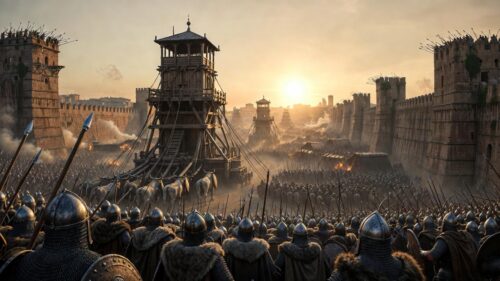

At dawn on Tuesday, October 21, 1096, roughly twenty-five thousand European pilgrims, impoverished knights, runaway villeins, and religious zealots stepped onto an unpaved military road cutting through the densely wooded valley of the Dracon River in northwestern Anatolia. They had no scouts. They had no flanking screen. They possessed almost no heavy cavalry, very few chainmail hauberks, and zero unified command structure. What they carried in obscene abundance was certainty.
Every individual in that marching column believed, with the unshakable conviction that only collective panic and religious hysteria can forge, that the fortress of Nicaea was theirs for the taking. Rumors had rippled through their camp for seventy-two hours: a rival splinter vanguard of Germans and Italians had supposedly broken through Turkish lines, captured the citadel of Xerigordos, and was currently stuffing linen sacks full of Byzantine gold, Levantine silks, and smoked mutton.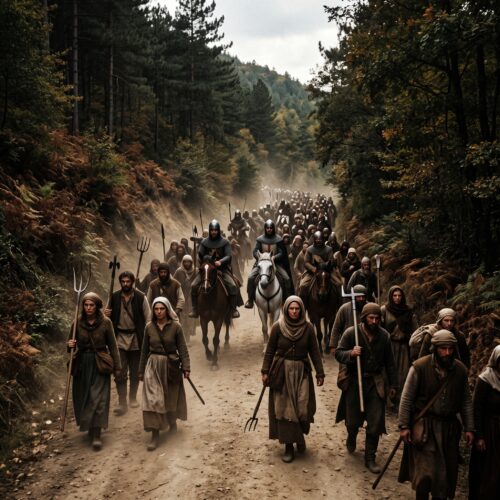
It was one of the most successful pieces of military disinformation ever concocted.
The German vanguard was not swimming in silk. They were already dead, captured, or parched into oblivion inside an arid stone fortress after being forced to drink donkey urine and the warm blood of their own pack animals when their water supply was severed. The Seljuk Sultan of Rûm, a seventeen-year-old tactical savant named Kilij Arslan I, had stationed thousands of mounted composite-bow archers inside the thick, bracken-covered pine woods that framed the narrow pass near the coastal fortress of Civetot.
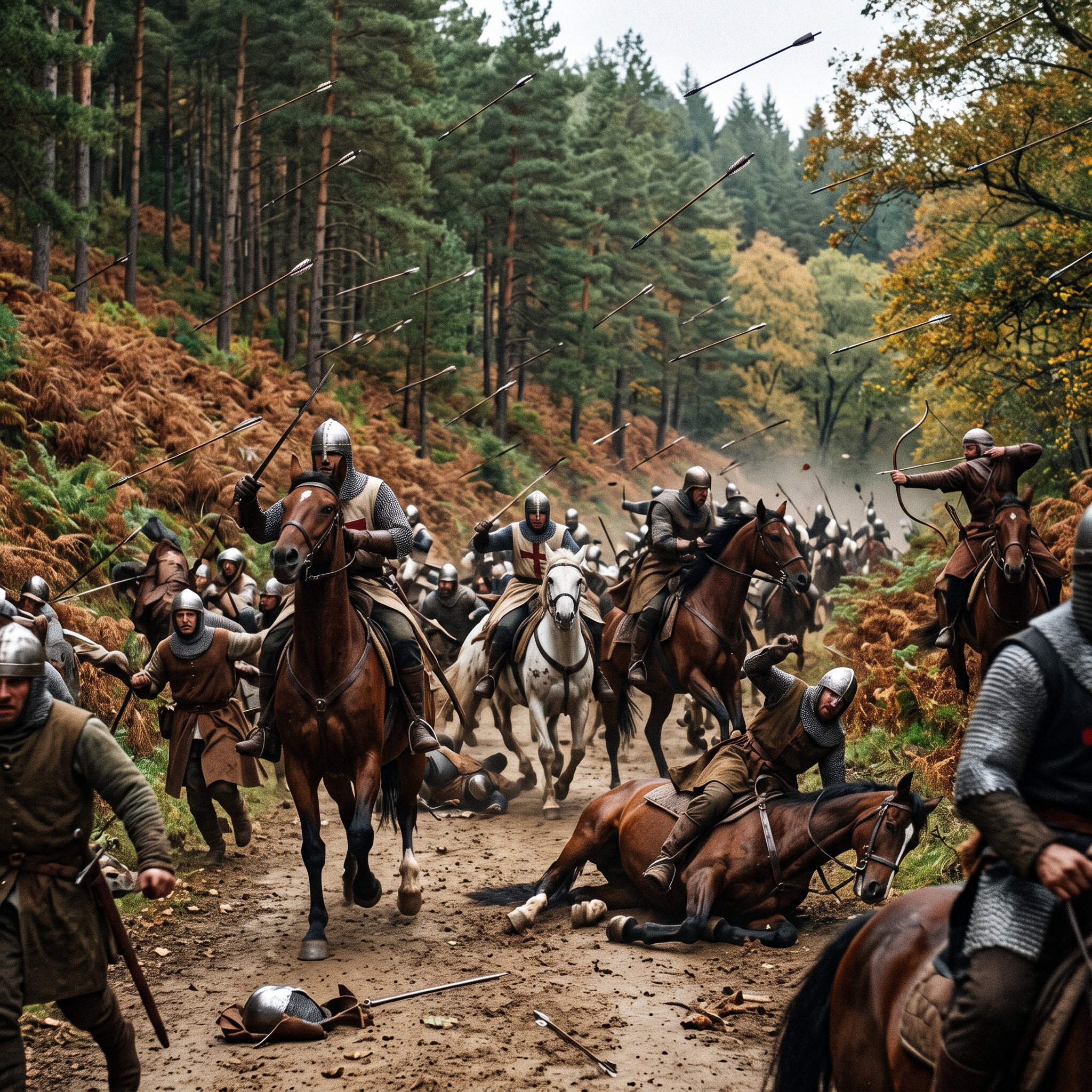
When the head of the civilian crusade marched past the first line of brush, the autumn forest let loose a sound described by contemporary chroniclers not as a war cry, but as a sickening hiss—thousands of horn-and-sinew composite bows snapping simultaneously, releasing steel-tipped arrows into a dense, unarmored mob. Within two hours, the movement known to history as the People’s Crusade ceased to exist.
History loves to remember the First Crusade as the gleaming, steel-clad triumph of Godfrey of Bouillon and Bohemond of Taranto taking Jerusalem three years later. But the grim, bloody prologue that unfolded on October 21, 1096, at Civetot is the real masterclass in human psychology. It is the definitive case study in what happens when catastrophic enthusiasm outruns basic operational competence, when peer pressure disguises itself as moral duty, and when an undisciplined crowd allows its most aggressive loudmouth to set the pace.
If you have ever launched an ambitious life change, a business venture, a career pivot, or a personal overhaul on pure adrenaline, only to watch it collapse in a hail of unexpected administrative friction within thirty days, you have marched down the Dracon Valley. Civetot is your story. And understanding every brutal, absurd, tragic mistake made on October 21 is your only immunization against repeating it.
The Spark at Clermont: When Charisma Outran Logistics
To comprehend the disaster of October 21, 1096, one must wind the clock back eleven months to a frosty field outside the French city of Clermont. In late November 1095, Pope Urban II stood before a gathered assembly of bishops, counts, and petty nobles to deliver an impassioned sermon. Alexios I Komnenos, the beleaguered Emperor of the Eastern Roman (Byzantine) Empire, had written desperate appeals to Rome requesting Western mercenary cavalry to help stave off the Seljuk Turks, who had dismantled Byzantine Anatolia following the Battle of Manzikert in 1071.
Urban II had a geopolitical scheme. By rallying the unruly, violent feudal nobility of Western Europe toward an expedition to Jerusalem, he could direct their predatory violence outward, heal the Great Schism between the Western and Eastern churches, and assert papal primacy across the Mediterranean. Urban was a trained administrator. He set a specific, orderly departure date: August 15, 1096—the Feast of the Assumption. The timing was strictly deliberate. August would allow the regional baronies to harvest their crops, store grain for provisions, assemble logistical wagons, organize proper knights, and raise funding through mortgage arrangements.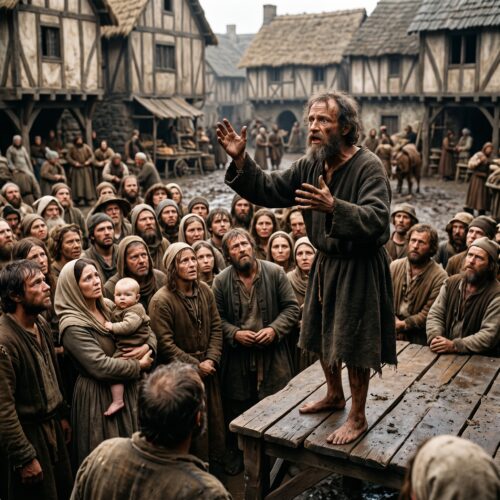
Urban’s fatal miscalculation was that he completely underestimated the apocalyptic fever gripping eleventh-century Europe.
The Western peasantry lived on the razor’s edge of starvation. The 1090s had brought catastrophic flooding across the Rhine, followed by brutal drought, failed barley harvests, and repeated outbreaks of ergotism—the “Holy Fire,” a terrifying fungal poisoning caused by infected rye that produced burning sensations in the limbs, hallucinations, gangrene, and convulsions. The common folk did not view life through the lens of long-term strategic statecraft; they believed the world was ending, that Christ was returning, and that marching east toward Jerusalem was an immediate, physical escape from a life of unrelenting misery and mud.
Enter Peter the Hermit.
Peter was an itinerant ascetic from Amiens. Contemporary accounts describe him as a diminutive, weathered man with a face resembling his own donkey, wandering barefoot in a filthy woolen tunic, subsisting entirely on wine and dry fish. Yet Peter possessed a voice that could crack stones. He claimed that Christ had appeared to him directly in the Church of the Holy Sepulchre and handed him a celestial letter ordering him to summon the faithful.
While Urban II was negotiating with grand dukes and counts, Peter took his message directly to the gutters, the village squares, and the rural hovels of France, Flanders, and the Rhineland. He did not ask for passports. He did not ask for pedigree. He asked for bodies.
Within weeks, Peter became an unstoppable folk hero. Peasant mothers brought their sick infants to touch his donkey’s tail hairs for healing. Wherever he traveled, entire hamlets emptied out. Craftsmen abandoned their anvils, farmers left oxen standing in half-plowed furrows, petty cutpurses decided holiness sounded more profitable than the gallows, and bankrupt knights saw a heaven-sent opportunity to erase their debts. By the early spring of 1096—nearly five months before Urban’s scheduled, organized start date—Peter had amassed a moving human avalanche estimated between forty and one hundred thousand souls.
The Road of Bones: The Disastrous March Across Christendom
No one had packed enough bread. In fact, almost no one had packed anything. The sheer operational absurdity of the march began the moment the column reached the borders of Hungary and the Byzantine Empire.
Modern self-help and motivational literature frequently celebrates the romantic myth of “leaping before you look,” claiming that “the net will appear.” The People’s Crusade leapt without looking, and instead of a net, they discovered that an army of sixty thousand starving humans moving at ten miles per day functions less like a pilgrimage and more like a plague of locusts.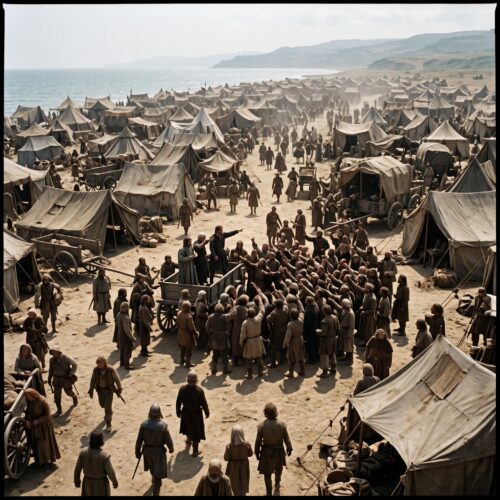
Because the peasants had brought neither gold nor sufficient stores, they were entirely dependent on local market exchanges. When local Hungarian and Bulgarian market towns could not or would not feed a foreign swarm that spoke a bizarre tongue, the pilgrims turned to predatory foraging. In Semlin (modern-day Zemun), a petty squabble over the sale of a pair of leather shoes escalated into a pitched riot in which the crusaders stormed the citadel, killed four thousand Hungarian inhabitants, and stole their livestock.
When they reached Niš, the Byzantine governor, a seasoned bureaucrat named Nicetas, attempted to guide them safely along the imperial highway with armed military escorts, offering food markets in exchange for hostages of good behavior. But the rearguard of Peter’s undisciplined rabble decided to burn down seven mills along the river outside the city walls. Nicetas lost his temper and deployed his garrison of hardened Pecheneg mercenary horse-archers. The imperial cavalry fell upon the crusader rear, cutting down thousands, scattering their wagons, and capturing their treasury chests. Peter fled into the hills, weeping, and spent three days blowing an animal horn in the brush until a fraction of his shattered host found him.
By the time the ragged procession reached the golden gates of Constantinople in August 1096, they were half-starved, deeply paranoid, and thoroughly ungovernable.
Emperor Alexios I Komnenos took one look at them from the walls of the Blachernae Palace and felt a chill. This was not the elite contingent of Norman and Frankish heavy cavalry he had requested from the Pope. This was an armed, fanatical, destitute horde of peasants, runaway serfs, and destitute adventurers camping on his suburban doorsteps. Almost immediately, the crusaders began vandalizing the historic villas outside the Golden Horn, tearing lead roofing off Byzantine churches to sell to metalsmiths, and raiding local orchards.
Alexios was a veteran diplomat who understood the grim arithmetic of Anatolian warfare. He knew the Seljuk Turks were not disorganized desert nomads; they were a battle-tested steppe empire composed of lethal horse-archers who practiced complex tactical feints, encirclements, and ambushes. Alexios held a private audience with Peter the Hermit and gave him explicit, crystal-clear strategic counsel:
Do not leave your encampment. Do not provoke the Turks. Stay anchored to the coast under Byzantine protection, dig defensive fortifications, and wait for the princes—the heavy armies of Duke Godfrey and Count Raymond—who are arriving in late autumn.
To get them out of his hair before they set fire to Constantinople, Alexios ferried the entire crusade across the Bosporus to the Asian shore on August 6, 1096, housing them in a sprawling fortified camp called Civetot (the ancient Kibotos), perched on the southern shore of the Gulf of Nicomedia.
It was the ultimate tactical buffer: sea behind them, mountains ahead, fresh water available, and Byzantine supply boats running regular bread runs across the water. All they had to do was sit tight, keep watch, and wait.
They waited less than three weeks.
Ego, Factionalism, and the Fall of Xerigordos
Human nature has not mutated in a thousand years. When you place thousands of anxious, unvetted, undisciplined individuals together without a clear hierarchy, they do not default to patient collaboration; they fracture into toxic tribalism and peacocking bravado.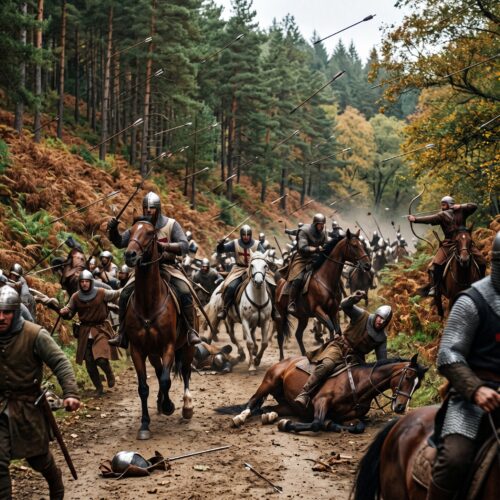
Inside the camp at Civetot, two toxic currents collided: national rivalry and the desperate need for external validation. The French contingents looked down on the Germans and Italians as boorish rustics; the Germans and Italians despised the French as arrogant windbags. Worse, the camp had no official commander. Peter the Hermit was a powerful preacher, but he possessed no military training, no tactical instincts, and zero executive authority. When soldiers bickered, Peter could only offer moral platitudes, which hungry men ignored.
The real power began shifting toward men like Geoffrey Burel—an aggressive, loud, lower-tier French combatant whose primary qualification was that he possessed immense swagger and told the restless mob exactly what they wanted to hear. Burel argued that the Byzantine Emperor was a coward, that Peter was losing his nerve, and that real soldiers of God did not sit by the ocean eating Byzantine barley like penned cattle.
In late August, bands of French crusaders began mounting unauthorized raids toward the outskirts of Nicaea, the Seljuk capital just twenty-five miles inland. They pillaged Christian villages, slaughtered cattle, and returned to Civetot with carts of grain and plunder, boasting about how easily the “infidels” had fled before them.
The German contingent, stung by French bragging and desperate not to be outdone, decided to stage a grander spectacle. In mid-September, six thousand German and Italian crusaders, led by a nobleman named Reinald, marched past Nicaea and seized the hilltop fortress of Xerigordos. They were ecstatic. They hauled down the garrison, slaughtered the inhabitants, feasted on stored provisions, and declared that the conquest of the Levant had begun.
They had walked directly into an architectural mousetrap.
Sultan Kilij Arslan, observing their movement from his mountain outposts, dispatched a veteran general named Ilkhanus with a force of several thousand light cavalry. Ilkhanus did not bother mounting a bloody uphill assault against the stone walls of Xerigordos. Instead, he simply seized the valley floor, cutting off access to the fortress’s only water source: a single well and an open spring located outside the citadel gates.
What followed over the next eight days was an agonizing descent into madness. Trapped under the relentless Anatolian sun, with no water, the defenders inside Xerigordos resorted to drinking the blood of their horses, puncturing donkey veins, and burying themselves naked up to their chins in damp earth to absorb subterranean moisture through their pores. By the eighth day, Reinald could bear it no longer. He opened the gates and surrendered.
Those who agreed to renounce their faith were spared and sent as slaves into Khorasan; those who refused were beheaded where they stood. Kilij Arslan then burned the interior of the fortress, gathered his scouts, and prepared the second half of his plan.
The Architecture of the Deception
Kilij Arslan understood that emotional mobs make catastrophic decisions when fed information that confirms their existing biases. He did not conceal the fall of Xerigordos by silence; he concealed it by weaponizing a lie.
The Sultan hired two Greek Christian double-agents and dispatched them back toward the crusader camp at Civetot. The two men burst into the camp breathing heavily, wild-eyed, and carrying carefully staged news: Reinald and his German knights had not merely held Xerigordos—they had pushed straight through to Nicaea itself! The great capital of the Seljuks was on the verge of falling! The streets of Nicaea were allegedly flowing with Turkish gold, silks, weapon caches, and cattle, and the Germans were hoarding every coin for themselves while the French sat idle at Civetot.
The psychological effect on the camp was immediate and volcanic. The crowd went into an uncontrollable frenzy. The fear of missing out (FOMO) completely dismantled what little common sense remained.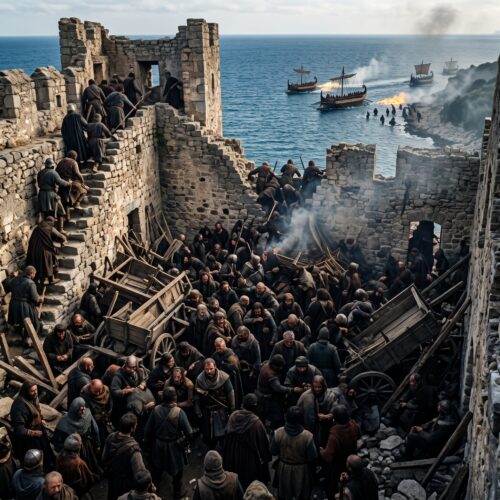
Peter the Hermit was not in the camp. Sensing that his authority had evaporated and fearing the uncontrollable violence of the men, he had returned to Constantinople days earlier to plead with Emperor Alexios for more supplies and firmer imperial guidance. With the charismatic preacher gone, the camp was governed purely by testosterone, greed, and crowd hysteria.
A small council of cooler heads attempted to speak reason. Walter Sans-Avoir (Walter the Penniless), an impoverished but legitimate knight from the Île-de-France who possessed actual battlefield experience, stood before the assembly. He warned them that the news smelled like a trap. He argued that marching blindly into mountainous enemy territory without scouts, without siege engines, and against the direct orders of the Emperor was suicide. He begged them to wait for Peter’s return, or at least for the vanguard of the French dukes.
Geoffrey Burel stepped forward to crush him. Burel did not offer logistical arguments; he used the classic tactic of the political grifter: he weaponized shame. He publicly accused Walter and the senior knights of cowardice. He claimed that anyone urging patience was secretly in league with the Greeks or too frightened to fight for the Cross. He told the roaring peasants that real men of courage marched today, and that those who stayed behind were traitors and cowards.
It was an impossible rhetorical trap. In a crowd drunk on self-righteousness, the voice urging caution is always framed as weak, and the voice screaming for reckless aggression is always hailed as visionary. Walter Sans-Avoir, realizing he could not prevent the catastrophe, chose to ride with them rather than suffer the lifelong brand of dishonor.
The decision was finalized. On the morning of October 21, the gate swung open.
October 21, 1096: The Slaughter in the Dracon Valley
The camp at Civetot was left virtually undefended. Over twenty thousand men—accompanied by a chaotic vanguard of five hundred armored knights on horseback—marched eastward along the road to Nicaea. Left behind in the seaside tents were the elderly, the sick, the women, nursing mothers, and young children, along with priests praying for a swift victory.
The road out of Civetot traced a narrow coastal plain before climbing steadily into the rugged, wooded valley of the Dracon River. The terrain was treacherous: steep, scree-covered ridges flanking a narrow dirt roadway framed by thick pine forests, hazel scrub, and dense undergrowth.
It was the ideal landscape for a Turkish ambush.
Kilij Arslan had spent the previous night deploying his entire strike force—between five and ten thousand elite mounted warriors—along both flanks of the valley, concealed behind the ridgelines and hidden within the thick autumn foliage. They did not need breastplates or heavy poleaxes; their weapon was the recurved composite bow, an engineering masterpiece of horn, wood, and animal sinew capable of punching arrows through light armor at two hundred yards with blistering reload speeds.
Around nine o’clock in the morning, approximately three miles from the camp, the crusader vanguard entered a narrow defile known locally as the Dracon Pass.
The column was stretched out over several miles. The knights were at the front, kicking up clouds of dust, shouting battle cries, and jostling for position. Behind them trailed the massive, unranked sea of peasants, clutching pitchforks, iron-tipped staves, hunting knives, and cheap spears. No outriders had been sent ahead to scout the ridge lines. No flank guards walked the tree lines. They moved like a parade, not a combat unit.
Suddenly, the valley erupted into a terrifying roar of kettledrums, brass horns, and ululating war cries.
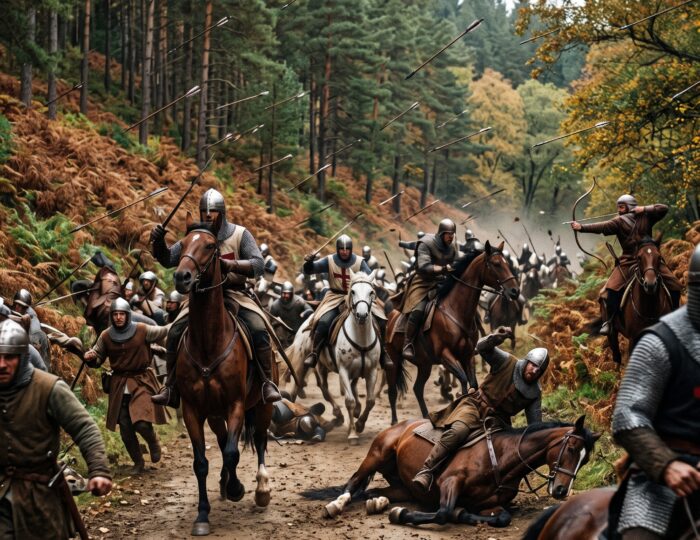
From both sides of the wooded hills, a relentless storm of arrows fell upon the crusader column. The first salvo struck the horses of the vanguard. Warhorses, pierced through the neck and flanks, reared, shrieked, and collapsed into the road, throwing their armored riders into the dirt. Within seconds, the mounted vanguard disintegrated into a churning mass of thrashing hooves, wounded men, and tangled gear.
Before the knights could reform their lines or mount a counter-charge, Turkish horse-archers poured out of the trees, firing at point-blank range, then wheeling away into the brush to reload while another rank advanced. Walter Sans-Avoir fought with desperate, tragic valor, rallying a handful of men around his banner until he was pierced by seven arrows through his mail coat and collapsed dead into the mud.
The shock broke the vanguard completely. The surviving knights wheeled their mounts and fled rearward—straight into the surging, tight-packed mass of twenty thousand unarmored peasants pushing up the narrow road.
The panic was instantaneous and absolute. Armored horses trampled peasant foot-soldiers underfoot. Men threw down their weapons to run, only to find themselves wedged in a bottleneck between the steep hills and the riverbank. The Seljuk cavalry discarded their bows, drew their scimitars and maces, and rode down the valley, butchering the fleeing crusaders from behind like cattle.
The retreat was not a fighting withdrawal; it was a three-mile corridor of continuous slaughter. The Turks did not halt their pursuit at the entrance to the pass. They chased the screaming survivors all the way back to the gates of the camp at Civetot.
The End of the Dream: The Ransacking of Civetot
In the camp, the morning had begun quietly. Women were baking bread over earthen hearths, children were playing in the tent lines, and priests were chanting morning liturgies.
Suddenly, a wall of dust appeared on the western horizon, followed by the deafening sound of thundering hooves, panicked screaming, and the desperate cries of their own men. Seconds later, the fleeing crusader remnants crashed through the camp perimeter, with the Seljuk cavalry riding on their heels.
There was no battle for Civetot; it was pure carnage. The tents were torched. Thousands of non-combatants were cut down where they stood. The chronicler Albert of Aachen records that the elderly and sick were slaughtered in their bedding, while young boys and girls were rounded up by the hundreds to be bound in ropes and dragged away into the slave markets of Syria, Persia, and Anatolia.
A desperate contingent of approximately three thousand crusaders—including Geoffrey Burel, the man whose loudmouthed arrogance had orchestrated the catastrophe—managed to scramble into an abandoned, roofless coastal fortress that projected out into the sea. The fortress had no gates, no water, and crumbling masonry, but the survivors hastily barricaded the entrances with overturned wagons, timber, and the corpses of their fallen comrades.
The Turks surrounded the seaside redoubt, piling dry timber around the stone base in an attempt to burn the defenders out. But the wind blew off the sea, pushing the flames away from the stone. The Seljuks settled in for a siege, knowing thirst would finish the job within forty-eight hours, just as it had at Xerigordos.
Only an act of outside intervention saved those final three thousand. A Greek fisherman in a light skiff managed to slip past the Turkish pickets under cover of dusk and rowed furiously across the gulf to Constantinople, where he found Peter the Hermit and reported the horror unfolding across the water. Peter rushed to the palace, threw himself at the feet of Emperor Alexios, and wept for mercy.
Alexios, despite having had his warnings utterly ignored, acted with decisive imperial professionalism. He dispatched a squadron of the Byzantine Imperial Navy, equipped with siphon tubes of Greek Fire and carrying contingents of elite imperial marines under the command of Constantine Katakalon.
When the sleek imperial warships glided into the bay of Civetot, their bronze prows cutting through the smoke and their catapults slinging incendiary petroleum onto the beach, the Seljuk cavalry—lacking coastal artillery and satisfied with their massive haul of plunder and captives—retreated back into the hills.
The imperial marines evacuated the three thousand shivering, starving survivors from the seaside fortress, brought them aboard the galleys, and ferried them back to Constantinople. When they landed, the imperial guards confiscated what few weapons remained among them and ordered them dispersed into the poor quarters of the capital.
The People’s Crusade was over. In a single morning, over twenty thousand human lives had been extinguished. The valley of the Dracon River was so blanketed with corpses that when the professional armies of the First Crusade arrived nine months later in the summer of 1097, they did not need maps to find the road to Nicaea—they simply followed the bleached bones of Peter’s followers, which were piled in heaps alongside the road, used by the locals to construct gruesome marker cairns.
The Anatomy of the Failure: Why Enthusiasm Kills
Before we construct a tactical, highly differentiated personal operating framework out of the ashes of Civetot, we must brutally diagnose the cognitive and structural errors that doomed the expedition on October 21, 1096.
Most historical retrospectives make the lazy error of attributing the disaster to “religious fanaticism.” That is a superficial reading. The operational breakdown at Civetot was not caused by religious belief; it was caused by specific, timeless cognitive distortions that appear in every startup, corporate boardroom, fitness transformation, and personal endeavor:
- The Rejection of Phase-Gating: Pope Urban and Emperor Alexios had designed a phase-gated operation. Phase 1: Resource accumulation, harvest storage, and alliance building. Phase 2: Staging at Constantinople. Phase 3: Coordinated assault with heavy cavalry. Peter’s mob completely discarded Phase 1 because they mistook emotional momentum for operational readiness.
- The Distortion of Information Verification: The moment the crusaders heard that the Germans were looting Nicaea, zero verification took place. The rumor confirmed what they desperately wanted to believe (that the enemy was weak and wealth was near). They had no scouts, no double-sourcing, and no reconnaissance.
- The Dominance of the Vocal Extremist: Walter Sans-Avoir was an experienced professional who understood defensive positioning. Geoffrey Burel was an agitator with zero strategic credentials whose only weapon was attacking the bravery of anyone urging caution. The crowd chose the agitator because aggression feels like progress, while patience feels like stagnation.
- The Complete Absence of Flank Protection: When they marched down that road on October 21, they assumed the roadway was the only reality that mattered. They ignored the ridgelines. They ignored the woods. They did not secure their perimeter before projecting their force.
Now, how does a modern, high-performing individual leverage this historical disaster? You do not need another pastel-colored, generic “morning routine” or a vague corporate platitude telling you to “stay positive and manifest your goals.” You need a rigorous, contrarian defense mechanism against your own internal Geoffrey Burel.
The Anti-Civetot Protocol: How to Execute Audacious Ambition Without Walking into an Ambush
Modern self-help is obsessed with acceleration. It screams at you to “take massive action,” to “burn the ships,” to “jump and build your wings on the way down.”
That is Geoffrey Burel logic. Burning your ships when you don’t even know how to build a camp perimeter is how twenty thousand people end up bleached bones in a Turkish riverbed.
The Anti-Civetot Protocol is an aggressive, five-tier execution framework designed to harness massive ambition while constructing impenetrable operational safeguards. It is built for individuals launching high-stakes career moves, demanding physical transformations, major financial restructurings, or creative ventures that demand months of sustained resilience.
Principle 1: The Bread Run Rule (Kill Adrenaline-Fueled Launches)
- The Historical Lesson: The pilgrims rushed across Europe five months before the harvest was gathered, forcing them to loot friendly towns and burn imperial mills just to avoid starvation before reaching the enemy.
- The Modern Trap: You decide on a Sunday night that you are completely overhauling your life. You buy a gym membership, purchase three hundred dollars of niche supplements, dump all carbohydrates in the trash, register an LLC, and announce your intentions on social media. By Thursday, your blood sugar has crashed, your administrative baseline has collapsed, and your adrenaline has evaporated. You are stranded in Bulgarian farmland without bread.
- The Tactical Execution:
-
- Enact a Mandatory 14-Day Baseline Buffer: Whenever you conceive an aggressive new direction (a drastic fitness regime, a sudden business pivot, or a massive financial leap), forbid yourself from taking public or operational action for precisely fourteen days.
-
- Logistical Pre-Loading: Use the fourteen-day buffer solely for invisible logistics. If you are changing your diet, do not cut calories yet; spend fourteen days identifying and testing three high-protein meal preps you can make in under twelve minutes. If you are launching a business, do not buy logos; spend fourteen days auditing your personal monthly burn rate and establishing a six-month cash buffer.
-
- The Friction Test: If your excitement for the initiative cannot survive fourteen days of quiet, unglamorous administrative preparation, it was not a genuine strategy; it was an emotional fever dream.
Principle 2: Scout the Ridges (Active Disconfirmation Reconnaissance)
- The Historical Lesson: The crusaders marched into a two-sided valley bottleneck without putting a single scout onto the ridgelines to see what was rustling in the pine trees.
- The Modern Trap: Confirmation bias. When you fall in love with an idea—a new speculative asset, a career change, a new training split—you consume exclusively content that validates your excitement. You follow accounts that celebrate the move, read success stories, and mute anyone who raises operational objections.
- The Tactical Execution:
-
- Deploy the Red Team Audit: Before launching any high-consequence initiative, explicitly identify three specific individuals who possess domain expertise and are inherently skeptical, critical, or conservative.
-
- The Pre-Mortem Interrogation: Hand them your plan and ask one precise question: “Assume it is eighteen months from today, and this initiative has completely imploded, costing me thousands of dollars and immense emotional distress. Walk me through the exact operational sequence that killed it.”
-
- Listen to the Walter Sans-Avoirs: If someone tells you your timeline is delusional or your margins are too thin, do not call them “haters” or “cynics.” Probe their critique until you have identified the exact structural risks they see.
Principle 3: Silence the Geoffrey Burels (The Bravado Filter)
- The Historical Lesson: Geoffrey Burel weaponized masculine insecurity and peer pressure to override the seasoned tactical warnings of veteran knights, resulting in a unanimous rush off an operational cliff.
- The Modern Trap: You allow peer environments, online hustle influencers, or overly aggressive associates to dictate your pace. You let people who carry zero personal liability for your failure convince you that caution is cowardice.
- The Tactical Execution:
-
- Isolate Risk-Bearing Counsel: Establish a rigid rule: Never accept strategic or pace-setting advice from anyone who does not personally bear the downside of the outcome. If an internet personality tells you to quit your job to trade options, or an acquaintance urges you to take on reckless leverage, ask yourself what they lose if you go to zero. If the answer is “nothing,” their counsel is dismissed as pure noise.
-
- Decouple Speed from Courage: Make a conscious mental distinction between operational velocity and genuine bravery. Real discipline is not sprinting blindly into gunfire; real discipline is the quiet, stubborn fortitude to hold your position, build your fortifications, and refine your skills until your logistical advantage is overwhelming.
Principle 4: The Xerigordos Trap (Verify the Rumor Before You Sprint)
- The Historical Lesson: The entire crusader camp emptied out because two double-agents reported that the Germans were currently rolling in Nicaean gold, triggering an irresistible wave of FOMO that clouded basic logic.
- The Modern Trap: You see an acquaintance or competitor posting about their massive revenue spike, their lightning-fast weight loss, or their incredible returns. You immediately assume they have unlocked a secret shortcut, panic about falling behind, and abandon your sustainable long-term system to chase their results.
- The Tactical Execution:
-
- Assume All External Triumphs Are Xerigordos: When someone in your orbit appears to be achieving effortless, rapid success without visible logistical infrastructure, operate on the default assumption that they are currently drinking horse blood in a siege fortress.
-
- The Three-Layer Verification Protocol: Never alter your personal trajectory based on an external success claim unless you can verify:
-
-
- The true net margin (not gross revenue).
-
-
-
- The physical/mental sustainability of the protocol over a minimum horizon of two full years.
-
-
-
- The hidden tail risks (debt, health degradation, legal exposure, or reputational damage).
-
-
- If you cannot independently verify all three, stay inside your perimeter.
Principle 5: Construct the Seaside Citadel (The Ultimate Downside Hedge)
- The Historical Lesson: The only reason three thousand human beings survived the catastrophe of Civetot is that an old, crumbling stone fortress sat physically anchored to the shoreline, giving them a fortified perimeter until imperial relief arrived.
- The Modern Trap: Living with zero structural redundancy. When people launch major life changes, they frequently operate on a fragile “best-case scenario” assumption. If their revenue dips for two months, if they suffer a minor tendon injury, or if client acquisition stalls, they have no secondary perimeter to fall back into, and the entire endeavor collapses into bankruptcy or total burnout.
- The Tactical Execution:
-
- Define Your Unbreachable Citadel: Before you attempt any major forward thrust, construct an explicit, immovable operational floor that cannot be liquidated under any circumstances.
-
- Financial Floor: A dedicated cash reserve held in boring, ultra-safe, liquid instruments covering a minimum of six months of baseline living expenses, completely walled off from your operating capital.
-
- Physical Floor: A minimal, non-negotiable health baseline that survives your busiest, most stressful weeks. When chaos hits, you do not abandon fitness entirely; you fall back to your “Citadel Routine”: 8,000 steps per day, 100 grams of protein minimum, and zero alcohol. No matter what happens on the frontline, the Citadel stands.
-
- Professional Floor: Maintain warm, authentic connections with three past employers, clients, or mentors. Never burn a bridge for the sake of dramatic “closure.” That professional goodwill is your Byzantine Navy waiting in the harbor.
The 48-Hour Rapid Execution Plan: Establishing Your Perimeter
You do not need six months to immunize your current life against a Civetot-style ambush. You can erect the perimeter within the next forty-eight hours through a sequence of sharp, concrete operational actions.
DAY 1: THE RECONNAISSANCE AUDIT
Hour 01–04: Map Your Dracon Valley
– Identify your single biggest current goal or initiative (e.g., launching a project, aggressive body recomposition, moving investments).
– List the three hidden “ridgeline risks” you have been deliberately ignoring because acknowledging them ruins your emotional excitement.
Hour 05–12: The External Red Team Contact
– Reach out to one trusted, battle-tested mentor or peer.
– Send this exact message: “I’m finalizing the operational blueprint for [Project X]. I don’t need encouragement; I need you to poke every structural hole you can find in my timeline and assumptions. Are you open to a 15-minute teardown tomorrow?”
Hour 13–24: The Supply Line Check
– Audit your personal burn rate and cognitive bandwidth for the next 90 days.
– Ensure your baseline resources (sleep, baseline cash flow, daily nutrition) are secured before adding any additional tactical load.
DAY 2: THE PERIMETER CONSTRUCTION
Hour 25–32: The Geoffrey Burel Purge
– Audit your informational inputs. Unfollow, mute, or cut off any sources that push unsustainable hype, reckless FOMO, or shame you for taking calculated, methodical steps.
– Re-anchor your metrics to long-term compounding rather than 30-day fireworks.
Hour 33–40: Erecting the Citadel Redoubt
– Formally document your “Citadel Protocols”:
- The minimum financial reserve that will not be touched.
- The non-negotiable physical floor (sleep and movement) that will not be sacrificed during crunch periods.
- The exact condition under which you will execute a controlled, strategic pivot rather than a blind, frantic retreat.
Hour 41–48: The First Controlled Advance
– Take one single, concrete, low-risk operational step forward that advances your objective without exposing your flanks.
– No public fanfare. No dramatic proclamations. Just relentless, disciplined execution.
The Final Lesson from the Woods of Civetot
When the morning sun crested the hills above Civetot on October 21, 1096, twenty-five thousand people marched out with singing, banners, and boundless excitement. By midday, the banners were trampled in horse manure, the singing had turned to screaming, and an entire generation of hopeful, desperate human beings had paid for operational hubris with their lives.
The tragedy of Civetot is not that those men and women lacked passion. They possessed enough passion to cross continents on foot.
The tragedy is that passion without operational architecture is merely self-destruction with high morale.
The world will constantly invite you to march down the Dracon Valley. It will dangle rumors of easy wealth, shout slogans designed to trigger your deepest insecurities, and tell you that careful preparation is the crutch of cowards. It will tell you to ignore the woods, ignore the supply lines, and charge headlong into the fog.
Listen to the stones of Civetot instead.
Secure your camp. Build your supply lines. Verify the rumor. Scout the ridgelines. Let the loudmouths sprint ahead into the crossfire if they must.
When you finally choose to advance, you will not do so as a panicked mob running on adrenaline. You will march with scouts on your flanks, armor on your breast, an unbreachable perimeter behind you, and the absolute certainty that when the woods begin to whisper, your lines will hold.
Share: