
Act I: The Murder at the Ferry and the Empty Chair of Europe
On the crisp, muddy morning of May 1, 1308, King Albert I of Germany—the grim, one-eyed Habsburg monarch whose empty eye socket gave him a permanent, terrifying snarl—was riding toward the Reuss River near Windisch, in what is now Switzerland. He had just finished breakfast, was separated from his retinue while waiting for a ferry across the river, and was accompanied by only a handful of attendants. Among them was his nineteen-year-old nephew, Duke John of Swabia, a young man who had spent years begging his uncle for his rightful inheritance and receiving nothing but condescending pats on the head and fresh excuses.
At the riverbank, John decided he was done filing paperwork. He and four co-conspirators drew their blades, dragged the King of the Romans from his horse, and split his skull open in the mud. Within minutes, Albert I was dead—supposedly cradled in his final moments by a passing peasant woman—and his nephew earned a brand-new nickname that would follow him to the grave: John the Parricide.
With one messy ambush at a river crossing, the most coveted, chaotic, and dangerously unstable job in medieval Christendom was suddenly vacant.
To understand what happened next, you have to understand the absolute fever dream that was the Holy Roman Empire in the early fourteenth century. Despite its grandiose name—which Voltaire would later mock as neither holy, nor Roman, nor an empire—the realm was a sprawling, fractious patchwork of duchies, bishoprics, free cities, and petty lordships stretching from the North Sea to the Alps. Crucially, the crown was not automatically hereditary. Whenever a king died, the fate of Central Europe rested in the hands of an exclusive, notoriously venal, and endlessly squabbling club of seven men: the Prince-Electors.
There were three spiritual electors—the Archbishops of Mainz, Trier, and Cologne—and four secular electors—the King of Bohemia, the Count Palatine of the Rhine, the Duke of Saxony, and the Margrave of Brandenburg. In theory, these seven titans gathered in solemn prayer to discern the will of Almighty God and select the most virtuous Christian prince to wear the crown of Charlemagne. In reality, a medieval imperial election looked less like a sacred conclave and more like a high-stakes auction in a back-alley pawnshop where the merchandise was Europe and the currency was cold silver, toll exemptions, and kidnapped castles.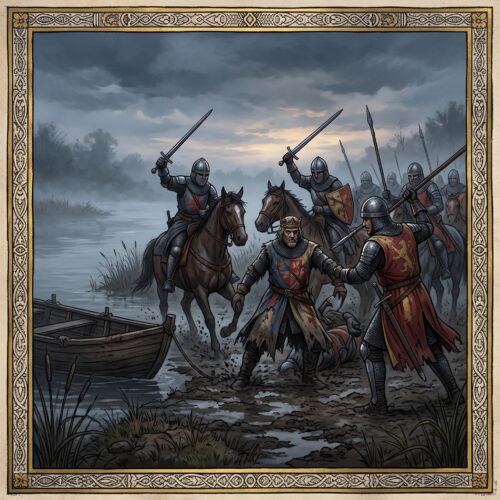
The moment news of Albert I’s assassination reached Paris, King Philip IV of France—known as Philip the Fair, though his methods were anything but—licked his chops. Philip had already brought the papacy to its knees, moving the papal court to Avignon under the thumb of a compliant French pope, Clement V. Now, Philip saw the chance to pull off the ultimate medieval hostile takeover: he would install his own younger brother, Charles of Valois, on the German throne. If Charles became King of the Romans and eventually Holy Roman Emperor, the Capetian dynasty of France would effectively own Western and Central Europe.
Philip IV immediately unleashed a tsunami of French gold across the Rhine. Envoys rode from castle to cathedral loaded with chests of silver, extravagant promises, and diplomatic threats, attempting to buy the Prince-Electors outright before the German princes could even catch their breath. Meanwhile, the Habsburgs—reeling from Albert’s murder—scrambled to rally support for Albert’s surviving son, Frederick the Fair. Other heavyweight German princes, including the Count Palatine and the Margrave of Brandenburg, quietly measured their own heads for the crown.
And sitting quietly in a tiny, French-speaking, cash-strapped border county wedged between France and Germany was a thirty-something nobleman whom almost nobody on the continent considered a serious contender.
His name was Henry VII, Count of Luxembourg. And on November 27, 1308, inside a Dominican church in Frankfurt, this mid-tier regional manager pulled off one of the greatest political heists in human history.
Act II: Anatomy of a Nobody—Who Was Henry of Luxembourg?
If you had walked into a tavern in Cologne, Prague, or Rome in the spring of 1308 and bet a silver penny that the Count of Luxembourg would be the next ruler of the Holy Roman Empire, the bartender would have checked your pulse and watered down your ale.
Luxembourg in 1308 was not the sleek, tax-friendly banking powerhouse of the modern era. It was a rugged, forested, modestly sized county in the Ardennes, perched awkwardly on the western fringe of the empire. Its rulers spoke French, dressed in French fashions, and existed in the suffocating gravitational pull of the French crown. In fact, Henry VII had actually sworn fealty as a vassal to King Philip IV of France for certain lands and revenues, spending much of his youth at the French royal court in Paris.
Even worse, the House of Luxembourg had spent the previous generation getting obliterated.
In June 1288, when Henry was roughly thirteen years old, his father—Count Henry VI of Luxembourg—decided to jump into a regional bloodbath known as the War of the Limburg Succession. At the Battle of Worringen, fought near Cologne, the House of Luxembourg charged into the meat grinder and suffered what can only be described as a generational wipeout. Count Henry VI was hacked to death on the field. Three of his brothers were slaughtered beside him. A staggering number of Luxembourg’s adult male nobles perished in a single afternoon.
Overnight, an adolescent boy inherited a hollowed-out, grieving, financially strained county surrounded by predatory neighbors.
Most teenagers handed a devastated inheritance in the fourteenth century either got swallowed whole by rival dukes or spent their lives bankrupting their peasants in petty border vendettas. Henry did neither. Guided initially by his shrewd mother, Beatrice of Avesnes, and later by his own sharp instincts, Henry spent twenty years practicing a brand of statecraft that looked positively bizarre to his hot-headed peers: competence.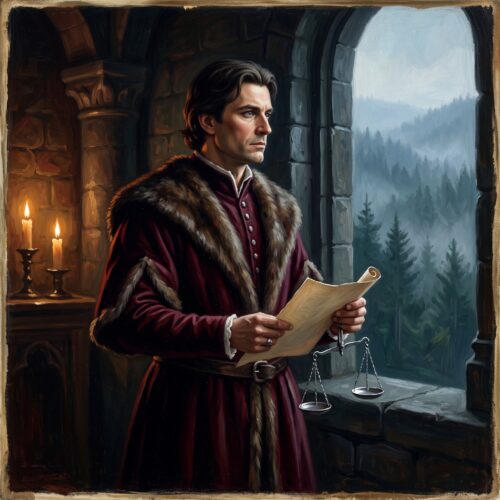
Instead of prolonging the suicidal feud with Duke John I of Brabant—the man whose knights had killed his father at Worringen—Henry made peace and married John’s daughter, Margaret of Brabant, in 1292. He cracked down on robber barons within his own borders, stabilized his local coinage, kept his roads safe for merchants, and developed a reputation as an honest, level-headed mediator in regional disputes. He wasn’t rich enough to intimidate anyone, he didn’t command a massive standing army, and his family had zero imperial pedigree.
In the ruthless ecosystem of medieval power politics, Henry VII had one supreme, paradoxical asset: he was completely unthreatening.
Act III: The Two-Man Backroom Conspiracy That Rigged the Board
While King Philip IV of France was throwing bags of cash at German princes like a drunken sailor in a port town, two quiet operators were already ten moves ahead of him. Those two men were Henry’s younger brother, Baldwin of Luxembourg, and a brilliant, hyper-ambitious Luxembourg-born cleric named Peter of Aspelt.
To appreciate the sheer audacity of this duo, look at their resumes.
Peter of Aspelt was the ultimate self-made medieval hustler. Born to a humble servant family working at St. Maximin’s Abbey in Trier—just down the road from Luxembourg—Peter had clawed his way out of obscurity by collecting university degrees in theology, philosophy, law, and medicine across Padua, Bologna, and Paris. He didn’t just read books; he used medicine as a VIP backstage pass into the inner sanctums of European royalty. He became the personal physician and chaplain to King Rudolf of Habsburg, then served as chancellor to the King of Bohemia, surviving prison, political purges, and papal intrigue along the way. In 1306, through sheer diplomatic wizardry, Peter secured the ultimate prize: he was named Archbishop of Mainz. That made him not just the primate of Germany, but the senior Prince-Elector of the entire Holy Roman Empire, the man who literally chaired the imperial election.
And right beside him was Henry’s younger brother, Baldwin. Only twenty-two years old in 1307, Baldwin had been studying canon law in Paris when the Archbishopric of Trier fell vacant. Through relentless lobbying at the papal court in Poitiers, Baldwin got himself elected and consecrated as Archbishop of Trier—making him another Prince-Elector.
Pause and do the math on that.
Out of the seven men in the entire world allowed to vote for the next ruler of the Holy Roman Empire, two of them—the Archbishop of Trier and the Archbishop of Mainz—were Henry VII’s literal baby brother and a loyal native son of Luxembourg. Before a single rival candidate had even saddled his horse, the Luxembourg syndicate already controlled two of the four votes needed for a majority.
Baldwin and Peter of Aspelt didn’t advertise Henry as a conquering hero. They pitched him to the rest of Europe as the ultimate diplomatic pressure valve.
First, they worked Pope Clement V. Sitting in France, Clement V was terrified of what would happen if King Philip IV’s brother, Charles of Valois, won the German crown. If the French royal family controlled both France and the Holy Roman Empire, the Pope wouldn’t just be Philip’s neighbor—he would be Philip’s permanent houseguest in a gilded cage. Baldwin and Peter whispered a brilliant alternative into the Pope’s ear: Back Henry of Luxembourg. He speaks French, he’s cultured, he’s devout, and—best of all—he’s too small to bully the Church, yet independent enough to block France from swallowing Germany. Clement V secretly gave his blessing.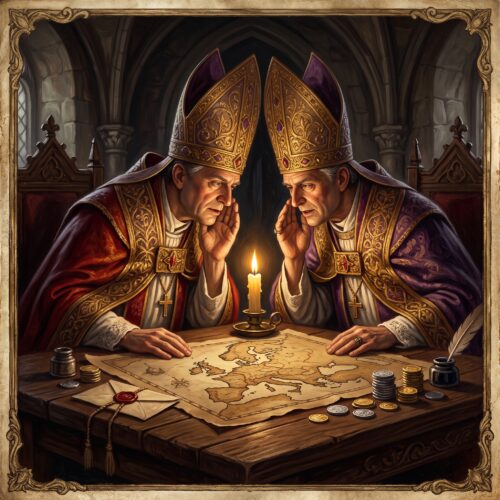
Next, Baldwin and Peter turned their attention to the remaining German electors, beginning with Archbishop Henry II of Virneburg, the Elector of Cologne. Cologne was deeply suspicious of both French expansion and Habsburg arrogance, and his predecessor had fought alongside Luxembourg at the bloody Battle of Worringen twenty years earlier. Still, medieval archbishops didn’t run on nostalgia alone. Baldwin and Peter sat down with Cologne and cut a cold, hard business deal: in exchange for his vote, Henry VII would restore lucrative Rhine river tolls that the late King Albert had abolished, hand over strategic territories, and reimburse his election expenses.
With the three ecclesiastical electors—Mainz, Trier, and Cologne—locked in a tight, unbreakable bloc, the secular princes suddenly realized the train was leaving the station without them.
Throughout October and November 1308, Baldwin and Peter of Aspelt conducted a masterclass in political horse-trading at Rhens and Frankfurt. They met with Rudolf I, the Count Palatine of the Rhine, along with his brother Louis (the future Emperor Louis IV), and bought their alignment with territorial concessions and marriage pledges. They neutralized the Habsburgs—who were terrified of losing their Austrian duchies if a hostile king took power—by quietly signaling that Henry wouldn’t strip them of their core lands as long as they stayed out of the way. They brought in Duke Rudolf I of Saxe-Wittenberg and Margrave Waldemar of Brandenburg, showering them with imperial confirmations, cash promises, and diplomatic honors.
King Philip IV of France had spent an absolute fortune trying to buy the empire from the outside in. Baldwin and Peter of Aspelt bought it from the inside out—using promises backed by the future authority of the very throne they were trying to win.
Act IV: November 27, 1308—The Election in the Dominican Church
By late November 1308, the imperial electoral college convened in Frankfurt am Main, the traditional voting ground of German kings.
Normally, the election of a King of the Romans took place in the Collegiate Church of St. Bartholomew, but due to an ecclesiastical interdict hanging over parts of the city, the electors gathered instead inside the Dominican church in Frankfurt on Wednesday, November 27, 1308.
Picture the scene inside that stone-vaulted nave. Outside, the late-autumn wind whipped off the Main River. Inside stood the heaviest power brokers in Central Europe, wrapped in fur-lined robes, surrounded by armed retainers, notaries, and scribes.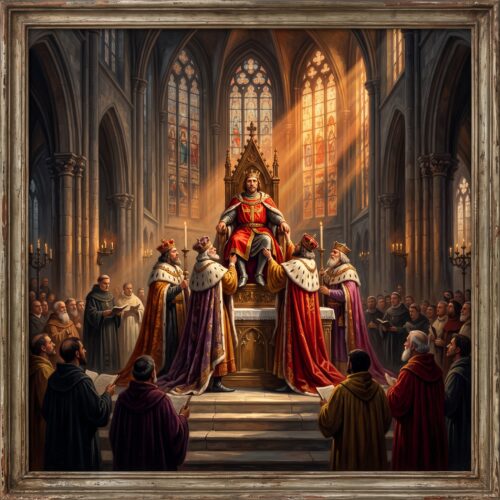
Six of the seven electoral seats were represented and ready to cast their ballots:
- Peter of Aspelt, Archbishop of Mainz, the mastermind who had engineered the coalition.
- Baldwin of Luxembourg, Archbishop of Trier, the twenty-three-year-old brother who had turned his family’s obscurity into leverage.
- Henry II of Virneburg, Archbishop of Cologne, freshly compensated with Rhine toll rights.
- Rudolf I, Count Palatine of the Rhine.
- Rudolf I, Duke of Saxe-Wittenberg.
- Waldemar, Margrave of Brandenburg.
The seventh elector—King Henry of Bohemia (also Duke of Carinthia)—was conspicuously absent. His own grip on the Bohemian throne was crumbling into civil war, and he had no stomach for traveling to Frankfurt only to watch his rivals crown a new overlord. (Ironically, within two years, Henry VII would marry his fourteen-year-old son John to the Bohemian princess Elizabeth, boot Henry of Carinthia off the throne in Prague, and hand the Kingdom of Bohemia to the House of Luxembourg as a consolation prize.)
When the formal roll call was taken inside the Dominican church, there was no dramatic tie, no bloody brawl on the altar steps, and no last-minute French rescue. All six present electors cast their votes unanimously for Henry, Count of Luxembourg.
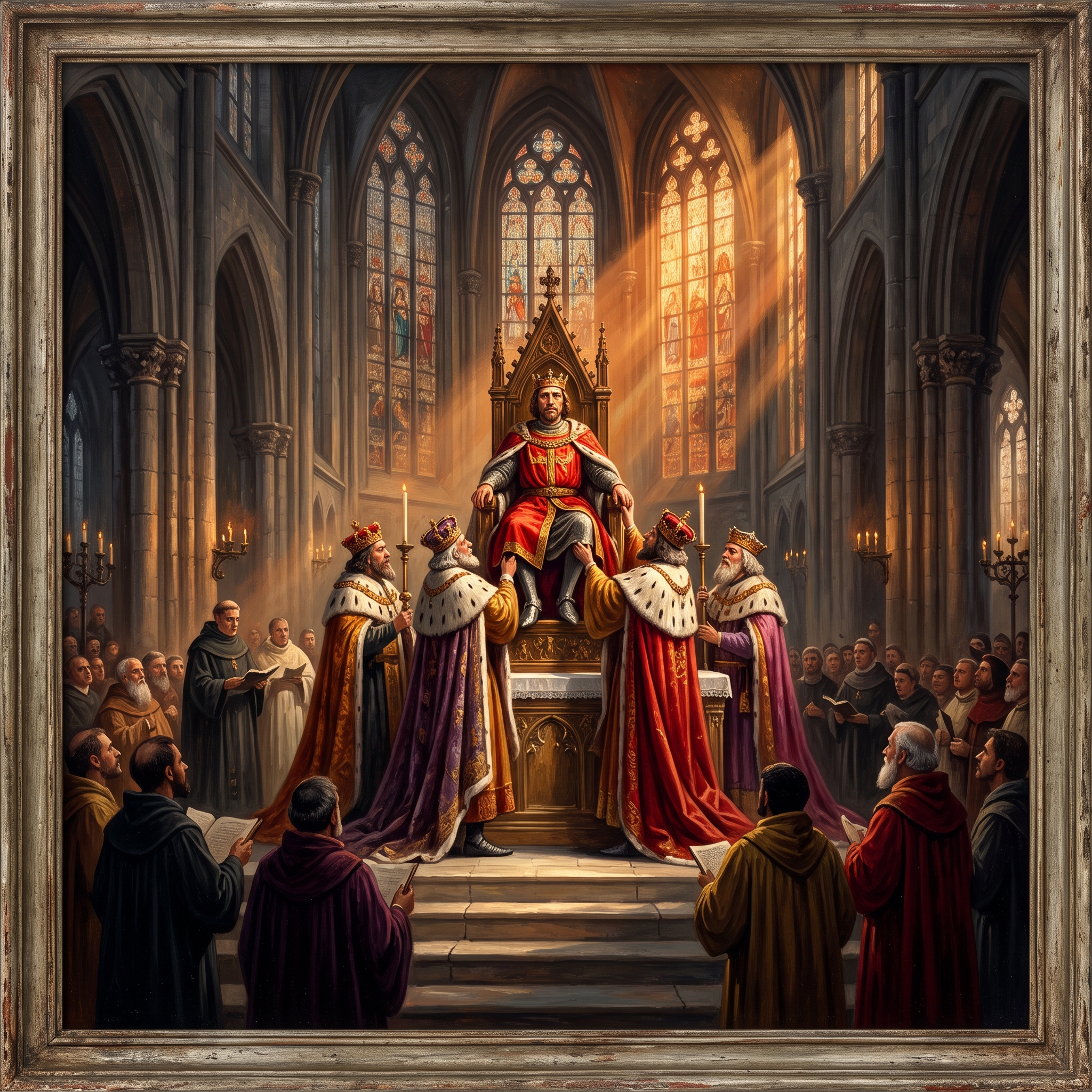
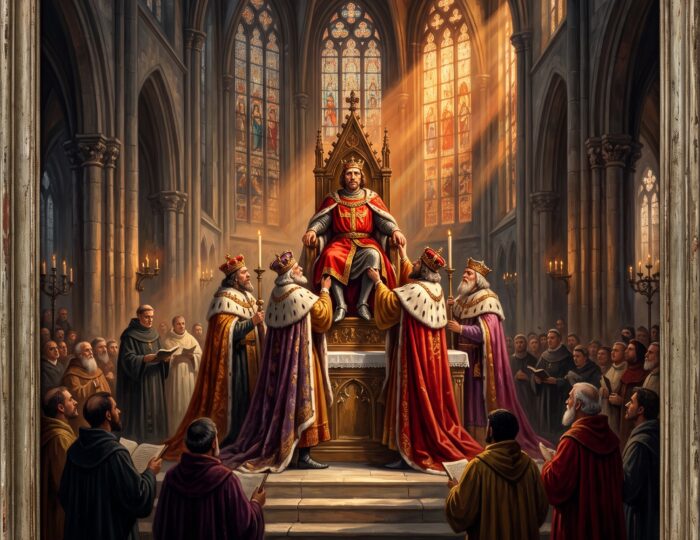
Immediately following the vote, the assembled princes lifted the bewildered-looking thirty-something count and enthroned him upon the high altar of the Dominican church—the ancient Germanic ritual signifying that a mortal nobleman had just been elevated above all earthly peers as Rex Romanorum, King of the Romans.
In Paris, King Philip IV was reportedly incandescent with rage. He had spent mountains of French silver, leaned on the Pope, and mobilized the diplomatic machinery of Europe’s richest kingdom, only to get outmaneuvered by a pair of churchmen from a county smaller than a French province.
Six weeks later, on January 6, 1309, Henry VII was crowned in Charlemagne’s cathedral at Aachen. Four years after that, in June 1312, he fought his way through street barricades in Rome—while archers rained arrows down from Castel Sant’Angelo—to be crowned Holy Roman Emperor in the Basilica of St. John Lateran, becoming the first emperor in over sixty years since the death of Frederick II. Dante Alighieri himself wept with joy, hailing Henry in his Divine Comedy and his political treatises as alto Arrigo—the noble savior destined to heal a broken world.
Henry VII died young in Italy in August 1313, likely felled by malaria during a military campaign, leaving his grand Italian dream unfinished. Yet the shockwave of November 27, 1308 reshaped European history for the next century and a half. From that single afternoon in Frankfurt, the once-insignificant House of Luxembourg exploded into a continental superpower—producing four Holy Roman Emperors (Henry VII, Charles IV, Wenceslaus, and Sigismund), ruling Bohemia and Hungary, building Prague into one of the cultural capitals of Europe, and rivaling the Habsburgs themselves.
All because a broke count from nowhere realized that when the giants are busy trying to crush each other, the person who wins isn’t the loudest contender in the arena—it’s the quiet operator who owns the referee.
Act V: Why Standard “Self-Help” Advice Would Have Gotten Henry VII Killed
If Henry VII had listened to modern internet productivity gurus, hustle-culture podcasters, or LinkedIn thought leaders in 1308, he would have died a forgotten middle-manager in a damp Ardennes castle.
Think about what conventional self-help screams at you every single day:
- “Build a massive personal brand! Make noise! Dominate the room!” (Philip IV of France tried that. He spent a fortune on PR and bribes and lost to a guy nobody had heard of.)
- “Outwork the competition 10x! Brute-force your way to the top!” (Henry’s father, Henry VI, tried brute force at the Battle of Worringen in 1288 and got himself and three brothers chopped to pieces.)
- “Fake it till you make it! Project overwhelming dominance!” (If Henry had acted like a superpower in 1308, every elector in Germany would have united to crush him before he reached the Rhine.)
Henry VII didn’t win on November 27, 1308 because he was the richest, the strongest, or the loudest. He won because he exploited structural asymmetry.
Look at the exact mechanics of his victory:
- He turned smallness into safety: Because Luxembourg posed zero existential threat to the major German princes or the Pope, nobody mobilized an immune response against him. He slipped past every gatekeeper because he looked like a harmless compromise.
- He bypassed the crowd and targeted the chokepoints: Instead of campaigning to the masses or fighting forty rival dukes, his team identified the exact seven people who actually held the legal keys to the door—and secured four of them before anyone else realized a race was happening.

- He used future value to fund present acquisition: Henry didn’t have the liquid cash to outbid the King of France. Instead, he traded future administrative permissions—Rhine toll charters, territorial confirmations, and political protection—that cost him nothing today and only existed once he won.
- He let the giants exhaust each other: While France and the Habsburgs locked horns in loud, expensive, visible tug-of-war matches, Henry quietly collected the undecided votes in the back room.
You don’t need a medieval duchy to use this. Whether you are trying to land a career-defining promotion, pivot industries, launch a business in a saturated market, or escape a stagnant rut, you are constantly competing against people with bigger budgets, louder resumes, and entrenched head starts. Playing their game by their rules guarantees you lose.
Act VI: The “Frankfurt Chokepoint” Protocol—Your 48-Hour Dark-Horse Arbitrage Plan
Forget vision boards, 5:00 AM ice baths, waking up at dawn to journal about your “gratitude frequency,” or spamming five hundred generic resumes into an algorithmic black hole. Those are peasant tactics for frontal assaults at Worringen.
Instead, apply the Frankfurt Chokepoint Protocol—a rapid, surgical, 48-hour dark-horse maneuver designed to let you bypass louder, richer competitors by positioning yourself as the zero-threat, high-leverage consensus choice.
Core Strategic Principles (The Luxembourg Rules of Engagement)
- Weaponize Your “Harmlessness” (The Compromise Wedge): Stop trying to intimidate competitors or bluff about how massive your operation is. When incumbents feel threatened, they form coalitions to block you; when they view you as a low-ego, reliable stabilizer who won’t burn down their turf, they actively invite you into the room to block their bigger rivals.
- Map the Seven Electors, Ignore the Empire: In every career move, contract bid, or life transition, 99% of the noise comes from people who do not have a vote. Identify the exact 3 to 7 decision-makers who hold actual signing authority—and dedicate 100% of your energy to their specific incentives while everyone else argues in public.
- Trade Future Charters, Not Present Cash: Never try to outspend a rival who holds more capital than you. Identify non-monetary permissions, administrative relief, risk-reduction guarantees, or future revenue shares that cost you nothing up front but solve an immediate headache for a gatekeeper.
- Recruit a “Peter of Aspelt” Inside the Room: You cannot advocate for yourself nearly as effectively as a trusted insider who already sits at the table. Find the well-connected operator whose own prestige rises when they sponsor an overlooked, competent outsider—and equip them with the exact talking points to pitch you.
- Turn Past Losses Into Boring Competence: Nobody cared about Henry’s tragic family history; they cared that his roads were safe and his books balanced. Strip away dramatic origin stories and present a track record of calm, friction-free execution in a chaotic environment.
The Quick 48-Hour Execution Plan
- Hours 0–4: The Chokepoint Audit (Stop Mass-Applying)
- Pick one specific, high-upside target you currently feel “underqualified” or “under-resourced” to win (a senior role, a major client account, a board seat, or a strategic partnership).
- Write down the exact names of the 3 to 5 individuals who actually hold veto or approval power over that outcome. Delete every task on your to-do list that does not directly reach one of those people.
- Hours 4–12: The Rhine Toll Diagnostic (Find the Hidden Pain)
- Research what each decision-maker is currently losing sleep over—not the public corporate mission statement, but their personal political headache (e.g., a stalled project, an obnoxious rival department, a compliance bottleneck, or an overworked boss who hates micromanaging).
- Identify one annoying burden you can take off their plate immediately, analogous to restoring a blocked river toll.
- Hours 12–24: Activate Your “Archbishop of Mainz” (Sponsor Alignment)
- Identify one person already inside that organization or network who has credibility with the decision-makers—a former colleague, a mentor, a vendor, or a mid-level leader tired of the current frontrunners.
- Send them a concise, zero-fluff message framing yourself not as a desperate applicant, but as a low-drama, high-reliability solution that makes them look like a genius for bringing you in.
- Hours 24–36: Draft the “Dominican Church” Proposal (Future-Value Offer)
- Write a single-page memo outlining a concrete 60-day stabilization plan for their specific bottleneck.
- Structure the terms using asymmetric upside: propose a low-friction trial, performance-tied milestone, or shared win that removes all perceived risk for the gatekeepers while locking in your seat at the table once you deliver.
- Hours 36–48: Execute the Quiet End-Run
- Have your insider deliver or co-sign the one-page memo directly to two of the primary decision-makers before any formal open-call or public competition begins.
- When the heavyweights finally show up loud, expensive, and demanding concessions, you will already be sitting calmly on the high altar.
Share: