
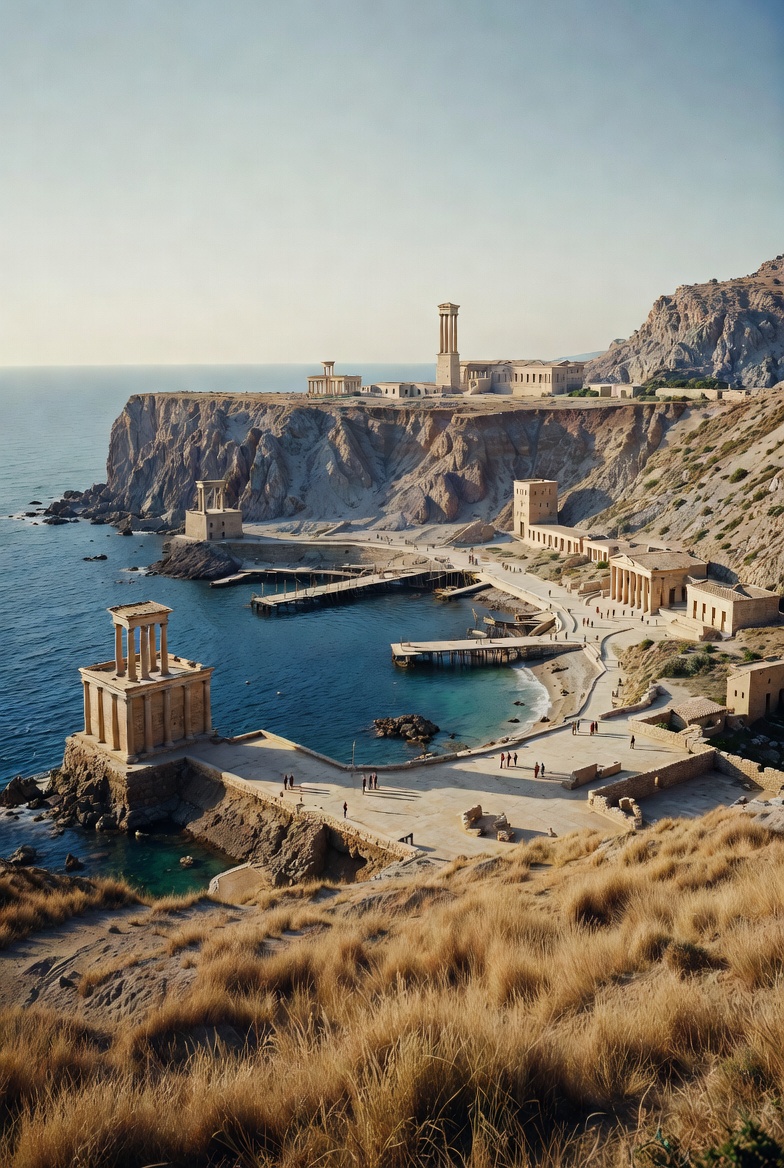
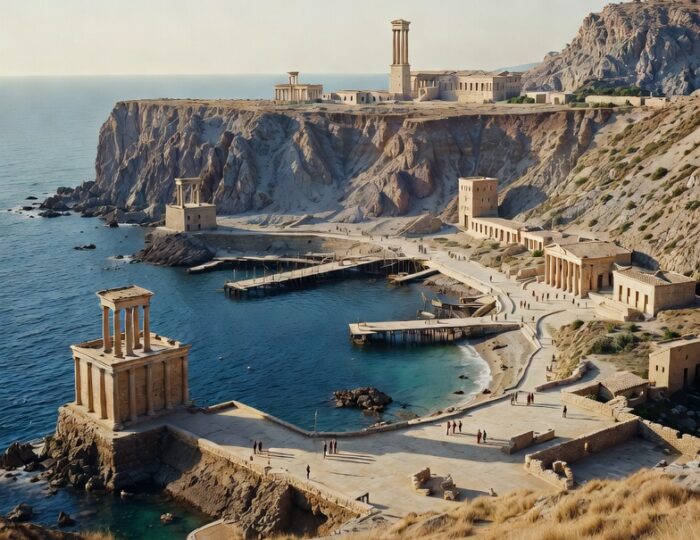
On the morning of July 21, 365 AD, just after daybreak, the Eastern Mediterranean did something no one living had ever seen and few would ever forget. The earth shuddered with a violence that modern geologists rank among the largest earthquakes ever recorded in the region—an estimated moment magnitude of 8.5 or higher, possibly closer to 8.6. The epicenter lay off the southwest coast of Crete, along the Hellenic Trench where the African plate dives under the Eurasian plate. In a single catastrophic rupture, the western end of Crete was thrust upward by as much as nine meters—nearly thirty feet. Ancient harbors that had sat at sea level for centuries suddenly found themselves high and dry. Coral reefs that had lived underwater were lifted clear into the air and left to die in the sun. Wave-cut notches and sea caves that had been carved at the waterline now hang thirty feet above the waves, silent geological witnesses still visible today near Paleochora and Phalasarna.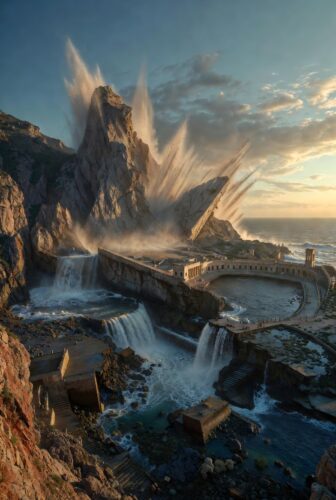
That permanent uplift is one of the most dramatic coseismic vertical displacements known from antiquity. Carbon-dated corals and marine organisms fixed to the rock prove the rise happened in one brutal push. The western tip of Crete tilted like a colossal trapdoor. Antikythera rose several meters; Kythera farther north barely noticed. The harbor of ancient Phalasarna, once a thriving Hellenistic and Roman port with fortifications and slipways, was left stranded inland, its docks and towers staring at a new coastline that no longer touched them. What had been a strategic naval base became an archaeological curiosity overnight—literally. The land itself had been rewritten.
But the quake was only the opening act. Within minutes the sea performed its own terrifying magic trick. Ammianus Marcellinus, the last great Roman historian, was not an eyewitness in Alexandria but he spoke with people who were, and his account in *Res Gestae* Book 26 remains the most vivid and scientifically precise description of a tsunami from the ancient world. Slightly after daybreak, preceded by heavy repeated thunder and lightning, “the whole of the firm and solid earth was shaken and trembled, the sea with its rolling waves was driven back and withdrew from the land, so that in the abyss of the deep thus revealed men saw many kinds of sea-creatures stuck fast in the slime; and vast mountains and deep valleys, which Nature, the creator, had hidden in the unplumbed depths, then, as one might well believe, first saw the beams of the sun.”
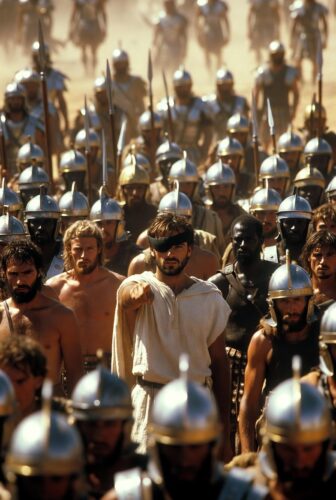
The sea retreated. Not a gentle ebb. A full-scale withdrawal that exposed the seabed for what must have felt like an eternity. Ships that had been floating moments earlier now sat on wet sand and mud. Fish flopped in the slime. People—ordinary Alexandrians, sailors, dockworkers, merchants, curious onlookers—walked out onto the newly revealed ocean floor. They collected fish with their bare hands. They wandered among stranded vessels. They treated the catastrophe like a bizarre free market opened by Poseidon himself. Ammianus notes the almost carnival atmosphere of the moment: men “roamed about without fear in the little that remained of the waters, to gather fish and similar things with their hands.”
Then the sea came back.
“The roaring sea, resenting, as it were, this forced retreat, rose in its turn; and over the boiling shoals it dashed mightily upon islands and broad stretches of the mainland, and levelled innumerable buildings in the cities and wherever they were found.” The returning wave killed many thousands by drowning. Ships that had been left high and dry were picked up and hurled inland—some nearly two miles from the shore. In Alexandria, huge vessels ended up perched on the roofs of houses. One Laconian ship Ammianus later saw near Methone still lay rotting far inland, a ghostly wreckage yawning open from long decay. The face of the earth was altered. Innumerable buildings flattened. The harbor of one of the greatest cities of the Roman world turned into a lake of mud, wreckage, and corpses.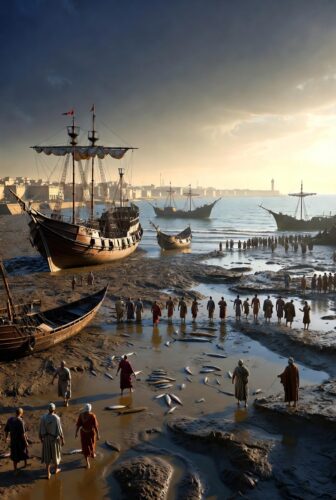
Alexandria was hit hard. Contemporary estimates and later traditions speak of thousands dead—some sources claim around five thousand in the city alone, with tens of thousands of homes damaged or destroyed. The tsunami flooded the great cisterns that stored the city’s fresh water, contaminated wells, and wrecked the canal system that linked Alexandria to the Nile. Fresh water became scarce. Disease likely followed in the weeks after. The anniversary of the disaster was still observed in Alexandria at the end of the sixth century as a “day of horror.” For generations, people marked July 21 with remembrance of the morning the sea vanished and then returned as a destroyer.
The destruction was not limited to Egypt. In Cyrenaica (modern Libya), towns such as Cyrene, Ptolemais, and Apollonia suffered catastrophic damage. At Ptolemais, skeletons of people crushed under fallen columns were found in the peristyle pool of the Palazzo delle Colonne—victims who never made it out. Coin hoards buried under collapsed structures end with issues of 364, freezing the moment of disaster. In Crete itself nearly every town was wrecked. The quake’s effects were felt from Sicily to Cyprus, from Spain to the Levant. Libanius the sophist and church historians such as Sozomen later folded the event into the charged religious atmosphere of the time—some saw it as divine sorrow or wrath connected to the death of Emperor Julian the Apostate two years earlier. Ammianus, more restrained and pagan-leaning, simply recorded the physical horror without heavy theological overlay. The event burned itself into the late antique imagination precisely because it was so total and so sudden.
Geologically the 365 event stands out even today. It generated one of the largest known Mediterranean megaturbidites—a thick layer of sediment that raced across the Ionian Sea floor, now studied as the Homogenite/Augias deposit. Modeling shows wave heights that could have reached several meters along exposed coasts, with particularly nasty amplification in the Nile Delta approaches to Alexandria. The permanent uplift of Crete remains the smoking gun: nine meters of rise in one go is not something that happens often. Scientists estimate recurrence intervals for such extreme slips on that segment of the Hellenic Trench on the order of thousands of years, though neighboring segments could move more frequently.
Recovery began almost immediately because it had to. Alexandria was too important to abandon. The grain fleet that fed Rome and Constantinople needed its harbor. Engineers and laborers under imperial orders cleared wreckage. The city rebuilt, scarred but functional. Trade resumed. Life, stubborn and practical, continued. Yet the landscape itself had changed forever. Crete was higher. Ancient harbors were inland museums. The seabed had been rearranged. And every year on the anniversary, Alexandrians remembered the morning the water walked away and then came roaring home.
That is the raw historical record: a megathrust earthquake at sunrise on July 21, 365 AD; instantaneous nine-meter uplift of western Crete; a classic three-phase tsunami (quake, dramatic seafloor exposure, catastrophic return wave); thousands dead; ships on rooftops; a “day of horror” commemorated for centuries; permanent geological rewriting of the map; and a Mediterranean world that absorbed the blow and kept moving.
Now the application. The outcome of that July morning was not merely destruction. It was the revelation that the most dangerous moment is often the false calm—the sudden retreat of the sea that looks like opportunity or relief but is actually the prelude to the real force. People walked out onto the exposed seafloor and collected free fish. They treated the abnormal as a gift. Then the water returned and erased them. The land itself was permanently raised. What had been normal became obsolete. Survivors rebuilt on new ground. The smart ones never forgot the day the rules changed in minutes.
That pattern maps with brutal precision onto individual lives. Most personal catastrophes do not arrive as continuous storms. They arrive as a sudden withdrawal of the familiar—job security evaporates, a relationship goes quiet, health shifts, finances dry up, a long-standing structure collapses—and in that exposed interval people often wander out collecting “free fish”: temporary comforts, denial binges, opportunistic shortcuts, or simply standing there marveling at how calm it suddenly feels. Then the real wave hits. The ones who thrive are those who treat the retreat not as a holiday but as the loudest possible warning, who use the exposed ground to move to higher ground before the water returns, and who accept that the coastline of their life has permanently changed and build accordingly.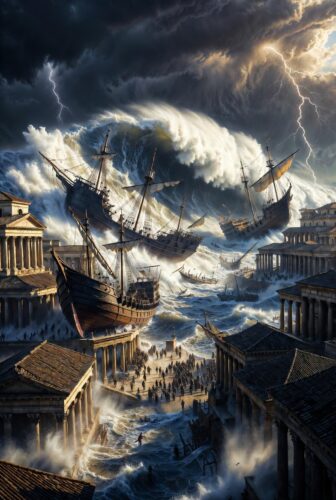
Here is the unique plan extracted directly from the mechanics of July 21, 365. It is not gratitude journaling, morning routines, or vision boards. It is the **False Calm Protocol**—a short, aggressive, geologically flavored operating system for turning the next sudden retreat of your personal sea into permanent uplift instead of drowning. It is designed to be executed in hours and days, not months of therapy-speak. It assumes the wave is coming and the land will be different afterward.
**The False Calm Protocol — Immediate Execution Steps**
– **Seafloor Mapping Drill (Do this once, today, 45 minutes max)**: Take a blank sheet or digital note. Draw three concentric zones labeled exactly like the 365 event: (1) the Old Harbor (structures, routines, income streams, relationships, habits that currently keep you afloat), (2) the Exposed Seafloor (things that would suddenly look like free opportunities or strange calm if the familiar suddenly withdrew—impulse spending, comfort scrolling, “temporary” vices, people who only show up when things are weird, denial narratives), and (3) the High Ground (skills, cash buffers, relationships, physical capabilities, and knowledge that remain useful even if the harbor is destroyed and the coastline rises nine meters). Be brutally specific. Name the actual fish you would be tempted to collect. Name the actual higher ground. This is not abstract. If your “harbor” is a single job or a single client or a single source of identity, write it down. If the free fish would be bingeing, complaining, or freezing, write that down too. The point is to see the seafloor before it is exposed.
– **Retreat Alarm Installation (Tonight, 20 minutes)**: Create three personal “tsunami sirens”—specific, observable early-warning signals that the sea is starting to withdraw in your life. Examples drawn from the historical mechanics: a key relationship goes unusually quiet for 72 hours; a recurring payment fails; energy or health metrics drop hard for three days running; a major plan meets unexpected friction from three unrelated directions at once. Write the three sirens on a card or phone lock-screen note titled “SEA IS LEAVING.” When any one triggers, you do not collect fish. You immediately execute the next two steps. No debate. The Alexandrians who lived treated the retreat as the alarm, not the entertainment.
– **Harbor Abandonment Sprint (Triggered by any siren, 72-hour maximum)**: The moment a siren sounds, you have 72 hours to move critical assets to high ground and deliberately strand the vulnerable ships. Concrete actions only: transfer liquid cash or convertible assets to a separate, harder-to-reach account; document and back up every piece of work or creative output that matters; have the difficult conversation that clears a toxic dependency; cancel or pause the subscription/habit/relationship that only works in the old harbor; physically relocate one piece bare-minimum survival kit (documents, meds, tools, three days of food/water equivalent) to a different location. The historical parallel is exact: the people who wandered the seafloor collecting fish died; the ones who ran inland or climbed before the return wave lived. Speed beats elegance. You are not optimizing the old harbor. You are accepting it may be rubble.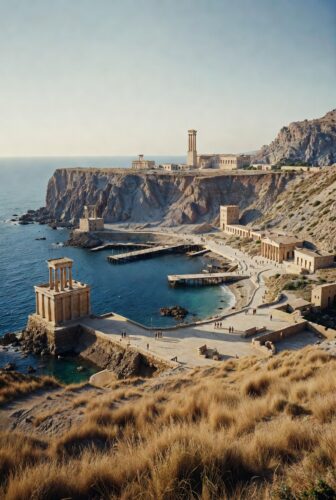
– **Nine-Meter Uplift Commitment (Within one week of any siren, permanent)**: Choose one irreversible structural change that raises your personal “Crete” permanently higher so the next wave cannot reach the same places. Examples with historical teeth: lock a percentage of income into an account that requires a 30-day cooling-off period to touch (the geological uplift equivalent—once raised, not easily lowered); master one high-leverage skill that remains valuable even if your current industry or identity collapses (the new elevated coastline); eliminate one major fixed cost or obligation that only made sense on the old shoreline; build or join one durable alliance that survives individual wrecks. Do it once, hard, and make it sticky. The western tip of Crete did not bounce back down. Neither should your elevation.
– **Day of Horror Anniversary (Annual, non-negotiable, 90 minutes)**: Every July 21, or on the personal anniversary of your last major wave, spend ninety minutes alone reviewing the last year’s seafloor maps, sirens that fired or failed, and uplift actions taken. Rewrite the three zones with updated reality. This is not reflection for its own sake. It is the Alexandrian commemorative practice turned into a calibration tool. The survivors who marked the day of horror for centuries did not do it for poetry. They did it so the next generation would not walk out onto the mud when the water left again. You are that next generation for your own future self.
– **Ship-on-Rooftop Audit (Quarterly, 30 minutes)**: Walk through your current life and identify any “ships on rooftops”—resources, identities, relationships, or projects that are stranded in absurd places because the last wave dumped them there and you never cleaned them up. A skill you no longer use sitting unused on a high shelf. A grudge or story about past damage that still occupies mental real estate. An obsolete goal still listed as active. Either haul the ship back to a useful harbor, break it down for parts, or push it into the sea. Stranded wreckage is not a trophy. It is a navigation hazard for the next event.
Execute the Seafloor Mapping Drill today. Install the three sirens tonight. The rest of the Protocol sits armed and waiting. When the sea next packs its bags and leaves—and it will—you will not be the person wandering the slime collecting free fish while congratulating yourself on the strange calm. You will already be moving assets uphill, abandoning the old harbor without sentiment, and locking in permanent elevation so that when the water returns it finds you nine meters higher than before.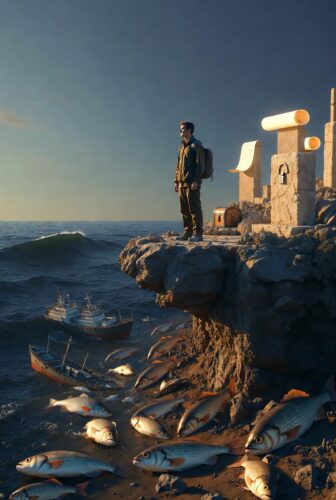
The Mediterranean of 365 AD did not become gentle. Crete did not sink back. Alexandria still remembered the horror centuries later. But the people who treated the retreat as the real signal, who refused the free fish, and who rebuilt on raised ground kept their cities, their trade, and their descendants. The land itself cooperated by staying uplifted. Your job is simpler and harder: notice when your personal sea starts to leave, refuse the carnival on the seafloor, and make sure the next version of you stands permanently higher than the wave can reach.
That is the full lesson of July 21, 365 AD—geological, historical, human, and immediately usable. The sea will leave again. Be the one already climbing.
Share: