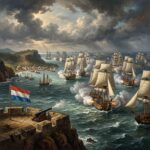

Picture the scene in the central Bay of Bengal on the morning of November 18, 1809. The Indian Ocean is rolling under a heavy swell at roughly six and a half degrees north latitude, a watery no-man’s-land hundreds of miles from the nearest friendly port. Three plump, heavy-bellied merchantmen belonging to the Honourable East India Company—the Windham, the United Kingdom, and the Charlton—are plodding northward toward Madras and Bengal, laden with trade goods, Company dispatches, and the quiet, bureaucratic optimism of a trading empire that assumed the sea belonged to its accountants.
And then, rising over the horizon like three sharks smelling spilled tallow, come the topgallant sails of the French Imperial Navy.
If you have never heard of the Action of November 18, 1809, you are in good company. It does not appear on the Arc de Triomphe. It has no Hollywood screenplay, no commemorative tea towel, and not a single mention on the pages of historyhabits.com. Yet tucked inside the forgotten margins of the Napoleonic Wars’ Indian Ocean theater—specifically the Mauritius Campaign of 1809 to 1811—this obscure, chaotic, improbably dramatic naval collision contains one of the sharpest strategic lessons ever recorded on salt water. It is a story of a merchant captain named John Stewart who refused to read the script written for him, turned a lumbering cargo ship into an attacker against a heavily armed French frigate, led the pride of Commodore Jacques Hamelin’s squadron on a five-day, dead-sprint chase across the open ocean by hurling his own ship’s stores into the waves, and then—in an ending no novelist would dare pitch to an editor—saved his captors’ lives during a catastrophic cyclone and walked away a free man.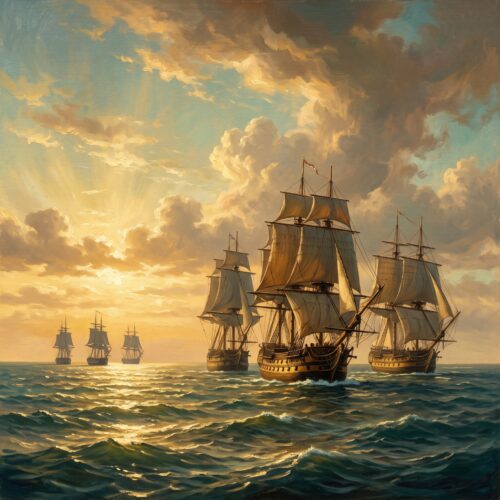
To understand why November 18, 1809 unfolded the way it did, we have to step back into the geopolitical pressure cooker of the Indian Ocean during the height of Napoleon Bonaparte’s European hegemony, where two empires were fighting a shadow war over spices, bullion, and sea lanes thousands of miles from London and Paris.
Part I: The Chessboard of the Indian Ocean in 1809
By the autumn of 1809, the British Royal Navy had largely swept the French battle fleets from the Atlantic and Mediterranean, most famously at Trafalgar four years earlier. Yet the Indian Ocean remained a vast, porous frontier where Britain’s greatest vulnerability was not a lack of battleships, but an excess of lucrative targets. Every year, the Honourable East India Company dispatched dozens of massive merchant vessels—known as East Indiamen—between Britain, St. Helena, the Cape of Good Hope, India, and China.
To understand what an East Indiaman actually was, imagine a floating warehouse disguised as a warship. Built in yards like Blackwall on the Thames, vessels like the Windham, United Kingdom, and Charlton measured roughly 820 to 900 tons burthen. From a distance, their painted gunports, towering masts, and sheer bulk mimicked a Royal Navy fourth-rate ship of the line. Up close, however, the illusion dissolved. Their hulls were broad and deep to maximize cargo capacity rather than speed; their decks were cluttered with livestock pens, trade crates, and passenger cabins; and their cannon, while numerous enough to deter Malay pirates or privateers, were smaller-caliber pieces manned not by drilled naval gunners, but by a polyglot merchant crew. A substantial portion of those crews consisted of lascars—South Asian and Southeast Asian sailors who were skilled mariners in heavy weather, yet widely dismissed by contemporary British officers as untrained and unreliable when grape-shot began tearing through the rigging.
Napoleon’s naval planners knew this Achilles’ heel intimately. Operating out of the twin French island bases of Île de France (modern-day Mauritius) and Île Bonaparte (modern-day Réunion), French frigate squadrons waged a relentless guerre de course—a commerce-raiding war aimed at bleeding British trade dry.
At the center of this French offensive stood Commodore Jacques Félix Emmanuel Hamelin. Born in Honfleur in 1768, Hamelin was no desk-bound aristocrat; he had clawed his way up through the revolutionary and imperial navies, survived the disastrous 1798 expedition to Ireland, fought at Trafalgar, and in July 1806 taken command of the brand-new 40-gun frigate Vénus at Le Havre before sailing for Île de France. By 1809, Hamelin commanded a compact, lethal raiding squadron based at Port Louis: his flagship Vénus, the 40-gun frigate Manche (under Captain Jean Dornal de Guy), the frigate Bellone, and the nimble brig-corvette Créole.
While British Commodore Josias Rowley was busy mounting amphibious raids against French anchorages—such as his September 21, 1809 attack on Saint-Paul on Île Bonaparte, where British forces captured the French frigate Caroline and burned coastal warehouses—Hamelin slipped out into the Bay of Bengal with Vénus, Manche, and Créole to hunt the richest prey on the globe.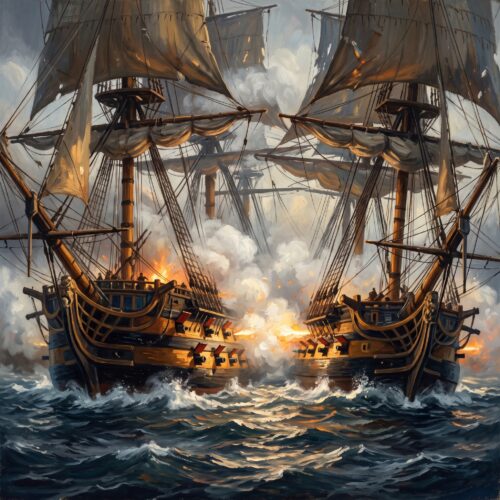
Part II: Three Slow Ships and One Stubborn Captain
Meanwhile, three British East Indiamen were lumbering across the eastern hemisphere on their outward voyage from England. All three had weighed anchor from Portsmouth together on July 7, 1809, stopped at Madeira on July 19, rounded the Cape of Good Hope, and entered the Indian Ocean bound for Madras and Bengal:
- The Windham: Launched at the Blackwall Shipyard in 1800 and rated at 820 tons burthen, she was the largest and best-armed ship in the little trio. Her captain, John Stewart, was a seasoned East India Company commander who possessed a rare and dangerous trait for a merchant skipper: he did not believe that carrying cargo meant forfeiting his spine.
- The Charlton: Launched in December 1798 and commanded on this sixth voyage by Captain Charles Mortlock, carrying East India Company cargo valued at £27,985.
- The United Kingdom: An 820-to-888-ton Indiaman commanded by Captain William Parker D’Esterre on her fourth voyage, carrying a smaller Company cargo valued at £2,194 alongside private trade and passengers.
In an era without satellite weather, radar, or wireless telegraphy, the open ocean was an information desert. Ships learned of war news, squadron movements, and imminent threats only by physically speaking through brass trumpets to passing vessels. On November 11, 1809—exactly one week before disaster struck—Stewart’s three-ship convoy crossed paths with the British sloop-of-war HMS Rattlesnake. The news shouted across the water was grim: a powerful French frigate squadron was actively prowling the Bay of Bengal.
Here is where the divergence between ordinary management and extraordinary leadership becomes visible under a microscope.
Captains Mortlock and D’Esterre acknowledged the warning, kept their merchantmen on course, and hoped the ocean was big enough to hide them. Captain John Stewart, aboard the Windham, immediately assumed the ocean was not big enough. Knowing his crew was a mix of British seamen and lascars who had never fought a naval action together, Stewart spent the next seven days turning his merchant ship’s gun deck into a floating academy. Every day between November 11 and November 18, Stewart drilled his men relentlessly at the great guns, rehearsing loading, running out, aiming, and firing routines until the motions became muscle memory. He could not change the Windham’s broad hull or conjure Royal Navy marines out of thin air, so he obsessed over the single variable entirely under his control: preparation speed.
Part III: Dawn on November 18, 1809 — The Trap Springs Shut
At daybreak on Saturday, November 18, 1809, at coordinates roughly North, East—deep in the Bay of Bengal west of the Nicobar Islands—lookouts at the mastheads of both squadrons spotted strange sails piercing the morning haze.
Commodore Hamelin, aboard the 40-gun Vénus, had Manche and the brig Créole in company. Through their spyglasses, the French officers quickly recognized the unmistakable silhouette of three heavy British East Indiamen sailing in loose formation. To Hamelin, it looked like an early Christmas gift from Napoleon himself: three fat merchantmen loaded with British wealth, escorted by zero Royal Navy warships.
Yet Hamelin had a sound historical reason to be cautious. Just four years earlier, in 1805, at the Battle of Pulo Aura in nearby waters, a convoy of East Indiamen had bluffed and aggressively attacked a vastly superior French squadron under Admiral Charles-Alexandre Léon Durand Linois, actually driving the French warships away in retreat. East Indiamen were slow, yes—but if they formed a tight line of battle and used their massed broadsides, they could severely damage a frigate’s rigging, leaving a French captain crippled thousands of miles from a friendly drydock.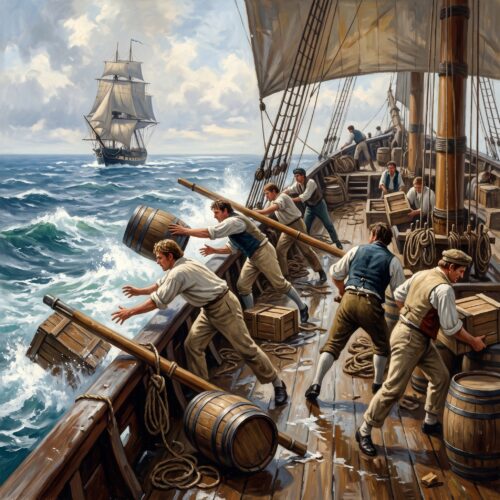
Hamelin immediately signaled his squadron to form a line of battle and bear down on the British convoy.
Down on the quarterdeck of the Windham, Captain John Stewart sized up the odds in seconds. His three ships were outgunned, outmaneuvered, and outcrewed by two purpose-built 40-gun frigates and an armed brig. Worse, Charlton and United Kingdom were sluggish sailers. Running away in a straight line meant being picked off one by one from astern without firing a shot in anger.
So Stewart did the one thing Hamelin never expected a merchant captain to do: he attacked.
As the French ships maneuvered to close the distance, a sudden shift in the wind and sea state briefly disrupted the French formation, leaving the frigate Manche slightly isolated ahead of Vénus and Créole. Stewart saw the gap instantly. Hoisting signal flags to Mortlock aboard Charlton and D’Esterre aboard United Kingdom, Stewart urged his fellow captains to close up, form a united front, and strike the isolated French frigate while she was unsupported.
Stewart put his helm over, squared his yards, and bore straight down on the Manche.
And what did the Charlton and the United Kingdom do? Nothing. Whether out of caution, confusion, or the sobering arithmetic of staring down forty French cannon, Mortlock and D’Esterre held back, leaving the Windham to charge into the teeth of a French warship entirely alone.
For a full hour, the Bay of Bengal echoed with the thunder of black-powder broadsides as a single British cargo ship dueled a 40-gun French frigate yardarm to yardarm. Those seven days of relentless gunnery drills after meeting HMS Rattlesnake now paid off in splinters and smoke. Stewart’s polyglot crew worked their guns with shocking discipline, slamming round shot into Manche’s hull and rigging with enough accuracy and ferocity that the French frigate, unwilling to risk crippling mast damage against a stubborn opponent while Vénus was still coming up, actually disengaged and hauled off to wait for Hamelin.
Let that sink in for a second. On November 18, 1809, a British merchantman fought a French Imperial frigate to a standstill in a one-hour gun battle and forced the warship to break off the engagement.
Part IV: The Five-Day Marathon of Jettisoned Cargo
The strategic picture, however, remained brutal. While Windham had battered Manche back, Hamelin’s flagship Vénus—faster, heavier, and fresh—swept onto the scene. Seeing that his two consort ships had refused to join the fight and were now hopelessly trapped, Stewart made a split-second pivot. If he stayed, all three ships would be captured. If he ran, he might save the Windham and force Hamelin to divide his squadron.
Hamelin took the bait. Recognizing that Charlton and United Kingdom had no fight left in them, the French commodore ordered Manche and Créole to round up the two passive Indiamen—which surrendered after offering virtually no serious resistance, suffering four killed and two wounded across the convoy—while Hamelin personally took Vénus in hot pursuit of the fleeing Windham.
What followed was not a brief skirmish, but an extraordinary five-day endurance race across the Indian Ocean.
By every law of naval architecture, the Vénus should have run down the Windham before sunset on November 18. Vénus was a sleek, sharp-hulled frigate built specifically for speed; Windham was a deep-bellied cargo carrier loaded down with heavy stores. Yet as November 18 bled into November 19, and November 19 into November 20, Hamelin stood on his quarterdeck in disbelief as the British merchantman refused to shrink in his telescope.
Stewart was fighting physics with radical subtraction.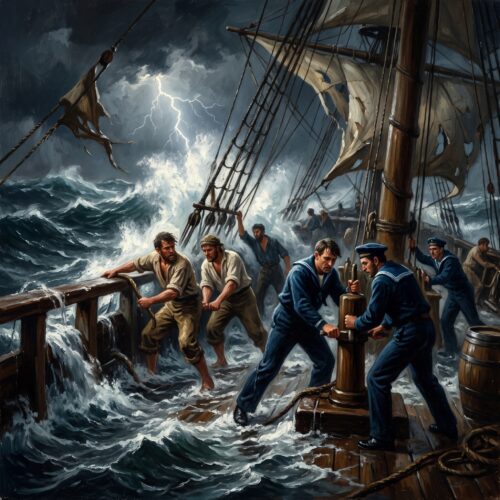
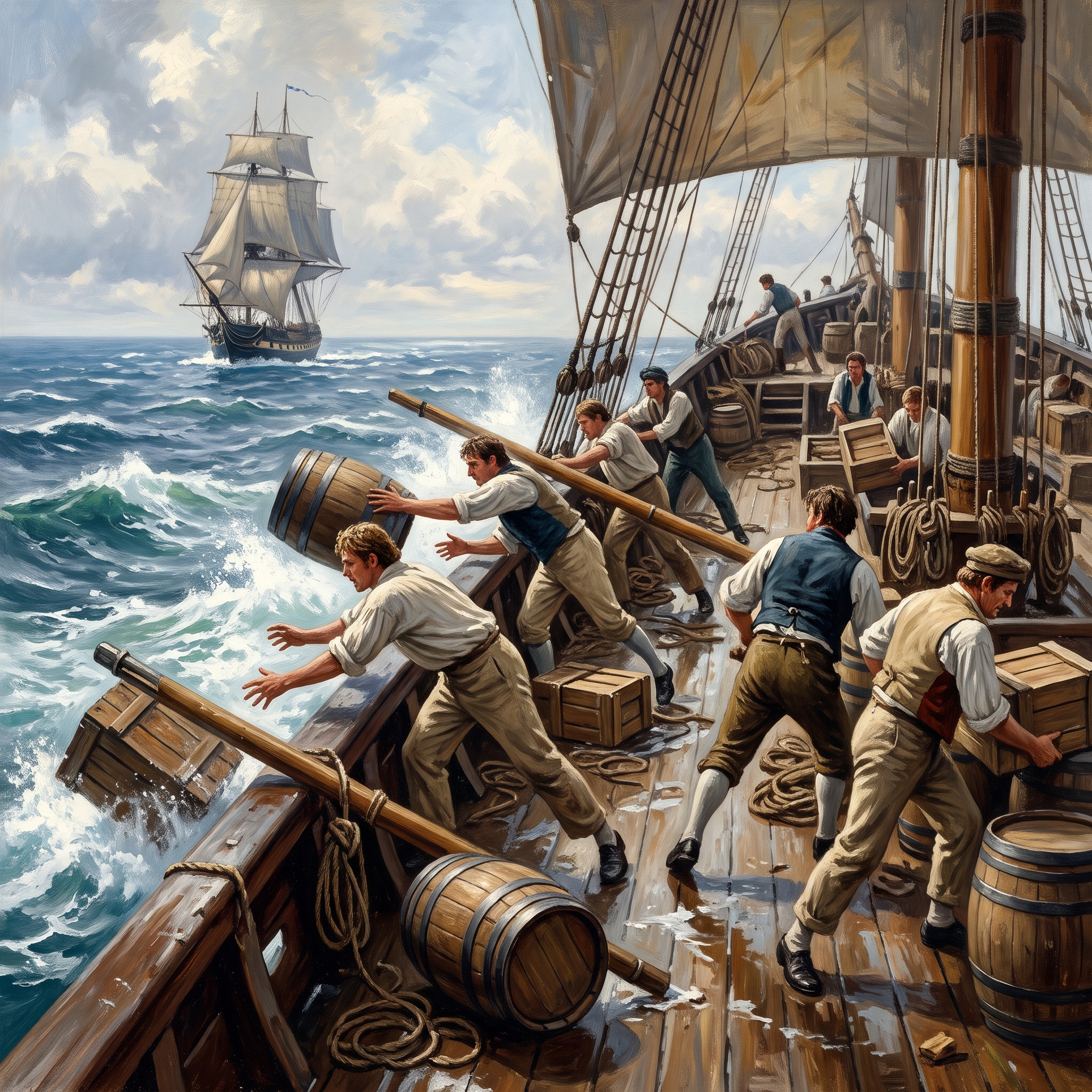
Realizing that every pound of dead weight buried his hull deeper in the water and created drag, Stewart ordered his crew to begin systematically throwing everything non-essential overboard. Spare spars, heavy water casks, trade stores, crates, timber, provisions—anything that did not directly keep the ship afloat or catch the wind went over the rail into the wake. As the Windham shed ton after ton of ballast and cargo, her hull rose higher in the swell, her wetted surface area shrank, and she skimmed across the waves at speeds her Blackwall designers had never intended.
For five days and five nights—from November 18 until the morning of November 22—Stewart and Hamelin played a high-stakes game of cat-and-mouse across hundreds of miles of open sea, trimming sails to every shift in the monsoon breeze, completely out of sight of every other ship on earth. Only at 10:30 AM on November 22, 1809, after Vénus finally squeezed the last fraction of a knot out of the wind and pulled within decisive gun range, did Stewart recognize that further resistance would only slaughter his crew to no purpose. At 10:30 AM, John Stewart hauled down his colors and surrendered the Windham.
Hamelin had his prize. He had captured all three British East Indiamen without losing a single ship of his own. On paper, it was a clean sweep for the French Empire.
Then the Indian Ocean decided to rewrite the final act.
Part V: The Cyclone That Turned Prisoners into Saviors
With three massive captured merchantmen in tow, Hamelin’s squadron began the long, grueling passage southwest across the Indian Ocean toward Île de France. To sail three large prizes home, Hamelin had to strip experienced sailors and officers from his own warships to form prize crews, leaving every vessel in his flotilla short-handed.
As the ships pushed southwestward in December 1809, the barometer plummeted. They sailed straight into the teeth of a ferocious Indian Ocean cyclone.
In the age of wooden sailing ships, a full-blown tropical cyclone was an existential terror. Screaming winds shredded canvas into ribbons, mountainous seas stove in gunports, and violent rolling snapped topmasts like dry twigs. Hamelin’s flagship Vénus—the very frigate that had hunted Stewart down—was battered so savagely by the storm that she began taking on catastrophic amounts of water and was nearly destroyed. Short-handed because so many French sailors were away manning the captured prizes, the French crew aboard Vénus fought desperately at the pumps and rigging, losing ground against the rising sea in the hold.
And down below decks on the Vénus sat Captain John Stewart and his British prisoners from the Windham.
Stewart had every excuse in the book to sit on his hands—or worse, to exploit the chaos. Instead, recognizing that the ocean does not care whose flag is painted on the stern when the hull starts sinking, Stewart and the Windham’s crew stepped forward and volunteered to help save the French warship that had captured them. British merchant seamen and French naval ratings stood shoulder-to-shoulder in the waist-deep bilge water, manning the pumps, clearing tangled wreckage, and wrestling the crippled frigate back under control until the cyclone blew itself out.
Meanwhile, the tempest had scattered Hamelin’s convoy to the four winds. While Charlton and United Kingdom eventually limped into Port Louis on Île de France in early January 1810 (where the French converted both ships into floating prisons), the Windham was blown off course and separated from her escorts. On December 29, 1809—just miles from the safety of French harbor guns—the newly arrived British frigate HMS Magicienne, under Captain Lucius Curtis, spotted the stray Windham and recaptured her without difficulty.
And Commodore Jacques Hamelin? A man of strict old-world naval honor, Hamelin did not forget who had kept the Vénus from going to the bottom during the cyclone. In formal recognition of their crucial assistance during the storm, Hamelin released Captain John Stewart and the Windham’s crew from captivity, placing them aboard a cartel vessel bound for the Cape of Good Hope.
In February 1810, John Stewart stepped onto the dock at the Cape of Good Hope—a free man—and looked out across the harbor to see none other than his own ship, the Windham, riding peacefully at anchor after her recapture by HMS Magicienne. Captain and crew climbed right back aboard their own vessel and resumed their career.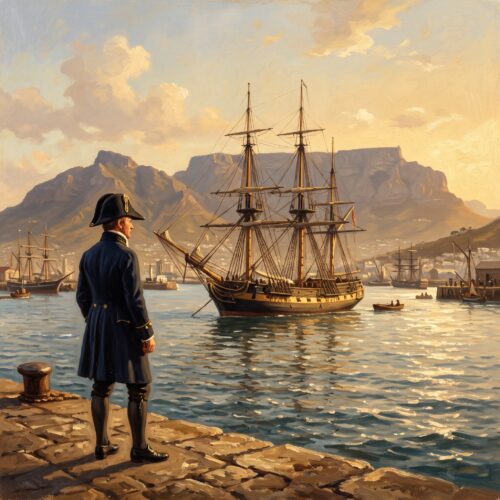
Even the broader geopolitical ripple effects were immense. The shock of losing three East Indiamen in a single stroke on November 18, 1809—combined with two other convoy losses—finally forced the British Admiralty to stop treating the Indian Ocean as a side show. Britain poured massive naval reinforcements into the theater in 1810. Ten months after capturing Stewart, on September 18, 1810, Commodore Hamelin himself was wounded and captured when his battered Vénus was overtaken by Commodore Josias Rowley aboard HMS Boadicea. By December 3, 1810, British forces had captured Île de France altogether, liberating the Charlton and the United Kingdom from Port Louis harbor and ending French naval power in the Indian Ocean permanently. As for the Windham herself, she outlived the Napoleonic Wars entirely—eventually being sold to Chile in 1818, renamed the Lautaro, and fighting for South American independence off Valparaíso.
Part VI: Why This Obscure 1809 Sea Chase Beats Every Self-Help Cliché on the Internet
Most online self-help is obsessed with addition and optimization. It tells you to buy another planner, stack twelve morning habits before 6:00 AM, manifest good vibes, and pretend that if you just smile hard enough at a 40-gun French frigate, it will turn into a yacht.
John Stewart didn’t survive November 18, 1809 by manifesting anything. He survived—and ultimately won back both his freedom and his ship—because he practiced The Jettison Doctrine: a ruthless, unsentimental method of stripping away non-essential dead weight the moment reality changes, combined with radical competence during someone else’s emergency.
Here is how the exact mechanics of the Bay of Bengal clash translate directly into your personal life today:
- Pre-Crisis Rehearsal Beats Crisis Improvisation: Stewart didn’t wait until French cannonballs were splintering his bulwarks on November 18 to teach his crew how to load a gun; he used the seven quiet days after HMS Rattlesnake’s warning to drill relentlessly. In your life, the time to build financial buffers, update your resume, learn a hard skill, or have a tough conversation is when the horizon is still empty—not when the frigates are already within range.
- Never Outsource Your Courage to the Convoy: Captains Mortlock and D’Esterre had the exact same warning and the exact same opportunity to fight as Stewart, yet they froze and surrendered without a serious struggle. If you wait for your coworkers, your friend group, or your family to charge first before you take decisive action on a career move or personal boundary, you will end up captured in someone else’s harbor.
- Speed Comes from What You Throw Overboard, Not What You Hoard: Stewart’s cargo ship outran a purpose-built warship for five straight days only because he was willing to chuck his own valuable stores into the ocean. When you are overwhelmed, burnt out, or falling behind on a major goal, adding another productivity app is like loading extra crates onto a sinking deck. You get faster by violently throwing commitments, subscriptions, low-value obligations, and ego-driven busywork over the rail.
- Strategic Surrender Is Not Defeat: At 10:30 AM on November 22, when the math was genuinely finished, Stewart lowered his flag instead of getting his crew killed for vanity. Knowing when to cleanly exit a dead-end job, a failing project, or a pointless argument preserves your crew for the storm ahead.
- Competence in a Shared Storm Buys Freedom That Money Cannot: Stewart earned his release not by begging Hamelin for mercy, but by being the most useful, steady, indispensable person on deck when the cyclone hit. When a crisis strikes your workplace, your family, or your community, stepping up to pump water alongside your rivals creates a reputation debt that almost always pays you back when the skies clear.
The 72-Hour “Jettison & Run” Protocol: A Quick, Zero-Fluff Action Plan
Forget 30-day vision boards, gratitude journals, and waking up at 4:30 AM to stare at a wall. Over the next 72 hours, execute this five-step maritime reset inspired directly by Captain John Stewart’s logbook:
- Hour 0–2: Run the Rattlesnake Audit (Spot the Frigates Early).
-
- Take one blank sheet of paper and write down the single biggest threat or bottleneck currently closing in on your career, finances, or health over the next six months.
-
- Write down the exact date you first noticed the warning signs. Stop pretending the ocean is big enough to hide in, and pick one concrete daily drill (20 minutes of skill practice, cold outreach, debt payoff, or physical training) you will execute every day for the next seven days before the storm arrives.
- Hour 2–12: Execute the Overboard Purge (Throw 5 Dead Weights into the Sea).
-
- Walk through your calendar, your bank statement, and your active to-do list. Identify five non-essential “stores” creating drag on your hull—recurring subscriptions you barely use, committee meetings you attend out of guilt, half-finished side projects, social obligations you dread, or digital clutter.
-
- Cancel, delete, decline, or quit all five before tonight. Do not “reschedule” them. Throw them over the rail so your ship rises higher in the water.
- Hour 12–24: Break Formation from the Slow Ships.
-
- Identify one area where you have been waiting for consensus, permission, or a peer group to move first (just like Stewart waiting on Charlton and United Kingdom).
-
- Make the unilateral move yourself within 24 hours: send the pitch, book the solo trip, set the boundary, or launch the draft without waiting for anyone else to hoist their signal flags.
- Hour 24–48: Cut One Lost Cause Cleanly at 10:30 AM.
-
- Pick one unwinnable argument, sunk-cost hobby, or draining dynamic you have been dragging out purely out of pride.
-
- Haul down your colors cleanly. Send the polite exit message, close the tab, and reallocate 100% of that recovered energy into your primary objective.
- Hour 48–72: Step Up to the Bilge Pumps.
-
- Look around your immediate environment—your team at work, a stressed friend, or a messy household problem—for a “cyclone” someone else is struggling to bail out alone.
Step in for 45 uninterrupted minutes and help solve the hardest, least glamorous part of their problem with zero expectation of immediate reward. You are building the exact kind of high-trust leverage that turns captors into allies—and puts you right back on the quarterdeck of your own ship
Share: