
The Morning the Horizon Coughed Smoke
On the morning of November 16, 1776, the Caribbean sun climbed over the dormant volcanic cone of The Quill and poured white-hot glare across the roadstead of Oranje Bay, a crescent of deep blue water hugging the leeward flank of Sint Eustatius. To the uninitiated eye, Sint Eustatius—affectionately known to sailors, smugglers, and customs-dodgers across the Atlantic world as “Statia”—looked like an ecological afterthought. Barely five miles long and two miles wide, totaling just over eight square miles of volcanic rock, scrub brush, and sugar plantations, the island sat wedged into the northern Leeward Islands between British Saint Kitts and Danish Saint Croix. It possessed no deep natural harbor, no fresh river systems worth bragging about, and a garrison that on a good Tuesday could barely muster fifty soldiers without borrowing cooks from the local tavern.
Yet in the autumn of 1776, this speck of basalt was arguably the richest, loudest, most chaotically indispensable piece of real estate in the Western Hemisphere.
Down along the narrow beach of Lower Town, a continuous wall of brick and stone warehouses stretched for nearly a mile and a half along the water’s edge. Inside those buildings—and spilling out onto the cobblestones under tarpaulins because the roofs simply could not hold another crate—sat the commercial lifeblood of four empires. There were hogsheads of French sugar from Martinique, barrels of Chesapeake tobacco, bales of German linen, casks of Madeira wine, chests of Chinese tea, Dutch cheese wheels stacked like cannonballs, and, tucked beneath innocent-looking layers of salt fish and dry goods, enough gunpowder, flintlock muskets, and brass ordnance to equip a continental army. Over three thousand merchant ships dropped anchor in Oranje Bay every single year. The island had earned its nickname, the “Golden Rock,” not because it mined precious ore, but because its merchants had perfected the lucrative art of ignoring everyone else’s mercantilist trade laws.
At the center of this glorious, tax-evading ecosystem sat a man whose physical silhouette matched his appetite for profit: Commander Johannes de Graaff, the Dutch West India Company’s chief administrator on Sint Eustatius. Born on the island, educated in the Netherlands, and married into the local ruling dynasty, de Graaff was no wide-eyed idealist. He was a pragmatic, portly, fiercely ambitious Caribbean oligarch who owned ten plantations, sixteen merchant vessels, roughly a quarter of the island’s real estate, and an ironclad conviction that free trade was a moral imperative—especially when he owned the warehouses. Just two months earlier, on September 5, 1776, de Graaff had officially taken the reins as governor. He had barely broken in his official chair before a sleek, square-rigged warship appeared off the southern point of the island, flying a banner nobody in the Caribbean had ever seen on a sovereign vessel.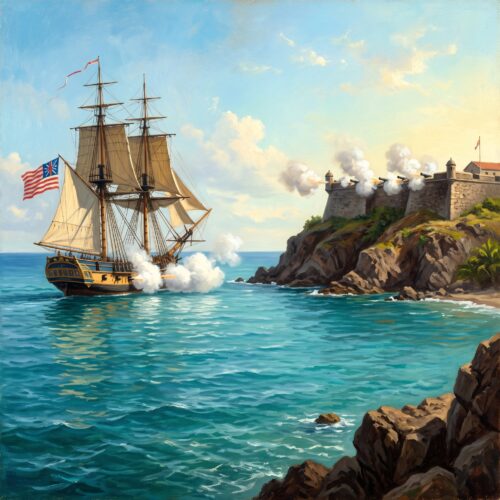
The ship was the Continental Navy brig Andrew Doria, a fourteen-gun converted merchantman named after a sixteenth-century Genoese admiral and commanded by Captain Isaiah Robinson of Philadelphia. At her mainmast fluttered the Grand Union Flag—thirteen alternating red and white stripes with the British Union Jack still stitched awkwardly into the upper left canton, a visual symbol of a brand-new country that had declared independence in July and was currently getting chased across New Jersey by the British Army.
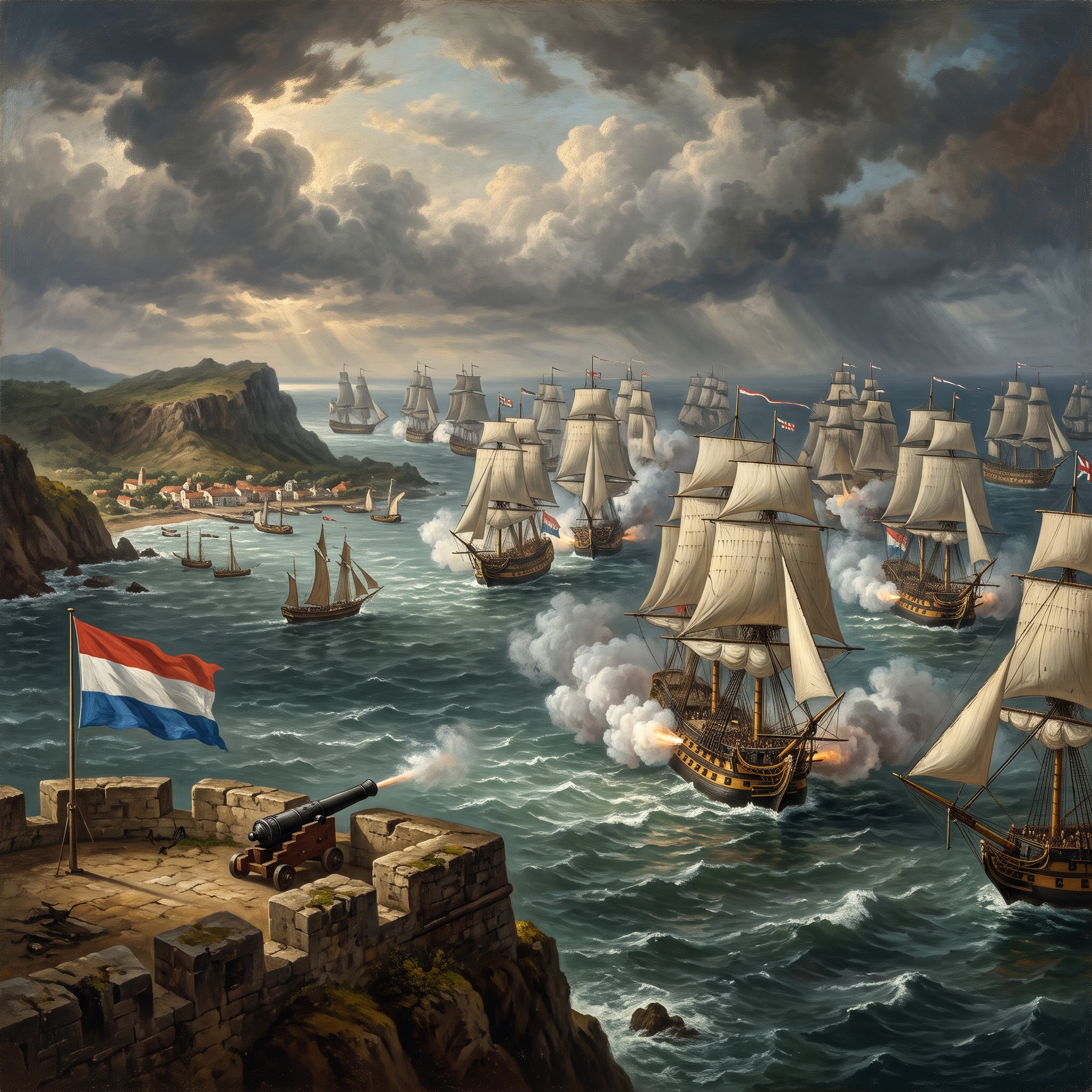
As the Andrew Doria glided into the anchorage beneath the cliffside ramparts of Fort Oranje, Captain Robinson ordered his gunners to run out their cannons. Across the water rolled the thunderous boom of thirteen blank charges—one shot for each of the thirteen United States. White sulfurous smoke drifted lazily across the turquoise bay.
Up on the stone parapet of Fort Oranje, sixty feet above the surf, the garrison artillery officer froze. In the rigidly choreographed theater of eighteenth-century maritime law, a gun salute was never mere background noise. It was a binding diplomatic contract written in black powder. When a merchant vessel fired a salute upon entering a foreign port, the shore battery responded with a polite, routine courtesy. When a warship flying a national ensign fired a formal national salute, however, returning that salute—traditionally with two guns fewer than the visiting vessel—constituted an unmistakable, public, irreversible act of international law. It meant the host government officially recognized the visiting ship’s flag as the emblem of a sovereign, independent nation.
To return the salute meant declaring, in front of hundreds of foreign sailors, British spies, and French merchants lounging on the docks, that the rebellious American colonies were no longer pirates or traitors, but a legitimate country. To refuse the salute meant humiliating the American captain, jeopardizing the most profitable arms pipeline in the Atlantic, and admitting that tiny Statia bowed to British intimidation.
The artillery commander sent a runner sprinting to Johannes de Graaff. British observers on the neighboring island of Saint Kitts—barely seven miles away across a channel narrow enough to carry cannon fire on a clear wind—were already watching through brass spyglasses. De Graaff’s own superiors in The Hague had explicitly ordered him to maintain strict neutrality and avoid provoking King George III.
Johannes de Graaff looked out over Oranje Bay, weighed the wrath of the British Empire against the future of Atlantic commerce, and gave an order that echoed across two and a half centuries.
“Fire back,” he commanded. “Eleven guns.”
Boom. Boom. Boom. Eleven times the iron cannons of Fort Oranje belched flame and smoke over the water. With that eleventh thunderclap, a volcanic rock smaller than Manhattan’s Central Park became the first foreign authority on Earth to officially salute the flag of the United States of America.
The Golden Rock: How a Volcanic Speck Became the Supermarket of Smuggling
To understand why Johannes de Graaff had the nerve to thumb his nose at the greatest naval superpower on the planet, you have to understand the bizarre, hyper-capitalist anomaly that was Sint Eustatius in the 1770s.
While Great Britain, France, and Spain locked their colonial possessions inside suffocating mercantilist cages—forbidding their colonies from trading with outsiders, taxing every bushel of wheat, and patrolling the sea lanes with ruthless customs frigates—the Dutch West India Company had looked at Sint Eustatius and realized a fundamental truth. The island was too steep and rocky to compete with the massive sugar plantations of Jamaica or Saint-Domingue. If Statia played by traditional colonial rules, it would remain a dusty backwater feeding goats on volcanic slopes.
So, beginning in 1688 and formalized as absolute free-port policy in 1756, the Dutch turned the entire island into a duty-free bazaar. Any ship from any nation could sail into Oranje Bay, drop anchor, unload cargo, buy supplies, and sail away without paying the crippling tariffs demanded everywhere else in the Americas.
The result was an eighteenth-century logistical miracle. Because British planters on nearby Saint Kitts, Antigua, and Barbados were legally forbidden from selling their sugar directly to French or Dutch buyers—and forbidden from buying cheap French molasses or Dutch textiles—they simply rowed across the channel to Statia under cover of darkness. French merchants from Martinique and Guadeloupe did the exact same thing. Dutch merchant houses in Amsterdam, Rotterdam, and Middelburg shipped entire fleets loaded with European manufactured goods directly to Oranje Bay.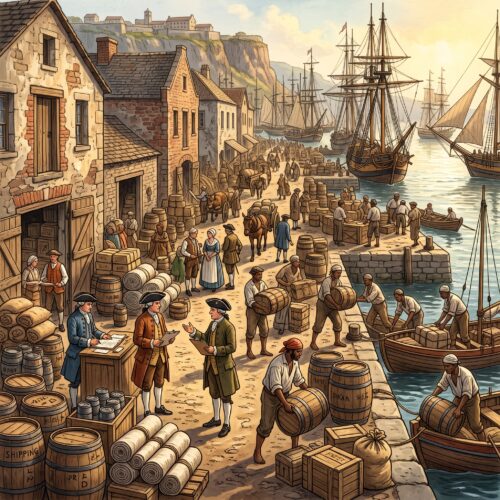
By 1775, Sint Eustatius had become the clearinghouse of the Western Hemisphere. Its permanent population hovered around a few thousand souls—a polyglot swirl of Dutch administrators, Sephardic Jewish merchants whose family networks spanned Amsterdam, London, Curaçao, and Newport, British expatriates, French factors, and thousands of enslaved Africans whose forced labor built the seawalls and hauled the cargo. On any given afternoon, the anchorage below Fort Oranje looked like a floating forest, crowded with up to two hundred vessels flying every ensign in Christendom.
Then, in April 1775, musket fire erupted at Lexington and Concord, and Statia’s business model went from wildly profitable to stratospheric.
The thirteen rebellious American colonies had plenty of heart, plenty of farmland, and almost zero industrial capacity to manufacture gunpowder. During the first year of the Revolutionary War, George Washington’s Continental Army faced a terrifying secret: at several points during the siege of Boston, American soldiers had fewer than nine cartridges per man. Without external gunpowder, the American Revolution would have collapsed before Thomas Jefferson ever dipped a quill into ink to write the Declaration of Independence.
Enter the merchants of Sint Eustatius.
The moment word of Bunker Hill reached the Caribbean, gunpowder prices in Oranje Bay skyrocketed, delivering profit margins of over one hundred percent. Dutch merchant firms began shipping millions of pounds of black powder, flints, saltpeter, sulfur, lead, muskets, and cannon barrels from Amsterdam to Statia disguised as crates of tea, barrels of nails, and casks of rice. American blockade runners—fast, shallow-draft schooners and sloops out of Philadelphia, Baltimore, Boston, and Charleston—slipped past Royal Navy patrols, raced down to Sint Eustatius, traded tobacco, indigo, and flour for gunpowder, and dashed back north.
The scale of the operation drove British diplomats into apoplexy. Lord Stormont, the British ambassador in Paris, famously seethed that if Sint Eustatius had sunk into the bottom of the ocean three years earlier, Great Britain would have crushed George Washington’s rebellion in a single season. British ministers in London fired off furious diplomatic notes to the States General in The Hague, reminding the Dutch Republic that centuries-old Anglo-Dutch treaties forbade aiding rebels against the British Crown.
Under relentless British pressure, the Dutch government in Europe finally blinked. They issued formal edicts prohibiting Dutch subjects from exporting arms or munitions to the American colonies.
In theory, the pipeline was shut. In practice, The Hague was four thousand miles away across an ocean that took six weeks to cross, and Johannes de Graaff was standing right there on the docks of Oranje Bay.
De Graaff treated edicts from Amsterdam the way a seasoned poker player treats a polite suggestion from a spectator. When Royal Navy captains dropped anchor to complain that American ships were loading gunpowder in broad daylight, de Graaff expressed theatrical shock, promised an immediate investigation, and quietly cleared the American vessels to sail at midnight under false manifests listing their destinations as Dutch Suriname or French Saint-Domingue. Even Benjamin Franklin, operating as America’s chief diplomat in Paris, routed his secret dispatches to the Continental Congress through Sint Eustatius because it was the most reliable communications hub on Earth.
The Voyage of the Andrew Doria and the Secret in the Cabin
Against this backdrop of high-seas intrigue and wholesale smuggling, the Continental Congress in Philadelphia made a calculated strategic gamble in the autumn of 1776.
Summer had been brutal for the fledgling United States. In August, British General William Howe had shattered Washington’s army at the Battle of Long Island. By November, Manhattan was falling piece by piece—in fact, on that exact same day, November 16, 1776, British and Hessian troops were storming Fort Washington on the northern tip of Manhattan Island, capturing nearly three thousand Continental soldiers. Morale in Philadelphia was hanging by a thread. Congress needed two things desperately: gunpowder to keep the army firing, and international legitimacy to prove to France, Spain, and the Dutch Republic that the United States was an actual sovereign state rather than a temporary tax riot.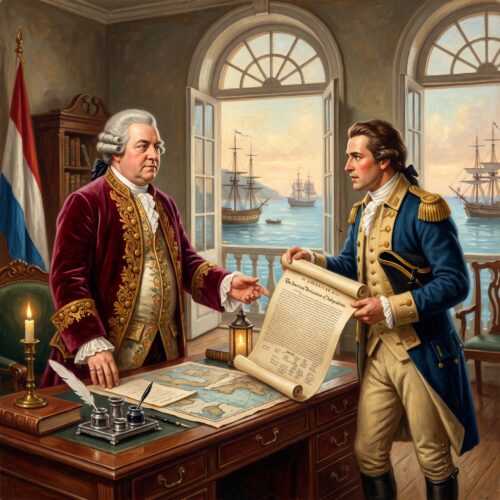
On October 17, 1776, Captain Isaiah Robinson steered the Andrew Doria down the Delaware River and out into the Atlantic. Robinson was an experienced, cool-headed mariner who had already proven his mettle in the Continental Navy’s daring amphibious raid on Nassau earlier that spring. In his hold, he carried American colonial produce to barter for military stores. Locked inside his sea chest, however, he carried a far more explosive piece of cargo: an official printed copy of the Declaration of Independence, signed by John Hancock, along with formal instructions from the Continental Congress’s Secret Committee.
This was actually the second copy of the Declaration dispatched toward Dutch territory. An earlier vessel carrying the document had been intercepted by a British warship. When British naval intelligence officers cracked open the captured packet, they found the Declaration wrapped in sheets covered in strange, looping characters that their finest cryptographers spent weeks trying to decode as an advanced American espionage cipher. As historical irony would have it, the “unbreakable spy code” turned out to be personal letters written in Yiddish by a Dutch-American merchant to his relatives in Amsterdam.
Captain Robinson had no intention of letting his copy end up in a British intelligence folder. Navigating past British cruisers patrolling the Windward Passage, he brought the Andrew Doria smoothly around the southern headland of Sint Eustatius on the morning of November 16.
Everything about Robinson’s approach was deliberate, theatrical, and legally precise. He did not sneak into Oranje Bay at midnight with muffled oars and no colors, the way a common smuggler would. He sailed in during broad daylight, with the Grand Union Flag snapping crisply from his masthead, and fired a full, unmistakable thirteen-gun national salute directly at Fort Oranje.
Robinson was forcing a binary choice. Either Sint Eustatius treated him as a common pirate and ignored his guns, or Sint Eustatius answered his salute and acknowledged the United States of America as a peer among nations.
Up in Fort Oranje, Johannes de Graaff understood the game immediately. For months, he had been playing a profitable shadow game—denying official involvement while quietly greasing the wheels of the arms trade. Now, a fourteen-gun Continental warship was sitting beneath his windows demanding public recognition in front of half the merchants in the Caribbean.
If de Graaff hesitated, every American captain in the Atlantic would hear that the Dutch governor lacked the backbone to stand behind his own harbor. If he fired back, he would cross a diplomatic Rubicon that no European monarch—not even King Louis XVI of France, who was secretly funneling weapons to the Americans through shell companies—had yet dared to cross publicly.
De Graaff didn’t just order the eleven-gun salute. Once the Andrew Doria dropped anchor and Captain Robinson rowed ashore, de Graaff rolled out the full diplomatic red carpet. He received Robinson at his residence with formal honors, accepted the printed copy of the Declaration of Independence, and threw an extravagant banquet celebrating the arrival of the American warship, inviting every American merchant and sea captain on the island to toast the newborn republic.
The Diplomatic Earthquake Across the Channel
Seven miles away on the British island of Saint Kitts, Governor Craister Greathead nearly choked on his afternoon tea.
Within hours of the cannon smoke clearing over Oranje Bay, fast-sailing sloops carried eyewitness reports across the narrow strait to Basseterre, Saint Kitts. British sailors who had been anchored in Statia’s roadstead swore under oath that they had watched Fort Oranje return the salute of a rebel pirate ship flying a striped flag.
Governor Greathead immediately dispatched a blistering, apoplectic letter to Johannes de Graaff demanding an explanation for this “public and open insult” to His Britannic Majesty, King George III. Greathead accused de Graaff of violating international law, breaching centuries of alliance between Great Britain and the Netherlands, and giving formal diplomatic recognition to traitors in arms against their sovereign.
De Graaff’s reply was a masterclass in bureaucratic gaslighting and plausible deniability.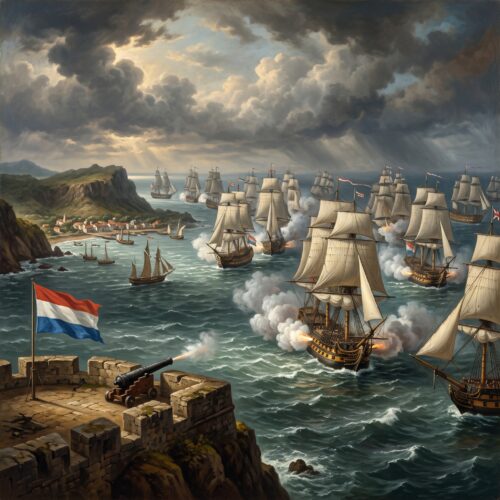
Writing back with serene, innocent politeness, de Graaff professed utter bewilderment at Greathead’s outrage. He explained that he was merely a humble colonial administrator following standard maritime etiquette—returning a routine courtesy salute to a merchant vessel entering a free Dutch port—and insisted that he had no idea what the stripes on the ship’s flag meant, nor could any small colonial garrison presume to decide questions of national sovereignty. In private, of course, de Graaff had toasted American independence with Robinson and loaded the Andrew Doria’s hold to the gunwales with gunpowder, blankets, and military supplies before sending her safely back to Philadelphia.
Greathead didn’t buy a single word of it, and neither did London.
In February 1777, the British ambassador in The Hague, Sir Joseph Yorke, marched into the chambers of the Dutch States General and delivered an ultimatum dripping with imperial fury. Yorke demanded the immediate dismissal and punishment of Johannes de Graaff for the “high insult” of saluting the rebel flag at Fort Oranje, warning that Great Britain would not tolerate a Dutch island functioning as the primary arsenal of the American Revolution.
The Dutch government, caught between its lucrative commercial interests and its terror of the Royal Navy, summoned de Graaff back to Amsterdam in 1778 to answer for his conduct.
Anyone who expected Johannes de Graaff to arrive in the Netherlands groveling for mercy had severely misjudged the man. De Graaff sailed to Europe armed with an encyclopedic legal defense, meticulously kept harbor logs, and the quiet backing of Amsterdam’s wealthiest merchant bankers—many of whom were making fortunes off the very trade de Graaff was facilitating. Standing before the directors of the Dutch West India Company and government ministers, de Graaff argued with cold, razor-sharp precision that he had broken no Dutch law, violated no treaty, and merely upheld the sacred Dutch principle of free navigation and neutral port hospitality.
The Dutch authorities were so thoroughly outmaneuvered—and so quietly delighted by the money flowing into Amsterdam from Statia—that they completely exonerated him. In 1779, Johannes de Graaff sailed triumphantly back to Sint Eustatius, reinstated as governor with his authority stronger than ever.
The Price of Courage: Admiral Rodney’s Revenge
History rarely lets a bold move go unpunished forever, and Great Britain had a long memory.
By December 1780, London had finally had enough. Furious over Dutch refusal to stop the arms trade through Sint Eustatius—and alarmed that the Netherlands was preparing to join the Russian-led League of Armed Neutrality—Britain declared war on the Dutch Republic, igniting the Fourth Anglo-Dutch War.
Secret orders raced across the Atlantic to Admiral Sir George Brydges Rodney, commander of the British fleet in the West Indies. Rodney had been nursing a personal vendetta against Statia for years, complaining to the Admiralty that the island was a “nest of vipers” that had single-handedly kept Washington’s army alive.
On February 3, 1781, Rodney appeared off Oranje Bay with fifteen ships of the line, several frigates, and three thousand troops. Johannes de Graaff, whose entire garrison consisted of roughly fifty soldiers and a handful of aging cannons, stared out at a floating wall of British naval firepower capable of reducing Oranje Bay to volcanic gravel in twenty minutes. Knowing resistance would only get his townspeople slaughtered, de Graaff fired two symbolic shots for the honor of the Dutch flag and formally surrendered the island.
What followed was one of the most notorious plunders of the eighteenth century.
Rodney was stunned by the sheer mountain of wealth stacked inside Statia’s warehouses—goods valued at well over three million pounds sterling, an astronomical fortune in 1781. Driven by both imperial malice and desperate personal debt, Rodney confiscated every bale of merchandise, every ship in the harbor, and every coin in the island’s vaults. He singled out the island’s Jewish merchants with vicious brutality, stripping them of their possessions, ripping open the linings of their coats, and deporting the men without their families. He even kept the Dutch flag flying over Fort Oranje for weeks after capturing the island, luring dozens of unsuspecting American, French, and Dutch merchant ships straight into the harbor like flies into a spiderweb.
Yet in a twist worthy of Greek tragedy, Rodney’s obsession with looting Statia actually helped save the American Revolution.
While Rodney lingered on Sint Eustatius for months auctioning off stolen cargo and squabbling over prize money, French Admiral François Joseph Paul, Comte de Grasse, slipped past British patrols in the Caribbean and sailed north to Virginia. Because Rodney had tied up his ships and attention policing the Golden Rock instead of tracking the French fleet, de Grasse was able to blockade the Chesapeake Bay in September 1781, trapping British General Lord Cornwallis at Yorktown and forcing the decisive surrender that won American independence.
Even in defeat, Sint Eustatius had delivered one final, accidental assist to the nation whose flag it had saluted five years earlier.
Today, Sint Eustatius is a quiet, sun-drenched special municipality of the Netherlands with a population of around three thousand people—a peaceful haven for scuba divers exploring sunken eighteenth-century anchorages and hikers climbing the lush volcanic crater of The Quill. Every year on November 16, the island celebrates Statia Day, its national holiday. And mounted on the white flagpole monument inside the stone walls of Fort Oranje sits a heavy bronze plaque placed there in 1939 by President Franklin D. Roosevelt, honoring Johannes de Graaff and the eleven cannon shots that formally acknowledged the sovereignty of the United States for the very first time.
Why Eleven Cannon Shots Matter to Your Life Right Now
Here is the uncomfortable truth most modern productivity and self-improvement advice completely misses: talent and preparation do not matter if nobody recognizes your flag.
Think about how most people operate in their careers, creative projects, and personal ambitions. They spend years quietly building their ship in the dark. They refine their skills, polish their resumes, stack credentials, read thirty books on leadership, and rehearse their pitch in the bathroom mirror. Then, when they finally sail into the harbor of a new opportunity—a career pivot, a business launch, a negotiation, a creative leap—they lower their colors, apologize for taking up space, and wait politely for an established gatekeeper to grant them permission to exist.
The United States in November 1776 had zero formal treaties, a retreating army, an empty treasury, and a flag that half the world considered treasonous. If Captain Isaiah Robinson and Johannes de Graaff had waited until the Continental Army looked “safe,” “proven,” and “officially endorsed by European consensus,” the American Revolution would have starved for gunpowder before the winter of 1777.
Instead, two things happened in Oranje Bay on November 16, 1776, that separate people who build real momentum from people who spend their whole lives waiting in the outer anchorage:
- First, Isaiah Robinson fired first. He did not hover outside the harbor sending polite inquiries asking whether Fort Oranje would mind recognizing his flag. He sailed in under full colors and announced his presence with thirteen unmistakable shots, forcing the room to respond to his reality.
- Second, Johannes de Graaff understood asymmetric leverage. While London and Paris were paralyzed by protocol, reputation risk, and fear of offending the incumbent superpower, de Graaff realized that being the first to validate an emerging force creates a permanent bond and massive strategic upside that latecomers can never replicate.
- Third, de Graaff mastered strategic ambiguity. When the inevitable backlash arrived from Saint Kitts and London, he did not panic, retract his salute, or grovel. He stood behind his operational reality using calm, indisputable protocol while continuing to execute his core mission.
- Fourth, Statia built an indispensable hub before the crisis hit. De Graaff’s salute only carried weight because Sint Eustatius had already spent decades becoming the one place where everyone needed to trade. Legitimacy without utility is just noise; utility paired with boldness changes history.
Most online self-help tells you to “manifest your goals,” “optimize your morning routine,” or “network authentically.” That is gentle, padded advice designed to make you feel productive without ever risking a single cannon shot. Real momentum requires stepping out of the safe cove, flying your actual colors, and creating undeniable value in a marketplace full of hesitant spectators.
The 48-Hour “Eleven-Gun Protocol” for Instant Legitimacy
Forget five-year vision boards, daily affirmations, or thirty-day habit trackers. Those tools keep you busy polishing cannons you never actually fire. Over the next 48 hours, you are going to execute The Eleven-Gun Protocol—a rapid, zero-fluff tactical sprint modeled directly on Fort Oranje and the Andrew Doria to establish immediate authority in whatever arena you are currently trying to conquer.
Phase 1: Hours 1 to 12 — Audit Your “Golden Rock” Utility
Before Johannes de Graaff fired a single shot, Statia was indispensable because its warehouses held what nobody else had. You cannot demand recognition if your harbor is empty.
- Identify your single sharpest asymmetric asset: Write down the exact problem you can solve faster, cleaner, or more reliably than ninety percent of the people in your immediate professional or personal circle. Strip away generic buzzwords (“hard worker,” “team player,” “passionate”). Name the actual gunpowder in your warehouse—the specific technical skill, industry insight, relationship bridge, or execution speed people desperately need right now.
- Eliminate “Mercantilist Friction” from your accessibility: Eighteenth-century empires choked themselves with tariffs and paperwork; Statia won because anyone could dock and do business immediately. Look at your LinkedIn profile, portfolio, website, email signature, or project pitch. Delete every vague paragraph, passive disclaimer, or confusing hoop that forces a decision-maker to work hard to understand what you do and how to engage you.
- Package one “Immediate-Dispatch Manifest”: Create a concrete, one-page proof of value—a sharp three-bullet diagnostic, a micro-case study, a working prototype, or a specific solution to a live problem facing someone you want to work with. No cover-letter begging; just pure, ready-to-load cargo.
Phase 2: Hours 13 to 30 — Sail Into the Bay and Fire Thirteen Guns
Most people lose opportunities because they approach gatekeepers like smugglers sneaking in at midnight rather than sovereign vessels announcing their arrival.
- Select three high-value “Fort Oranje” targets: Identify three specific people, organizations, or opportunities where a single return salute—an introduction, an interview, a partnership, a green light—would permanently alter your trajectory over the next six months.
- Deliver a “Broad-Daylight Salute” to each one: Send a direct, high-conviction message to each target that bypasses generic pleasantries. State clearly who you are, what specific flag you are flying (your exact thesis, capability, or mission), and attach your Immediate-Dispatch Manifest from Phase 1. Force a binary reaction by asking a crisp, low-friction question that requires an actual answer rather than a polite brush-off.
- Endorse an underdog before the crowd arrives: Channel Johannes de Graaff directly. Find one talented peer, junior colleague, independent creator, or overlooked idea in your field that everyone else is too timid to back publicly because it isn’t “established” yet. Give them a public, specific, high-visibility endorsement—introduce them to a decision-maker, spotlight their work publicly, or stake your reputation on their capability. Being the first to fire a return salute builds loyalty that money cannot buy.
Phase 3: Hours 31 to 48 — Hold the Parapet Without Flinching
When you stop asking for permission and start acting like a sovereign entity, someone—an insecure boss, a skeptical peer, an inner voice trained to play small—will send you a “Craister Greathead letter” questioning your nerve.
- Prepare your “De Graaff Defense” in advance: Write down the two most likely criticisms, rejections, or pushbacks you might face for putting yourself forward boldly. Draft a calm, unbothered, three-sentence response grounded entirely in objective facts and standards—zero defensiveness, zero apologies, zero over-explaining.
- Log your “Harbor Receipts”: At Hour 48, review every action you took over the previous two days. Did you hide behind research and preparation, or did you actually sail into the bay and fire your guns? Regardless of how many return salutes have echoed back yet, you have permanently broken the habit of waiting in the dark.
History does not remember the cautious governors on neighboring islands who kept their gunpowder dry, followed every rule from headquarters, and never offended anyone. It remembers the rogue administrator on an eight-square-mile volcanic rock who looked at an unproven flag on the horizon, stepped up to the cannon, and gave the order to fire.
Run out your guns. Light the fuse. Make them answer.
Share: