
Act I: The Strait of Bottlenecks and the Myth of the Empty Map
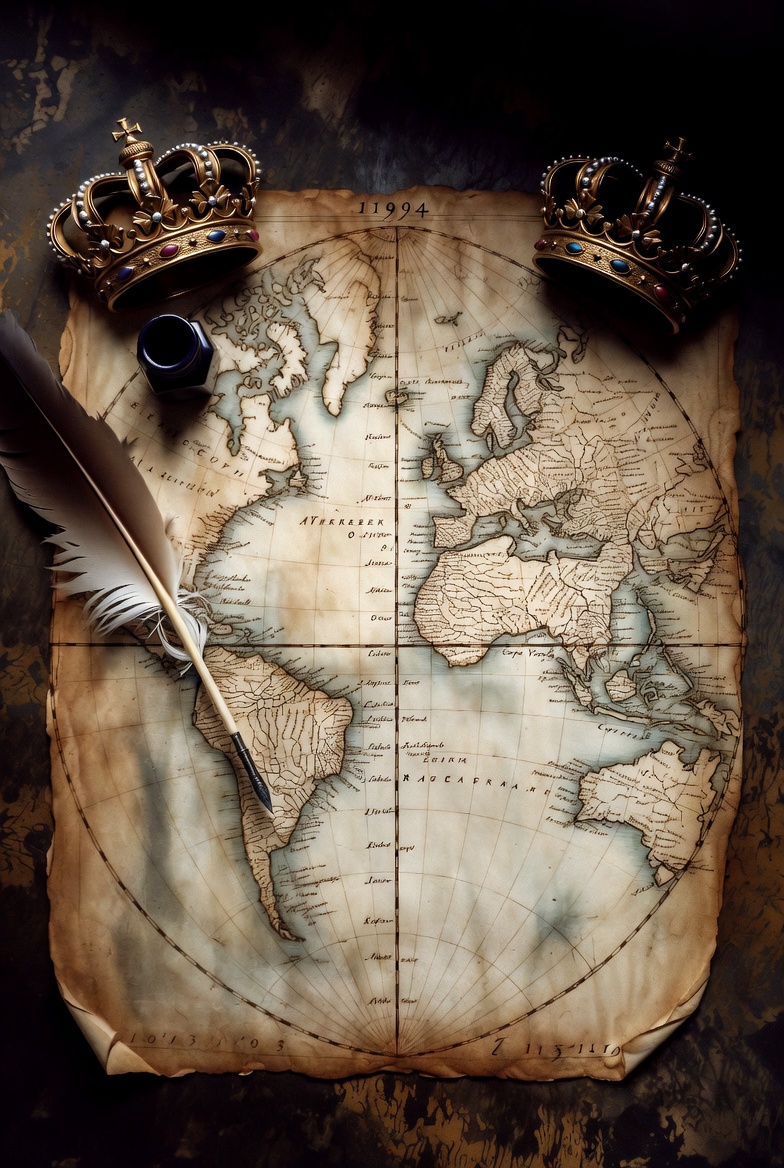
If you glance at a modern map of the Persian Gulf, your eye slides almost effortlessly over a jagged, sun-bleached hook of land jutting out toward Iran like a stone thumb trying to pinch shut the Strait of Hormuz. Today, that thumb belongs to the United Arab Emirates, a hyper-modern federation of glass towers, artificial islands, air-conditioned ski slopes, and sovereign wealth funds so large they have their own gravitational pull. Because we live in an era where cargo supertankers glide through the Strait of Hormuz on GPS autopilot while satellite constellations monitor every ripple in the water, it is remarkably easy to forget that in the autumn of 1809, the British Empire—the undisputed naval superpower of the planet, fresh off Trafalgar and busy strangling Napoleon’s continental ambitions—could not safely sail a single wooden merchantman through that thirty-mile chokepoint without risking total annihilation.
To understand what happened at two o’clock in the morning on Monday, November 13, 1809, on a crescent of blinding white sand in Ras Al Khaimah, you first have to throw away the cartoon version of nineteenth-century maritime history. If you read the London newspapers of 1809 or the dispatches of the Honourable East India Company in Bombay, the men who ruled the southern coast of the Persian Gulf were painted as a monolithic horde of bloodthirsty, mustache-twirling sea-bandits. The British called them the “Joasmee,” a phonetic mangling of Al Qasimi (plural: Al Qawasim), the formidable seafaring clan that controlled Ras Al Khaimah, Sharjah, and several key ports on the Persian side of the Gulf, including Lingeh.
From the perspective of a London shipping insurer or an East India Company factor sweating through his wool waistcoat in Bombay, the Al Qawasim were an existential menace. By early 1809, intelligence estimates put the Al Qasimi maritime confederation at roughly sixty massive bhagalas—deep-sea, double-ended wooden galleons with towering carved sterns and lateen sails capable of catching the faintest Gulf breeze—backed by more than eight hundred smaller, razor-fast dhows and roughly nineteen thousand seasoned mariners. Against this swarming, shallow-draft armada, the Bombay Marine—the East India Company’s private navy—could initially muster just two overstretched cruisers, the Mornington and the Teignmouth, to patrol an entire sea.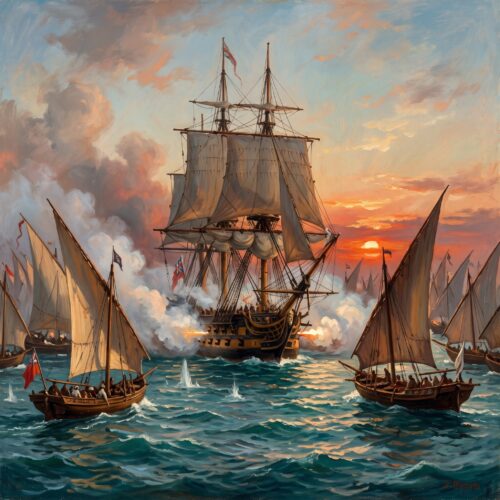
Yet if you crossed the water and sat inside a palm-frond barasti council hall in Ras Al Khaimah, the story looked completely different. To the Al Qawasim, they were not “pirates” at all; they were the sovereign maritime power of the lower Gulf, collecting traditional transit tolls and defending their historic trade routes against an aggressive foreign corporation—the British East India Company—that had recently allied itself with their bitter regional rival, Saiyid Said, the Sultan of Muscat. Even more complicating was the desert politics roaring behind them. In the years leading up to 1809, the puritanical First Saudi State, expanding outward from Diriyah in the Arabian interior, had swept down to the coast. The Saudi ruler had deposed Ras Al Khaimah’s legitimate Qasimi leader, Sheikh Sultan bin Saqr—hauling him off into inland captivity before he staged a daring escape through Yemen to Muscat—and installed a hardline tax collector and governor named Husain bin Ali in the nearby forts of Rams and Dhayah, alongside Hassan bin Rahmah in Ras Al Khaimah.
Under this new, uncompromising regime, the Al Qawasim stopped treating British vessels with cautious diplomacy and began treating them like floating ATMs. In 1797, they had attacked the British brig Viper in Bushire harbor, though the old Sheikh had apologized afterward. By 1804, they were seizing the Trimmer and the Shannon. When the 24-gun East India Company cruiser Mornington tried to recapture the Trimmer, nearly forty Al Qasimi dhows swarmed the warship like hornets on a bear, and the Mornington barely limped away with her rigging in shreds. A shaky truce signed in February 1806 evaporated within months. Then came the humiliations of 1808 and 1809 that turned London’s irritation into imperial fury.
First, in October 1808, the British envoy Sir Harford Jones was sailing up the Gulf toward Persia aboard the frigate HMS Nereide, accompanied by the eight-gun schooner HCS Sylph. Captain Robert Corbet of the Nereide, a man whose impatience was matched only by his contempt for local sailors, refused to slow down for the smaller Sylph. Left lagging behind near the Strait of Hormuz, the Sylph was surrounded by Al Qasimi dhows, boarded in a whirlwind of curved khanjar daggers, and captured, with thirty of her crew killed before Corbet doubled back and blasted the schooner free.
Seven months later, in May 1809, the Al Qawasim struck an even louder nerve. A fleet of fifty dhows intercepted the Minerva, a massive, heavily armed merchant “country ship” sailing from Bombay to Basra. For two running days and nights, the Minerva fought off wave after wave of boarders until her decks ran slick and her ammunition ran dry. Forty-five of the seventy-seven souls aboard were killed. The survivors—including the wife of a British officer, who was held for a hefty ransom—were hauled in chains to Ras Al Khaimah, while the Minerva herself was refitted with twenty cannons and turned into the flagship of the Al Qasimi fleet. Around the same time, Husain bin Ali sent an audacious demand to the British government in Bombay: if East India Company ships wanted to pass through the Gulf without being boarded, they could start paying annual protection tribute just like everyone else.
To Governor Jonathan Duncan in Bombay and Lord Minto, the Governor-General of India in Calcutta, paying tribute to “pirates” while Napoleon’s diplomats were whispering in the ears of the Shah of Persia and the Sultan of Oman was unthinkable. If Britain looked weak in the Strait of Hormuz, French privateers operating out of Mauritius would team up with Gulf dhows and sever the jugular vein between British India and Europe. Diplomacy was officially dead. It was time to send a floating hammer to burn Ras Al Khaimah to the waterline.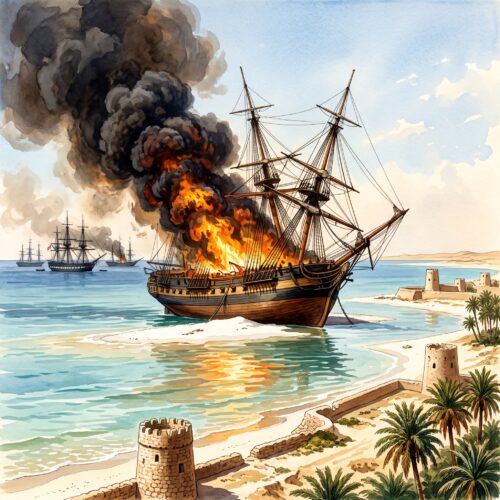
Act II: The Sandbar Trap and the Slow March from Bombay
Assembling an amphibious strike force in late-summer Bombay was nobody’s idea of a smooth military operation. The British command structure was a bureaucratic three-headed hydra: the Royal Navy answered to the Admiralty in London, the Bombay Marine answered to the East India Company’s Court of Directors, and the red-coated infantry answered to the British Army’s Horse Guards. Getting those three egos to share a single quarterdeck without dueling over precedence required delicate choreography.
Command of the naval squadron fell to Captain John Wainwright of the Royal Navy, a veteran officer commanding the 36-gun frigate HMS Chiffonne. Alongside him sailed Captain Charles Gordon in the 36-gun frigate HMS Caroline, plus a flotilla of eight East India Company warships—the Mornington, Aurora, Ternate, Mercury, Nautilus, Prince of Wales, Vestal, and Ariel—along with the bomb vessel Strombolo (packed with heavy mortars for lobbing exploding shells over town walls) and four large transport ships carrying roughly 1,400 British and Indian sepoy troops. Leading the land forces was Lieutenant Colonel Lionel Smith of His Majesty’s 65th Regiment of Foot, a tough, pragmatic infantry officer who understood that marching wool-clad European soldiers across Arabian sand dunes in high humidity was an invitation to heatstroke and ambush.
From the moment the expedition weighed anchor in Bombay on September 14, 1809, Murphy’s Law boarded the flagship as an uninvited passenger. First, the squadron was delayed by mandatory merchant convoy escort duties. Then, shortly after clearing the Indian coast, the bomb vessel Strombolo—the very ship carrying the heavy siege mortars specifically designed to smash mud-brick fortifications from offshore—foundered and sank in heavy seas, taking its crew and artillery straight to the bottom of the Arabian Sea. By the time Wainwright’s battered fleet limped into the dramatic, volcanic harbor of Muscat in late October to regroup and take on water, the element of surprise had vanished completely.
In Muscat, Sultan Saiyid Said welcomed the British officers with lavish hospitality and terrible intelligence. His scouts reported that word of the Bombay expedition had raced up the coast weeks earlier. Far from panicking, the Al Qawasim had fortified Ras Al Khaimah into a bristling coastal fortress and summoned reinforcements from the interior. According to the Sultan’s spies, anywhere from ten thousand to twenty thousand Bedouin warriors were converging on the coast to back up the town’s defenders.
Wainwright and Lieutenant Colonel Smith sat down in the sweltering cabin of HMS Chiffonne and did the math. They had roughly 1,400 soldiers against potentially ten times that number on unfamiliar terrain. Worse yet, British nautical charts of the Persian Gulf in 1809 were little better than educated guesswork drawn on parchment. Nobody on the British ships actually knew the exact depth of the shoals outside Ras Al Khaimah. A protracted land siege was out of the question; if Smith’s troops got bogged down in the desert without siege mortars, they would be surrounded, cut off from fresh water, and wiped out.
So Wainwright and Smith abandoned the grand imperial occupation plan and pivoted to pure surgical speed. Instead of conquering territory, they would conduct a lightning series of smash-and-burn amphibious raids—hit the harbor at dawn, torch the ocean-going fleet, blow up the powder magazines, and get back onto the boats before the twenty thousand Bedouin reinforcements in the interior could even saddle their camels.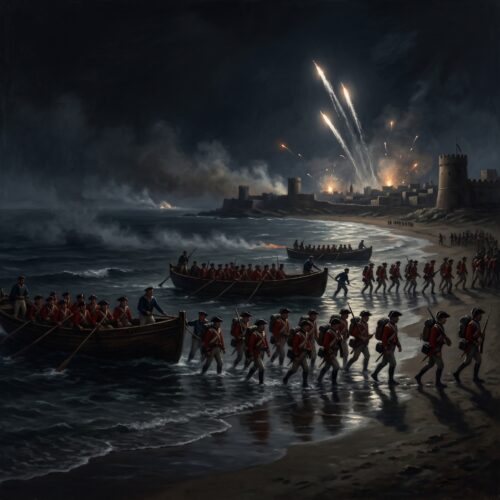
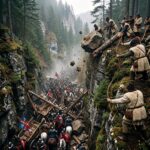
On November 11, 1809, the British topsails finally rose above the horizon off Ras Al Khaimah. Built on a narrow, low-lying spit of sand that separated the open Persian Gulf from a deep, sheltered backwater creek, the town looked deceptively peaceful from a distance—a cluster of coral-stone towers, mud-brick houses, and date-palm groves shimmering in the midday haze. Anchored right in front of the town was the captured prize ship Minerva, surrounded by dozens of towering bhagalas and sleek dhows.
At first, the Al Qasimi captains decided to test the British nerves. Seeing the squadron approaching, a swarm of dhows hoisted their triangular sails and surged out toward the vanguard, drums beating and crews waving swords from the gunwales. Then the morning mist cleared, revealing the full wall of canvas behind the lead ships: two 36-gun Royal Navy frigates and eight Company cruisers bearing down in battle formation. The Al Qasimi commanders immediately spun their helms and raced back toward the protective embrace of the coastal sandbars.
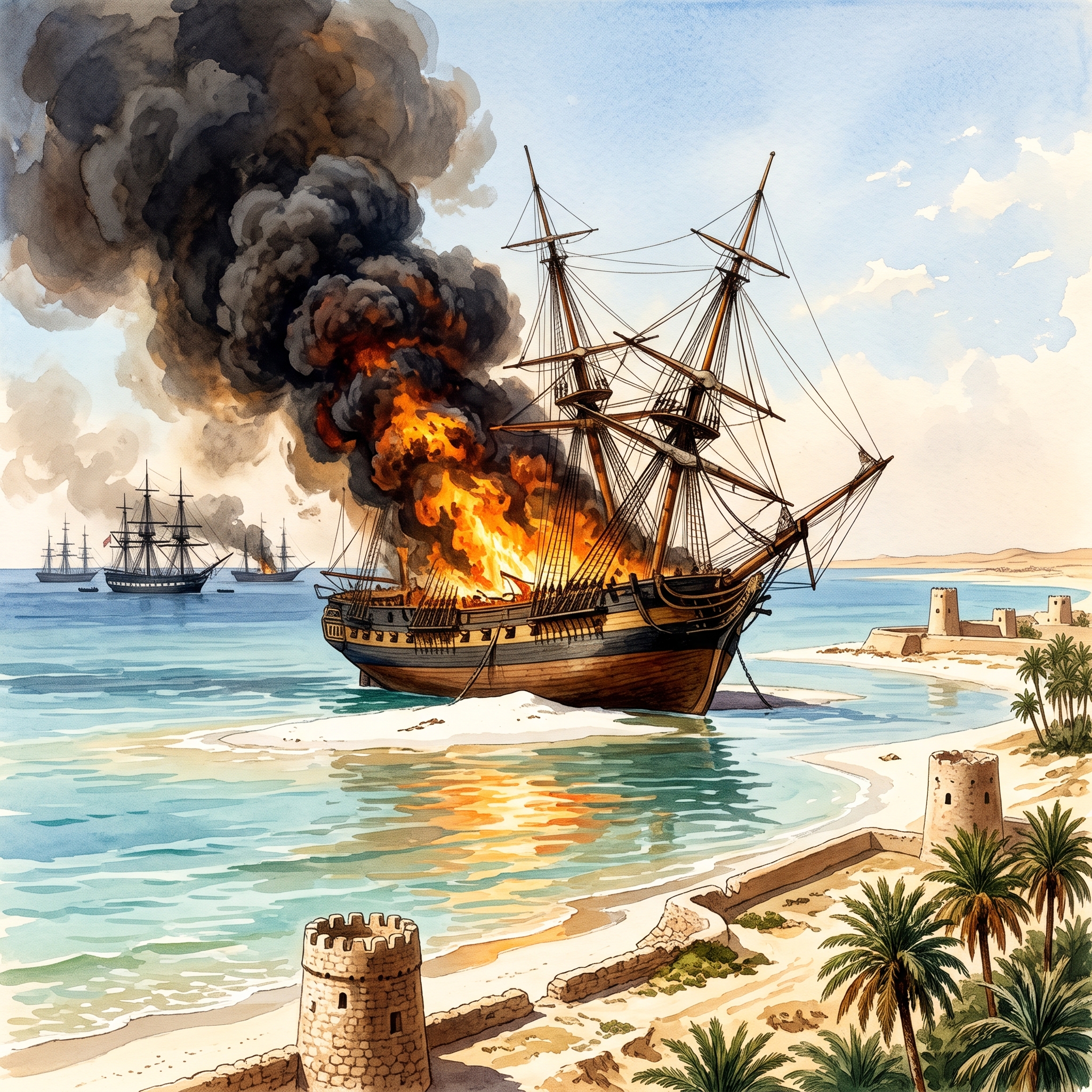
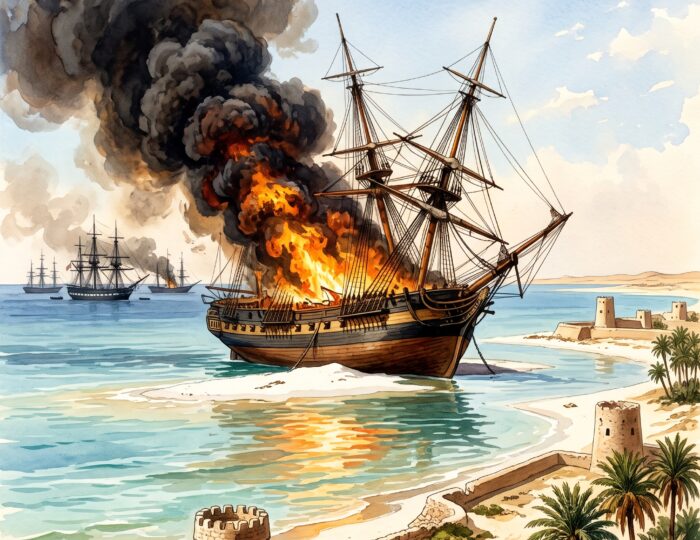
That is when the Minerva met her end—not by British cannon fire, but by sheer navigational hubris. Trying to squeeze the deep-hulled, British-built merchantman back into the shallow harbor channel at top speed, her prize crew misjudged the tide and slammed her keel hard onto a submerged sandbar. Stuck fast at an awkward tilt within range of the approaching British guns, and knowing they could never refloat her before Wainwright’s boarding parties arrived, the Al Qawasim stripped her valuables, poured pitch across her oak decks, and set their own prized flagship ablaze. Throughout the afternoon of November 11, a thick column of black, oily smoke coiled into the sky over Ras Al Khaimah as the Minerva burned down to the waterline—a grim, floating funeral pyre signaling that the battle had already begun.
Act III: The 2:00 AM Feint and the Bayonet Charge Through Smoke
When Captain Wainwright tried to move his heavy frigates Chiffonne and Caroline closer to shore to blast the town’s defenses, he immediately discovered why Ras Al Khaimah had remained unconquered for centuries. A vast, treacherous shelf of coral reefs and shifting sandbars extended nearly two miles out into the Gulf. The deep-draft British frigates could not get within four miles of the beach without ripping their own hulls open. Even the lighter East India Company cruisers had to kedging-anchor carefully in shallow water, firing long-range broadsides whose iron roundshot mostly splashed harmlessly into the surf or buried themselves with dull thuds into the soft sand embankments the defenders had hurriedly thrown up along the shoreline.
An initial probe toward the shore on November 12 proved that a frontal daylight assault would be a bloodbath. Behind their sand ramparts and coral-stone towers, thousands of Al Qasimi fighters and their Bedouin allies crouched with long-barreled matchlock muskets, swivel guns, and coastal batteries, waiting for British longboats to get stuck on the flats so they could pick off the redcoats like ducks in a barrel.
Wainwright and Lieutenant Colonel Smith realized that if they played by the defenders’ rules—marching straight into the teeth of the harbor batteries in broad daylight—they would lose half their landing force before their boots even dried. So they engineered a two-pronged nocturnal shell game scheduled for the deadest, darkest hour of the night: 2:00 AM on Monday, November 13, 1809.
At precisely two in the morning, under a moonless Gulf sky where the only light came from the glowing embers of the wrecked Minerva and the flickering watch-fires along the town wall, dozens of ship’s boats slipped silently away from the British cruisers with muffled oars. They split into two completely separate divisions.
To the north, directly opposite the town’s heaviest shore batteries and the mouth of the inner creek, a small detachment of sailors and marines commanded by Lieutenant Samuel Leslie rowed straight toward the teeth of the Al Qasimi defenses. As soon as their keels scraped the shallows, Leslie’s men raised a deafening racket—blasting bugles, firing volleys of musketry, and lobbing Congreve rockets that screeched across the dark water in trails of blinding white sparks. To the defenders peering through the dark from the ramparts of Ras Al Khaimah, it looked and sounded like the entire British army was storming the northern beachhead. Hundreds of Al Qasimi warriors immediately abandoned their posts along the southern perimeter and sprinted northward through the narrow alleys, pouring heavy musket fire toward Leslie’s boats to repel what they believed was the main invasion.
Two miles to the south, in total, eerie silence, Lieutenant Colonel Lionel Smith stepped out of his longboat into waist-deep, lukewarm surf. Behind him came the real hammer: the 65th Regiment of Foot, flank companies of the 47th Regiment, Royal Marines, and disciplined sepoys from Bombay, dragging lightweight field howitzers across the wet sand. Because Leslie’s noisy feint had pulled the bulk of the defenders north, Smith’s main force landed on the southern beach almost completely unopposed, forming into crisp battle lines on the dark sand while the Al Qawasim were still shooting at shadows up the coast.
By the time sunrise broke over the jagged Hajar Mountains to the east, the Al Qasimi commanders realized they had been brilliantly duped. Dozens of Arab warriors wheeled around and launched a furious, screaming counterattack down the beach toward Smith’s southern flank, wielding curved swords, spears, and matchlocks. For twenty chaotic minutes, the shoreline erupted into close-quarters combat. Smith’s left flank wavered under the sheer ferocity of the charge—until the shallow-draft East India Company gunboats, positioned just offshore, opened up with devastating broadsides of grapeshot and canister, sweeping the open beach with iron hail and forcing the attackers back behind the town’s outer walls.
Then came the hardest part: clearing a fortified town built like a labyrinth. Ras Al Khaimah’s narrow, winding alleys and thick-walled coral houses were designed to trap intruders in deadly crossfires, with defenders firing from rooftop loopholes and barred windows. Smith knew that fighting house-to-house room by room would bleed his small battalion dry in an hour. Instead, he ordered his troops to fix bayonets and use fire as a tactical smokescreen. As the redcoats advanced down the main thoroughfares, pioneer squads set fire to the dry palm-frond roofs and wooden storehouses directly in their path. Within minutes, a wall of dense, choking smoke rolled ahead of the British column, blinding the sharpshooters on the rooftops and masking the size and direction of Smith’s advance.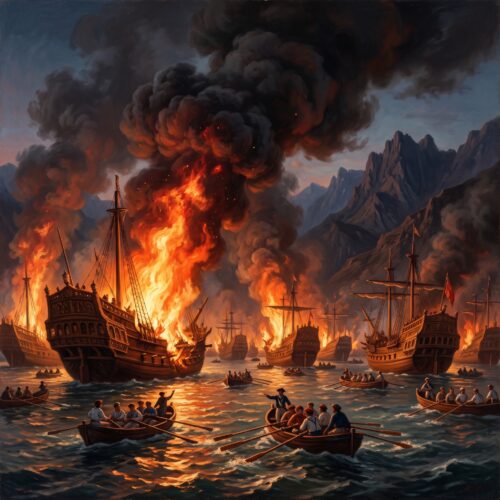
At one fortified stone storehouse near the edge of town, a pocket of diehard defenders held out with lethal accuracy, killing Captain Dancey of the 65th Regiment as he led an assault on the heavy wooden doors before British artillery blew the entrance apart. Pressing relentlessly forward through the blinding smoke, Smith’s soldiers stormed the central square and captured the Sheikh’s fortified palace by mid-afternoon.
With the town’s landward defenses shattered and the surviving Al Qasimi fighters retreating across the creek to the mainland hills—where they stood shaking their swords and shouting taunts down at the smoking ruins—Captain Wainwright finally gave the signal to the fleet. Armed British ship’s boats surged into the inner harbor channel, carrying buckets of tar, turpentine, and slow-matches.
What followed was one of the most systematic maritime demolitions in nineteenth-century naval history. Over the next several hours, British sailors boarded and torched more than fifty Al Qasimi vessels anchored in the creek, including thirty of their massive, irreplaceable ocean-going bhagalas. Huge pillars of flame roared two hundred feet into the air as dry teak hulls, hemp rigging, and barrels of date-syrup and gunpowder ignited in chain reactions. On shore, Smith’s troops blew up the town’s stone towers, spiked the coastal cannons, and burned warehouses stacked with naval stores.
By dawn on November 14, barely twenty-four hours after the first oars touched the beach, the raid was completely finished. Smith marched his men back down to the southern beach in orderly columns, boarded the longboats without losing a single straggler, and returned to the fleet. The British casualty list for the entire assault on Ras Al Khaimah was astonishingly low: just five men killed and thirty-four wounded. The Al Qawasim, by contrast, had lost half of their entire deep-water navy in a single afternoon.
Act IV: The Aftermath That Carved a Modern Nation Out of Smoke
If you think the story ends with British ships sailing back to Bombay to collect their prize money, you miss the real historical punchline. Wainwright’s squadron spent the next several weeks conducting similar lightning raids across the Gulf—burning twenty dhows at Lingeh on the Persian coast without firing a shot, surviving a bloody ambush at the fort of Laft on Qeshm Island where seventy British soldiers were cut down at the fort gates before the gunboat Fury blasted the walls into submission, and finally storming the fort of Shinas in January 1810 on behalf of the Sultan of Muscat.
Yet when Captain Wainwright returned to Bombay in late January 1810 and declared the Persian Gulf “pacified,” he had actually solved only half the problem. Because British charts of the Gulf’s labyrinthine creeks and mangrove inlets were still woefully incomplete—a flaw Wainwright angrily highlighted in his official report, prompting the Bombay Marine’s Lieutenant David Ewen Bartholomew to publish the first accurate hydrographic charts of the coast in 1810—dozens of smaller Al Qasimi dhows had simply hidden up uncharted channels during the November 13 raid. Within two years, the Al Qawasim had rebuilt their fleet and resumed seizing ships.
It took a second, much larger British expedition in December 1819—this time bringing heavy siege artillery that flattened Ras Al Khaimah’s rebuilt walls—to force the coastal sheikhs to the negotiating table. On January 8, 1820, British Major-General Sir William Grant Keir and the regional rulers signed the General Maritime Treaty of 1820.
That treaty, born directly out of the ashes of the November 13, 1809 raid, permanently altered the geopolitical DNA of the Middle East. To ensure that no single maritime power could ever dominate the Strait of Hormuz again, the British deliberately recognized and signed separate treaties with individual coastal sheikhdoms—Ras Al Khaimah, Sharjah, Ajman, Umm Al Quwain, Dubai, and Abu Dhabi. They became known to the world as the “Trucial States”—a collection of independent, treaty-bound emirates that, over a century and a half later in 1971, united to form the United Arab Emirates. As historians at UAE University have noted, without the British intervention triggered by the 1809 assault on Ras Al Khaimah, smaller emirates like Ajman and Umm Al Quwain would almost certainly have been swallowed whole by larger neighbors, and the map of the modern Gulf would be completely unrecognizable.
Even more importantly for the rest of the world, the November 13, 1809 raid established the blueprint for modern asymmetric naval and amphibious warfare. Wainwright and Smith proved that when you are outnumbered ten to one on hostile ground, with faulty maps and missing heavy equipment, you do not win by grinding out a head-on war of attrition. You win by reading the terrain (the sandbars), splitting the enemy’s attention with a noisy decoy (Leslie’s northern feint), striking the unguarded flank in the dark (Smith’s southern landing), destroying the enemy’s actual engine of leverage (the fifty ships in the harbor), and extracting yourself before the enemy’s massive reserves can even show up.
Act V: How the 2:00 AM Sandbar Raid Exposes Your Modern Self-Sabotage
Now, take a step back from the smoke of 1809 and look at your own calendar, your inbox, and your daily to-do list. Chances are, you are living your life exactly like the Al Qasimi defenders on November 12, 1809—or worse, like the original, failed British battle plan before Wainwright and Smith threw it out the cabin window.
Think about what happens to you every single morning. You wake up with a finite supply of cognitive horsepower, time, and energy—your “1,400 troops”. Meanwhile, the modern world has parked twenty thousand metaphorical Bedouin warriors on your horizon: Slack pings, “urgent” emails marked with red exclamation points, social media outrage cycles, pointless status meetings, and minor administrative fires.
And what does every conventional “self-help” guru tell you to do? They tell you to wake up at 4:30 AM, drink green sludge, write in a gratitude journal for forty-five minutes, color-code your calendar into fifteen-minute blocks, and heroically grind through every single task on your list with “grit” and “hustle.” That is the equivalent of marching red-coated soldiers straight across four miles of exposed sandbars in broad daylight into the teeth of shore batteries. You are fighting a frontal war of attrition against an endless swarm of trivialities, wondering why you feel completely burned out by Wednesday afternoon while your actual big goals—your “ships in the harbor”—sit untouched.
Conversely, look at how easily you get tricked by Lieutenant Leslie’s 2:00 AM feint. Someone sends you a frantic text or drops a noisy, dramatic crisis onto your desk at 9:15 AM. Rockets screech, bugles blare, and you sprint northward—dropping your deep, high-leverage work to spend three hours putting out a fire that never actually threatened your existence. While you are busy firing muskets at shadows in the north, your real priorities on the southern flank get overrun without a single shot fired in their defense.
If you want to stop getting ambushed by your own schedule, you do not need another morning routine, a habit-tracking app, or a motivational poster with a picture of an eagle. You need The Sandbar Raid Protocol—a ruthless, asymmetric, three-step operational strike modeled directly on Wainwright and Smith’s November 13, 1809 playbook.
Why Conventional Self-Help Fails (And How the 1809 Raid Fixes It)
- Stop Bringing Siege Mortars to a Speed Raid: When the bomb vessel Strombolo sank on the way from Bombay, Wainwright didn’t turn the fleet around and wait six months for a replacement; he switched to a fast, lightweight raid. Most people delay starting a major project, career pivot, or fitness overhaul because they are waiting for their metaphorical Strombolo—the perfect software, the extra certification, the ideal Monday morning, or the uninterrupted six-hour block of free time. Accept that your heavy artillery is at the bottom of the ocean and execute with the light howitzers you already have in the boat.
- Audit Your “Sandbars” Before You Row: The British frigates couldn’t reach the beach because of a two-mile shelf of shallow coral. In your daily life, “sandbars” are the hidden friction points that ground your momentum before you even start—the phone sitting next to your pillow, the twenty open browser tabs, the unstructured “quick sync” calls on your calendar. Stop trying to force a deep-draft frigate over a two-foot reef; map the shallow water first and route around it.
- Recognize Every 2:00 AM Decoy: Whenever a task arrives wrapped in loud urgency—all-caps subject lines, breaking news alerts, or someone else’s poor planning disguised as your emergency—assume it is Lieutenant Leslie’s diversionary boat. Its entire purpose is to pull your attention away from the quiet, unglamorous work that actually moves the needle.
- Burn the Bhagalas, Not the Palm Fronds: Smith’s men didn’t waste time trying to conquer every square inch of the Arabian desert; they went straight for the fifty ocean-going ships in the creek because those ships were the sole source of the Al Qawasim’s power. Every day, identify the one or two “flagship” tasks that actually generate 80% of your career, financial, or personal leverage, and ignore the surrounding desert.
- Enforce a Hard 24-Hour Extraction: The British landed at 2:00 AM on November 13 and were back aboard their ships by dawn on November 14, long before the twenty thousand Bedouin reinforcements could trap them. Endless “grindset” culture traps you on the beach until you get surrounded by exhaustion. High-output work requires a strict extraction deadline where you shut the laptop, walk off the sand, and recover.
The Quick, Zero-Fluff “Sandbar Raid” Daily Plan
Forget forty-page workbooks and meditative breathing exercises. Execute this four-part tactical strike tomorrow morning in under ninety minutes of actual focused effort:
- The Night-Before Chart Check (5 Minutes at 8:00 PM): Before you go to sleep, write down one single flagship target on a physical index card—the one vessel in your harbor that, if destroyed tomorrow, makes the entire week a win. Clear your desk of everything else so there are no submerged sandbars waiting for you at dawn.
- The 2:00 AM Silent Landing (First 60 Minutes After Waking): Do not open your email, news feed, or messaging apps—those are the northern decoy rockets. Land silently on your southern beach by dedicating your very first waking hour exclusively to your index-card target while the rest of the world is still asleep or shooting at shadows.
- The Smokescreen Protocol (10:00 AM – 12:00 PM): When the inevitable daytime noise begins, deploy tactical smoke just like Smith’s troops in the alleys of Ras Al Khaimah. Put your phone in another room, set an auto-responder or Slack status indicating you are offline until noon, and use artificial isolation to blind the “sharpshooters” trying to snipe your focus from the rooftops.
- The Dawn Extraction (Hard Stop at 5:30 PM): Pick a non-negotiable hour to row back to the fleet. When the clock hits your extraction time, close every open tab, leave the unfinished minor tasks to the desert, and step completely away from work. You did not come to occupy the entire coastline; you came to burn the ships and get out intact.
Share: