
Act I: The Great Royal Land Grab and the Myth of the Sovereign King
Every schoolchild with a passing grade in world history knows about Magna Carta. We are taught to revere that damp June afternoon at Runnymede in 1215, where a ring of heavily armed, disgruntled Anglo-Norman barons cornered King John—a man whose administrative incompetence was matched only by his cartoonish cruelty—and forced him to sign away absolute royal power at swordpoint. We hang replicas of it in law school libraries. We quote it in Supreme Court dissents. Politicians invoke it like an ancient mystic talisman whenever their civil liberties feel pinched.
Hardly anyone talks about what actually happened on the ground after the ink dried at Runnymede, because the immediate aftermath was an unmitigated catastrophe. King John almost immediately reneged on the agreement, appealing to Pope Innocent III, who obligingly annulled Magna Carta within ten weeks, declaring it shameful, demeaning, and null and void under threat of excommunication. England plunged straight into the First Barons’ War. John spent the next year rampaging across the countryside, burning castles, hiring foreign mercenaries, and terrorizing his own subjects until October 1216, when he contracted dysentery—allegedly after gorging himself on peaches and unfermented cider—and died in a foul-tempered sweat at Newark Castle.
He left behind an utterly fractured kingdom, an invading French prince occupying London, an empty treasury, and a terrified, crowned nine-year-old boy named Henry III.
The true battle for ordinary human survival in the thirteenth century was never fought in the gilded halls of Runnymede over arcane baronial inheritance taxes. It was fought in the wet, muddy, bramble-choked underbrush of the royal forests. Because while Magna Carta protected the top one percent of medieval landowners—the wealthy earls, bishops, and warlords who possessed armies of their own—it did virtually nothing for the people doing the sweating, chopping, and starving.
Under the Norman and Angevin kings, beginning with William the Conqueror and accelerating like a runaway cart under Henry II and King John, the crown instituted what modern legal scholars recognize as the single most aggressive, extractive property heist in European history: the Forest Law.
To modern ears, the word “forest” conjures images of pristine, unblemished wilderness, towering redwoods, and untouched fairy-tale glades. In the medieval legal lexicon, a “forest” had nothing to do with tree density. A forest was an administrative jurisdiction—a legal wasteland created by royal decree. When a king declared an area to be “forest,” he was not planting saplings; he was removing thousands of square miles of inhabited land from the protection of the traditional common law and placing it under the brutal, arbitrary personal jurisdiction of the monarch and his private police force.
At its peak in the late twelfth and early thirteenth centuries, nearly one-third of England’s entire landmass was classified as royal forest. This did not just encompass dense woodlands like Sherwood or the New Forest; it swallowed whole arable valleys, pastoral meadows, functioning farms, and entire working villages. In counties like Essex, Huntingdonshire, and Northamptonshire, virtually the entire landscape was declared forest.
If you were an ordinary peasant or a modest freeholder caught living inside these royal forest borders, your daily existence was criminalized overnight.
Under Forest Law, the land existed for one primary purpose: vert and venison—the king’s royal deer and the green vegetation that sustained them. Everything else was secondary, and everyone else was a trespasser on the monarch’s private hunting preserve. You could not clear a thicket of brush to plant barley without paying an extortionate fine for “assart.” You could not construct a wooden fence to prevent wild boars from trampling your vegetable garden, because that constituted an illegal “purpresture,” an encroachment that might hinder a royal stag’s grazing path. If a winter freeze hit and your children were shivering on the dirt floor of your cottage, you could not simply wander into the woods to chop down an oak branch for firewood.
To enforce this tyrannical system, the crown deployed an army of notoriously corrupt officials: wardens, foresters, verderers, agisters, and regarders. These men operated without judicial oversight. They held their own special courts—the Forest Eyres—where ordinary legal rights did not apply. Foresters were infamous for shaking down villagers, demanding illegal kickbacks known as “scotale” (essentially forced royal tavern crawls where locals were coerced into buying watered-down royal ale on pain of harassment), and arresting anyone seen carrying a bow or a hunting knife.
The cruelty was deliberate and systemic. Under the earlier Assize of the Forest enacted by Henry II and enforced with sadistic relish by his sons Richard the Lionheart and John, commoners caught taking deer faced blinding, castration, or hanging. Even more insidious was the terror inflicted upon domestic companions: King John’s foresters routinely carried out the “expeditation” of local dogs. If an ordinary family owned a dog within the boundary of a forest, the animal was considered an inherent threat to the king’s game. To ensure the dog could not chase deer, royal regarders would pin the dog down on a wooden block and strike three claws from each front paw with a broad chisel and a heavy mallet.
For decades, the ordinary people of medieval England were systematically starved, dispossessed, and subjected to institutional terror so that a succession of despots could gallop on horseback across the English countryside, spearing wild boars on a whim.
Then came Sunday, November 6, 1217.
Act II: The St. Paul’s Conclave and the World’s Greatest Knight
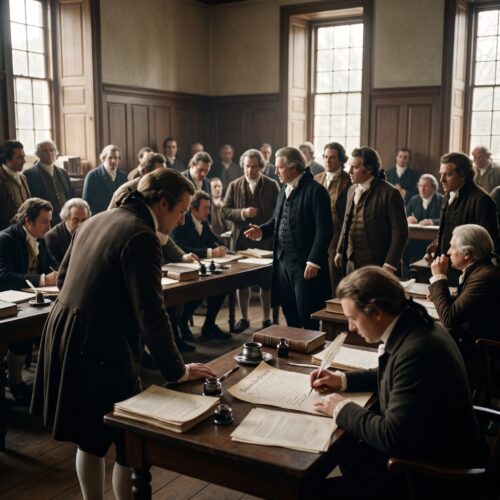
On the cold, grey morning of November 6, 1217, inside the soaring Gothic shadows of Old St. Paul’s Cathedral in London, a gathering took place that would dismantle this machinery of institutional tyranny.
At the center of the nave sat a frail, silver-haired warrior who was already a living legend across Europe: William Marshal, 1st Earl of Pembroke. Marshal was seventy years old—an astonishing age for a medieval knight who had survived dozens of jousts, hand-to-hand skirmishes, and full-scale wars. Contemporaries without hyperbole referred to him simply as “the greatest knight that ever lived.”
Marshal had served four successive kings: Henry II, the Young King Henry, Richard the Lionheart, and the treacherous King John. When John lay dying at Newark in October 1216, leaving his nine-year-old heir, Henry III, surrounded by rebellious barons and facing an imminent invasion by Prince Louis of France, the desperate crown had only one man left to turn to. On his deathbed, John begged Marshal to take the Regency of England and save his boy’s throne.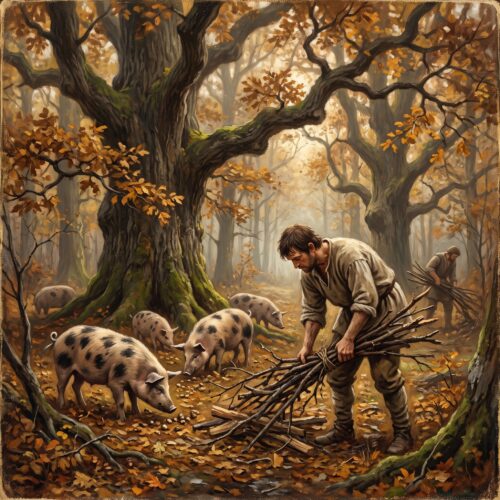
Marshal had every reason to retire to his expansive estates in the Welsh Marches. He was exhausted, battered from a lifetime of war, and well aware that the royal treasury had negative funds. Accepting the regency meant defending a child monarch against impossible odds. Yet Marshal accepted the duty.
Six months earlier, in May 1217, Marshal had strapped on his plate armor, mounted his warhorse at the age of seventy, and personally led the royalist army to a crushing, audacious victory over the rebel baronial and French forces at the Battle of Lincoln. By September, Prince Louis of France had surrendered his claims, signed the Treaty of Lambeth, and sailed back across the English Channel.
William Marshal had saved England from foreign conquest. But Marshal was a shrewd political realist. He knew that military victory alone would not secure peace. The realm was teetering on a knife-edge of rebellion. The English people—not merely the elite barons, but the knights, the burghers, the freemen, and the working classes—were simmering with a generational fury born of decades of royal extortion. The kingdom was an engine running red-hot, and the pressure had to be released immediately.
Surrounded by papal legate Gualo Bicchieri, royal justices, and a consortium of exhausted barons, Marshal did something unprecedented.
Rather than doubling down on crown privilege or re-issuing a cosmetic revision of Magna Carta, Marshal and his council severed the document in two. Magna Carta was stripped down and reissued to handle high-level constitutional and baronial concerns. And out of its sheared margins, Marshal drafted an entirely separate, revolutionary document dedicated exclusively to the economic lifeblood of the realm: Carta de Foresta—the Charter of the Forest.
Sealed on November 6, 1217, alongside the Great Charter, the Charter of the Forest did what no royal decree had ever dared to do: it broke the state’s monopoly on the basic resources required for human life.
Act III: The Radical Architecture of Carta de Foresta
The Charter of the Forest was not a vague philosophical manifesto about the brotherhood of man. It was an intensely practical, tactical, clause-by-clause demolition of institutional predation. It is arguably the most radical economic document in the history of English common law, because it established an ironclad principle: the common human being has an inherent right to access the resources necessary for basic subsistence.
Consider the sheer scope of what William Marshal and his council codified on November 6, 1217:
- The Rollback of State Encroachment (Disafforestation)
Clause 1 and Clause 3 struck at the very heart of royal overreach. The Charter mandated that all lands illegally declared to be forest by King Richard I and King John were to be immediately “disafforested”. Independent commissions of “good and law-worthy men” were dispatched across every shire to inspect the boundaries. If a monarch had seized private woods or communal pasture land to expand his hunting grounds, that land was forcibly stripped of its forest status and returned to the protection of common law. In one stroke, vast tracts of England were liberated from the arbitrary jurisdiction of royal rangers.
- The Abolition of Capital Punishment for Poaching
For over a century, a starving peasant who brought down a royal deer to feed his family faced the gallows or horrific mutilation. Clause 10 of the Charter put an immediate, permanent end to this barbarism: “No one shall henceforth lose life or limb for our venison.” Poaching was reduced to a fine or, if the poacher had no money, a prison sentence of a year and a day, after which they could be released upon finding sureties for good behavior. The king’s sport was explicitly decoupled from the divine right to murder his own starving citizens.
- Codification of the “Common Rights”
The Charter did not just tell the state what it could not do; it codified the positive, sovereign rights of the individual to sustain themselves from the land. It legally enshrined five ancient, foundational rights that sustained medieval society:
- Estover: The legal right to gather wood from the forest for necessary shelter and heat—specifically split into housebote (wood to repair your home), hedgebote (wood to repair agricultural fences), and firebote (wood to heat your hearth and cook your food).
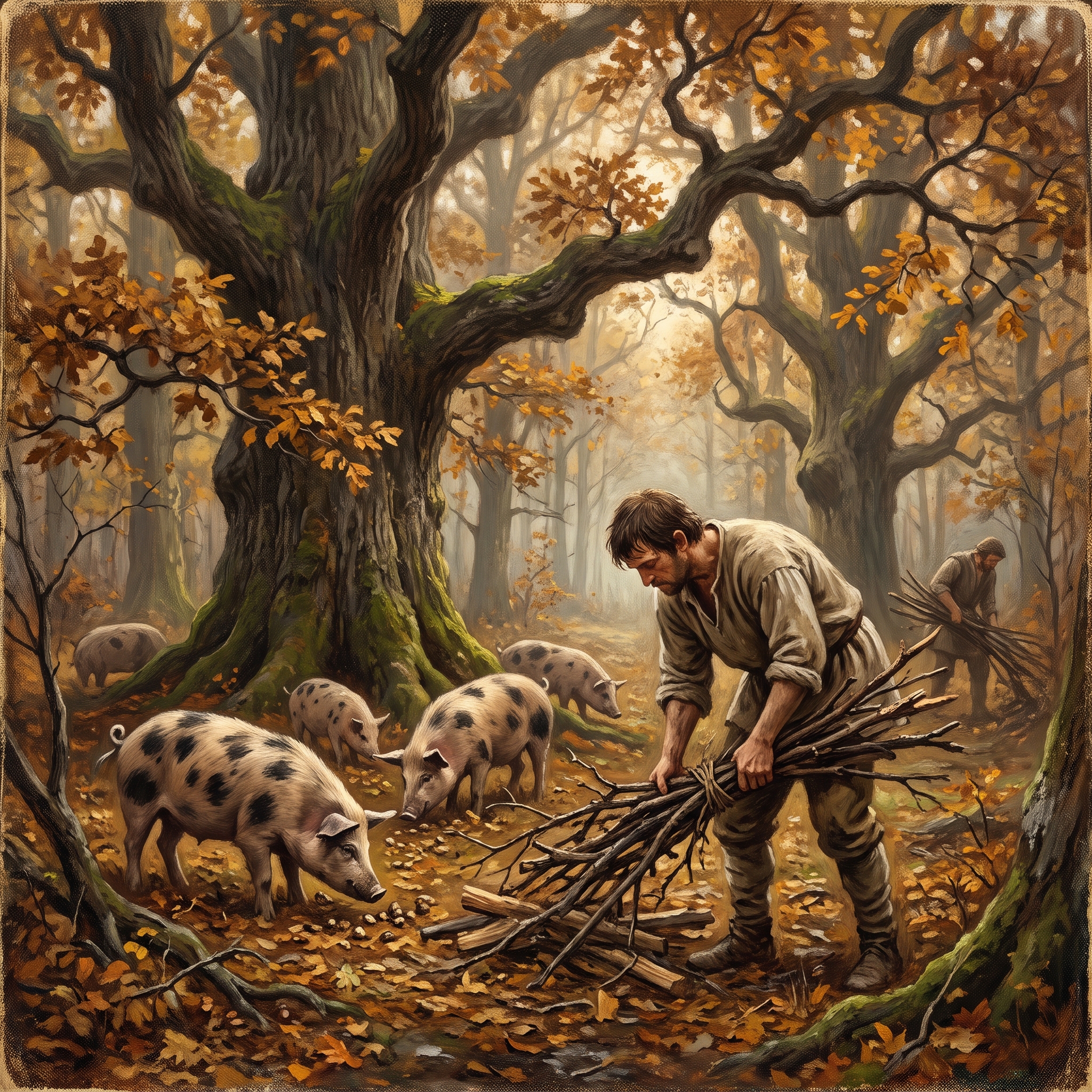
- Pannage: The right of commoners to drive their pigs into the royal oak and beech woods during autumn to feed on fallen acorns and mast, ensuring their livestock could fatten up before the winter freeze.
- Turbary: The right to cut turf and peat from communal bogs to use as winter fuel.
- Piscary: The right to catch fish in common streams and ponds to sustain household nutrition.
- Agistment: The right to graze domestic livestock—cattle, sheep, horses—on communal pastures without facing arbitrary seizure by royal bailiffs.

- The End of Official Blackmail and Dog Mutilation
Clause 7 dismantled the racket run by crown officials: foresters and beadles were explicitly prohibited from collecting compulsory levies of grain, oats, lambs, and piglets, and the predatory extortion schemes known as “scotale” were banned.
Clause 6 addressed the brutality against animals: the practice of cutting the pads off dogs’ paws was abolished. Henceforth, “expeditation” was strictly limited: only three claws on the forefoot could be trimmed, the ball of the foot was never to be touched, and inspections could only occur once every three years by sworn juries of local men, rather than roving gangs of corrupt bailiffs.
The Charter of the Forest remained in active legal effect in England for more than seven centuries—lasting all the way until the Wild Creatures and Forest Laws Act of 1971. While Magna Carta became the darling of politicians and constitutional theorists, it was the Charter of the Forest that kept the average person fed, warm, housed, and legally protected from the rapacious reach of centralized authority.
Act IV: The Medieval Lesson for the Modern Trap
Look past the archaic Latin clauses and the references to wild boars and peat bogs, and the events of November 6, 1217, reveal an unsettling, brilliant mirror for the modern world.
The central tragedy of thirteenth-century England was not that trees were being felled or that deer were being hunted. The tragedy was that a centralized, self-serving apparatus slowly, quietly, and systematically declared the basic inputs of daily survival to be its exclusive private property, and convinced the population that they had to pay rent just to exist on their own land.
Look at the architecture of your modern life. How much of your day-to-day existence is spent living inside modern “royal forests”?
You do not have to worry about King John’s bailiffs hiding in the brush to confiscate your pig. But you do live in an era where the modern equivalents of vert and venison—your attention, your time, your psychological peace, your basic physical health, and your fundamental capacity to produce value—have been systematically cordoned off, financialized, and turned into private preserves for algorithmic platforms, predatory subscriptions, and corporate gatekeepers.
Consider how the modern “Forest Law” operates:
- The Modern Assart Fine: You want to build a quiet, creative, focused life? The digital ecosystem penalizes you instantly. Every app, platform, and notification hub is engineered to charge you an attention tax. If you try to clear an hour of uninterrupted time to think, write, or build, an onslaught of pings, feeds, and artificial urgencies charges in to claim that territory back for the platform.
- The Modern Expeditation: King John’s men clipped the claws of hunting dogs so they couldn’t hunt independently. Today’s digital landscape does the exact same thing to human cognition. By outsourcing our memory to search engines, our sense of direction to navigation software, our social connections to algorithmic feeds, and our critical thinking to automated aggregators, we voluntarily allow our mental claws to be clipped. We become dependent on the very platforms that extract our data, unable to hunt, focus, or survive without their continuous interface.
- The Enclosure of the Mental Commons: Just as medieval kings declared that common grazing lands suddenly belonged to the royal treasury, modern culture has enclosed the basic commons of human well-being. Good sleep has been turned into a multi-billion-dollar optimization market. Wholesome nutrition has been replaced by ultra-processed industrial sludge and then sold back to us via expensive dietary supplements. Unstructured human friendship has been replaced by engagement loops designed to harvest ad revenue.
On November 6, 1217, William Marshal and the people of England drew a line in the mud. They did not politely request that the king be a little nicer when he rode through their fields. They audited the perimeter. They demanded the return of their commons. They established their right of Estover—the absolute right to take what was necessary for their own survival and warm their own hearths.
The outcome of that chilly November morning in Old St. Paul’s is the ultimate blueprint for modern personal sovereignty. If you feel fragmented, drained, financially squeezed, or mentally scattered, it is not because you lack “willpower” or haven’t read enough generic productivity hacks. It is because you are living inside an administrative jurisdiction designed to extract your energy, and you have not yet issued your own Charter of the Forest.
Act V: The Personal Charter of the Forest: Your Sovereignty Protocol
Most self-help advice on the internet is a form of soft compliance. It tells you to wake up at 4:30 AM so you can work harder for someone else’s system, or to download another mindfulness app to meditate away the stress caused by the five other apps stealing your sanity. That is not empowerment; that is paying the king for permission to gather a few dead twigs in his forest.
Real sovereignty requires an act of structural disafforestation. It means identifying where external systems have enclosed your life, revoking their jurisdiction, and reclaiming your foundational commons.
Here is your exact, non-conformist, practical plan to apply the lesson of November 6, 1217, to your life today:
The Core Principles of Modern Disafforestation
- Establish Your Personal Estover (The Right of Fuel): In 1217, firebote meant you had an indisputable right to wood to keep your hearth warm. In modern terms, your fuel is your non-negotiable mental energy. You must define a mandatory, inviolable daily block of time that belongs exclusively to your intellectual, physical, and creative preservation—before any employer, inbox, or social feed gets a single spark.
- End Cognitive Expeditation (Restore Your Hunting Claws): Refuse to let platforms blunt your innate human capacities. Regularly practice raw, unassisted capability: navigate a route using your eyes and memory, do complex calculations on paper, read a sixty-page physical document without checking a notification, and spend ninety minutes in a room with zero screens.
- Conduct the Boundary Regard: Every three years, the medieval regarders walked the perimeter of the forest to mark what was crown property and what belonged to the people. You must run a ruthless audit on your daily commitments, identifying where outside entities have crept over the boundary line and claimed jurisdiction over your time.
- Abolish the Modern Scotale: Cease paying voluntary taxes to social, professional, and digital obligations that offer nothing in return except social exhaustion. Cut off performative meetings, group chats that generate friction without value, and algorithmic drama designed solely to keep your pulse racing.
The Tactical 7-Day “Disafforestation” Execution Plan
This is a fast, precise, four-stage protocol engineered to systematically strip parasitic claims off your schedule, reclaim your cognitive commons, and establish your sovereign baseline.
Phase 1: The Boundary Audit (Day 1)
- The Trespass Inventory: Take a blank sheet of paper. Draw a vertical line down the middle. On the left side, list every external demand, app, recurring commitment, and subscription currently extracting your time, attention, or money. On the right side, write one word: Commons or Forest. If an item does not directly feed your health, your family, your genuine craft, or your long-term independence, mark it as Forest.
- The Instant Dissolution: Immediately disafforest at least three parasitic items. Cancel one recurring subscription you haven’t used with joy in sixty days, remove two notifications from your phone lock-screen that generate anxiety without actionable utility, and decline one optional meeting or obligation this week that drains your energy.
Phase 2: Sealing Your Firebote (Days 2 to 3)
- The Untouchable Hearth: Carve out a non-negotiable 60-minute window every single morning before checking any digital input. This hour is your firebote—wood for your own fire. Use it strictly for physical movement, deep reading, or building a high-value skill. If an email, message, or breaking news item attempts to cross the threshold during this hour, it is an illegal purpresture. Strike it down.
- The Device Quarantine: Remove all digital screens from your sleeping quarters permanently. The bedroom is your sanctuary; treating it like an open digital thoroughfare allows the modern bailiffs to harvest your attention the instant you open your eyes.
Phase 3: Restoring Your Cognitive Claws (Days 4 to 5)
- The Deep Wood Sprint: Select the single most important, complex project or problem you have been avoiding. Set a timer for 90 minutes. Disconnect your machine from the internet, silence all hardware, and work on that single problem without looking away. Experience the friction of your brain doing the heavy lifting without algorithmic assistance. That friction is your cognitive claws growing back.
- The Friction Inversion: Make low-value digital habits physically irritating to execute. Log out of social platforms every time you finish using them; store entertainment devices in closets across the room; turn your phone display to grayscale. Force the parasitic algorithms to work harder to capture your gaze than you work to ignore them.
Phase 4: Declaring the Common Ground (Days 6 to 7)
- The Wilderness Day (Pannage Protocol): Dedicate a half-day over the weekend to absolute unstructured freedom. No scheduled calls, no productivity trackers, no optimization metrics. Go for a long walk in a real physical space, cook a meal from raw ingredients, or sit with friends and family without a screen on the table. Reclaim the simple, foundational commons of human existence.
- Codify the Code: Write down your personal three rules of engagement for the next quarter (e.g., “I do not answer communications before 9:00 AM,” “I do not trade my evenings for administrative backlog,” “I guard my focus as non-negotiable territory”). Seal it.
On November 6, 1217, an old knight with the scars of a thousand battles sat in a London cathedral and proved that when a system overreaches, the solution is not to surrender, nor is it to beg for scraps. The solution is to draft a better law, push the boundaries back where they belong, and fiercely defend the ground that keeps you alive.
The forest has always belonged to the commoner. It is time to take yours back.
Share: