
On November 2, 1418, while Western Europe was busy tearing itself apart in the aftermath of the Council of Constance and the endless mud-soaked theater of the Hundred Years’ War, a baby was born in a cramped, vinegar-scented house on the Via dei Pelacani in the parish of San Vitale, Bologna. His name was Gaspare Nadi.
History books do not write epic poems about people born on the Via dei Pelacani. The street literally translated to the “Street of the Dog Skinners,” named for the local leather tanners who scraped carcasses by the canal, leaving an aroma that could peel the varnish off a cathedral door. Gaspare’s father, Filippo di Domenico, was one of those tanners—a working-class artisan scraping out an existence in an Italian city-state perpetually caught between papal ambition, aristocratic vendettas, and outbreaks of the bubonic plague.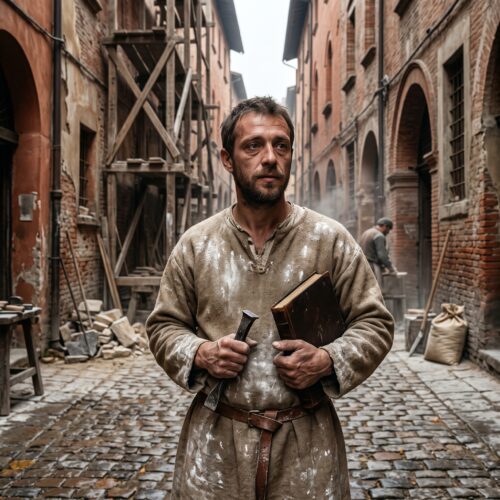
Nobody expected Gaspare Nadi to leave an indelible mark on human culture. He was not born into the Medici banking dynasty, he did not study rhetoric at the ancient University of Bologna, and he was not groomed to be a dashing prince of the Renaissance. Yet Gaspare lived eighty-five years—an outrageous, defying-the-odds lifespan for the fifteenth century—and spent more than fifty of those years diligently scribbling down the sheer, chaotic madness of his daily life.
In doing so, he created the Diario bolognese di Gaspare Nadi, one of the most astonishing, hilarious, raw, and deeply human diaries ever salvaged from the medieval dirt.
Through wars, guild strikes, collapsing bell towers, astronomical anomalies, barroom brawl reckonings, bad investments, and four marriages, Gaspare kept putting one brick on top of another—both literally with mortar and metaphorically with his quill. His life, commencing on this very day in 1418, is a masterclass in psychological resilience, practical obstinacy, and gritty, boots-on-the-ground reality.
Here is the forgotten chronicle of Bologna’s most stubborn master mason, why his legacy stands tall against history’s grand delusions, and the exact blueprint for applying his ruthless, pragmatic clarity to your own modern life.
Part I: Growing Up in the Shadow of Scaffolding and Skinned Hides
To understand Gaspare Nadi, you must first understand Bologna in the early fifteenth century. It was not a postcard of romantic Tuscan hills and leisurely glasses of Chianti. It was a turbulent, walled cauldron of factional violence, governed intermittently by the Bentivoglio family, threatened constantly by the Visconti of Milan, and harassed by papal legates who demanded tax revenues with the gentle touch of an iron mace.
Gaspare’s childhood was severed when he was barely nine years old. In 1427, his tanner father died. In medieval Italy, the death of a patriarch meant immediate, existential precarity. His mother, Chiara, did what almost every impoverished widow had to do to keep food on the wooden trestle table: she remarried swiftly, wedding a shoemaker named Giacomo Senzabarba—literally “James the Beardless”.
Gaspare was not sent to a high academy to debate Aristotle. He was apprenticed out to trade guilds. He learned the physics of lime mortar, the chemistry of river sand, the temper of chisel iron, and the treacherous balance of standing on wooden poles forty cubits in the air. He did not become a lofty “architect” in the modern sense—the Renaissance had not yet invented the ivory-tower designer who sits in an air-conditioned room sipping espresso while sketching geometric fantasies. Gaspare was a capomastro, a master builder who got gravel beneath his fingernails, negotiated with recalcitrant lime-haulers, and personally climbed into the arches to test whether the stones would hold.
By the late 1430s and 1440s, young Gaspare had taken his trowel on the road, traveling to Tuscany, working in Prato, and learning the cut of Italian stone. It was during this journeyman period that Gaspare’s fire flared up. In the records of Prato around 1450, we learn of an incident that belongs in a Scorsese film: someone insulted Gaspare’s deceased father, and Gaspare, honoring the code of the artisans, settled the dispute with bare fists in the piazza, defending the memory of a tanner from Bologna.
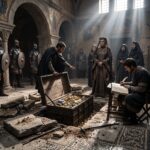
Shortly thereafter, his mother died. Gaspare buried her, returned to his home soil in Bologna, entered the Company of Masons (Compagnia dei Moraduri), and in 1452, bought a bound book of rag-paper sheets.
He began his diary.
Part II: The Diary That Cut Through the Noise
Most writings that survive from the fifteenth century are either ecclesiastical hagiographies (monks writing about how holy their abbot was) or courtly propaganda (scribes being paid bags of florins to convince the populace that the local Duke was a descendant of Hercules).
Gaspare Nadi did not care about heroic mythmaking. He had to account for sacks of lime, deal with dishonest brick suppliers, and keep track of who owed him twelve silver soldi.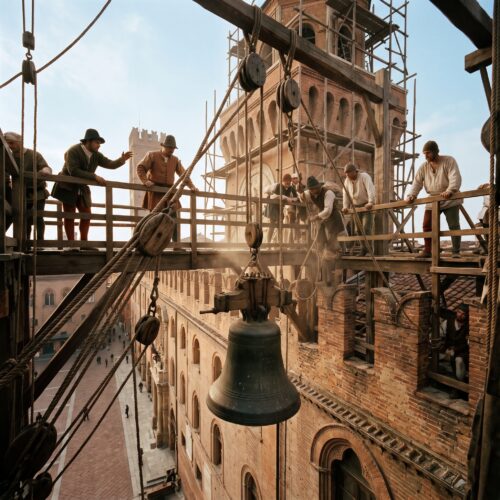
His Diario began as an account ledger—a libro di ricordanze—but it rapidly metastasized into a fifty-year, high-definition panoramic snapshot of fifteenth-century existence. Gaspare recorded everything with the unflinching eye of a man who measured his world with a plumb line:
- The Weather and Crops: When a late frost murdered the vineyards in the hills, Gaspare noted the price jump of sour wine down to the copper coin.
- The Political Terror: When rival clans massacred each other in the streets, Gaspare did not write high-minded treatises on civic humanism. He wrote down who got stabbed outside the butcher shop, how many men came armed to the town square, and whether the city gate was locked before he could get his cart of sand inside.
- The Celestial Signs: When a blazing comet cut through the November sky, while churchmen cried out that the apocalypse was scheduled for next Thursday, Gaspare described the shape of the tail, noted the date, wondered if it meant grain would get expensive, and went back to checking the alignment of a church pillar.
- The Domestic Reality: Gaspare was married four times. His journals lay bare the brutal mortality rates of his era. His first wife bore him multiple children and suffered excruciating miscarriages before succumbing to illness in 1462. Gaspare felt grief, but life did not pause for mourning; a craftsman with children had to maintain an operational household, which meant finding another partner, balancing dowries, and keeping the family afloat amid constant disease. His third marriage, to a woman named Caterina, turned out to be an absolute disaster of mutual spite, leading to bitter domestic friction that prompted him to pack his belongings and move in with his adult son Giovanni. Gaspare recorded the heartbreak, the rage, and the domestic squabbles with the exact same objective cadence he used for a flawed foundation arch.
Part III: Hanging the Bell of the Republic
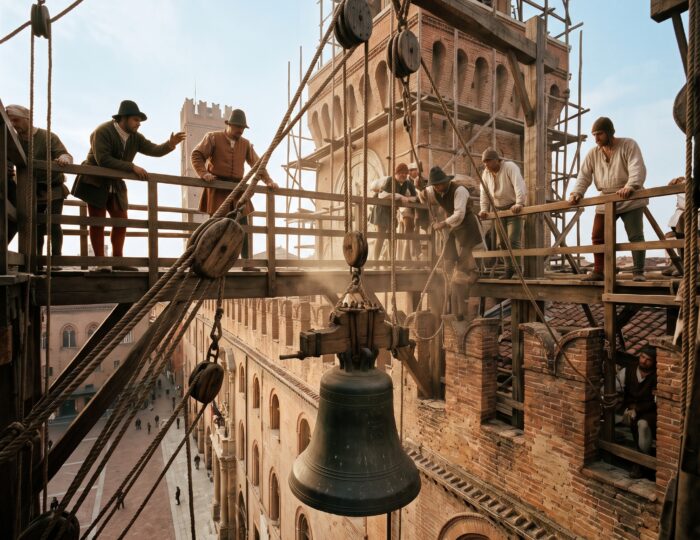
Gaspare’s crowning engineering triumph arrived in the heart of Bologna: the Palazzo d’Accursio (also known as the Palazzo del Comune), the massive seat of municipal power presiding over the Piazza Maggiore.
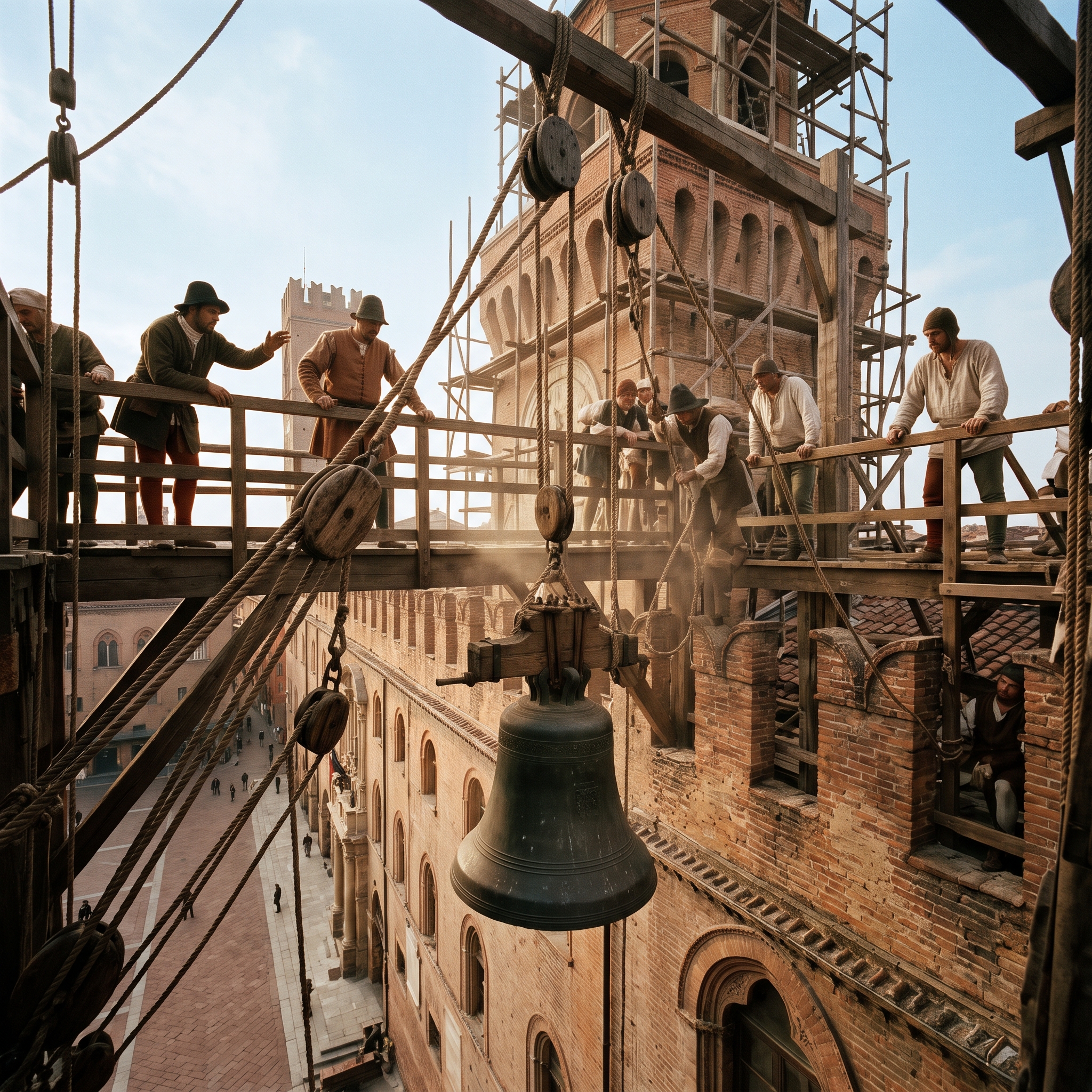
The city decided it needed a monumental clock tower—the Torre d’Accursio—and a civic bell large enough to ring through the foggy Po Valley, summoning the populace for assemblies or warning them of approaching armies. The architect Fioravante Fioravanti drew up the conceptual outlines, but the terrifying physical task of executing the works and mounting the massive bronze bell fell upon the sturdy shoulders of Gaspare Nadi.
Hoisting thousands of pounds of resonant bronze eighty feet into the air using hemp ropes, wooden capstans, and human sweat is an endeavor where a single mathematical miscalculation or frayed fiber results in crushed limbs, splintered masonry, and public execution by embarrassment.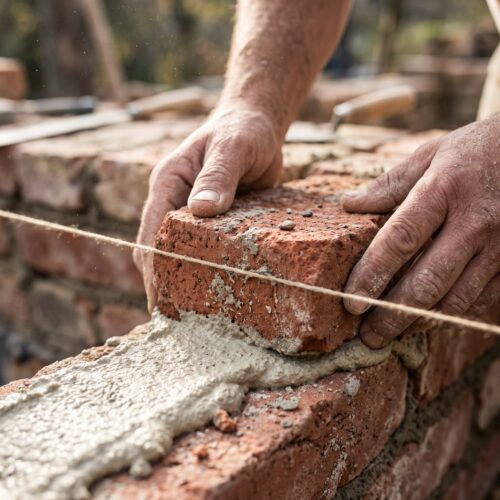
Gaspare didn’t just hang the bell; he anchored it into the very bones of the palazzo. He served as the manager (massaro) of the masons’ guild multiple times, and was elected as its auditor (revisore) and syndic (sindaco). The people trusted him because he had a simple, incorruptible virtue: his walls didn’t fall down.
He went on to construct the library of the magnificent Basilica of San Domenico and worked on the historic San Michele in Bosco complex and the Church of San Salvatore. When an earthquake rattled northern Italy, shaking the famous leaning towers of Bologna (the Asinelli and the Garisenda), Gaspare inspected the cracks, logged the tremor in his diary, calculated the structural shear, and repaired the masonry.
He died on January 9, 1504, at the age of eighty-five. In an era where living past forty was a gamble and living to sixty was considered biblically ancient, Gaspare had outlived popes, tyrants, kings, and rivals. When his casket was carried to the parish church of San Vitale—a short walk from where the dog skinners had worked eighty-five years prior—the entire Company of Masons marched beside him, burying him, in the words of a contemporary diarist, con grande onore de la conpagnia di moraduri (“with great honor of the company of masons”).
Part IV: The Illusion of the Dramatic Leap
Why does this specific historical birthday matter to you right now?
We live in a culture poisoned by the mythology of the sudden, theatrical breakthrough. Every self-help guru, productivity influencer, and modern corporate manifesto sells the same underlying narcotic: the idea that your life will be fixed by a single seismic event. They tell you to quit your job overnight, manifest a millionaire mindset in ten minutes, adopt an extreme 4:00 AM ice-bath regime, or consume five bullet-pointed platitudes that will instantly shatter all your internal resistance.
Gaspare Nadi represents the exact, triumphant antidote to this fantasy.
Gaspare did not survive the Renaissance because he had a visionary podcast. He survived because he understood the physical law of masonry: a cathedral is nothing more than thousands of heavy, dirty, unremarkable stones laid in plumb alignment, one after another, held together by mortar that takes days to dry.
When modern people face chaos—market shifts, career disruptions, relationship fractures, financial anxiety—they tend to freeze, waiting for an epiphany or an escape hatch. When Gaspare faced chaos—literal plague at his doorway, political assassinations in his piazza, domestic turbulence at his dinner table—he recorded the facts in ink, picked up his trowel, checked his plumb line, and laid the next brick.
The outcome of his historical existence is proof of a forgotten truth: Objective reality always outlasts emotional turbulence. If you want to build an enduring life, you must stop operating like a dramatic actor playing a role and start operating like a fifteenth-century master mason.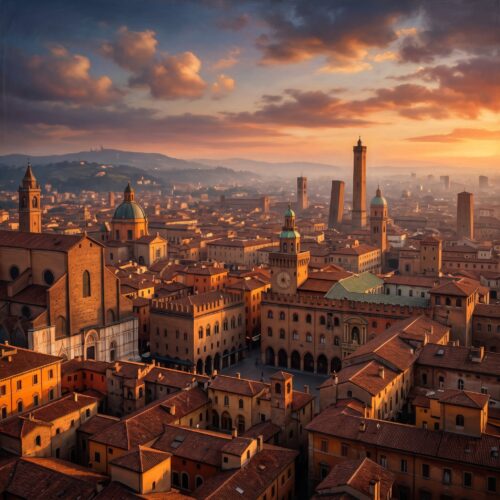
Part V: The Mason’s Blueprint: Tactical Tenets for Everyday Resilience
To extract Gaspare’s hard-won wisdom from the dust of 1418 and use it to solve modern paralysis, you must discard traditional self-help advice and apply these concrete principles:
- Treat Emotion as Weather, Not Architecture: When rain fell on Bologna, Gaspare did not hold a philosophical debate about whether the rain was fair; he covered the wet lime and waited for the clouds to break. Your anxiety, self-doubt, and fear are purely atmospheric conditions passing over your project. They are not structural load-bearing walls. Acknowledge them, write them down objectively, and keep building.
- The Ledger Principle of Self-Evaluation: Stop evaluating your self-worth based on vague feelings of inadequacy or grand fantasies of future greatness. Keep an objective tally. What went into the ground today? How many pages were written? How many miles were walked? How many dollars were saved? Numbers and facts are immune to self-deception.
- Reject Ornamental Expertise: Gaspare was surrounded by courtiers who could quote Ovid in Latin but couldn’t keep a cellar from flooding. In the modern knowledge economy, the world is inundated with people who can theorize brilliantly about work without producing anything durable. Value the execution of the craft above the social performance of the craft.
- Honor the Plumb Line: A plumb line is a simple weight on a string. It relies on universal gravity to show what is truly vertical. You must possess non-negotiable operational principles that do not shift based on mood, trends, or peer pressure. If an action does not align with your true plumb line, tear it down before the wall gets higher.
- Embrace the Unfinished Chapter: Gaspare lived through failed contracts, family tragedies, and horrible marriages. He never expected life to be a tidy, unbroken arc of triumph. He understood that every great build includes batches of bad clay and days lost to winter storms. Longevity is the only victory that truly counts.
Part VI: The Anti-Self-Help Execution Plan: The 48-Hour Masonry Protocol
Most productivity systems fail because they require elaborate setup rituals, color-coded apps, and emotional inspiration. The following plan is deliberately mechanical, completely devoid of positive-thinking clichés, and designed for immediate execution starting today.
Stage 1: The Mortar Triage (Time required: 15 minutes)
Sit down with a plain sheet of paper and an ordinary pen. Write down the single biggest professional or personal problem currently causing you friction.
Now, divide it ruthlessly into two columns:
- The Dead Lime: Factors you cannot alter today (macroeconomic trends, other people’s temperaments, past decisions, company restructurings).
- The Cut Stone: Physical actions entirely within your tactile control during the next 8 hours (writing an email, clearing a desk, balancing an account, walking 5,000 steps).
Draw a single thick black line through everything in the first column. Never devote a single second of mental runtime to it for the rest of the day.
Stage 2: The Plumb-Line Audit (Time required: 10 minutes)
Identify the one metric that defines genuine progress in your current pursuit. Cut out all secondary “performative” work (organizing your desktop files, tweaking color themes, reading five more articles about how to start).
- If you are writing, the plumb line is word count.
- If you are launching a business, the plumb line is customer conversations.
- If you are fixing your finances, the plumb line is the net difference between income and outgoings.
Calibrate your next three hours entirely around that single plumb line.
Stage 3: The 50-Minute Mason Block (Time required: 50 minutes)
Work with the focused isolation of an artisan carving a corner joint:
- Place your phone in another room.
- Set a timer for 50 minutes.
- Work on your plumb-line task without pausing to check email, research tangential topics, or seek validation.
- When the timer rings, stop immediately.
Stage 4: The Gaspare Ledger Entry (Time required: 5 minutes)
At the end of your day, open a blank notebook or text file. Do not write a gratitude essay or an emotional vent. Write three dry, factual sentences in the style of Gaspare Nadi:
- What was built today (exact numbers and completed deliverables).
- What weather or friction occurred (the objective obstacle encountered, without complaining).
- The single primary stone scheduled to be laid tomorrow morning.
The Lasting Bell
When Gaspare Nadi was laid into the stones of San Vitale in 1404, the world had changed around him. Gutenberg had invented the printing press, Columbus had sailed across the Atlantic, and the high Renaissance was blooming across Italy.
Gaspare didn’t build the Sistine Chapel, nor did he write the Divine Comedy. But if you stand in Bologna’s Piazza Maggiore today, the bells of the Palazzo still ring out over the ancient brick roofs. The arches he buttressed still support weight. And the battered rag-paper pages he wrote in the flickering candlelight of a fifteenth-century workshop continue to remind us that human greatness is not an explosive flash of luck, but the relentless, unglamorous dignity of showing up to the worksite every single day.
Put on your work clothes. Clear the dust from the mortar board. Check your plumb line.
Lay your next stone.
Share: