
On the crisp, salt-scoured morning of Monday, October 30, 1340, four rulers stood at the southernmost hem of Western Europe, staring across a shallow, brackish ribbon of water known as the Salado River.
To look at the map of Andalusia near Tarifa, you would never guess that a trickling creek could serve as the headstone for an entire geopolitical epoch. The Salado is not the Danube, nor is it the Rhine. On an ordinary summer afternoon, a thirsty mule could cross it without wetting its belly. But on that final Monday of October, the stream bed was swelled by autumn rains and surrounded by over eighty thousand armed men locked in an existential vice.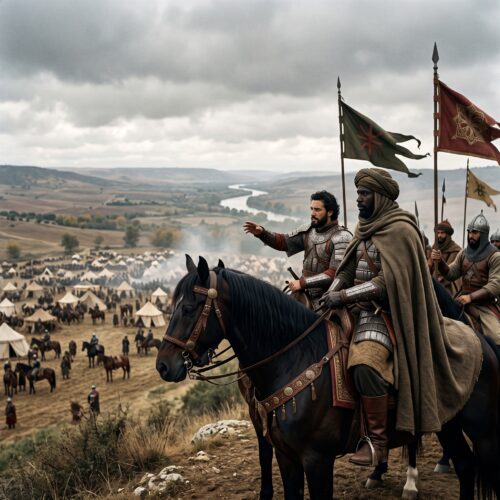
On the southern ridge stood Sultan Abu al-Hasan Ali of the Marinid dynasty of Morocco, alongside Sultan Yusuf I of Granada. Abu al-Hasan, often called the “Black Sultan” in North African chronicles, had not crossed the Mediterranean merely to conduct a border raid or collect tribute. He brought the entire logistical weight of the Maghreb with him: thousands of seasoned Berber horsemen, Turkish mercenary archers, camel supply trains, and an artillery corps packing early gunpowder siege engines designed to smash the stone castle of Tarifa into powdered gravel.
Abu al-Hasan’s grand strategic goal was unambiguous: roll the calendar back a hundred years. He intended to reverse the territorial conquests of the Reconquista, push Christian hegemony back behind the Sierra Morena, and re-establish a permanent, fortified North African bridgehead on European soil.
Facing him from the northern bluffs were King Alfonso XI of Castile and his estranged father-in-law, King Afonso IV of Portugal. Just months earlier, Alfonso XI had found himself in a tactical nightmare that would induce cardiac arrest in any modern crisis manager: his entire Atlantic fleet had been annihilated in the Strait of Gibraltar by the Marinid navy, leaving him with an empty treasury, severed supply lines, and an allied Portuguese crown that had spent the preceding five years actively waging war against him over broken marriage agreements.
Yet by noon on October 30, three hours of concentrated violence altered Mediterranean trade, destroyed the Marinid amphibious capacity permanently, and ensured that no Islamic military expedition from North Africa would ever cross into Europe again.
History books tend to reduce battles like Río Salado to tidy textbook footnotes, but zoom into the muddy realities of that morning, and you find a masterclass in how human beings behave when every metric says they should pack up and surrender.
The Strait Strangled: How Castile Ended Up Backed Against the Water
To understand why the ground at Tarifa mattered on October 30, you have to rewind to the spring of 1340.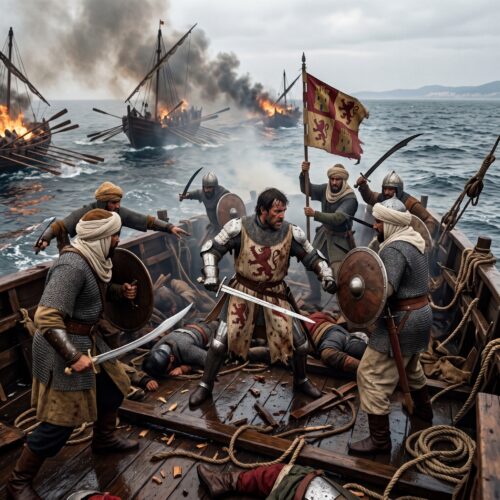
Tarifa was the cork in the Mediterranean bottle. Situated on the southernmost point of the Iberian peninsula, its fortress watched directly over the narrowest shipping channels between Africa and Europe. If Castile held Tarifa, North African armies had to negotiate treacherous open-sea landings under naval harassment. If the Marinids held Tarifa, the strait was transformed into a domestic highway, allowing troops, siege weapons, and gold to flow seamlessly across the water.
Abu al-Hasan knew this. He assembled a fleet of over sixty galleys and galleasses, manned by sailors from Ceuta, Tangier, and Algiers. In April 1340, Castilian Admiral Alfonso Jofre Tenorio took his royal fleet out to challenge the crossing. The resulting engagement off Algeciras was a catastrophic slaughter: the Castilian fleet was scattered and burnt, and Tenorio’s flagship was boarded. Rather than surrender his banner, the admiral fought to the deck boards until he was cut down and beheaded.
With the Castilian navy effectively reduced to driftwood, Abu al-Hasan walked his invasion force across the water unchallenged. In August, he linked up with Yusuf I of Granada and encircled Tarifa with a double ring of fortified trenches, siege mounds, and trebuchets. Inside the castle walls, Castilian garrison commander Juan Martínez de Leiva was rationing mule hide, salted lard, and ditch water.
Alfonso XI of Castile was twenty-nine years old. He was notoriously hot-headed, possessed an obsession with tournament chivalry, and had spent his youth putting down rebellions among his own treacherous grandees. When news arrived that Tarifa was eating its cavalry mounts to survive, Alfonso knew that losing the fortress meant losing control of Andalusia entirely.
There was only one problem: Alfonso lacked an army large enough to challenge the combined Marinid-Nasrid host, and his naval coffers were bone-dry.
So, he did what modern strategists hate doing: he ate absolute humble pie. He sent an embassy to his father-in-law, Afonso IV of Portugal, the very man whose daughter, Maria of Portugal, Alfonso XI had publicly humiliated by openly shacking up with his mistress, Leonor de Guzmán. Afonso IV despised Alfonso XI on an intensely personal, domestic level. But the Portuguese king possessed something far more dangerous than wounded family pride: strategic foresight. He recognized that if Abu al-Hasan broke Castile at Tarifa, the Portuguese border at the Guadiana River was next on the menu.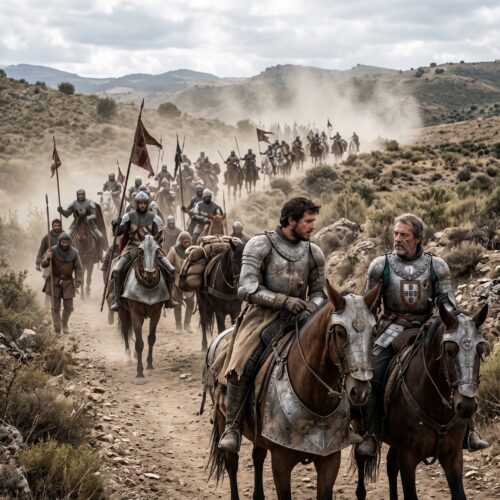
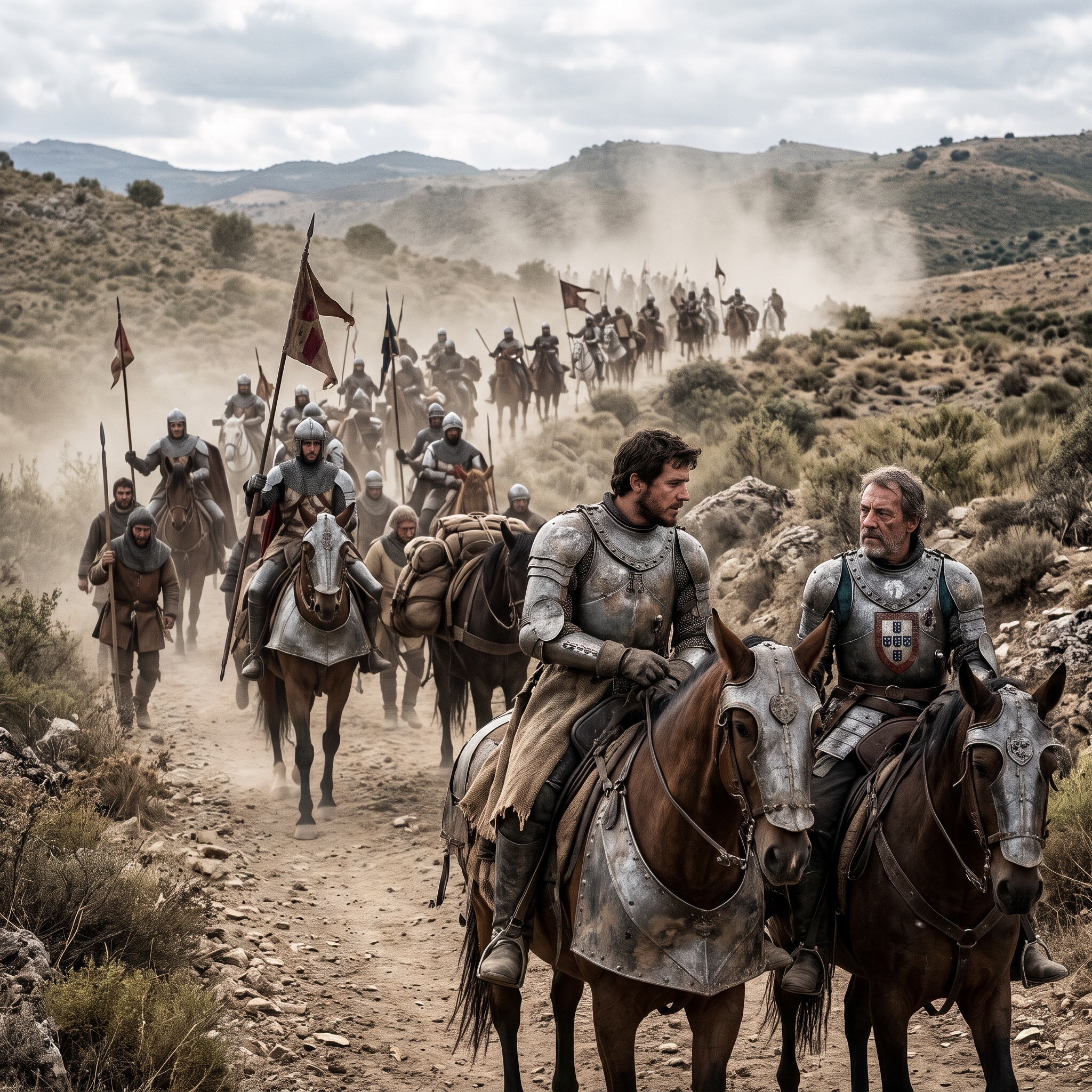
Afonso IV swallowed his rage, mustered a thousand elite heavy lances, and rode south to merge his standard with the Castilians. Together with allied Genoese galleys hired on credit to disrupt the coastal supply lines, the combined Christian army began their forced march through the rugged Andalusian hills toward Tarifa in late October.
The Chessboard on the Salado
When the Christian coalition crested the hills overlooking Tarifa on October 29, the view was disheartening.
Abu al-Hasan’s camp spread out across the rolling plains like a sprawling tent city. The Marinid host numbered around sixty thousand troops, backed by roughly seven thousand Granadan elite cavalry under Yusuf I. The Christian allies had managed to assemble around twenty thousand infantry and roughly eight to nine thousand mounted knights. Outnumbered nearly three to one, the Christians were also staring down a brutal operational constraint: their baggage train was completely exhausted, local wells had been salted or fouled, and there was zero forage for thirty thousand horses.
Alfonso XI could not afford a siege, a blockade, or a delay. If he did not fight immediately, his army would dissolve from dehydration and desertion within forty-eight hours.
Abu al-Hasan knew this. He had established his primary command post on high ground behind the Salado River, while Yusuf I took the Granadan wing on the left flank. His plan was straightforward: wait for the thirsty Christians to plunge into the marshy riverbed, catch them broken in the silt, and sweep both flanks with light Berber cavalry.
It was during the dead silence of the night between October 29 and October 30 that Alfonso XI pulled the trigger on a gambit that textbook generals would have labeled suicidal.
Rather than conserving every man for the frontal assault across the river, Alfonso detached a strike force of one thousand heavy cavalry and four thousand infantry under the command of Juan Martínez de Leyva and Alvar Pérez de Guzmán. Under cover of pitch darkness, this division was ordered to sneak around the Marinid pickets, bypass the entire enemy army, and slip inside the besieged fortress of Tarifa before morning.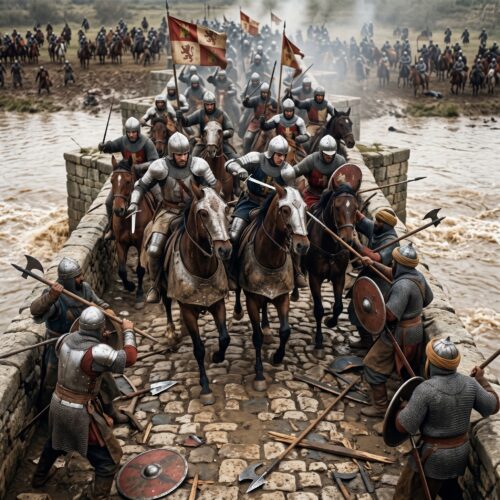
If the Marinid scouts detected them in transit, five thousand of Castile’s best fighting men would be trapped in the open against the sea and massacred. Even if they made it into the fortress, it meant Alfonso would be facing the main Marinid army across the river with five thousand fewer soldiers in his main battle line.
The Marinid sentries that night were complacent, distracted by their anticipation of a dawn battle across the riverbank. Moving along the tide line through the ocean foam, Guzmán’s men slipped unseen into the back gates of Tarifa. The cork was back in the bottle, and inside the fortress sat a fresh, rested strike force primed to hit the rear of the Moroccan lines the moment the main battle commenced.
Blood and Silt: The Three-Hour Rupture
At nine o’clock in the morning on October 30, the Christian battle horns sounded along the ridge.
The tactical deployment was clean: Afonso IV of Portugal, backed by Castilian reinforcements, turned left to face Yusuf I’s Granadan army. Alfonso XI of Castile took the center and right to throw himself directly at Abu al-Hasan’s Moroccan formations.
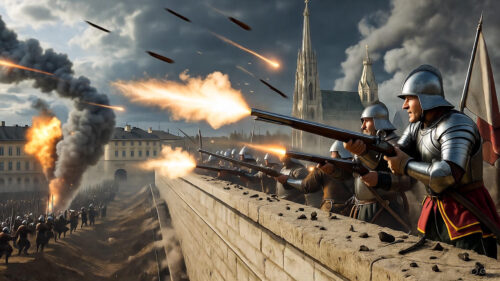
The initial clash was a disaster for the Castilian vanguard. Led by the Lara brothers, the front ranks charged down the steep slope and hit the Salado River. The water was chest-deep in places, the current was thick with autumn mud, and the opposing bank was a solid wall of Berber shields and archery fire. The vanguard stalled in the center, churning the water into pink foam as horses foundered and heavy armor dragged dismounted men beneath the surface.
Seeing the vanguard collapsing in the riverbed, Alfonso XI’s young sons, Fernando and Fadrique, spotted a narrow, stone-paved pack bridge a few hundred yards to their right. The bridge was held by two thousand five hundred Marinid cavalry. Without waiting for direct royal orders, the young princes wheeled eight hundred knights, formed an iron wedge, and hammered directly across the crossing.
The violence at the bridgehead was close and ugly. Alfonso saw the breach opening and poured fifteen hundred additional knights into the gap. The Marinid defense snapped at the perimeter; the bridge was cleared, and the Castilian center began funneling across the dry bank, reforming their ranks before Abu al-Hasan’s main cavalry reserves could wheel into position.
While the two main battle lines collided with earth-shaking kinetic force in the valley, the secret gambit from the night before bore its fruit.
The garrison gates of Tarifa swung wide. The five thousand men who had slipped in during the night, joined by the starved, vengeful defenders of the castle, charged straight out of the fortress and drove directly into the soft underbelly of Abu al-Hasan’s royal encampment.
In medieval warfare, an army’s encampment was not just a place where soldiers slept; it held the supply train, the pay chests, the royal family, the horse corrals, and the commanders’ retreat paths. When the Tarifa garrison burst through the tent lines, panic swept through the Marinid rear like a brush fire. Word spread to the front lines that the Sultan’s camp had fallen.
Across the field, Afonso IV’s Portuguese heavy cavalry smashed into Yusuf I’s Granadans. Yusuf’s men, seeing smoke pouring from the Moroccan encampment and realizing their rear was compromised, lost cohesion. The Granadan lines buckled, broke, and scattered along the road toward Algeciras.
Abu al-Hasan fought in the thick of the fray, swinging his scimitar from horseback until his personal bodyguard was almost entirely cut down around him. Recognizing that his army was disintegrating into a routed mob, the Sultan abandoned his pavilion, spurred his horse toward the coast, and fled for Algeciras, boarding a light galley back to Ceuta with barely a fraction of his household intact.
By noon—a mere three hours after the first horn blew—the Battle of Río Salado was completely over.
The casualty figures reported in medieval chronicles (some claiming hundreds of thousands) are typical chivalric exaggerations, but modern battlefield archaeology confirms the strategic reality: the Marinid army ceased to exist as an operational fighting force. Abu al-Hasan’s treasury, his royal archives, and even his wives and sisters were captured in the camp.
More importantly, the psychological illusion of North African military invulnerability was cracked beyond repair. Never again in world history did an army cross the Strait of Gibraltar to mount an offensive conquest of the European mainland. The entire geopolitical balance of the western Mediterranean swung definitively northward, paving the way for the maritime dominance that would eventually send European ships across the Atlantic.
The Anatomy of the 1340 Maneuver
When you look closely at what happened at the Salado River, you see that Alfonso XI did not win because he possessed superior strength, unlimited time, or a clean operational environment. He possessed none of those things. He won because he operated under three strict principles:
- Strategic Humility Over Personal Ego: Alfonso recognized that fighting a three-front problem alone to preserve his pride was a fast track to ruin. He brought in the one ally he had every reason to avoid speaking to, solely because their macro survival depended on joint execution.
- Pre-Planted Leverage: He did not rely exclusively on the head-to-head collision. By covertly slipping the Tarifa garrison five thousand men before the sun came up, he built an asymmetrical trigger that paid off the moment the front line stalled.
- Decisive Compression: Staring at an impossible water bottleneck with dwindling supplies, he refused to enter a protracted, agonizing delay. He created a forced conclusion inside a three-hour operational window.

Most modern personal or career failures do not occur because people lack talent, effort, or decent ideas. They happen because individuals get trapped in prolonged, slow-drip bottlenecks where they spend months or years “managing” an impossible situation rather than dismantling it with asymmetric leverage.
The Salado Asymmetry Plan: How to Break a Modern Stranglehold
Modern self-help culture loves to preach vague notions: “visualize success,” “manifest abundance,” or “wake up at 4:30 AM to journal about your dreams.” None of that saves you when your Atlantic fleet has been sunk, your treasury is empty, and your problems outnumber you three to one on the other side of a muddy river.
The Salado Asymmetry Plan is designed specifically for when you are stalled, hemmed in, or operating against overwhelming odds. It is a rapid, non-traditional protocol built to break deadlocks by creating secondary levers rather than bashing your head against the main resistance wall.
- Execute the “Unholy Alliance” Inventory: Identify the single individual, tool, competitor, or department you have been stubbornly avoiding because of minor personal friction or territorial pride. If partnering, integrating, or reconciling with them creates an immediate 30% jump in operational leverage, swallow your pride, draft a clear boundary agreement, and close the partnership within seventy-two hours.
- Plant the Midnight Infiltration Asset: Never tackle your primary bottleneck through direct, head-on force alone. While your primary project or career effort grinds in the foreground, quietly position an asymmetrical asset in the background that does not rely on the main system’s gatekeepers. This means securing an off-market contract, building an unannounced direct-to-client pipeline, or acquiring a proprietary credential that bypasses the conventional screening funnel entirely.
- Hunt for the Flank Bridgehead: When the central route stalls—whether it is a clogged corporate promotion ladder, a saturated marketing platform, or an intractable legal squabble—stop pouring energy into the middle. Actively scout the periphery for the unmonitored narrow crossing: an obscure regulatory niche, an overlooked distribution angle, or a specialized technical application that sidesteps the main defensive line.
- Compress the Engagement Window: Dragging out a losing or stalled battle drains morale, reserves, and attention. Impose a strict seventy-two-hour operational boundary on your current impasse. Force a definitive decision, launch the MVP, or initiate the decisive negotiation. If it does not yield ground inside the compressed window, pull back and redirect resources rather than bleeding slowly over twelve months.
- Target the Enemy Camp, Not the Phalanx: Stop spending your daily bandwidth arguing with frontline symptoms (interminable email threads, petty micromanagement, minor system bugs). Aim directly at the root structural lever—the supply train. If you resolve the underlying resource flow, funding mechanism, or executive incentive, the front-line resistance dissolves on its own.
When you find yourself staring at an impossible situation where the math looks terrible and the resources look thin, remember that October morning on the Salado. History belongs to the leaders who refuse to fight on the enemy’s terms, slip their assets into place while everyone else is asleep, and turn what looked like a defeat into a permanent victory.
To see a detailed tactical breakdown of the troop movements, troop concentrations, and terrain shifts during the engagement, you can explore the Battle of Rio Salado Documentary. This video provides an animated bird’s-eye view of how the Castilian and Portuguese forces managed the river crossings and executed the flank maneuver against the Marinid camp.
Share: