
On the afternoon of Saturday, 7 October 1780, the rain finally quit over a wooded spur on the border of the two Carolinas. The place was not a mountain in any honest sense of the word. It was a rocky, oak-covered ridge shaped, if you squint at a map, like a footprint, with the high heel to the northeast and a broader toe running southwest. The crest sat only about sixty feet above the surrounding woods. A man on a horse could ride the length of the camp in a few minutes. Fallen timber and laurel made the slopes awkward, not impossible. Major Patrick Ferguson of the 71st Regiment, the only British regular on the field that day, had put roughly eleven hundred Loyalist militia on that crest and decided it was enough.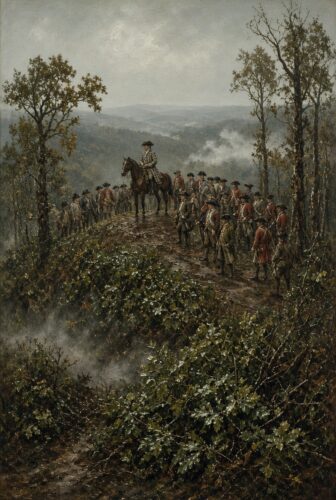
He is reported to have said he was king of that mountain, and that God Almighty could not drive him from it. By a little after four in the afternoon he was dead, shot from the saddle, and almost his entire command was killed, wounded, or taken. The fight lasted about sixty-five minutes. Thomas Jefferson later called it the turn of the tide of success. Lord Cornwallis, camped a day’s march away at Charlotte with the main British army in the South, abandoned his push into North Carolina and fell back toward South Carolina. A hill that looked like a fortress had functioned as a pen.
That is the event. The rest of this is how a boast, a whistle, a night ride, and a refusal to dig turned one wet October hour into the worst afternoon of the British southern campaign.
## The South had already been knocked flat
To understand why a militia fight on a scrub ridge mattered, you have to stand in the wreckage of the previous five months.
On 12 May 1780, after a siege of about six weeks, Charleston surrendered. It was the largest American capitulation of the war. Benjamin Lincoln gave up the city, the garrison, and a mountain of stores. The British under Sir Henry Clinton, and then under Charles, Earl Cornwallis, now held the great port of the lower South and believed the Carolinas could be peeled away from the rebellion the way Georgia already had been. Clinton sailed north. Cornwallis stayed, with a strategy that depended less on redcoat bayonets than on Loyalists. Arm the king’s friends in the backcountry. Let them hold the villages. March the regulars as a hammer behind them.
It did not go as drawn.
On 29 May, at Waxhaws, a force under Lieutenant Colonel Banastre Tarleton caught Abraham Buford’s Virginians on the march. What followed is still argued. Patriot memory called it a massacre: men cut down while asking quarter, the phrase “Tarleton’s quarter” entering the vocabulary of the backcountry as a promise that surrender would not be honored. British accounts disputed the scale and the intent. The political result did not depend on the dispute. In the cabins west of the Catawba, Waxhaws became a story fathers told sons. Quarter was a rumor. The king’s light troops killed men on the ground.
On 16 August, at Camden, Cornwallis destroyed the southern American army under Horatio Gates. Gates had arrived with militia and a thin spine of Continentals, misjudged his enemy, and watched his left collapse. He rode north so fast that the joke wrote itself. The organized Patriot field force in the Deep South ceased to exist in an afternoon. Francis Marion was still out in the swamps. Thomas Sumter was still raiding. Nathanael Greene had not yet been sent south to replace Gates. On paper, in London and in Charleston, the rebellion in the Carolinas was finished.
Into that vacuum Cornwallis sent Patrick Ferguson.
## The officer with the dead arm and the invention
Ferguson was thirty-six, Scottish, ambitious, and unlike most of the men he would fight, a professional. He had served in Germany during the Seven Years’ War as a teenager. He was a student of light infantry, of marksmanship, of the ugly small war of posts and partisans. In 1776 he had patented a breech-loading rifle that could be fired and reloaded lying down, a genuine mechanical leap past the muzzle-loader. A few of the guns were made. The Ordnance Board was not interested in retooling a war around a captain’s clever lock. The Ferguson rifle remained a curiosity with a short combat life. The man did not.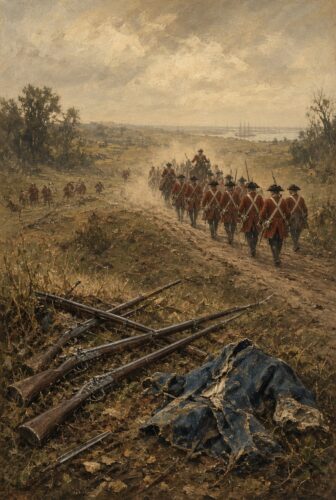
At Brandywine, on 11 September 1777, a ball shattered his right elbow. The arm never worked properly again. He taught himself to write, fence, and command with the other hand. A story followed him out of that battle, repeated often enough to become part of his legend and impossible, at this distance, to prove: that he had a conspicuous American officer in his sights in the woods near the Birmingham meetinghouse, recognized the quality of the man, and refused the shot. Later he is supposed to have decided the officer was Washington. True or embroidered, it fit the character his friends described. He was brave to the point of theater. He liked to be seen.
Cornwallis gave him the left, the western screen. Recruit Loyalists. Train them. Cover the flank while the main army lived off the Carolina piedmont and waited for the backcountry to declare itself for the king. Ferguson did the work. He was good at it. By early September 1780 he had a little army of North and South Carolina Loyalists, with a stiffening of about a hundred Provincial troops in red coats recruited from northern colonies, American Volunteers who had chosen the Crown and knew how to use a bayonet. He drilled them. He moved them. He wrote proclamations in the voice of a man who expected obedience.
From a camp at Gilbert Town, in Rutherford County, North Carolina, he sent word across the mountains.
## The message that recruited his enemy
The settlements on the Holston, the Watauga, and the Nolichucky were only a few years old. They sat beyond the Proclamation Line of 1763, on land the Crown had reserved, in theory, to the Cherokee and other nations, and which settlers had taken anyway. The men there were Virginians and North Carolinians who had walked west, fought the Cherokee in 1776, and built stations of logs and corn. They were not Continental regulars. Many of them had never seen a red coat. They hunted with long rifles, rode rough horses, and settled arguments with the same tools.
Ferguson’s message, as the mountain men remembered it, was not a negotiation. He required them to lay down opposition to British arms. If they refused, he would march over the mountains, hang their leaders, and lay their country waste with fire and sword. A later proclamation, issued around 1 October as he began to worry, was cruder. He called on the piedmont militia to join him, lest they be, in his phrase, pissed upon by a set of mongrels. He meant the overmountain men. He had just described them, in writing, as animals.
Threats of that kind work on people who are calculating whether resistance is worth the barn. They work badly on people who have already decided the barn is the whole point. Isaac Shelby, a militia colonel who had fought Ferguson’s men at Musgrove’s Mill in August and then ridden hard for the mountains, carried the insult home. John Sevier, the best-known leader on the Watauga, heard it. William Campbell, a towering Virginia backcountry colonel, heard it. Benjamin Cleveland, a man whose size and temper were both local legends, heard it. The message did the recruiting Ferguson had intended to do for himself, except it recruited the other side.
They set a muster for 25 September at Sycamore Shoals on the Watauga, near what is now Elizabethton, Tennessee.
## The shoals, the parson, and the leaving
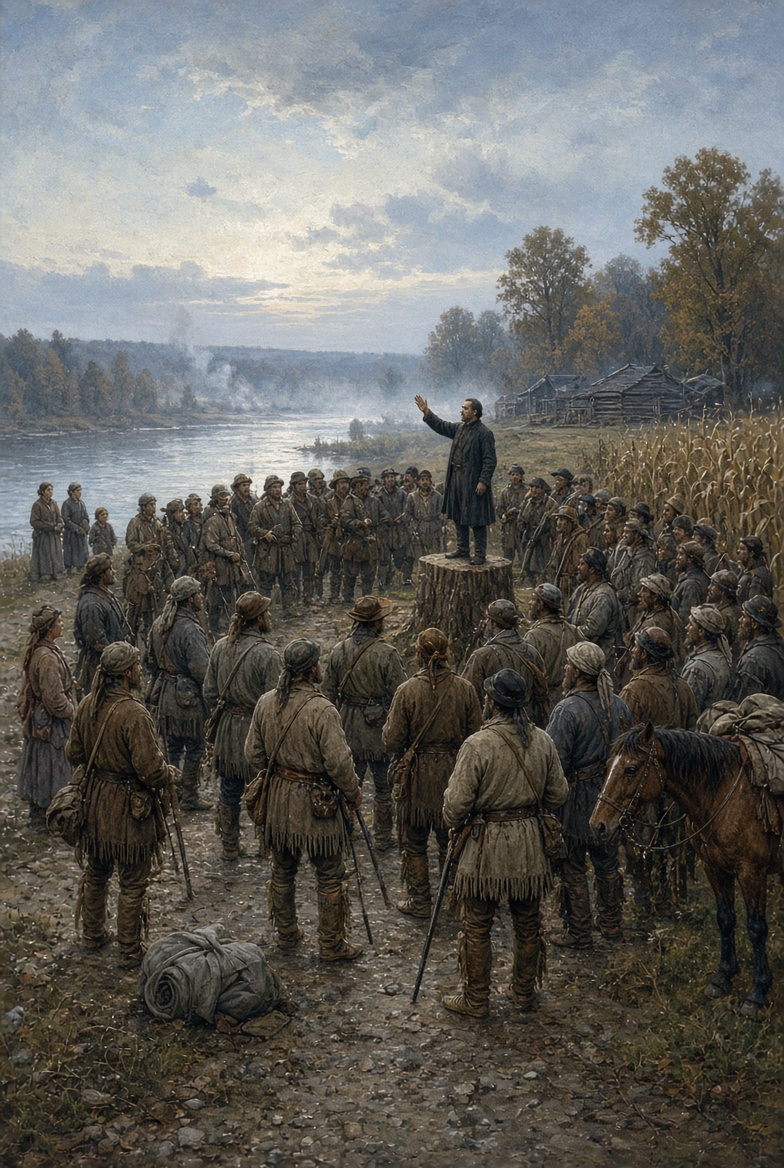
About a thousand men came into the flats by the river. They were not uniformed. Hunting shirts, leggings, a few old military coats, blanket rolls, powder horns, and rifles. Horses that would have embarrassed a British quartermaster. The camps smelled of woodsmoke and wet wool. Families stood at the edge of the muster because everyone understood this was not a militia day and home by supper. If Ferguson meant the threat, the stations could burn while the men were gone.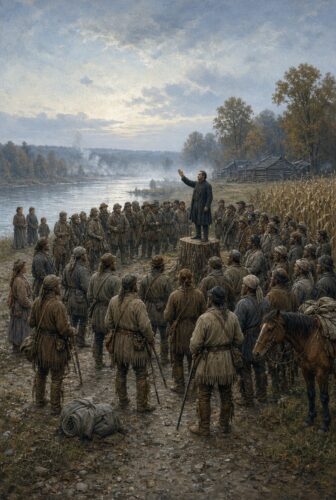
On 26 September the Presbyterian minister Samuel Doak preached and prayed. The words that come down are later recollections, not a stenographer’s copy, but they match the occasion. Doak told them they had taken those valleys from the Cherokee by force and faith, and asked whether they would now wait until another enemy carried fire and sword to the cabin door. He sent them out in the strength of their manhood, for their brethren, their liberty, and their homes. Then he prayed. Men who did not cry in public cried. The next morning the column put the river behind it and started east, up toward the balds.
The march was about two weeks of bad road and worse weather. They crossed the high country around Roan and Yellow Mountain in cold rain, leading horses where the trace pinched, sleeping in blankets that did not dry. Food was parched corn, a little meat, whatever a cabin spared. At Quaker Meadows, on the Catawba in Burke County, they met Benjamin Cleveland and others coming up from the North Carolina piedmont. The combined force swelled past fourteen hundred. Charles McDowell, a local colonel senior in age, was eased aside from overall command in favor of Campbell, a piece of frontier politics conducted so the army would not spend the war arguing about rank. McDowell accepted a mission to ride to Gates for authority. His brother Joseph stayed and fought.
They reached Gilbert Town on 4 October and found Ferguson gone. He had decamped toward Charlotte, looking for the safety of Cornwallis. The pursuit turned south. On 6 October the mountain men and their piedmont allies were at Cowpens, a pasture in South Carolina that would become famous for another reason in January. There they made the decision that won the battle before a shot was fired on the ridge.
Not everyone would go.
The horses were used up. Some men were sick. Some rifles were better than others. The colonels picked roughly nine hundred of the best mounted and told the rest to follow as they could. Then the nine hundred rode through the night of 6 October, in rain, toward a ridge they had not yet seen. A local guide, Enoch Gilmer, and intelligence from a man named Joseph Kerr, who had ridden into Ferguson’s camp pretending Loyalist sympathy, put the enemy on Kings Mountain. Kerr had a bad leg and a useful talent for being underestimated. He came back with the news that Ferguson was stopping on the high ground, a day’s march from Charlotte, waiting for reinforcements that had been sent for and would not arrive.
They forded the Broad River around dawn on the seventh. The water was up. Men crossed holding rifle and powder above the current, horses slipping on the stones. By early afternoon the rain eased. The ridge was ahead, dark with wet oak.
## What Ferguson thought the ground would do
Ferguson had chosen the spur because it looked like the answer to a militia army. High ground. A clear field of fire if the leaves were not too thick. Room on the crest for a camp. He was a day’s march from Cornwallis. He had written for help. He had not entrenched. No abatis worth the name. No artillery. His Loyalists carried muskets, many of them with bayonets, and he trusted the bayonet the way every British officer of that war trusted it. American militia, in the lesson of Camden and a dozen smaller panics, ran when steel came at them in a line.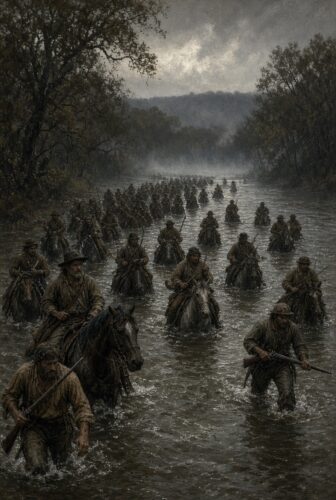
He was not entirely wrong about militia. He was wrong about these militia, and he was wrong about the shape of the ground. The slopes were steep enough to tire a man and wooded enough to hide him. A musket fired downhill, into timber, at an enemy who would not stand in the open, was a weapon for noise. A rifle fired uphill from behind a tree, at a man outlined on a crest, was a weapon for killing. Ferguson’s own drilled Provincials could charge. His Carolina Loyalists could fire a volley. Neither could make the woods go away.
He wore, by the accounts that fixed him in the memory of both sides, a checked hunting shirt or duster over his uniform, so his own men could find him in the smoke, and he carried a silver whistle on a cord. The whistle was his voice. Short blasts for the charge, different patterns to turn a company, the sound carrying farther than a shout in oak woods. It also told every rifleman on the slope exactly where the commander was. He rode a horse along the crest. He was the only man doing that.
Around three in the afternoon the first pickets fired. Campbell, Shelby, Sevier, Cleveland, Chronicle, Hambright, Winston, and the rest had divided the nine hundred into parties and sent them around the foot of the ridge until the camp was circled. Campbell’s order, remembered in several versions, was the opposite of a parade-ground command. Shout like hell and fight like devils. Do not wait for the word. Let each man be his own officer.
Then they went up.
## Sixty-five minutes
The first wave from the southwest took a volley and a bayonet charge and went back down the hill, because that is what men without bayonets do when steel is coming at a run. Ferguson blew the whistle. The Provincials and the steadiest Loyalists cleared the slope. In an open field this would have been the end of the engagement, the familiar story of the war: militia broken, regulars in possession, a report written after supper.
The woods refused the script. The men who fell back stopped behind trees, reloaded, and came up again on a different line. While Ferguson’s attention and his whistle were on one face of the ridge, Sevier and Shelby and Campbell were coming up the others. The Loyalist position was a perimeter, not a front. Every company that faced one direction had its back to another. The crest, which had looked roomy in the morning, began to shrink.
Loyalist muskets, aimed downhill at flashes and shirts, tended to fire high. Patriot rifles, aimed uphill at silhouettes, at the red coats of the Provincials, at the checked shirt on the horse, did not. The noise was the particular noise of that kind of fight: not a rolling volley, but a crackle, a yell, the whistle, a shout to dress the line, then the whistle again. Three times Ferguson organized a bayonet charge and drove a sector of the ring down into the timber. Three times the ring closed when the bayonets went back up to catch their breath. The overmountain men were not interested in holding a slope. They were interested in killing the line that held the crest, and the trees let them do it at their own distance.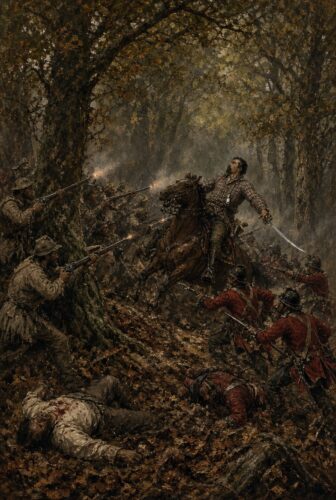
Colonel James Williams of South Carolina went down in the advance and died of his wounds. William Chronicle was killed. Ferguson rode the length of the camp, cutting at the sticks and shirts his own men were raising when pockets of the line decided the hour was lost. He would not let them surrender. Witnesses on the crest remembered him shouting that the day was theirs. It was not. A group of Sevier’s men, some accounts say, put a volley into him as he tried to break the ring toward the southeast. He was hit many times. Numbers vary. Seven wounds is the figure that settled into the telling. The horse dragged him. He was dead before anyone on the Patriot side reached him to demand the sword.
Abraham de Peyster, Ferguson’s second, tried to get a surrender accepted. For a few minutes it was not accepted. The memory of Waxhaws was on that slope, and so was the simpler fact of men who had been shot at for an hour and were no longer aiming. Campbell and Shelby rode and shouted the firing down. It stopped. By about half past four the ridge belonged to the men who had crossed the Broad before dawn.
The count, allowing for the usual argument over bodies, was lopsided. The Patriot militia lost 28 killed and 62 wounded. The Loyalists lost about 157 killed and 163 wounded, with somewhere between 668 and 698 taken prisoner. Ferguson was among the dead. So was a large fraction of the Provincial stiffening. The Loyalist field force that was supposed to hold the Carolina backcountry for the king had ceased to exist in the time it takes to cook a pot of corn.
## What the living did with the afternoon
Victory on a frontier is rarely clean, and this one was not.
Ferguson’s body was stripped. Urine was passed on it, a detail preserved because it shocked some of the same men who had done the shooting. He was wrapped in a beef hide and buried on the ridge, in a grave that later visitors had trouble finding. The Patriot dead were buried with more care. The wounded of both sides lay in the leaves. A young militiaman wrote afterward that the dead lay in heaps, that the groans came from every direction, and that he turned away from a scene he could not celebrate without weeping. That sentence is worth more than the monument. The men who won knew what the hour had cost.
The prisoners were herded north. There was not enough food for the victors, let alone for seven hundred captives. On the march, men slipped away into the woods by the dozen. At Biggerstaff’s plantation, on ground belonging to a Loyalist captain who had been mortally wounded on the ridge, a drumhead court sat. The charge was not simply that the prisoners had fought. It was that some of them had changed sides, or had burned and hanged in the partisan war already raging in the piedmont, or had ridden with parties that killed neighbors. Thirty-six were condemned. Nine were hanged from an oak before Campbell and the other colonels, sick of it or afraid of it or both, stopped the executions. The nine names that the nineteenth-century historian Lyman Draper recorded were Ambrose Mills, Robert Wilson, James Chitwood, a Captain Grimes, Thomas Lafferty, Walter Gilkey, John McFall, John Bibby, and Augustine Hobbs. The widow Biggerstaff cut them down the next day and buried them in her field.
This is the part of the story that does not fit a clean moral. The same improvised army that had answered a threat of hanging with a march over the mountains answered its own dead with a rope. Shelby, in later years, did not boast about Biggerstaff’s. The war in the backcountry had already taught both sides that quarter was a local decision. Kings Mountain did not invent that. It concentrated it into one week.
Most of the remaining prisoners eventually escaped or were exchanged. Anthony Allaire, a Loyalist officer who kept a diary, survived the march, got away, and reached Charleston. His account is one of the reasons the Loyalist side of the hour is not only a Patriot legend.
## The tide that actually turned
Cornwallis heard the news and did the rational thing. Charlotte was exposed. His Loyalist screen was gone. The overmountain men were between him and the belief that the backcountry would rise for the king. He left Charlotte and fell back to South Carolina. He would come north again in 1781, after Cowpens and the long race to the Dan, and he would end that campaign at Yorktown. But the October plan, the plan that treated the Carolinas as a pacified base, ended on the ridge.
Jefferson’s phrase was not poetry. After Camden, European courts looking at the war saw a rebellion losing its southern half. After Kings Mountain, the calculation changed. Militia who would not stand in Gates’s line at Camden would ride all night to shoot a man off a horse if the man had promised to burn their cabins. That was not a Continental army. It was worse for British strategy, because it could not be brought to a single field and destroyed. Greene, when he arrived in December, inherited a country in which the king’s friends were counting their dead and the king’s enemies had a story.
Washington, writing about the volunteers, treated them as proof that the country still had resources the British returns did not show. Light Horse Harry Lee, no sentimentalist about militia, described the overmountain men as hardy, used to horse and rifle, patient under privation, and brave. A Loyalist who saw them come up the slope said they looked like devils from the infernal regions, tall, raw-boned, sinewy, with long matted hair. Both descriptions can be true. They had been in the rain for a day and a night. They had not shaved for a campaign. They also knew what a rifle could do at eighty yards against a man who insisted on being visible.
The battle did not win the war. Yorktown was thirteen months away, and Yorktown required a French fleet, a Continental army, and a British general who had marched himself into a corner. What Kings Mountain did was simpler and, for the people on the ridge, enough. It killed the officer who had promised to come over the mountains. It removed the Loyalist army that made that promise credible. It told Cornwallis that the left flank was a rumor. And it did all of that in an hour, with men who had selected themselves the night before by the condition of their horses.
Ferguson’s breech-loader, the clever gun the Ordnance Board ignored, was not what decided the crest. The weapon that mattered was the ordinary rifle in the hands of a man who would fall back from a bayonet and come up again from a different tree. The invention that mattered was not mechanical. It was the decision, at Cowpens, to leave the tired horses behind.
## The hour, applied without a sermon
The ridge is a machine for one lesson, and the lesson is not “believe in yourself.” Ferguson believed in himself. He believed in the hill, the bayonet, the proximity of Cornwallis, and the whistle. All four were real. None of them had been turned into a defense. The men who beat him did not have a better system of motivation. They had a night ride, a selection, a circle, and a willingness to give ground every time the steel came, then take it back when the steel left.
If you are going to take anything off that Saturday, take the mechanics.
The unfortified ridge hour works like this.
– Name the hill you are already standing on. Not a goal. A position you have treated as safe because it is familiar, higher than the surrounding noise, and close to help that has not actually arrived. Ferguson’s help was a day’s march away and a letter in a saddlebag. Write the equivalent in one sentence: the thing you are counting on that is not in the room.
– Tonight, not this month, select only the mounted. At Cowpens they did not bring the whole muster up the ridge. They brought the horses that could still cover the ground. List the three resources that can move before dawn: one skill you can use without preparation, one person who will answer a message after dark, one tool already in your hand. Everything else is the column that follows later. Do not wait for it.
– Circle the problem instead of charging the face you can see. The first bayonet charge cleared the southwest slope and decided nothing, because the fight was already on the other three sides. Pick four approaches to the same stuck thing: the version you say out loud, the version on paper, the version a critic would use, and the version that remains if the conspicuous part is removed. Spend the hour moving among them. When resistance shows up in one approach, leave it and enter from another tree.
– Fall back on purpose when the bayonet comes. The overmountain men were not shamed by giving the slope. They were dead if they stood in the open against steel. If a task, a person, or a number hits you directly, step into cover, reload, and return on a different line. Standing still to prove you are not militia is how the crest held for the first twenty minutes and lost the last forty.
– Cut the whistle. Ferguson’s signal told his men where to look and told every rifle on the slope where to shoot. The checked shirt did the same work in daylight. For one hour, remove the broadcast that announces where you are: the status message, the public promise, the visible thrash. Command the thing quietly enough that the opposition has to search for you.
– Stop at sixty-five minutes, then do the accounting without the rope. Biggerstaff’s did not make the ridge safer. It made the march heavier and gave the other side a story of its own. When the hour ends, write what was killed, what was captured, and what will be released. Revenge is a second battle fought with worse intelligence.
That is the whole plan. One named hill. Three mounted resources. Four approaches. A practiced retreat. A silenced signal. A hard stop. It is not a morning routine, and it does not require a new identity. It requires the thing the colonels did at Cowpens on the night of 6 October, which was to admit that the entire army could not arrive in time, and to send the part that could.
The rain stopped. The whistle carried. The hill was never a fort. By half past four the king of it was in a beef hide, and the tide Jefferson named had already turned, whether or not anyone on the crest had the breath to call it that.
Share: