
How a Castle That Promised to Open on a Feast Day, an English Captain Who Kept One Battalion Uncommitted, a Breton Claimant Who Died Calling the Name of His Duchy, and One Afternoon Beside the River Loch on 29 September 1364 Ended Twenty-Three Years of Civil War
Picture a low river in late September, brown and already cold at the edges. The Loch slides past the town of Auray on Brittany’s southern coast, not far from the sea that has always decided who eats in this duchy. On the morning of 29 September 1364 the river still looked ordinary. By nightfall it had become the line that ended a generation of killing.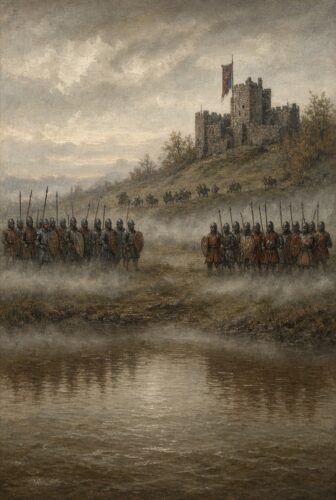
Two armies had already spent the previous day staring at each other across the water. One of them had come to keep a promise. The other had come to break it.
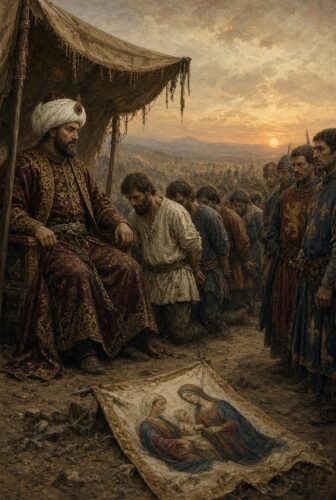
The garrison inside Auray’s castle had agreed, weeks earlier, that if no relief arrived by Michaelmas—the feast of the archangel who weighs souls and commands the heavenly host—they would open the gates. They were starving. The town itself had already fallen. The castle, perched above the river, still held. Michaelmas was the deadline both sides had written down. It was also the day the war of twenty-three years chose to finish itself in a single field.
This is not a story about destiny. It is a story about a calendar date that both sides accepted, a piece of ground one side chose and the other accepted, a reserve that one commander hated holding, and a letter written the day after the killing that turned a battlefield victory into a political settlement that lasted more than a century.
The war had begun because a duke died without a son.
John III, Duke of Brittany, died in 1341. He left no male heir. Two claims immediately collided. One came through his niece, Jeanne de Penthièvre, married to Charles of Blois, a nephew of the French king. The other came through John’s half-brother, John of Montfort, who claimed the duchy by male succession and immediately seized Nantes and the treasury. The French king recognized Charles. The English king recognized Montfort. Brittany, which had spent centuries playing Paris against London, became a proxy battlefield inside the larger Hundred Years’ War.
The first years were ugly even by fourteenth-century standards. John of Montfort was captured. His wife, Jeanne of Flanders—another Jeanne, the one chroniclers called “the Flame”—held Hennebont against a French siege, put on armor, led a sortie that burned the enemy camp, and then slipped out by sea to fetch English help. Charles of Blois, pious to the point of wearing a hair shirt under his armor and later put forward for sainthood, was himself captured at La Roche-Derrien in 1347 and spent years in English prisons. The duchy split into zones. Towns changed hands. Companies of unemployed soldiers after the 1360 Treaty of Brétigny drifted into Brittany because there was still pay and still a cause.
By 1364 the original John of Montfort was dead. His son, another John, now twenty-five, had grown up in England and returned with English captains who knew their trade. The most important of them was Sir John Chandos, already famous from Crécy and Poitiers, a man who fought dismounted, thought in lines, and understood that a battle is won by the unit you have not yet used. With him came Robert Knolles, Olivier de Clisson—who would later switch sides and become Constable of France—and Hugh Calveley, a huge Cheshire captain who did not enjoy being told to wait.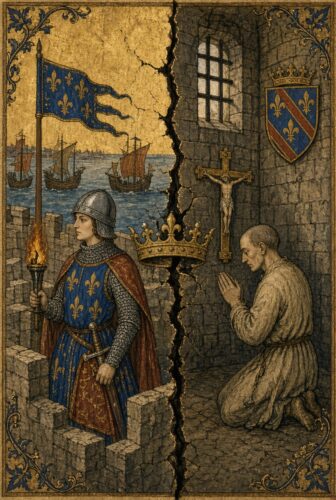
Charles of Blois had Bertrand du Guesclin.
Du Guesclin was not handsome. Chroniclers describe a squat, dark, snub-nosed Breton who looked more like a peasant than a knight and fought like a man who had decided early that beauty was a luxury. He had already made a reputation in small wars for patience, night marches, and the ability to make an enemy waste himself. In 1364 he was the best field commander the French party possessed.
The campaign that brought them to Auray started as a siege, not a meeting engagement. John of Montfort and Chandos moved against Auray because the town controlled the southern coast and because the castle still flew Charles’s banners. They took the town. The castle refused. The garrison, short of food, negotiated the Michaelmas clause: relief by 29 September or surrender. It was a clean, almost legal arrangement. Medieval sieges often ended that way when both sides still pretended the calendar had authority.
Charles of Blois marched to keep the date.
He arrived with roughly three to four thousand men—Bretons of his own party, French men-at-arms, some Normans. Du Guesclin commanded one of the three battles. The Count of Auxerre commanded another. Charles took the third. They crossed the Loch and formed on a marshy plain north of the town, facing south. Several of Charles’s own officers thought the ground was bad. They said so. He formed there anyway.
Montfort’s army was smaller, perhaps two thousand to a little over three thousand depending on the chronicle, but it held the slope on the other bank. Chandos placed the right. Knolles took the left. Montfort and Chandos stood in the center. Calveley was given the reserve and was visibly unhappy about it. The horses were sent to the rear. Everyone who mattered fought on foot. Plate was heavier than it had been at Crécy. Visors were down. The English longbowmen and the French crossbowmen opened the morning with the usual exchange that decided nothing except who would have to walk forward first.
There was a last parley. It failed. Some of Charles’s Breton contingents, seeing that the English captains would not bend and that their own commander would not withdraw, simply marched away. Desertion before contact is one of the least romantic facts of the war. It happened here.
Then the lines closed.
The fighting was not a clever sequence of flanking marches. It was three blocks of armored men walking into three other blocks and trying to kill the men in front of them because both sides had decided, after twenty-three years, that prisoners were a luxury they no longer wanted. Orders went out on the Montfort side: no quarter. Charles of Blois’s people understood the same thing. This was not a raid. This was the argument about who was duke.
Chandos’s wing hit first. The Count of Auxerre lost an eye and was pulled down. His men were driven into du Guesclin’s center. The center buckled. Charles’s right began to fold toward the middle because there was no unused body of troops behind it to stiffen the line. That is the detail that matters. Charles had divided his army into three roughly equal battles and kept no serious reserve. When one wing gave, the pressure transferred inward and the whole formation started to rotate against itself.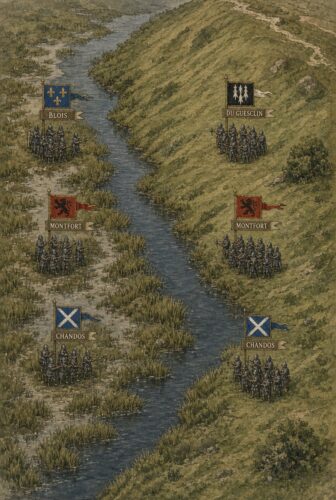
Calveley, who had been chewing the inside of his cheek all morning, was finally released. The reserve came in. Charles’s standard went down. The left wing, seeing the center dissolve, broke. Men who had stood for an hour suddenly discovered they had somewhere else to be.
Charles of Blois was struck by a lance and went down. An English soldier, obeying the order that had been given before the first arrow flew, finished him. There are several versions of the last moment. In one he is simply lost in the press. In another he is calling “Brittany.” He had spent his adult life insisting he was the legitimate duke by marriage and by royal French judgment. He died on the field that was supposed to prove it. Later generations tried to make him a saint. The process never quite finished. Holiness is harder to certify when the man died in a civil war he could have declined.
Du Guesclin fought until he had no weapon left that would hold an edge. Then he surrendered to Chandos. The two men knew each other by reputation. Chandos is supposed to have said something close to: look at this wretch Montfort; by your act he is duke today. Whether the sentence is exact, the meaning is. The best soldier on the losing side had just handed the winning side its legitimacy by remaining alive and famous.
Casualties followed the usual medieval pattern. The winners lost few men-at-arms—some accounts say seven knights killed and fewer than a hundred total. The losers left eight hundred to a thousand dead and more than a thousand prisoners. The numbers are chronicler numbers, which means they are directionally true and precisely unreliable. What is not in dispute is the political result.
The War of the Breton Succession was over.
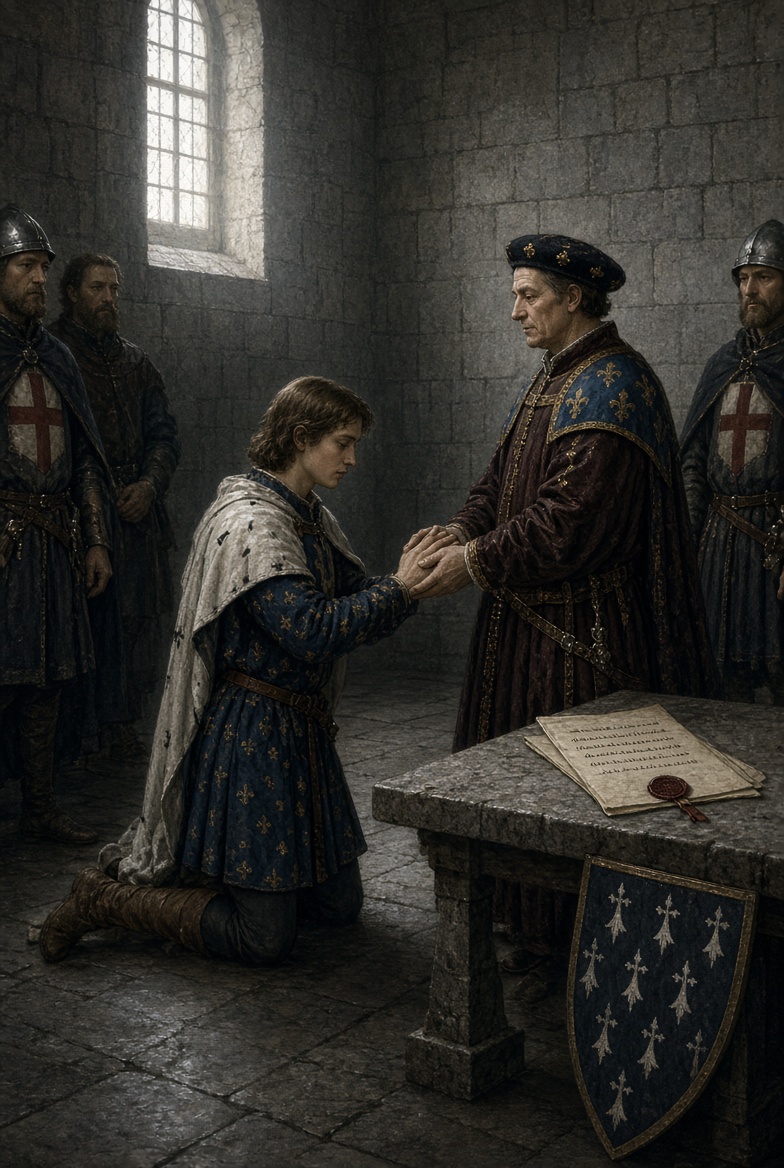
In April 1365 the first Treaty of Guérande recognized John of Montfort as Duke John IV of Brittany. Jeanne de Penthièvre kept her title for life and her Penthièvre lands, but she would not rule. The French king, Charles V, accepted the military verdict. Then John IV did the thing that still surprises people who like their history painted in two colors: he did homage to the King of France, not to Edward III of England, whose money and captains had just won him the duchy.
That letter, or the act it represented, is the second half of the battle. Winning the field with English help and then attaching the duchy to the French crown was not betrayal in the simple sense. It was the recognition that Brittany’s survival had always depended on not belonging completely to either neighbor. John IV spent the rest of his reign balancing. He would be driven out and would return. He would fight the French and reconcile with them. The Montfort line held the duchy until the end of Breton independence. The battle of 29 September 1364 is the reason that line existed.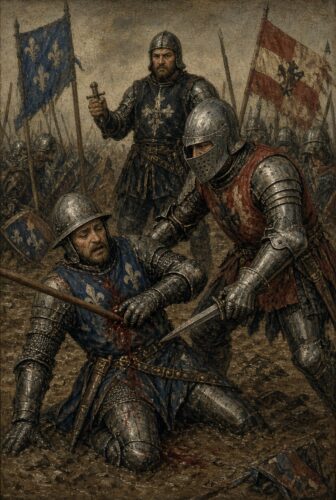
Du Guesclin was ransomed for a hundred thousand francs, a sum large enough to remind everyone that a living commander is a financial instrument. He went on to become Constable of France, to fight in Castile, to harass the English in the 1370s, and to die on campaign in 1380. Chandos died in 1370 from a wound taken in a skirmish, still fighting the same war under a different season. Calveley kept being Calveley. Clisson switched and became, for a time, the most powerful soldier in France. The men who walked away from the Loch carried the rest of the century with them.
The ground itself is still there. Auray is a small town. The river is still called the Loch. The castle’s role in the story is easy to miss if you arrive looking for a grand fortress. What remains is the logic: a garrison that set a date, a relief army that had to accept that date, a defending army that chose the slope, a reserve that was not spent in the first hour, and a political letter that converted a pile of bodies into a recognized duke.
Twenty-three years of civil war ended because one side treated Michaelmas as a real deadline, occupied the better bank, refused to empty its last box of men at the first shock, and then immediately negotiated with the power it had just beaten.
That is the event. It happened on this date. It is specific, distant, and finished. What it leaves behind is not a slogan. It is a sequence.
Most advice about “applying history to your life” turns the past into a mood. Auray is not a mood. It is a procedure.
The procedure is this.
First, stop treating your current fight as an open-ended siege. Find or create a date that the other party has already, in some form, accepted—a contract end, a review, a lease, a filing deadline, a season, a public commitment they made when they still thought they were strong. That date is your Michaelmas. You do not invent it out of inspiration. You use the one already on the paper.
Second, move onto the slope before the relief column arrives. In practical terms this means doing the unglamorous work—savings, skills, documents, alternative income, a second offer, a quieter living arrangement—while the other side still believes the castle will be relieved. The army that chooses the ground does not have to be larger. It has to be the one that does not have to cross the river under fire.
Third, keep one unit uncommitted. Calveley hated the assignment. That is the point. The reserve is the part of your life you refuse to throw into the first argument, the first month of a new job, the first wave of a family crisis, the first product launch. It can be cash, time, a skill you have not yet advertised, a relationship you have not yet leveraged, or simply the decision not to answer the second hostile message. When the other side’s formation starts to fold on itself—when their plan requires everything to work at once and one piece fails—you spend the reserve. Not before.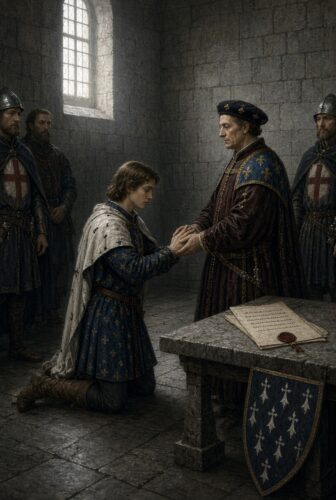
Fourth, write the homage letter the next day. John IV did not keep fighting England’s war after England had given him the duchy. He attached himself to the structure that could make the victory permanent. In a life this means converting a win into a settlement: the apology that locks the agreement, the contract that replaces the argument, the public acknowledgment that lets the other side stop fighting without humiliation, the new loyalty that is actually a boundary. Victory that stays a battlefield is just the next campaign.
A thirty-day sequence, unique because it is dated to a feast the other side already recognized:
Days 1–3. Write down the existing deadline that is already in the world, not the one you wish existed. Name the river you will not cross first.
Days 4–10. Occupy the slope. One concrete improvement in position that does not require the other party’s cooperation: a file completed, a skill practiced to a measurable standard, a reserve account moved, a conversation scheduled with someone who is not in the fight.
Days 11–20. Identify the reserve and give it a name. Tell no one who would spend it for you. Practice not using it.
Days 21–28. Watch for the fold—the moment their plan requires two things to be true at once and only one is. Do not announce that you see it.
Day 29. If the field is yours, spend the reserve. If it is not, do not invent a new battle. Renegotiate the date.
Day 30. Write the short letter or perform the small act that turns the result into a recognized fact instead of a grudge. Then stop talking about the battle.
The humor in the story is grim and useful. A man who wore a hair shirt and wanted to be holy died because he formed on the worse ground and kept no unused troops. A squat, ugly captain survived by breaking every weapon and then becoming the most valuable prisoner in France. A young duke won with English swords and then bowed to the French king. History is not a morality play. It is a set of decisions made under a deadline that both sides had already signed.
On 29 September 1364 the deadline came due. The castle was not relieved in time. The slope was already taken. The reserve was still in hand. The saint-king was dead. The ugly captain was in chains and worth a fortune. The new duke was about to write a letter that made the killing count.
That is what happened on this date. The rest is whether you treat your own Michaelmas as decoration or as the day the gates either open or the army on the hill finally moves.
Share: