
Picture a brick courthouse standing in the exact middle of a small Pennsylvania market square. Two German churches look at it from opposite sides of the street. The square itself is a muddy intersection of wagon roads that run toward Baltimore, toward the Susquehanna, and toward the frontier. On Tuesday, September 30, 1777, that courthouse became the capital of the United States.
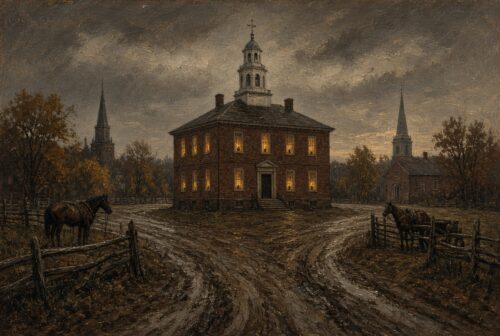 It did not look like a capital. It did not smell like one. The town of York—then usually called York Town—held fewer than two thousand people, most of them German-speaking farmers, millers, and tradesmen who kept their schools, psalms, and sermons in their own language. Many of them would live and die without ever becoming fluent in English. Into this place, after a panicked week on the roads, walked the Second Continental Congress.
They were not tourists. They were a government that had just lost its city.
Nine days earlier, on September 21, British troops under General William Howe had finished the work begun at Brandywine. Philadelphia, the largest city in the rebellious colonies and the seat of the Continental Congress, was about to fall. On September 26 Howe’s army marched in. The delegates had already left. They paused for a single day in Lancaster on September 27, discovered that the Pennsylvania assembly and a flood of refugees had already claimed every decent room and the only usable courthouse, and kept moving west. They chose York because the mile-wide Susquehanna River lay between them and the British, and because the little brick courthouse in Centre Square still had a roof.
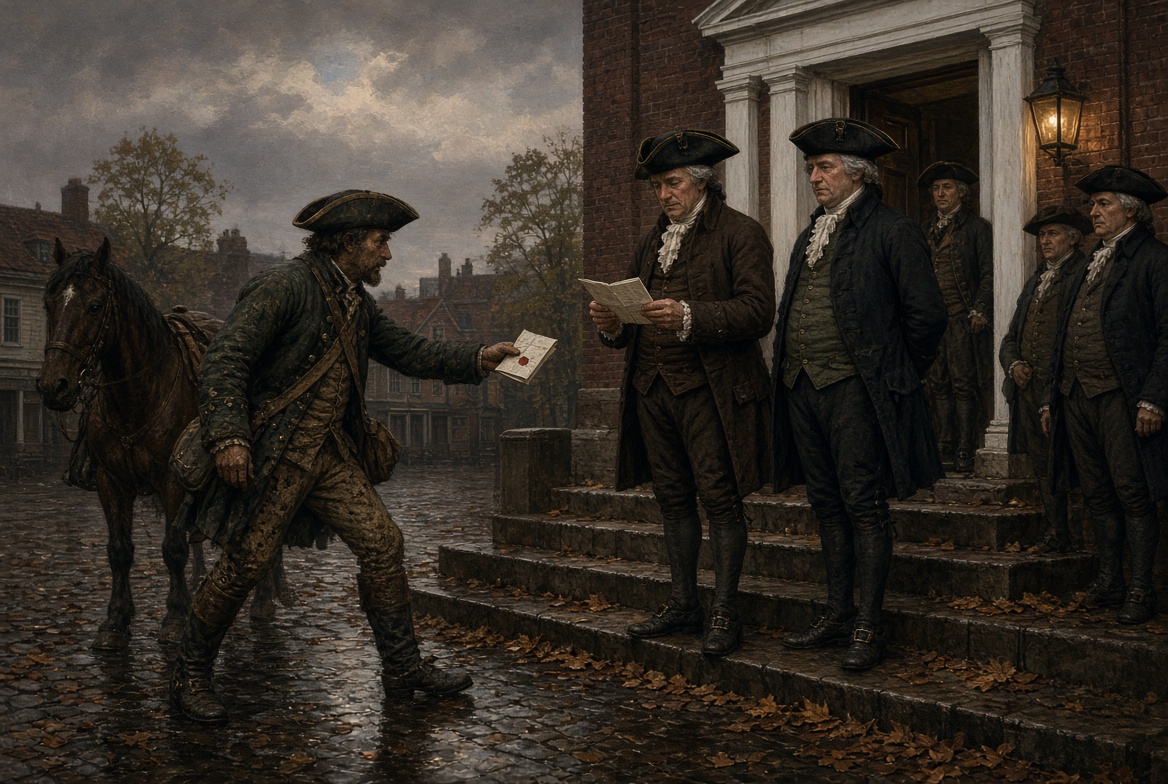
John Adams described the route to his wife Abigail. They did not take the direct eighty-eight-mile road. They went by Easton, Bethlehem, Reading, and Lancaster—nearly one hundred and eighty miles—because the papers of Congress were more important than the members. “In order to convey the Papers, with safety, which are of more Importance than all the Members,” he wrote, “We were induced to take this Circuit.” The delegates rode horses. John Hancock, still president, traveled in a chaise. Joseph Jones of Virginia arrived in a private carriage. The rest bounced west on tired animals while the British settled into the houses they had just vacated.
On the evening of September 30 they opened a short session in the York County Court House and adjourned until ten the next morning. The building had been finished in 1756. It sat in the geometric center of the town. It did not have enough chairs. Sessions would run from ten until one, resume at four, and often stretch late into the night. Committee work filled whatever hours remained. The doors stayed closed. The public was not invited. This was a government operating in exile, and it knew it.
Hancock lasted less than a month. On October 29 he took leave. The eight-hour days in the chair, plus the ordinary business of his office, had broken him. “I sat in the Chair yesterday & Conducted the Business Eight hours, which is too much,” he wrote his wife, “and after that had the Business of my office to attend to as usual … I cannot Stand it much longer in this way.” On November 1 the delegates elected Henry Laurens of South Carolina president. Laurens would steer the body through the winter.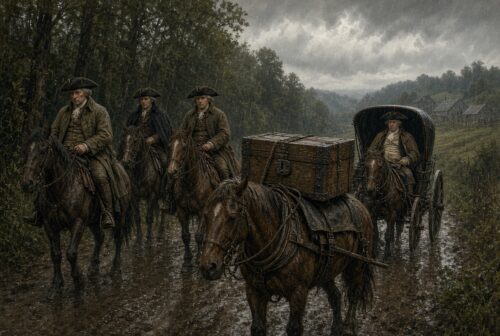
The town itself was already bursting. Soldiers used York as a staging point on the roads north and south. Delegates, secretaries, messengers, servants, and attached military officers poured in. Adams found lodging in the house of General Daniel Roberdeau, sharing space with Samuel Adams and Elbridge Gerry. He called the hospitality a rare felicity. He also complained that the house was so thronged he could not have a room to himself and therefore could not write as he once had. Other members slept in private houses, taverns, and parsonages. Prices rose. Inflation, already savage, grew worse. Three days of soaking rain in late October turned the streets to soup and the mood to gloom.
Adams, never one to spare a sentence, took the measure of his new neighbors. The town was no larger than Plymouth. Two German churches—one Lutheran, one Calvinist—filled on Sundays with decent, numerous congregations. The Germans, he noted, were careful to maintain public worship, “which is more than can be said of the other Denominations of Christians.” In politics he found them “a Breed of Mongrels or Neutrals, and benumbed with a general Torpor.” He was homesick, weary of public cares, and out of patience with the silence from the northern army. “If I live much longer in Banishment, I shall scarcely know my own Children.”
That was the setting. Now the work.
Congress had been trying, since 1776, to write a constitution for the union. John Dickinson’s draft had sat through a year of war, argument, and delay. In York the remaining disputes came to a head: how states would vote (one vote each, not by population), how taxes would be assessed (land value versus population), and what to do with the vast western lands claimed by several states. The debates ran through October and the first two weeks of November. On November 15, 1777, the Articles of Confederation and Perpetual Union were adopted. They were not yet law—the states still had to ratify, and Maryland would hold out until 1781 over the western lands—but they were the first written frame of an American national government. Congress ordered them printed and sent to the states on November 17. Copies were also prepared for France. The infant republic now had a document it could show a potential ally.
While they argued over articles, the war kept sending messengers.
In the north, Horatio Gates had forced John Burgoyne to surrender his entire army at Saratoga on October 17. The first unofficial word reached York around October 20. Confirmation arrived on October 31. The timing could not have been better. Philadelphia was gone. Washington’s army was sliding toward the winter that would become Valley Forge. The two largest American cities were in British hands. Then, suddenly, an entire British army laid down its arms in the woods of New York.
Congress did what governments do when they receive unexpected good news in a dark room: they declared a holiday. On November 1 they recommended that the states set aside Thursday, December 18, as a day of solemn thanksgiving and praise. The text, largely the work of Samuel Adams, thanked Providence for “the signal success lately obtained over the enemies of these United States” and asked that the people “with one heart and one voice” express gratitude. It was the first such recommendation addressed to all the states as a single people. York, not Plymouth, not Washington’s later presidential proclamation, produced the first national Thanksgiving of the United States.
The same weeks produced a quieter, uglier drama that historians later named the Conway Cabal.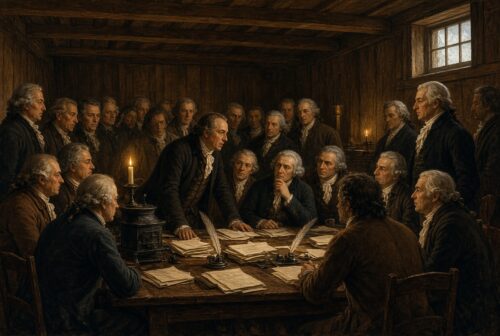
Thomas Conway, an Irish-born officer who had served in the French army, wrote a letter to Gates that included a line later reported as “Heaven has been determined to save your Country, or a weak General and bad counsellors would have ruined it.” The letter leaked. Washington learned of it. Conway offered his resignation as a bluff. Congress, which included men already uneasy about Washington after Brandywine and Germantown, instead promoted Conway to inspector general with the rank of major general and placed Gates at the head of a reorganized Board of War. For a few weeks in York it was possible to imagine that the hero of Saratoga might replace the Virginian who kept losing cities.
It never quite became a formal plot. There was no vote to remove Washington. There were letters, promotions, whispered comparisons, and a great deal of wounded pride. Henry Laurens, whose son John served on Washington’s staff, quietly passed information east. The Marquis de Lafayette, passing through York, made his loyalty to Washington unmistakable. Gates eventually apologized. Conway’s resignation was finally accepted. Baron von Steuben, who arrived later that winter, would do the actual work of turning the army into a professional force at Valley Forge. The cabal dissolved in the same small town that had given it a stage. Washington remained in command. Presidents’ Day still exists.
Through the winter and spring Congress kept legislating: prisoner exchanges, paper money, commissary reform, oaths for officers, an embargo, a day of fasting, half-pay debates, and, in May, the ratification of the treaties with France. The French alliance, made possible in part by Saratoga and in part by the existence of a written frame of government, changed the war from a colonial rebellion into an international conflict. On June 19 word arrived that the British were evacuating Philadelphia. On June 24 Congress resolved to return. On June 27 they adjourned in York. They had sat 271 days. Three delegates—Elbridge Gerry, James Lovell, and Henry Laurens—had stayed the entire time.
The old courthouse is gone. It was pulled down in 1841. A reconstruction now stands nearby. A bronze tablet in Centre Square still marks the spot. Visitors who stop rarely realize they are standing where the United States first possessed a constitution, first thanked itself as a nation, and first decided, in a room that did not have enough chairs, not to fire its commanding general.
That is the event. It is not a battle. No one planted a flag on a parapet. A tired collection of lawyers, planters, and merchants, chased out of their proper city, sat down in a German market town, closed the doors, and kept the government alive long enough to write the rules and wait for the next piece of luck.
Most of what they produced was imperfect. The Articles created a league more than a nation. The western-land fight delayed ratification for years. Inflation continued. Washington’s army still starved that winter. Yet the simple fact remains: when the capital fell, they moved the papers first, crossed a river, accepted a smaller room, and finished the work that could be finished.
That habit is the part worth stealing.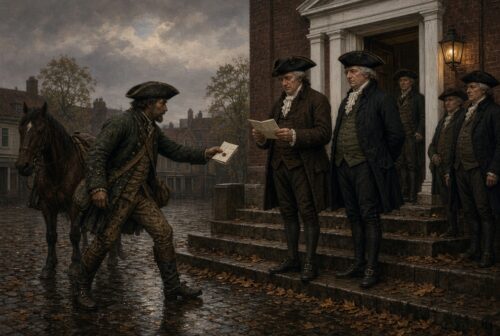
**The York Courthouse Protocol**
This is not a morning-routine list, a vision-board exercise, or a “protect your energy” sermon. It is a relocation-and-continuation method taken directly from what Congress actually did between September 26 and November 15, 1777. Use it when the place you have been operating from is about to be occupied—by a market change, a health collapse, a family rupture, a job that has already ended in everything but the paperwork, or any other Howe marching up the road.
– Pack the papers first, not the furniture. Identify the three documents, accounts, relationships, or skills that must survive even if the building does not. Congress treated its journals and correspondence as more important than the members. Do the same. If you had forty-eight hours and one wagon, what rides with you?
– Take the long safe route, not the short exposed one. Adams’s 180-mile detour was inefficient and correct. When the direct path runs through occupied territory—old colleagues who will gossip, platforms that will punish you, habits that will collapse under the first real pressure—go the long way. Add two extra days. Protect the records.
– Accept the town that actually has a courthouse. York was smaller, wetter, German-speaking, and crowded. It was also across a river the enemy did not immediately cross. Your next operating base will feel like a downgrade. That is the point. Measure it by whether the work can continue, not by whether it flatters you.
– Keep a quorum of whoever shows up. Average attendance in York hovered around twenty men, sometimes fewer. Sixty-four delegates were entitled to sit; many never came. The body still adopted the Articles. Stop waiting for the full committee, the perfect partner, or the version of yourself that has more energy. Work with the people and the hours that are actually in the room.
– Close the doors and finish the founding document inside forty-five days. Congress had been arguing the Articles for a year. In York they finished them in six weeks. Name the one structural decision you have been postponing—the pricing rule, the boundary with family, the definition of “enough,” the written terms of the next chapter—and give it a hard date no later than mid-November of whatever year you are in. Imperfect paper beats another year of talk.
– Proclaim one thanksgiving after the first unexpected win, even if the army is still starving. Saratoga arrived while Philadelphia was lost and Valley Forge had not yet begun. They still set aside a Thursday. When something actually works—a payment clears, a symptom eases, a single ally appears—mark it on the calendar in public language. Do not wait for the whole war to be over.
– Decline the cabal that wants a flashier general. There will always be a Gates in the next room and a Conway writing letters about your caution. The Protocol is to stay the commander of your own campaign unless the evidence is overwhelming. Laurens’s quiet loyalty and Lafayette’s public one mattered more than the promotions handed out in a moment of panic.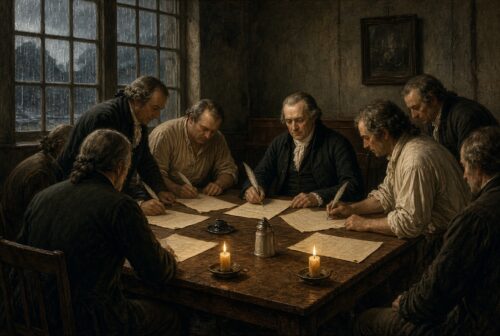
– Leave when the old city empties, not when you feel ready. Congress returned after the British left Philadelphia, not after they felt rested. Watch for the actual change in the field. Then go back or go forward. Do not make exile a personality.
Execute the Protocol once, on paper, this week. Write the three papers, the river you will put between yourself and the threat, the smaller room you will accept, and the date the Articles get signed. That is the entire plan. It is borrowed from men who sat in a courthouse that no longer exists and still managed to invent a country while the rain came through the roof.
Share: