
How a River Camp on the Pala, a Forest That Refused to Hide Anyone, Two Thousand Stolen Horses, a Spear Through Both Sides, and One Severed Head Carried Home on 21 September 1217 Buried Estonia’s First Unification Before It Could March
Picture a river that does not care who claims the banks. In early September 1217 the Pala—today the Navesti—ran brown and indifferent through the woods of Sakala in what is now southern Estonia. Beside a crossing that no longer has a name worth putting on a tourist map, six thousand men from six different counties waited. They had come because an elder named Lembitu of Lehola had sent word across every province that still answered to its own elders: Läänemaa, Harjumaa, Virumaa, Revala, Järvamaa, and his own Sakala. Ugandi stayed home. Saaremaa stayed on its islands. The rest arrived with horses, spears, axes, and the belief that this time the counties would move as one.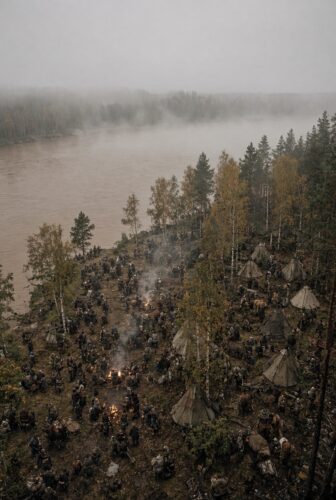
They sat for fifteen days.
Henry of Livonia, the priest who wrote the only detailed account we have, says they waited for the princes of Novgorod and Pskov. Sviatoslav Mstislavich had accepted gifts and promised to come. Vladimir of Pskov was supposed to ride with him. The combined host would then turn south toward Riga, the wooden town the Germans had planted at the mouth of the Daugava twenty years earlier, and finish the work the Estonians had started in earlier summers. The Russians never appeared. Whether Sviatoslav’s authority was already crumbling, whether the mobilization simply took longer than a Baltic harvest calendar allowed, or whether news of the German counter-march reached Novgorod first, the promised ally stayed on the other side of the lakes. Fifteen days is a long time to keep six thousand men fed, sober, and pointed in the same direction when the man they are waiting for does not exist on the horizon.
Lembitu was not a king in the Western sense. Henry calls him *princeps ac senior*—leader and elder. He is the only pre-crusade Estonian ruler about whom we have more than a single line. He first appears in 1211 leading raids that burned a church and reached as far as Pskov. In 1215 the Sword Brothers took his stronghold at Lehola (near modern Suure-Jaani), captured him, and later released him against hostages. He spent the next two years trying to do what no Estonian elder had managed: turn a collection of independent counties into a single army that could meet the Germans, the converted Livonians, and the Latgalians on something other than a raid-and-run schedule. The 1217 gathering was the high-water mark of that attempt. It was also the last.
While the Estonians waited, Riga did not. Word of the assembly reached the town. Bishop Albert’s men, the Brothers of the Sword under their master Volkwin, crusaders who had sailed in for the season, Livonian contingents under Caupo of Turaida, and Latgalian allies formed a force Henry puts at three thousand. They marched to get in front of the Russians. They reorganized near Sakala into a simple, stubborn order: Germans in the center (knights, brothers, bishop’s vassals, even merchants who could hold a line), Livonians on the right, Latgalians on the left. They reached the neighborhood of Viljandi on the evening of 20 September, the vigil of St. Matthew. They heard Mass in the morning. Then they moved.
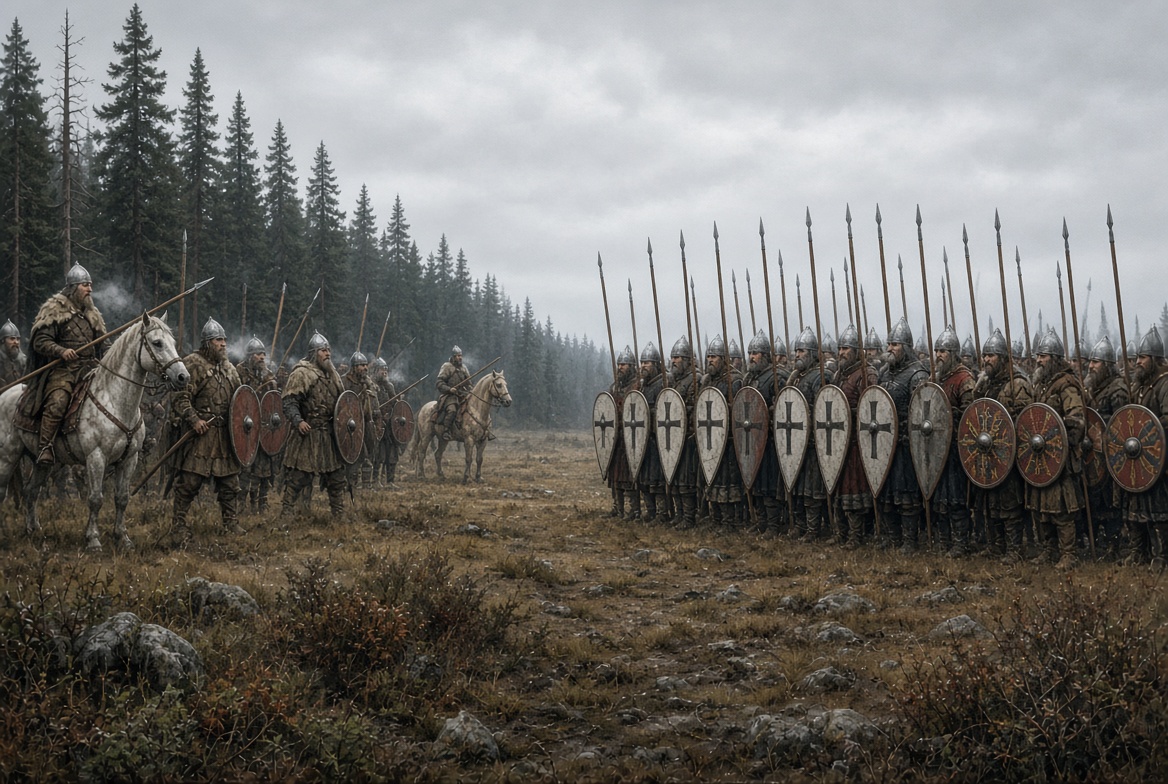
The Estonians had turned aside from the main road. The Germans followed until the Estonian host came out of the woods already formed for battle. There was no successful ambush. The forest did not swallow anyone. The two lines met on ground that later tradition places somewhere between Vanamõisa, old farm names like Madi and Rattama, and a rise that would one day carry a chapel. Moraine hills, scrub, and pasture favored the lighter Estonian horse and foot more than the armored German center, but formation and discipline favored the smaller army.
Henry’s description is the closest we will ever get to the hour. The Estonians divided themselves into three. The Sakalans under Lembitu himself faced the Latgalians on one wing and held for a long time, wounding many and killing some. The center—drawn from the northern counties and therefore the largest block—met the German mixed cavalry and infantry. That center broke. Once the middle gave way, the Sakalan wing saw the collapse and began to give ground. The Latgalians pressed. A Latgalian named Veko, brother of a man Henry calls Roboam, recognized Lembitu in the press, pursued him, and killed him. Others cut off the head. They carried it back to Livonia as a trophy. Two more Sakalan elders, Vootele and Manivald, fell in the same fighting. Unnepewe, Lembitu’s brother, survived.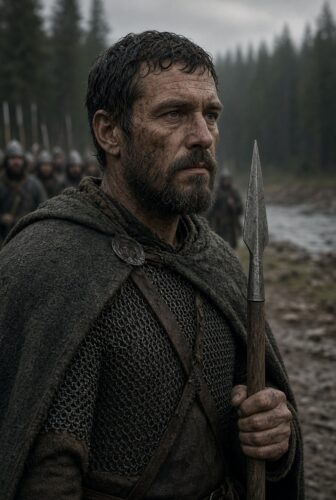
On the other side of the same field Caupo of Turaida took a lance through both sides. Caupo is the other ghost of the day. A Livonian chieftain baptized decades earlier, he had traveled to Rome, met the pope, and returned to fight with the Germans against his own former people. Pagans called him cursed. Henry, who liked a good Christian death, gives him one of the most carefully staged last moments in the entire chronicle. Pierced through, Caupo remembered the Passion, received the sacrament, made a sincere confession, and first divided all his goods among the churches already planted in Livonia. Count Albert, the abbot, and the men around him mourned. They burned the body on the field—an older custom still clinging to a new faith—and carried the bones home to Cubbesele for burial.
The numbers are the usual medieval mix of precision and propaganda. Henry says about a thousand Estonians died. The later Livonian Rhymed Chronicle raises it to fourteen hundred. The victors seized two thousand horses. Crusader losses are given in a later Teutonic source as around a hundred, a figure most modern readers treat as low. What is not in dispute is the immediate sequel. The winning army marched to Lembitu’s own village on the Pala, camped three days, and sent Livonians and Latgalians out to burn and loot the surrounding districts. Then Unnepewe and the remaining Sakalan elders came in, asked for the old peace to be renewed, and offered hostages. The Germans answered that God had punished them for despising baptism and taking counsel with pagans and Russians. If they returned to the faith, they would be received again. Hostages were given. Peace was made a second time. The army turned back toward Livonia with its spoils and praised the Lord who is blessed forever.
That is the day. It was not the last fight in Estonia. Resistance flickered for years. In 1219 the Danes landed in the north and took Lindanise. The Sword Brothers would later be smashed at Saule in 1236 and folded into the Teutonic Order. Terra Mariana, the crusader principality, took shape on paper and then on the ground. But 21 September 1217 is the moment the only recorded attempt to pull the Estonian counties into one field army under one elder ended with that elder’s head in a German baggage train and his brother signing the papers.
Lembitu’s earlier career makes the collapse sharper. He had already lost Lehola and walked out of captivity. He had already raided far enough to annoy Pskov. He understood that isolated county warbands could sting but not stop a force that combined heavy cavalry, a permanent military order, a bishop with a harbor, and local allies who had already switched sides. The 1217 coalition was his answer: numbers, a single gathering point, and an external partner who could pin the Germans between two fires. The partner never arrived. The numbers were real. The formation was not. When the center broke, the wings could not hold a line that no longer existed.
Caupo’s death on the same afternoon is the other half of the joke history likes to tell. The man who had crossed over, gone to Rome, and fought his former neighbors died in the same hour as the man who had tried to keep the old order standing. One body was burned and the bones carried to a Christian grave after the estate had been deeded to churches. The other head traveled as proof. Both men left the field. Only one of them had already decided what would happen to his property if the spear found him.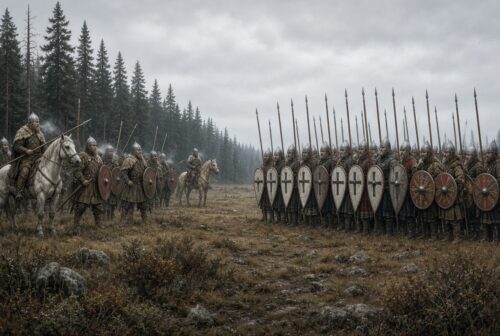
The longer shadow is institutional. The Sword Brothers were a small order—never more than a few dozen knight-brothers at a time in these years—yet they could call seasonal crusaders, levy converted Livonians and Latgalians, and move faster than a coalition that had to wait for Novgorod. Speed and a pre-agreed order of battle beat a larger host that had spent two weeks looking north for riders who were still arguing about whether to leave home. After the battle Sakala submitted again. Other counties would be picked off in sequence. The unification Lembitu had summoned lasted exactly as long as the wait for the missing prince.
There is a small, stubborn scholarly argument about how decisive the day really was. Some Estonian historians treat it as the last battle of an ancient war for freedom. Others point out that men and will remained, that 1217 was a heavy blow but not the extinguishing of every spark. Both can be true at once. What disappeared on 21 September was not every Estonian spear. What disappeared was the only documented moment when six counties answered one summons, stood in one camp, and tried to fight as a single instrument. After that the map is raids, submissions, hostages, and the slow stitching of Terra Mariana.
The river is still there. The exact meadow is still argued over by people who like old farm names and chapel hills. Lembitu has a monument at Suure-Jaani. Caupo has a memorial at Krimulda. The head and the bones went to different destinations. The six thousand who waited fifteen days became a thousand dead, two thousand captured horses, a brother who signed the next peace, and a story that only one priest writing in Latin bothered to tell in detail.
That is the fact of the date. The rest of the calendar moved on. The Northern Crusades did not pause for a funeral. Riga kept its harbor. The order kept its castles. Novgorod kept its own troubles. Estonia’s counties kept their separate names a little longer and then did not.
The outcome that traveled forward is simple and unsentimental. A coalition that waits for the ally who promised to appear can lose the only afternoon it will ever have. A line that looks impressive until the center folds is not a line. A leader who has already divided his goods and named the churches is finished with one kind of uncertainty. A brother who walks into the enemy camp three days later with hostages is practicing a different art than the man whose head is already in a sack. Both arts existed on the same field on the same Tuesday.
What a person does with that fact now is not a poster about “never give up” or “believe in yourself.” Those slogans would have sounded like noise next to the Pala. The usable residue is narrower and stranger.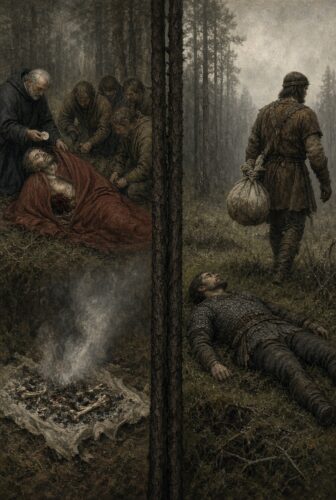
– Map the Novgorod in your current fight: the promised resource, partner, timing, or approval that has already been late more than once. Write the date you will stop waiting. Fifteen days was Lembitu’s number. Yours can be shorter.
– Draw your actual formation, not the one you describe at dinner. Who is your German center (the part that must not break), who are the wings that will run if the middle goes, and who is already fighting for the other side while still using your old name.
– Name your Unnepewe before the field. The person, document, or fallback that can walk into the camp three days later and trade hostages for time instead of dying on the same ground.
– Practice the three-day inventory Caupo performed in one hour: if the spear comes through both sides this week, which pieces of your work, money, and name are already assigned, and which are still sitting in a pile that someone else will burn or carry off.
– Run one Matthew’s Day drill that lasts twenty-one minutes, not twenty-one days. Stand up. Name the missing ally out loud. Name the flank that will collapse first. Write one sentence that Unnepewe would sign. Then stop. Do not add a vision board.
The unique plan is the Navesti Cut.
On the next calendar Tuesday that is not already claimed by something louder, sit with a single sheet of paper. Draw three boxes only.
Box one: the prince who has not come. Write the specific help you are still waiting for and the number of days you have already waited. Draw a line through it. That line is the cut. After the cut you move with the force you actually have.
Box two: the forest edge. Write the first action you will take that does not require the missing prince. It must be something you can finish before supper. Lembitu’s army came out of the woods already formed; yours should too.
Box three: the brother and the bones. Write the name of the person or the page that will handle the aftermath if the center breaks this month. Then write one concrete transfer—money, file, key, introduction—that happens this week, not after the disaster.
Fold the paper. Put it where you will see it on the morning of the twenty-first of any month. Do not decorate it. Do not share it. Do not turn it into a brand. The six thousand who waited for a prince who never came already demonstrated what happens when the ritual of assembly replaces the decision to march. The cut is the decision. Everything after the cut is just walking.
The river did not change its mind in 1217. It will not change its mind for you. The head left the field. The bones left the field. The brother signed. The horses changed owners. The date stayed 21 September. Use the date. Do not wait for the prince.
Share: