
Picture a strip of Yorkshire that does not look like the hinge of a kingdom.
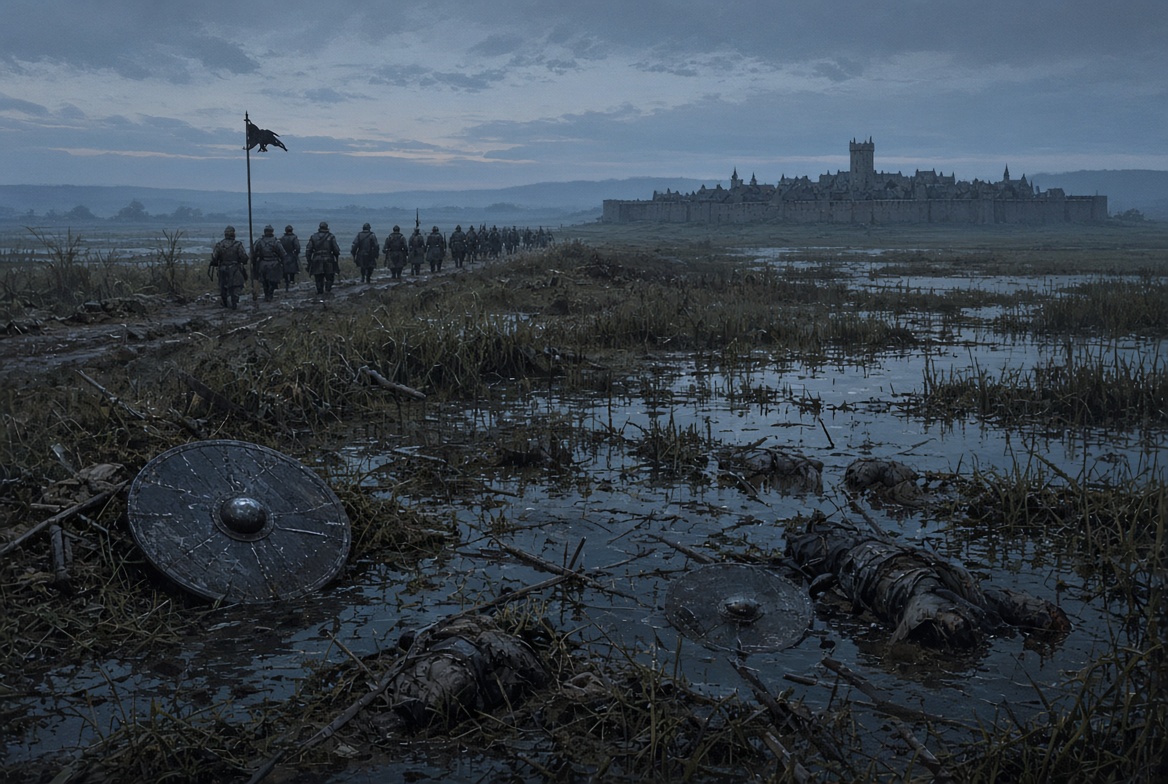
On the right, the River Ouse slides north toward York, brown and tidal, wide enough to drown a man in armor and narrow enough that a shout carries. On the left, a wet waste the later maps call Fordland and Dam Lands: reeds, standing water, ground that will take a boot to the knee and keep it. Across the front runs a ditch that drains the marsh into the river. In dry weeks it is a beck you can jump. On a spring tide it becomes a pool forty yards wide and deeper than a man is tall. The road from the south has to cross this pinch. Two miles behind the pinch sits York, the old Roman Eboracum, the northern capital, the city that still thinks of itself as a second London.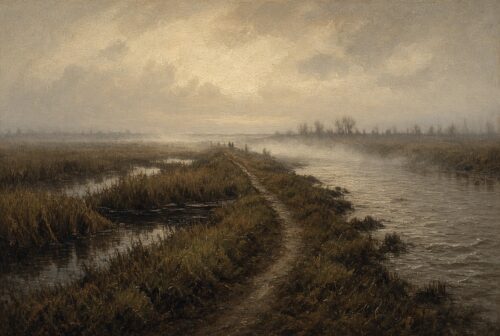
It is Wednesday, 20 September 1066. The harvest is in. The weather has been hot and dry for weeks, which means the meadows are firm enough to walk and the river is still a trap when the tide turns. Out of the south, from the landing at Riccall eight miles downriver, comes a host that has not been seen in England in this strength for a generation. At its head walks a king who is fifty-one years old, a head taller than most of the men around him, and already a legend in three languages. His banner is a black raven on a white field. The Norse call it Landøyðan. The English will remember it as Land-Waster.
That is the morning. What follows is not the battle everyone knows. Hastings is three and a half weeks away. Stamford Bridge is five days away. This is the fight that makes both of those fights possible, and it is the fight almost no one can name.
## The Year That Would Not Hold Still
Edward the Confessor died on 5 January 1066 without a son anyone could agree on. The witan in London chose Harold Godwinson, Earl of Wessex, the most powerful Englishman alive and the man who had actually been running the kingdom. Harold was crowned the next day. That speed was not vanity. It was insurance. Three other men believed the crown belonged to them.
William of Normandy claimed Edward had promised it and that Harold had sworn on holy relics to support the claim. Harald Sigurdsson of Norway — Hardrada, Hard-Ruler — claimed an old bargain between Harthacnut and Magnus the Good that whoever died first would inherit the other’s lands. Tostig Godwinson, Harold’s own brother, claimed Northumbria, which the Northumbrians had taken from him the year before and given to a young earl named Morcar.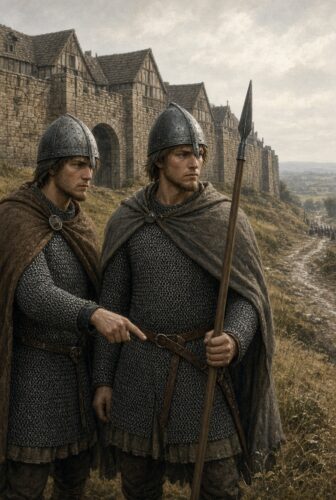
Tostig had been a disastrous earl. He taxed like a Dane and judged like a man who enjoyed the sound of the sentence. In October 1065 the thegns of Yorkshire rose, killed his housecarls in York, and outlawed him. Harold, then still earl and not king, had sided with the north rather than with his brother. Tostig never forgave it. He spent the winter of 1065–66 as a pirate with a grudge, raiding the Isle of Wight, then Lindsey, getting beaten by the northern earls, slinking to Scotland with a dozen ships, and talking a Norwegian king into an invasion.
Hardrada needed little talking. He had been a boy at Stiklestad when his half-brother Olaf was killed. He had fled east, served Yaroslav in Novgorod, gone south to Constantinople, and risen to command the Varangian Guard, the emperor’s axe-bearing foreigners. He had fought in Sicily, in Bulgaria, in the streets of the city itself. He had come home with a Russian princess, a chest of Byzantine gold, and the conviction that a throne was something you took. By 1066 he had already broken Denmark to a draw and Norway to his will. England was the last large prize in the old northern world.
He sailed late. The sagas give him three hundred ships. Modern estimates put the fighting strength somewhere between eight and ten thousand once Orkney and the Isles had added their levies and Tostig had added his hired knives. They entered the Humber, ran up the Ouse on the tide, and beached at Riccall. York was two easy days away.
Harold Godwinson was not there.
All summer he had sat on the south coast with the fyrd, watching for William. On 8 September the supplies ran out and the men had to go home to get the harvest in. The fleet was sent to London. Four days later the first reports of a northern landing began to move south. Harold called out a new army as he rode. The distance from London to York is a little under two hundred miles. He would cover most of it in four days. That fact sits over Fulford like a held breath. The northern earls did not wait for it.
## Two Young Earls and a City They Could Have Kept
Morcar of Northumbria was new to the job. His brother Edwin of Mercia was not much older. They were the sons of Ælfgar, which meant they had watched their family get squeezed between Godwinsons and kings for a decade. In 1065 they had been the beneficiaries of Tostig’s fall. In September 1066 they were the men who had to decide whether York would be a fortress or a battlefield.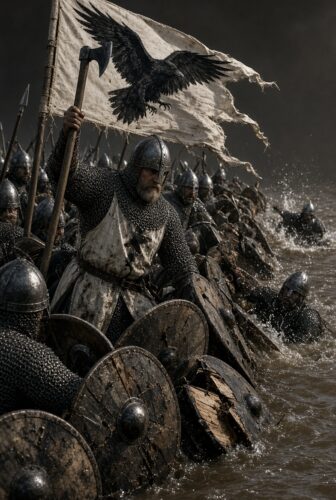
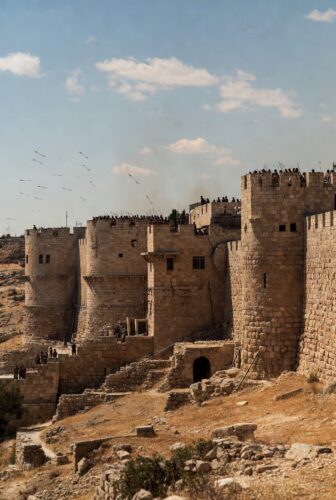
York had walls. Roman masonry still underlay the later work. A garrison behind those walls, even a modest one, could have held for the week Harold needed. The invaders would have been forced to sit in the meadows with a river at their back and a hostile countryside around them, eating the food they had and watching the road from the south. That is the unfought battle, and it is the only battle the earls could have won for certain.
They did not fight it.
The Anglo-Saxon Chronicle is brief and grim about what they did instead. They “gathered from their earldom as great a force as they could get,” and they marched out. Later writers try to explain the choice. Honor required a field. The city would starve if it sat through a siege. Tostig’s presence made any parley look like treason. The earls were young and had just proven they could chase Tostig out of Lindsey; perhaps they thought the same trick would work on a king who had commanded the Varangians. The most practical reason is the oldest: they did not believe Harold could arrive in time, and they would rather lose men in front of York than lose York with men still in it.
So they chose the pinch at Fulford.
The position looks clever on a map. Right flank on the Ouse, so no one goes around that way. Left flank on the marsh, so no one goes around that way either. Front covered by the beck. The road bottled. A commander with five thousand men and no genius can hold a six-hundred-yard gap against a larger army if he stays on his own bank and lets the other man come to him.
That is not what happened.
## Land-Waster and the Shape of the Line
Hardrada understood ground the way a carpenter understands grain. He had learned it in Sicily, where ravines and dry riverbeds decide more battles than speeches, and in the east, where steppe and river force you to pick a bank and live with it. He put his best men on his left, against the river, under his own banner. That put them opposite Edwin’s Mercians, the more professional of the two English wings. Tostig, with fewer and worse troops — Flemings, exiles, the leftovers of a year of failure — held the right, against the marsh, opposite Morcar and the Northumbrian fyrd.
Snorri Sturluson, writing a century and a half later in Iceland, is not a court reporter. He is a storyteller with a good ear for how a fight feels. He has Hardrada thin out Tostig’s wing on purpose. The English see the weak side. Morcar’s men come on hard across the beck as the tide drops and the ditch becomes a thing you can cross without swimming. The Northumbrians push Tostig back. For a stretch of the morning it looks as if the home side has guessed right. The Chronicle says the English “made a great slaughter.” Men on both sides go into the water and do not come out.
Then Hardrada does the thing the earls came out of the city to prevent.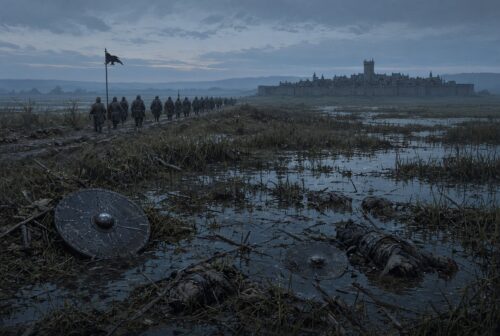
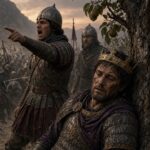
He does not reinforce the failing right. He spends it. He lets Morcar’s success pull the English left forward and out of line with Edwin’s right. The gap that opens is not large. It does not have to be. When the English wings lose contact, Hardrada orders the charge sounded and has Land-Waster carried straight into Edwin’s river flank. The Varangian habit is simple and ugly: a dense column of men with long axes hitting a shield wall that has already started to look two ways at once. Edwin’s line folds toward the Ouse. Men in mail go into the current. The river that was supposed to be a wall becomes a grave.
Once the river wing is broken, the Norwegian left wheels. Morcar’s men, who have been winning their private war against Tostig, discover that the war has moved behind them. The marsh that was supposed to be a wall becomes a second grave. The later Norse story, which should be read as poetry with mud on its boots, says the English dead lay so thick in the wet ground that a man could cross without wetting his feet. The Chronicle, which does not do poetry, says there was “much of the English people slain, and drowned, and driven away in flight,” and that the Northmen held “the place of carnage.”
Edwin and Morcar got off the field. That is almost the only mercy the day offered them. Their army, as an army, did not. Estimates vary because medieval numbers always do, but the shape is consistent across the thin sources: the northern host that could have stiffened Harold three weeks later was wrecked in a single morning. The fyrd of Yorkshire paid the heaviest bill. York opened its gates the next day. Hostages were given. Supplies were promised. Hardrada pulled back toward Stamford Bridge and Riccall to wait for the rest of what the city had agreed to bring him, and to let his men take off their mail in the September heat.
He thought he had bought the north.
He had bought five days.
## What the Winner Did Not Know He Had Purchased
Harold Godwinson left the south like a man who has just been told the house is on fire and the well is in the next county. The ride north is one of the famous forced marches in English memory, and it deserves the fame. Housecarls on horses, fyrd collecting as he passed, the king sleeping in the saddle if he slept. He was in Tadcaster on the 24th. On the morning of the 25th he came over the ridge at Stamford Bridge and found Hardrada’s men split, many of them without armor because the day was warm and they were waiting for hostages, not for a king who was supposed to be two hundred miles away.
That battle is a different story. Hardrada took an arrow in the throat. Tostig died on the same field as the brother he had spent a year trying to punish. Of the three hundred ships that had come up the Humber, the survivors needed only a couple of dozen to go home. Harold gave them the ships. He was not a fool about vengeance. He was in a hurry.
On 28 September, three days after Stamford Bridge, William of Normandy landed at Pevensey.
Harold turned around and marched south. The men who had just fought two battles in five days were asked to fight a third in three weeks. The northern earls, whose levies had been cut to pieces at Fulford, contributed little at Hastings. The housecarls who had survived the north were the same men who stood in the shield wall on Senlac ridge until the light went and the feigned retreat — a trick Hardrada had already used on them in spirit at Fulford — pulled gaps in the line. Harold died there. The kingdom changed hands.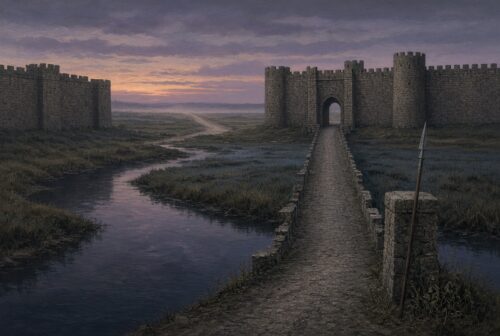
Fulford does not get the songs because Fulford looks, on a simple scoreboard, like someone else’s victory. Hardrada won the field. York submitted. The raven banner moved forward. Then the winner walked into a trap of his own making, and the loser of Fulford became the man who had to fight William with a half-spent army. The real product of 20 September was not a Norwegian kingdom in England. The real product was a thinner English army on 14 October.
That is why the ditch matters. It did not decide who would rule. It decided how tired the man who still had to decide would be when the deciding came.
## The Small Mechanics That Ate a Morning
A few details are worth keeping because they are the sort of thing a chronicle shrugs at and a soldier does not.
The tide. The Ouse at York is tidal. A spring tide in the third week of September could turn the beck from a crossing into a moat and back again in the space of a morning. Whoever timed his attack to the falling water got to choose whether the ditch was a shield or a snare. Hardrada had come upriver on tides. He thought in tides.
The banner. Land-Waster was not decoration. In a shield-wall fight the banner is the only instrument that can move a thousand men at once. When it dips and comes forward, the men under it have been told that this is the hour, not the next one. Hardrada had used that grammar from Kiev to Sicily. Edwin’s Mercians had not been standing under it for twenty years.
The youth of the English command. Morcar and Edwin were not cowards. They were unseasoned against a man who had been a professional killer since he was fifteen. The difference is not moral. It is inventory. Hardrada’s household troops included men who had stood in the Hippodrome and on Sicilian ridgelines. The Yorkshire fyrd included men who had been cutting barley ten days earlier.
The unfought option. York’s walls. The week of delay. The arrival of the king. Every account that bothers to wonder why the earls came out ends in the same silence. They came out because coming out felt like action, and sitting felt like surrender. The field rewarded the man who already knew the difference.
The brother. Tostig is the sour joke at the center of the year. He could not hold Northumbria. He could not beat his brother in a fair council. He could not even keep a fleet together until he found a Norwegian king to hide behind. He could, however, make sure that the northern earls would fight rather than talk, because the sight of him on the other bank turned a strategic problem into a family insult. History is full of great causes. It is also full of younger brothers who would rather burn the hall than eat at the low table.
## What the Day Was For
By nightfall on 20 September the Norwegians owned the meadows south of York. The English dead were in the river and the reed beds. The living were inside the city or scattered up the roads. The next morning the leading men of York came out and agreed to terms: hostages, supplies, no further resistance, and a promise that the north would accept Hardrada as king. It was a clean Viking success of the old style — land, submit, winter, expand.
It was also the last clean Viking success of the old style.
Within a month the man who won Fulford was in the ground at Stamford Bridge and the man who lost Fulford was in the ground at Hastings and the crown of England was on a Norman head. The ditch had done its work. It had spent the force that might have met William with a full north and a fresh king. It had taught, at the price of a kingdom, a lesson that does not fit on a memorial stone.
The lesson is not “be careful.” The lesson is narrower than that.
## The Fulford Refusal
Most advice borrowed from battles is costume jewelry. Stand firm. Trust your brothers. Wait for the right moment. All true, all worn smooth, all available on a thousand pages that will not change what you do after breakfast.
Fulford offers a harder instrument.
Call it the Fulford Refusal: you do not convert a delaying position into a decisive battle when the force that would make the battle worth fighting is already on the road.
The earls had a wall, a week, and a king moving north. They traded all three for the chance to look like the men who stopped an invasion at the city gate. They got a morning of local courage and a year that ended in someone else’s language. Hardrada had the opposite problem and made the opposite error five days later: he assumed the man on the road could not arrive, took off his mail, and paid for the assumption with his throat. Both mistakes are the same mistake wearing different helmets. Both are the refusal to treat time as a weapon.
Here is a plan that does not look like the plans that already exist.
### The Twenty-Day Unfought Wall
For the next twenty days — the span from Fulford to Hastings, shortened so a person can actually finish it — you run a single practice.
- Name the York.
Write one sentence that identifies the position you already hold that buys time: a skill that still works, a relationship that still answers, a reserve of money or health or reputation that has not been spent, a project that is ugly but standing. This is the wall. You are not allowed to dress it up. If it is a boring wall, it is still a wall.
- Name the Harold.
Write one sentence that identifies the reinforcement that is actually coming if you do not panic: a payment that clears on a date, a body of work that finishes if you stop interrupting it, a decision that becomes possible after one more cycle of rest or practice, a person whose help is real but not instantaneous. This is the force on the road. If you cannot name it, you do not have one, and the rest of the plan changes (you sit behind the wall and build a Harold instead of inventing a battle).
- Draw the beck.
On a single index card, list the invitations that will arrive in twenty days asking you to leave the wall and fight in the open: the argument that wants an immediate answer, the side project that wants your best hours, the public slight that wants a reply, the clever new plan that wants you to abandon the dull one that is already working. These are Tostig’s banners. They are designed to make sitting look like cowardice.
- Install the Refusal.
Before noon each day, you take the card and mark any invitation that would spend the York garrison before Harold arrives. You do not answer it with a better argument. You answer it with a delay that has a date. “I will deal with this on day twenty-one.” The sentence is boring on purpose. Fulford was lost by men who could not stand to be boring for a week.
- Keep a drowned-man count.
Each evening you write three lines, no more: what you refused, what it cost in pride, what it saved in the thing you named as Harold. If a day has no refusal, you write “no beck today.” The point is not journaling. The point is to make the unfought fight as visible as the fought one. The earls never counted the army they would need on 14 October. That is why 20 September felt like a solution.
- Ban the Land-Waster hour.
Once in the twenty days you will want to settle something forever before the reinforcement arrives. That urge will feel like courage. It is Hardrada ordering the banner forward because the other wing is busy. You are forbidden to use your best energy on a flank fight during this window. Best energy goes to keeping the wall standing and the road open. Secondary energy may swat mosquitoes. Primary energy does not.
- End with a field inventory, not a feeling.
On the morning of day twenty-one you look at the York and the Harold and ask only one question: did the wall hold long enough for the road to produce what it said it would produce? If yes, you may now choose a field, because you are no longer the earls on Wednesday morning. If no, you extend the wall. You do not invent a narrative in which the ditch was destiny.
That is the whole machine. It is not a morning routine. It is not a gratitude list. It is not a vision board. It is a rule for not spending the army you will need for the battle that is actually on the calendar.
The humor in it, if you want humor after a morning of drownings, is that almost every disaster that feels like fate is a Fulford: a fight accepted because the alternative was to look like a man waiting for help. The Northumbrian fyrd did not lack heart. It lacked a commander willing to be accused of hiding while a Norwegian king walked up the Ouse. Heart without a wall is how you get a saga. A wall with a date is how you still have an army when the next fleet beaches.
York is still there. The Ouse still turns. The beck still fills when the tide is high. The racecourse and the houses have covered most of the ground, which is fitting. The important part of 20 September 1066 was never a monument. It was a decision made in a few hours by men who could see the city behind them and could not stand to use it.
They went out.
The ditch did the rest.
Keep the wall. Let the road finish. Fight the battle that still has an army in it.
Share: