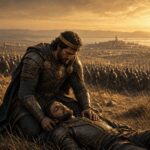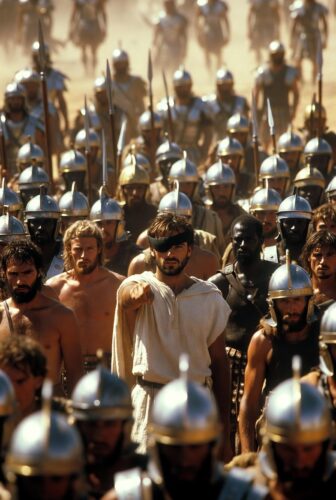

Picture a river that refuses to hurry. The Dee at Glyndyfrdwy in mid-September is brown, looping, and indifferent. On Thursday, 16 September 1400, a few hundred men stood on the high ground above it. They were not an army. They were cousins, brothers-in-law, a dean from St Asaph, tenants from the Berwyn, and a gentleman who until that morning had still believed the English courts might eventually notice him. They proclaimed Owain ap Gruffudd Fychan, lord of Glyndyfrdwy and half of Cynllaith, Prince of Wales. Then they went looking for a town to burn.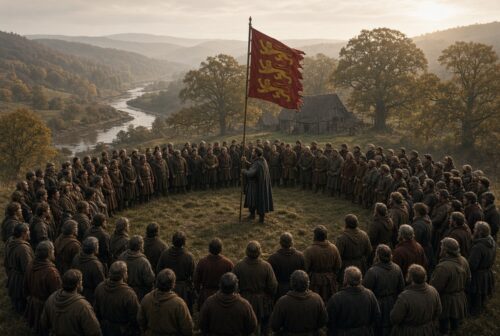
That is the whole plot in one paragraph. Everything else is the long, expensive, half-successful, half-vanished consequence of a man deciding that a neighbor’s fence line and a king’s silence were no longer private inconveniences.
Wales in 1400 was not a blank map waiting for a hero. It was a country that had already been conquered, catalogued, and taxed for more than a century. Edward I’s wars of the 1270s and 1280s had ended the independent principality of Gwynedd. Llywelyn ap Gruffudd died in 1282. His brother Dafydd was hanged, drawn, and quartered the following year. The Statute of Rhuddlan in 1284 carved the old kingdoms into shires, planted English boroughs with exclusive trading rights, and left the Welsh gentry as a tolerated class of local managers rather than rulers. Castles rose at Conwy, Caernarfon, Harlech, Beaumaris. English sheriffs collected the rents. Welshmen could still hold land by the old tenures, but they could not hold the offices that mattered, and they paid more for the privilege of existing.
The poets never accepted the arrangement. They kept reciting the old genealogies and the even older prophecies of a deliverer, the Mab Darogan, the Son of Destiny who would drive the foreigners back into the sea. By the late fourteenth century those poems had a convenient living candidate. Owain Glyndŵr’s father, Gruffudd Fychan, descended from the last prince of Powys Fadog. His mother, Elen, carried the blood of the Lord Rhys of Deheubarth and, through earlier marriages, a thin but usable thread back to the house of Gwynedd. In a society that still treated ancestry as a legal argument, that pedigree was not decoration. It was a spare claim sitting in a drawer.
Owain himself spent most of his first forty years looking like the opposite of a rebel. He was born around 1359. He inherited a comfortable patchwork of estates: the vill of Glyndyfrdwy in the Dee valley and half the commote of Cynllaith, with its moated hall at Sycharth. Sycharth was not a fortress. It was a statement of belonging. Iolo Goch, the best-paid poet of the age, described it in loving, slightly envious detail: a timber hall with nine bedrooms, a chapel, a mill, a dovecote, a fishpond, an orchard, a vineyard, a deer park, and enough income—perhaps seventy pounds a year—to keep a gentleman’s household in wine and praise-poems. Owain married Margaret Hanmer, daughter of a distinguished English-Welsh judge. He served in the Scottish campaigns of 1384–85 as a man-at-arms under Sir Gregory Sais. He testified in the famous Scrope versus Grosvenor heraldry trial in 1386. In 1387 he and his brother Tudur helped smash a Flemish wine fleet off Margate and came home with eight thousand tuns of other people’s cargo. He was never knighted. That small omission would later look like a clue.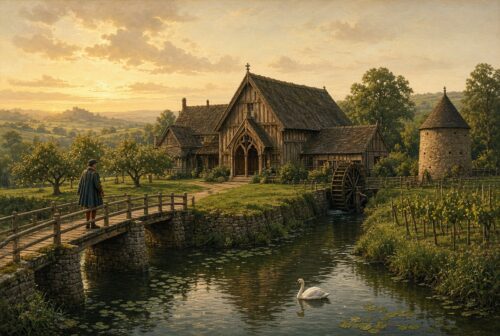
He was, in short, an assimilated Marcher gentleman who spoke the language of both sides of the border and expected the system to work for people like him. Then the system changed kings.
In 1399 Henry Bolingbroke deposed Richard II and crowned himself Henry IV. Richard had been popular in parts of Wales; many Welsh gentry had worn his livery. Henry was lord of Brecon, Monmouth, Kidwelly, and Ogmore—English interests planted deep in Welsh soil. He needed money. He needed loyalty. He did not need another round of petitions from a Welsh squire about a disputed field.
The field belonged, in Owain’s view, to him. Reginald Grey, third Baron Grey of Ruthin, thought otherwise. Grey was the classic Marcher predator: an English lord whose estates ran right up against Owain’s, who had the new king’s ear, and who understood that possession plus delay equals ownership. Owain went to law. The petition reached parliament. Parliament, or at least the men who mattered in it, reportedly dismissed the Welsh as “bare-footed idiots.” Grey then performed the second insult. Henry IV summoned his tenants for a Scottish campaign in the summer of 1400. Grey was supposed to pass the summons to Owain. He did not, or he passed it so late that compliance was impossible. When Owain failed to appear, Grey’s circle in London began calling him a traitor. Lands could now be declared forfeit. A comfortable life had been converted, in a few months, into a legal trap.
On 16 September 1400 Owain stopped petitioning.
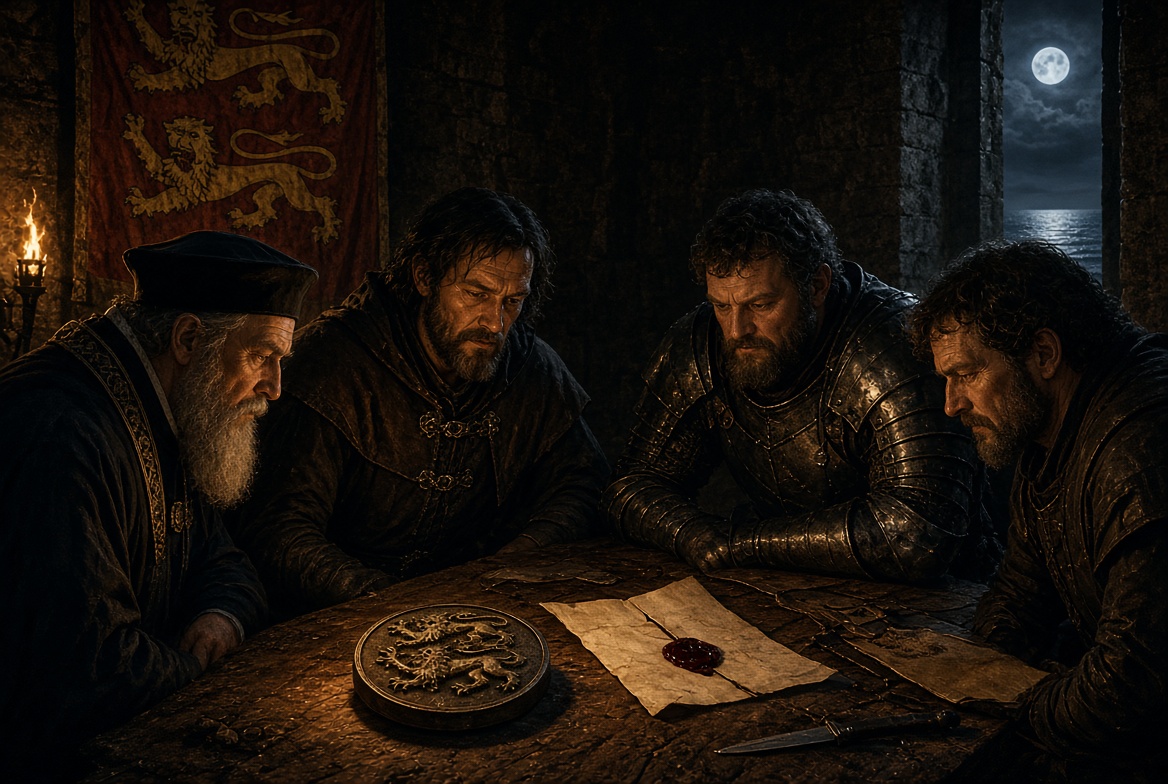
The gathering was small and deliberate. Sources put it at Glyndyfrdwy rather than Sycharth, though the two halls were only a day’s ride apart and later tradition likes to shuffle them. About three hundred men: Owain’s eldest son Gruffudd, his Hanmer brothers-in-law, the Dean of St Asaph, local freeholders from the Berwyn. They did not draft a manifesto for the newspapers. They performed a ceremony that everyone present already understood. They named him Prince of Wales, invoked the four lions of Gwynedd that would soon appear on his seal, and accepted that the next move would have to be violence because the previous moves had been paperwork.
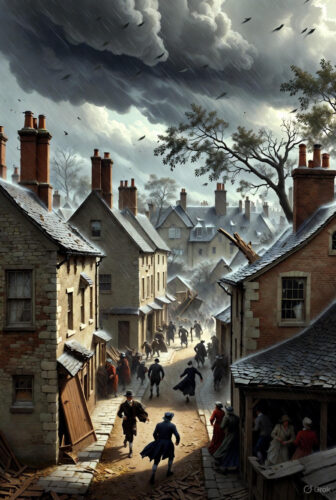
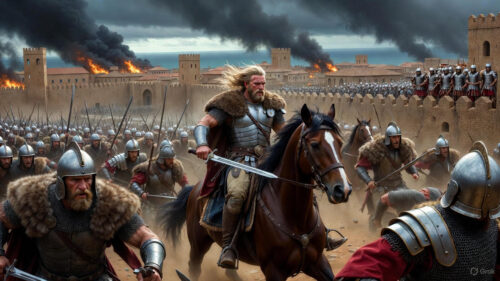
Two days later they hit Ruthin. It was fair day. The town was full of English traders and Grey’s people. The Welsh burned it. Then they kept moving: Denbigh, Rhuddlan, Flint, Hawarden, Holt, Oswestry, Welshpool. In six days they had turned a private grievance into a string of smoking market towns. Henry IV, just back from Scotland, swung south, reached Shrewsbury by 26 September, harried Anglesey, burned the Franciscan house at Llanfaes, and discovered that the Welsh melted into the hills the moment a royal column appeared. By mid-October the king was back in Worcester with very little to show except a new list of outlaws.
The revolt should have ended there. Most medieval uprisings did. Instead it thickened.
In April 1401 Owain’s cousins, the Tudor brothers of Anglesey—Rhys and Gwilym ap Tudur—walked into Conwy Castle on Good Friday dressed as carpenters, killed the gate guards, and held the place for three months. It was a theatrical, almost comic operation that announced the rebellion had friends in the north-west. In May or June Owain himself won his first proper field fight at Mynydd Hyddgen on the flanks of Pumlumon. A few hundred Welsh and a handful of French or Scottish adventurers smashed a larger force of English and Flemish settlers. Two hundred of the enemy died. The rest ran. Word traveled faster than royal messengers.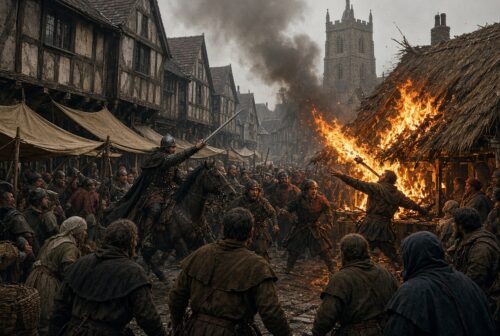
Henry IV answered with a punitive march that burned Strata Florida Abbey and executed a monk for good measure. The gesture produced the opposite of submission. Laborers started selling cattle to buy weapons. Students left Oxford and Cambridge and walked home. Bards became unofficial couriers. The English parliament of 1402 passed a fresh set of penal laws: Welshmen could not buy land in England, hold senior office, bear arms in the boroughs, or have their children apprenticed there. An Englishman who married a Welsh woman lost certain rights; a Welshman who married an English woman was penalized. Public assembly was restricted. The laws were meant to isolate the rebels. They recruited for them.
1402 was the year the revolt stopped being a regional nuisance. In late winter Owain ambushed and captured Reginald Grey himself. Grey sat in a Welsh prison for nearly a year until Henry IV paid a ransom large enough to sting. In June, at Bryn Glas near Pilleth, Owain’s men destroyed an English force under Sir Edmund Mortimer. Mortimer was taken alive. Henry IV refused to ransom him. Mortimer was too close to the old royal line; paying for him would have acknowledged a rival claim. So Mortimer switched sides, married Owain’s daughter Catrin, and became the rebellion’s most useful English aristocrat.
By 1403 the south had joined. Owain marched down the Tywi, took Carmarthen, burned Abergavenny, seized Cardiff and Newport. A Franco-Breton contingent appeared off the coast. In Glamorgan a Welsh army that included French troops beat an English column at Stalling Down. Prince Henry—the future Henry V, still a teenager—retaliated by burning Sycharth and Glyndyfrdwy. Iolo Goch’s beloved hall with the nine bedrooms and the vineyard went up in smoke. Owain did not come home to rebuild it. He kept moving.
The high-water mark arrived in 1404–1405. Harlech and Aberystwyth castles fell. Owain held court at Harlech, appointed a chancellor named Gruffydd Young, and summoned a parliament to Machynlleth. Envoys came from France, Scotland, and Castile. The assembly sketched an independent Wales: two universities, one north and one south; the old laws of Hywel Dda restored; an independent Welsh church that would no longer take orders from Canterbury. In March 1406, from the church of St Peter ad Vincula at Pennal, Owain wrote to Charles VI of France. The Pennal Letter is one of the few surviving documents in which a medieval rebel states a program instead of a grievance. He offered to recognize the Avignon pope Benedict XIII if France would send real help. He wanted a sovereign principality, not a bigger farm.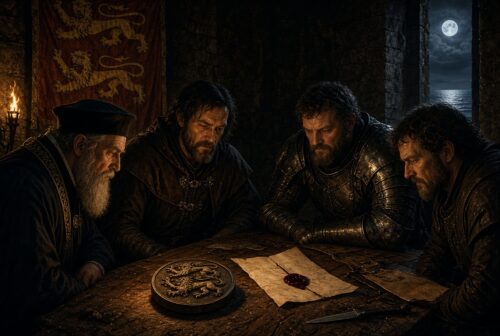
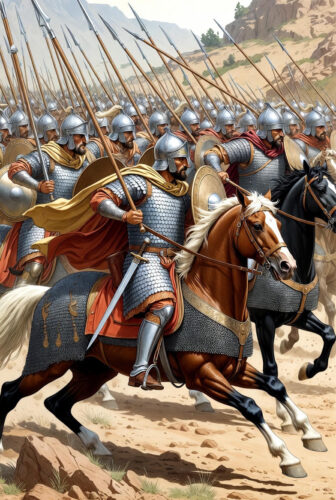
France did send help. A French army landed in 1405. Together the allies pushed through south Wales and, in one of the oddest near-misses of the century, marched to the outskirts of Worcester. Henry IV’s army faced them. Neither side quite dared a full battle. The French, unpaid and homesick, eventually sailed home. The weather, the logistics, and the usual medieval inability to keep a coalition fed did what English chivalry had not.
After 1406 the tide turned with the slowness of a siege. English forces under the young Prince Henry adopted a policy of blockade and attrition rather than heroic chevauchées. They retook Anglesey. They won ugly fights at Grosmont and Pwll Melyn near Usk; hundreds of Welsh prisoners were beheaded in a single afternoon. Owain’s brother Tudur died. His son Gruffudd was captured and sent to the Tower, where he later died. Aberystwyth surrendered in 1408 after cannon—the first recorded use of artillery in Britain—were dragged against its walls. Harlech, the last great prize, held until 1409. When it fell, Owain’s wife Margaret, two daughters including Catrin, and three Mortimer grandchildren were taken to London. Most of them died in captivity before 1415. Edmund Mortimer himself died during the final fighting.
Owain was not in the castle when it opened its gates.
He slipped away. In 1410 a raid into Shropshire failed and several of his remaining captains were executed in the old spectacular style: hanged, drawn, quartered, heads on bridges. In 1412 he still had enough friends to ambush and ransom the famous Welsh loyalist Dafydd Gam. After that the record thins to rumor. On 21 September 1415—St Matthew’s Day in harvest—someone noted that he was still in hiding. Then nothing. No scaffold, no signed submission, no body produced for the crowd. Henry V, once he was king, offered pardons. Owain never collected one.
The English did not get the satisfaction of a public death. The Welsh did not get a restored principality. What they got instead was a story that refused to end cleanly. Later generations decided he was sleeping in a cave with his men, waiting for the hour when Wales would need him again. Shakespeare turned him into Owen Glendower, a magician who could call spirits from the vasty deep. Nineteenth-century nationalists put his face on banners. In 2000 the Welsh Assembly opened on the six-hundredth anniversary of the proclamation. Glyndŵr Day is still marked every 16 September.
The revolt failed in the only sense that medieval revolts are allowed to fail: it did not replace one dynasty with another. It succeeded in every other sense that actually lasts. It proved that a mid-level gentleman with a good pedigree, a burning hall, and a talent for not being where the enemy expected him could keep the richest kingdom in western Europe off-balance for a decade and a half. It produced the first recognizably national Welsh political program. It left behind a set of penal laws so harsh they became an advertisement for the thing they were trying to kill. And it gave the country a prince who never signed the paper that would have made his defeat official.
That is the history. The rest is what you do with a man who discovered that the court would never rule in his favor and therefore stopped appearing in it.
The practical inheritance is not “believe in yourself” or “never give up.” Those slogans fit on mugs and die there. Glyndŵr’s actual method was narrower and more useful.
– He audited the exact moment the old channel closed. The withheld summons and the mocked petition were not background color. They were data. After they happened, further letters to the same address were a hobby, not a strategy.
– He converted a private injury into a public jurisdiction in a single afternoon. The proclamation was theater, but it was theater with a seal, a title, and an immediate raid so that the new claim had a body count before sunset.
– He built parallel institutions instead of begging to be admitted to the existing ones. A parliament at Machynlleth, a chancellor, a foreign policy, a church plan, two imaginary universities. None of them survived intact. All of them proved the English system was not the only conceivable operating system.
– He mastered disappearance as a tactic, not a tragedy. When the castles fell he did not stage a last stand for the chroniclers. He became weather. The enemy could burn the hall; they could not produce the man.
– He let poets and genealogies do part of the fighting. The four lions and the Mab Darogan prophecy were not branding. They were pre-existing software that thousands of people already ran in their heads. He simply executed the program.
Here is the plan that does not exist on any other self-help page because it is not self-help. It is a scaled, time-boxed recreation of the Glyndyfrdwy sequence. Call it the Fifteen-Week Principality. It takes one neglected domain of your life—the project you keep explaining to people who do not have the power to help, the skill you keep asking permission to use, the claim you keep submitting to the same indifferent office—and treats it as a stolen field.
Week zero, the Thursday. Choose the domain. Write a one-page charter that states, in plain language, that you are no longer petitioning the previous authority for recognition inside that domain. Date it. Sign it. If you want ceremony, read it aloud to three people who will not laugh or, if you prefer Glyndŵr’s actual ratio, to no one. That is the proclamation. It costs an evening.
The next forty-eight hours are Ruthin fair. Perform one irreversible, visible, slightly rude action that makes the new claim real. Publish the work without the usual gatekeeper. Send the invoice. File the alternative document. Move the money. Burn the equivalent of a market stall—nothing illegal, nothing theatrical for its own sake, just one deed that cannot be quietly undone by the old court. Then stop announcing.
The following fifteen weeks are the revolt proper. You will not hold a press conference. You will conduct small, frequent, hard-to-map operations: two hours before dawn or after dark, three days a week, always on the same neglected front. Keep a private log with dates and outcomes the way a medieval clerk kept a roll. Do not share the log. The point is not motivation. The point is to accumulate facts on the ground until the previous authority is responding to your reality instead of the other way around.
At the end of week fifteen you perform the Harlech maneuver. You do not request a meeting to discuss progress. You withdraw the old identity that used to do the asking. Change one public signal—the title on the account, the address that received the rejections, the weekly habit of checking the same inbox for a reply that will never come. You are not hiding from work. You are denying the enemy the satisfaction of a captured prince.
If the domain still matters after that, you may negotiate from the new position. If it does not, you have lost a hall and gained a disappearance, which is the better half of the bargain Owain actually collected.
The weather in the Dee valley on 16 September 1400 was ordinary. The men who stood there were not especially numerous or well-armed. They had simply reached the last day on which asking nicely was still a respectable option. They used the day. The rest of us are still living in the long echo of a Thursday when a gentleman with a burned vineyard decided the map would have to be redrawn by people who no longer appeared on it.
Share: