
On the night of July 24–25, 1261, a small force of roughly eight hundred men, the majority of them Cuman horsemen in the service of the Empire of Nicaea, slipped toward the massive Theodosian Walls of Constantinople. They were not the main army. They had not been ordered to take the city. Their commander, the aristocratic general Alexios Strategopoulos, had been sent on a routine reconnaissance and watch mission along the Bulgarian frontier and the approaches to the Latin capital. What he found instead was an almost empty city, its garrison and its Venetian fleet away on a raid, and a narrow secret passage near the Gate of the Spring that local Greek farmers knew how to open from the inside.
By dawn the Latin Empire of Constantinople was finished. Baldwin II, the last Latin emperor, fled with whatever he could carry. Venetian warehouses along the Golden Horn burned. The Queen of Cities, lost in the catastrophic Fourth Crusade of 1204, belonged once more to a Greek emperor. The restored Byzantine Empire under the Palaiologos dynasty would last nearly another two centuries.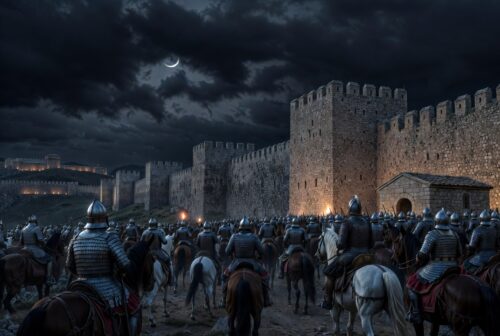
This is not a story of overwhelming force or brilliant multi-year strategy. It is a story of timing, local knowledge, hesitation overcome by opportunity, and the quiet decision to walk through a door that history had left unlocked for one night only.
### The Long Shadow of 1204
To understand why a side force of eight hundred men could accomplish what larger armies had failed to do, one must begin with the trauma of April 1204. The Fourth Crusade, originally preached against Egypt and the Holy Land, had been diverted by Venetian commercial interests, unpaid transport debts, and the ambitions of a young Byzantine pretender. Crusader and Venetian forces stormed Constantinople, the largest and richest city in Christendom. For three days the city was sacked. Churches were stripped. The Hagia Sophia was desecrated. Ancient bronzes were melted. Relics that had drawn pilgrims for centuries were carted west. The Byzantine Empire, already strained by internal intrigue and external pressure, shattered.
In the partition that followed, Baldwin of Flanders was crowned Latin emperor in the Hagia Sophia. Venice received three-eighths of the city and strategic islands and ports. The remaining Byzantine territories fractured into successor states. In northwestern Asia Minor the Empire of Nicaea formed under Theodore Laskaris and his successors, preserving the administrative and military traditions of the old empire and claiming legitimate succession. In the mountains of Epirus another Greek state took shape. On the Black Sea coast the Empire of Trebizond established itself under a Komnenian branch. Further fragments and local warlords filled the gaps. The Latin Empire itself controlled little more than Constantinople, parts of Thrace, and a few surrounding districts, constantly short of money, men, and legitimacy among the Greek population it ruled.
The Latin regime never recovered the prosperity of the city it had seized. By the mid-thirteenth century the Latin emperors were reduced to desperate expedients. Baldwin II pawned the Crown of Thorns and other relics to Western lenders. He is said to have sold the lead from the roof of the Blachernae Palace simply to raise cash. The once-great imperial city had become a diminished outpost, dependent on Venetian naval power and occasional reinforcements from the West that arrived too late or in too small numbers. Greek inhabitants in the surrounding countryside and even within the walls retained their language, their Orthodoxy, and their memory of a lost empire. Some of them would prove decisive in 1261.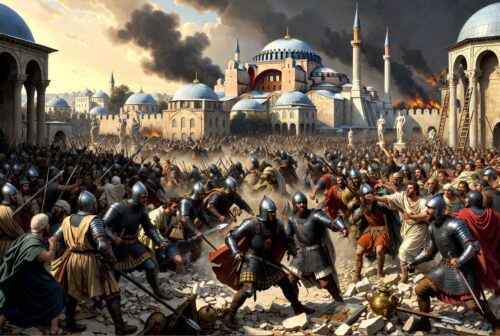
### Nicaea’s Steady Climb and Michael’s Ruthless Ascent
While the Latins struggled, the Empire of Nicaea consolidated. Under John III Doukas Vatatzes the state expanded in Asia Minor, absorbed refugees, and built a functioning administration and army that included both Greek troops and Cuman and other Turkic auxiliaries. Theodore II Laskaris continued the work but died in 1258, leaving a seven- or eight-year-old son, John IV. Power struggles followed. Michael Palaiologos, a capable and ambitious aristocrat with Komnenian connections and a record of military service (including periods of exile and service among the Turks), maneuvered into the regency. Within months he had himself proclaimed co-emperor. The child John IV was sidelined; after the reconquest he would be blinded and imprisoned, a dark stain on the legitimacy of the new dynasty that never fully washed away.
Michael VIII proved an energetic ruler. In 1259 his forces won the decisive Battle of Pelagonia against a coalition of Epirotes, Latins, and Sicilians, removing the most immediate threat to Nicaean expansion in Europe. He negotiated the Treaty of Nymphaeum with Genoa in March 1261, securing a naval ally against Venice. He launched an unsuccessful attack on Constantinople itself in 1260, attempting to exploit a promised betrayal of a gate that never materialized and then turning against Galata. The city still looked impregnable behind the double land walls and the sea defenses, and a one-year truce followed.
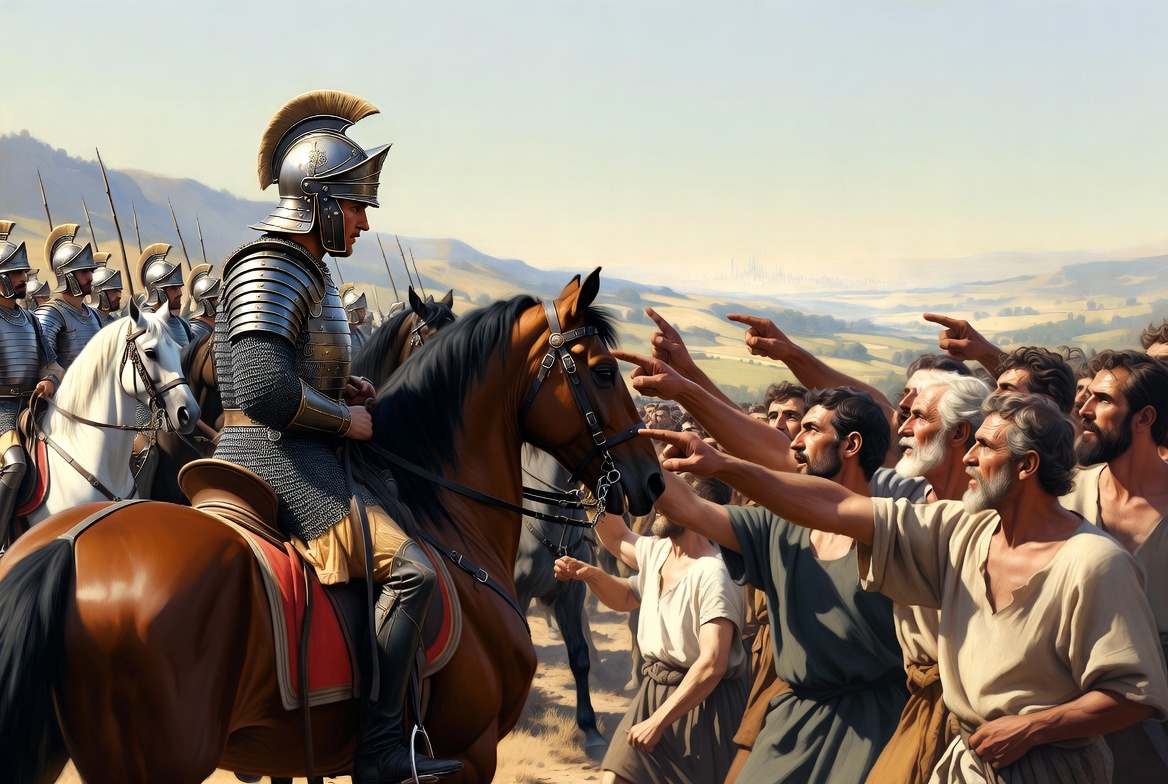
In July 1261, with the truce about to expire, Michael sent Alexios Strategopoulos, recently raised to the rank of Caesar after earlier campaigns and a period of captivity, with a modest force of about eight hundred men—mostly Cumans—to watch the Bulgarians and to reconnoiter the approaches to Constantinople. It was a secondary mission. No one expected the capital to fall that summer.
### The Opportunity at Selymbria
Strategopoulos reached the village of Selymbria, roughly thirty miles west of the city. There independent local Greek farmers, known as *thelematarioi*—men who lived in a kind of voluntary or semi-independent status on the fringes of the Latin regime—brought startling news. The entire Latin garrison and the Venetian fleet had left the city on a raiding expedition against the Nicaean-held island of Daphnousia in the Black Sea. Constantinople was defended by a skeleton force at best.
The general hesitated. His orders did not include an assault. His numbers were tiny against the famous walls that had held off Persians, Avars, Arabs, and Bulgars for centuries. If the Latins and Venetians returned quickly, his detachment could be annihilated. Yet the opportunity was extraordinary. A prolonged siege with the full Nicaean army might take months or years and invite Western intervention. A sudden stroke while the defenders were absent might succeed with almost no bloodshed.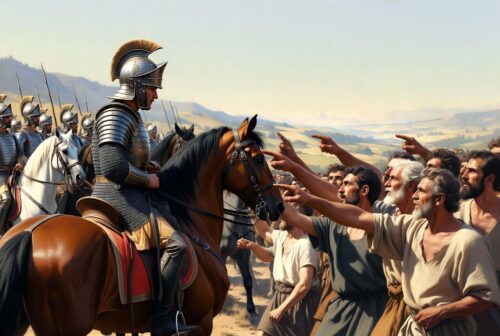
He decided to try.
### The Night of the Gate of the Spring
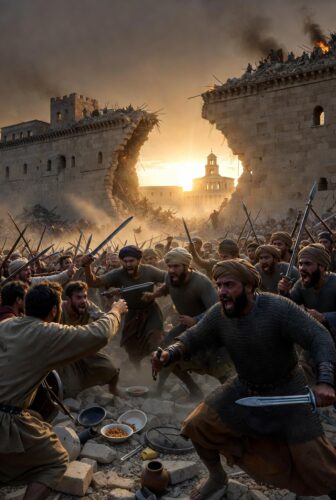
On the night of 24–25 July the small force approached the walls near the Gate of the Spring (the Pege Gate, also associated with the Selymbria Gate area). They hid at a nearby monastery. A detachment, guided by the local *thelematarioi* who knew the terrain and the defenses intimately, made its way through a secret passage or postern that allowed them to enter the circuit of the walls from within. They surprised the sparse guards, opened the gate, and admitted the main body of Strategopoulos’s men.
There was a short struggle for control of the Theodosian land walls. Once the Nicaeans held sections of the wall-walk and towers, panic spread through the Latin population. Emperor Baldwin II and the remaining Latin residents fled toward the harbors of the Golden Horn, hoping for ships. Strategopoulos’s troops set fire to Venetian warehouses and buildings along the waterfront to prevent any easy return or landing by the absent fleet. When the Venetian ships did return from the failed Daphnousia raid, they found their quarter burning and the city already lost. They could do little more than evacuate as many Latins as possible to remaining Latin holdings in Greece.
The reconquest was astonishingly bloodless by the standards of the age. The great city that had required a massive crusader-Venetian assault in 1204 fell to a reconnaissance force that had not even been intended to attack it.
### Aftermath and the New Reality
Word reached Michael VIII. On 15 August 1261, the feast of the Dormition of the Theotokos, he made a triumphal entry into Constantinople. He was crowned in the Hagia Sophia. The restored Byzantine Empire was proclaimed. Strategopoulos received high honors and a triumphal reception; the event was commemorated in church services for years afterward.
The recovery was incomplete and the empire that emerged was a shadow of its pre-1204 self. Asia Minor remained vulnerable. The western provinces were contested. Venice remained a hostile naval power. Michael’s focus on European threats and on securing recognition from the West (including the controversial Union of Lyons in 1274) diverted resources from the eastern frontiers that would later prove fatal. Yet the symbolic and practical importance of holding the capital cannot be overstated. The Palaiologos dynasty ruled from Constantinople until the Ottoman conquest of 1453—nearly two full centuries of additional imperial life that would never have existed without the events of that July night.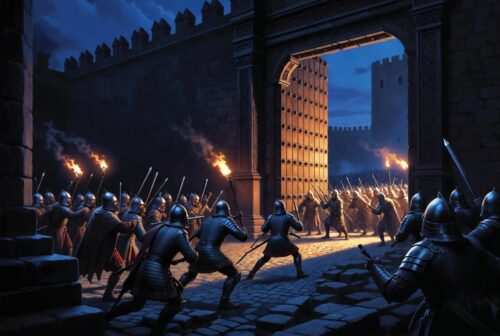
Alexios Strategopoulos himself had a checkered later career. He suffered defeats and captivity in campaigns against Epirus, was ransomed, and eventually retired, dying around 1275. His moment of glory was singular and almost accidental. That is precisely why it remains instructive.
### Why This Night Still Matters
The reconquest of 1261 demonstrates that history’s great reversals are not always the product of overwhelming preparation or inevitable momentum. Sometimes they arrive because a secondary force is in the right place, local people with quiet knowledge decide to share it, a commander overcomes legitimate caution, and a physical or institutional gap is exploited before it closes. The Latin Empire had survived for fifty-seven years behind walls and fleets; it collapsed in hours because those walls and fleets were momentarily elsewhere and because someone noticed.
### Applying the Outcome Today: The Pege Gate Protocol
The historical fact yields a specific, non-generic method for personal use. Most self-help frameworks preach endless preparation, positive visualization, or grinding consistency. The Pege Gate Protocol is different. It treats opportunity as a temporary physical or social aperture that must be entered with deliberately limited force, guided by unconventional local knowledge, and then locked behind you by deliberate disruption of the previous order.
Here is how a person benefits, translated into concrete, individual terms:
– You stop waiting for perfect conditions or full resources. The eight hundred men did not wait for the main army. They moved with what they had when the gap appeared.
– You cultivate and listen to peripheral, non-official sources of information—the modern equivalent of the *thelematarioi*. These are not the loud voices or institutional briefings; they are the quiet people who actually live next to the walls.
– You practice deliberate hesitation followed by decisive commitment. Strategopoulos paused, calculated the risk of annihilation, then chose. The protocol builds that exact sequence into decision-making rather than either impulsive action or permanent delay.
– You accept that the opening may close. The Venetian fleet was returning. Speed mattered more than elegance.
– You set controlled “fires” after entry—actions that make it costly or impossible for the old problem or rival claim to reassert itself easily.
– You claim the symbolic capital of the recovered territory quickly (Michael’s formal entry and coronation) so that the change becomes psychologically and socially real for everyone involved, including yourself.
### The Detailed, Quick, Unique Plan: The Pege Gate Protocol in Practice
This is not a thirty-day challenge or a morning routine. It is a repeatable operational sequence designed for moments when a genuine, time-sensitive opening appears in a long-standing constraint—career stagnation, financial limitation, creative block, relational pattern, or personal project that has been stuck for years.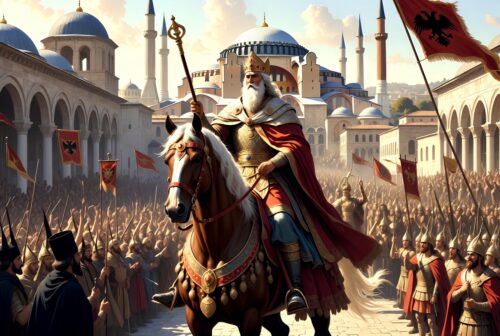
- **Maintain a permanent low-level reconnaissance posture.** Once a week, spend ninety minutes in a domain adjacent to your main goal but not inside it. Talk to people who operate at the edges—suppliers, former employees of a target company, independent contractors, neighborhood regulars, online forums of practitioners rather than influencers. Record only concrete, verifiable details about absences, temporary weaknesses, or overlooked access points. Do not seek inspiration. Seek maps of temporary emptiness.
- **Pre-identify your secret passages.** For every major long-term goal, list three physical, social, or procedural routes that are rarely used or poorly guarded. These might be an under-utilized application deadline, a secondary contact who can introduce you without formal process, a technical workaround, or a quiet time of day when decision-makers are absent. Keep the list short and concrete. Update it monthly. These are your Pege Gates.
- **When an opening is reported, run the hesitation filter.** Ask only three questions in writing within one hour of receiving the information: (a) What is the absolute minimum force I can commit that still has a chance of success? (b) What is the realistic time until the gap closes? (c) What irreversible cost will I pay if I fail? If the answers show a survivable downside and a closing window measured in days rather than months, proceed. If not, return to reconnaissance. This is the exact filter Strategopoulos applied.
- **Enter with the smallest viable force and local guidance.** Commit only the resources you can afford to lose entirely. Bring or consult one or two people who actually know the terrain from the inside. Move at night—metaphorically or literally—when attention is lowest. Do not announce. Do not seek permission from the old structure.
- **Immediately set the fires.** Within the first twenty-four to forty-eight hours after successful entry, take one concrete action that raises the cost of reversal: cancel an old contract, publish a public statement of the new status, relocate key assets, change passwords and access, or formally notify relevant third parties. The goal is to make the previous occupants’ return expensive and public.
- **Stage the formal claim.** Within one week, create a visible, irreversible marker of ownership—file the paperwork, announce the change to the necessary audience, move into the new physical or digital space, or hold the equivalent of a private coronation ritual that makes the new reality feel solid to you. This prevents the psychological reversion that often follows unexpected success.
- **Stand down the main army.** Do not immediately pour every resource into the recovered territory. Consolidate, observe what the new position actually requires, and only then expand. Over-commitment after sudden success was a recurring Byzantine error after 1261; the protocol avoids it by design.
Repeat the cycle. Most openings are smaller than the reconquest of a capital city. The protocol scales down cleanly. A temporary absence of competition, a short window of institutional distraction, a local source who knows an unadvertised path—these are the modern equivalents of the empty garrison and the farmers who knew the tunnel.
The Latin Empire lasted fifty-seven years because its walls and fleet were usually present. It ended in a single night because, for once, they were not, and because a small force noticed and walked through the resulting gap. The restored empire that followed was imperfect, embattled, and ultimately finite. Yet it existed. The difference between continued exile and a capital recovered was measured in hours and in the decision to use a secret passage while it remained open.
That is the historical fact of July 25, 1261. The rest is what you choose to do with the next opening that appears in your own walls.
Share: