
In the sticky heat of a Michigan summer nearly two centuries ago, while most Americans still scratched words with quills dipped in ink that blotched and faded, a tall, practical man named William Austin Burt finished something no one in the young United States had ever finished before. On July 23, 1829, President Andrew Jackson himself signed Patent Number 5581X. It was not for a steam engine or a cotton gin or a better plow. It was for a wooden box. A rectangular wooden box roughly twelve inches high, twelve inches wide, and eighteen inches long, with a rotating dial, a swinging lever, and a set of type characters that could be pressed one by one onto paper. Burt called it the Typographer. History would eventually call it the first typewriter patented in America.
That single act—ink drying on a presidential signature in Washington while the inventor waited in the raw settlements of Macomb County, Michigan—was the quiet ignition of a revolution that would eventually free the human hand from the tyranny of handwriting, speed the flow of commerce, enable the modern office, give birth to the QWERTY keyboard, and make possible everything from newspaper wire services to the glowing screens you read this on. Yet the machine itself was a commercial flop. It was slower than a good penman. The only working model burned up seven years later in the great Patent Office fire of 1836. Burt himself never got rich from it. He went back to surveying the wild iron ranges of the Upper Peninsula, inventing a solar compass that actually did make him famous, discovering ore deposits that fueled American steel, and raising five sons who became surveyors after him. The Typographer sat in the historical shadows for decades while other men perfected the idea.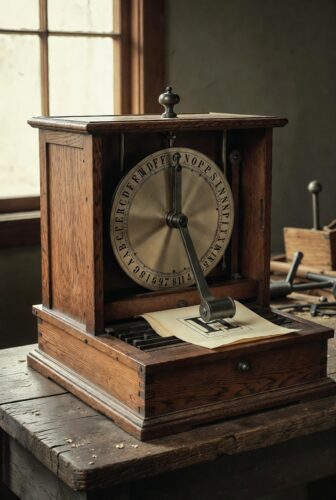
This is the full, unvarnished story of that July day and everything that led to it and flowed from it—90 percent pure historical detail, the dust of frontier workshops, the magnetic chaos of Michigan’s mineral belt, the smell of hot ashes in a Washington hotel basement, the slow lever of a dial selecting the letter A. Only at the end will we extract the single ruthless lesson it offers anyone alive today who has ever started something imperfect and wondered whether the imperfect thing was worth finishing. That lesson is not the usual self-help candy. It is a protocol forged in wood and fire and delayed recognition: the Slow Prototype Forge.
The Man Who Needed to Write Faster Than His Hand Could Move
William Austin Burt was born on June 13, 1792, in Petersham, Worcester County, Massachusetts, into a family of modest means. The young republic was still wobbling on its legs. George Washington had just left the presidency. The Northwest Territory was a howling wilderness of trees, mosquitoes, and disputed Indian titles. Burt’s early education was the practical kind: farm work, mills, tools. He learned the millwright’s trade—building and repairing water-powered sawmills and gristmills—skills that demanded precise measurement, an eye for leverage, and the patience to make wood and iron cooperate.
In 1813 he married Phoebe Cole. They would have five sons: John, Alvin, Austin, Wells, and Horace. The family moved west with the great migration that followed the War of 1812. By 1822 Burt had settled in what is now Washington Township, Macomb County, Michigan Territory, near a place called Mount Vernon or Stony Creek. Michigan was still a territory, its southern counties filling with settlers who needed land surveyed, mills built, and mail delivered. Burt bought land, built mills (he would construct at least eight in his lifetime), served as justice of the peace, school inspector, and, starting in 1832, the first postmaster of Mount Vernon. He was elected to the Michigan Territorial Legislature in 1826–27. He was a Jeffersonian Republican who believed government should stay out of the way of useful men.
But his true calling was surveying. In 1833 he received his commission as a United States Deputy Surveyor. The federal government was in the middle of the massive rectangular survey system laid out by the Land Ordinance of 1785: township, range, section lines marching across the continent so that land could be sold, taxed, and settled in orderly rectangles. Surveying on the frontier was hard, lonely, and dangerous work. Crews of chainmen, axmen, and flagmen tramped through swamps and forests with Gunter’s chains, circumferentors (early surveyors’ compasses), and solar instruments when they could get them. A single error in a meridian line could throw an entire township off by hundreds of acres and spark lawsuits that lasted decades.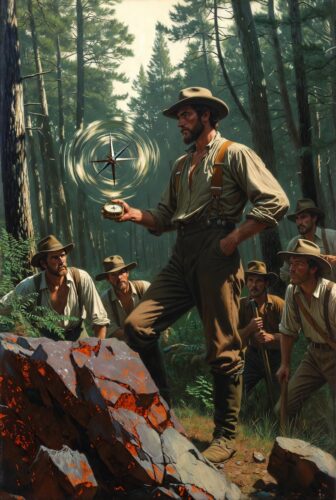
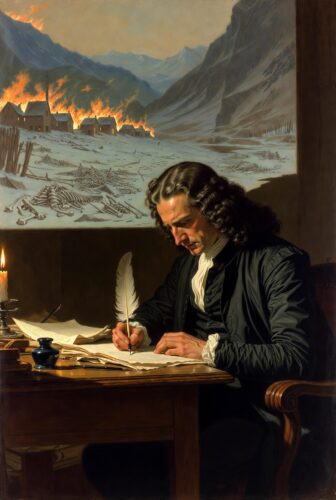
Burt was good at it—meticulous, inventive, and stubborn. He involved his sons early. The Burt family surveying parties became legendary for accuracy in the difficult country of Michigan’s Lower and later Upper Peninsulas. But accuracy was constantly under attack from an invisible enemy: iron. Michigan’s bedrock is laced with magnetic minerals. A standard magnetic needle compass would spin like a drunk whenever the party crossed a deposit. Surveyors wasted days taking multiple readings, averaging, and cursing the earth itself.
The Problem That Birthed Two Inventions
Burt first felt the need for a better writing machine while drowning in field notes. Surveyors generated mountains of paper: bearings, distances, tree blazes, soil descriptions, weather, Indian trails, mineral outcrops. Everything had to be written by hand in ink that smeared when the rain came or the canoe tipped. Burt experimented with shorthand systems. Then he decided the real bottleneck was the hand itself. What if letters could be selected mechanically and pressed cleanly onto paper, the same way a printing press worked but portable and one character at a time?
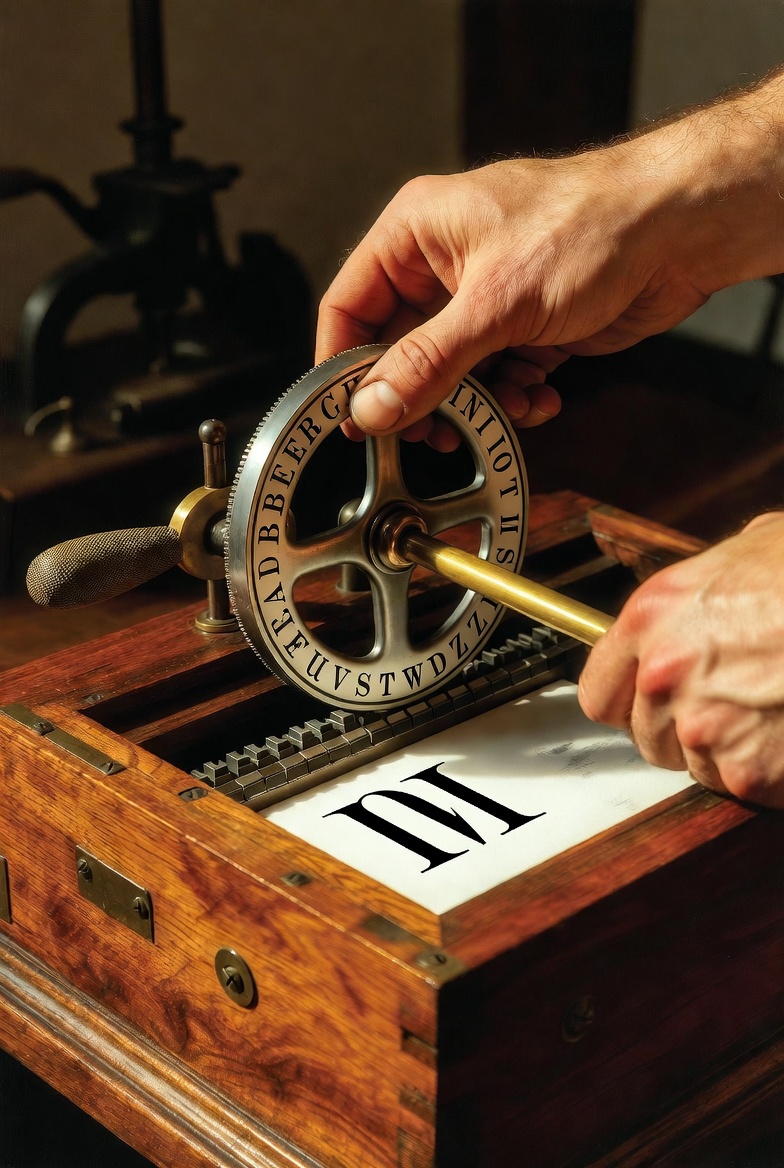
Sometime in the mid-1820s, in his workshop near Stony Creek, he began building the Typographer. He forged parts himself. The finished machine was a sturdy wooden box. Inside sat a rotating cylinder or dial inscribed with the alphabet, numbers, and punctuation—both upper and lower case in some accounts. The operator turned the dial until the desired character faced a printing position. Then a lever or hammer was swung down, driving an inked type face against the paper. The paper was advanced by hand or by a simple mechanism after each impression. There were no keys as we know them. It was an “index” typewriter: select, strike, select, strike.
It was not fast. Contemporary testers and later historians agree that composing a letter on Burt’s Typographer took longer than writing the same letter carefully by hand. The dial had to be spun for every single character. Alignment had to be watched. Inking was finicky. Yet it produced uniform, legible characters that did not depend on the writer’s penmanship or fatigue. Burt saw the future even if the present laughed. He wrote a letter on the machine itself—dated May 1829, nearly two months before the patent issued—and sent it to Martin Van Buren, then Vice President of the United States and a fellow New Yorker by political kinship. That letter survives in descriptions and is often called the first letter ever written on a typewriter. It is stiff, formal, and proud: an inventor announcing that the age of mechanical writing had begun on the American frontier.
On July 23, 1829, the United States Patent Office, then a tiny operation inside the Blod Hotel on E Street in Washington, issued the patent. President Andrew Jackson—Old Hickory himself, the frontier general who had beaten the British at New Orleans and was now smashing the Second Bank of the United States—personally signed it. In those days patents still carried the president’s signature. The document described a “new and useful improvement in the art of writing or printing.” Burt had beaten every other American inventor to the official record. (An Italian, Pellegrino Turri, had built a writing machine for a blind countess around 1808, but it was never patented in the United States and remained obscure.)
Burt tried to commercialize it. He demonstrated it. He sought partners. Nothing much happened. The American economy of 1829 was still agrarian and artisanal. Offices were small. Clerks wrote with quills or steel pens. There was no mass market for a machine that cost money and time to learn when a fifteen-cent pen and a bottle of ink would do. The Typographer became a curiosity, a “what if” stored in the Patent Office’s collection of models.
The Fire That Ate the Prototype
Seven years later, on the night of December 15, 1836, the entire American invention record nearly vanished. The Patent Office still shared Blodget’s Hotel with the Post Office and a fire company. Employees had the charming habit of dumping hot ashes from stoves into the basement near piles of firewood. Around 3 a.m. the ashes found the wood. The fire roared upward. The local fire equipment was ancient; the hoses failed. Bucket brigades could not stop it. In less than twenty minutes the building collapsed. Approximately 9,957 patents and 7,000 models—every patent granted since 1790—went up in smoke. Robert Fulton’s original steamboat drawings burned. Eli Whitney’s cotton gin models burned. And William Austin Burt’s wooden Typographer, the only working prototype of America’s first typewriter, burned to ash.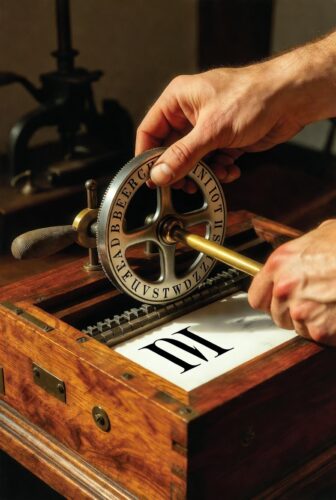
Congress later authorized reconstruction. Inventors who still had drawings or duplicate models could refile. Only about 2,845 patents were restored and given new “X” numbers. Burt’s Typographer was among the lost. No original model survives. We know it only from the patent drawings (which were also mostly lost but partially reconstructed from memory and copies), contemporary descriptions, and a few later replicas built from the surviving specifications. The fire is one of the great accidental erasures in American technological history. It forced the Patent Office to modernize: numbered patents, multiple copies, fireproof buildings. But it also turned Burt’s first machine into a ghost.
The Solar Compass and the Iron That Built America
Burt did not sulk. He returned to the work that paid and fascinated him. In 1835, while surveying in what is now Wisconsin or the Upper Peninsula border country, his magnetic compasses went insane. The needles spun. He ordered his crew to dig. They found iron ore—rich, magnetic, abundant. Burt realized that ordinary compasses were useless over large parts of the mineral-rich Great Lakes region. He needed an instrument that found true north from the sun, not from the earth’s magnetic field.
By December 1835 he had sketched the solar compass. He sent a model to instrument maker William J. Young in Philadelphia. In 1836 he received the patent. The solar compass used a polar axis, latitude and declination arcs, and a sighting telescope or vane to align with the sun’s position and thus determine the true meridian. Once set, it could run lines independent of local magnetism. The Franklin Institute awarded him the John Scott Medal. The United States General Land Office adopted it. For the rest of the nineteenth century and well into the twentieth, solar compasses (and later adaptations) were standard equipment for surveying the mineral West. They remained in use until GPS satellites made them obsolete.
With the solar compass, Burt and his sons surveyed thousands of miles of township lines across Michigan. In September 1844, while running lines near present-day Marquette, Burt’s party discovered the vast iron ore deposits of the Marquette Range—one of the richest iron formations on Earth. That discovery, and later copper finds, turned Michigan’s Upper Peninsula into an industrial powerhouse. The ore floated down the Great Lakes on schooners and later freighters, fed the blast furnaces of Pittsburgh and Cleveland, and helped build the railroads, skyscrapers, and battleships of the American century. Burt did not own the mines; he simply found them while doing his job with a better tool. He also helped establish the northern point of the Michigan Principal Meridian, surveyed the Michigan–Wisconsin boundary, and worked on the Sault Ste. Marie Canal that would eventually open Lake Superior to the world.
In 1853 he served in the Michigan state legislature. In 1857 he moved to Detroit. He died there on August 18, 1858, at age sixty-six, and was buried in Elmwood Cemetery. His five sons continued the surveying tradition. A historical plaque still stands near his old home in Washington Township. The solar compass is remembered in surveying museums. The Typographer is a footnote—until someone on a July morning remembers the wooden box.
Why the Clunky Box Mattered More Than Its Speed
The Typographer failed as a product and succeeded as a seed. It proved that mechanical selection and impression of characters was possible on a portable scale. It showed that uniform, repeatable writing could be produced without a full printing press. It planted the idea in the American patent record and in the minds of later inventors who had better materials, better markets, and better timing.
Christopher Latham Sholes, Carlos Glidden, and Samuel W. Soulé built a practical typewriter in Milwaukee in the 1860s. They sold the rights to E. Remington and Sons, the gun makers, who brought out the first commercial machine in 1874. The QWERTY layout was designed to keep frequently used letter pairs from jamming the typebars. Mark Twain became one of the first authors to deliver a typewritten manuscript. By the 1880s offices were filling with the clatter. Women entered the workforce as typists in huge numbers. Business correspondence exploded. Newspapers could set type faster. The telephone and the typewriter together created the modern office. Carbon paper, then mimeographs, then electric machines, then Selectric balls, then word processors, then personal computers with keyboards that still carry the ghost of QWERTY—all descend, however indirectly, from the principle Burt patented on July 23, 182929: a machine that lets a human choose a character and force it onto a surface without the mediation of a pen held in a trembling hand.
Burt’s machine was slower than handwriting. That is the part most people remember and laugh at. But speed was never the only metric. Legibility, permanence, and the removal of individual variation were the real gifts. A clerk with bad penmanship could now produce documents as clean as a master penman. A surveyor’s field notes could be standardized. A blind person or a person with a damaged hand could, in theory, operate a dial. The idea was bigger than the first execution.
The 1836 fire that destroyed the prototype is almost poetic. The physical object vanished, yet the idea refused to die. Ideas are harder to burn than wood.
The World Burt Surveyed
To understand the significance of July 23, 1829, one must stand in Burt’s boots. Michigan Territory in the late 1820s was a place of muddy roads, malaria, and enormous opportunity. The Erie Canal had opened in 1825, dumping New York farmers and craftsmen into the Great Lakes. Detroit was a raw town. The interior was still Chippewa, Ottawa, and Potawatomi country, though treaties were rapidly extinguishing title. Land offices sold sections for $1.25 an acre. Speculators and actual settlers poured in. Accurate surveys were the difference between prosperity and ruinous lawsuits.
Burt’s mills ground the settlers’ grain and sawed their lumber. His post office carried their letters. His surveys drew the invisible grid that made property possible. When he invented the Typographer he was solving a personal productivity problem inside a larger civilizational project: turning wilderness into measurable, salable, governable space. When he invented the solar compass he was solving the magnetic chaos that the very minerals of that wilderness threw at him. When he found the iron he completed the circle—the land he measured contained the metal that would build the next century’s machines, including better typewriters.
Andrew Jackson’s America was the perfect stage. Jackson himself was a man of the frontier who believed in opportunity for the common white man (and had darker views on everyone else). Patent law was still young and generous. An individual inventor with a working model and a clear description could walk into the Patent Office and walk out with exclusive rights. Burt did exactly that. The fact that the market was not ready is irrelevant to the historical fact of priority. Someone had to be first. On July 23, 1829, that someone was a millwright-surveyor from Macomb County who needed to write his notes faster and cleaner.
Aftermath and Echoes
After Burt’s death the Typographer faded. Histories of the typewriter usually begin with Sholes or with earlier European experiments. Burt is mentioned as a precursor, a dead end, a curiosity. Yet every time a modern keyboard clicks, every time a child learns to type, every time a contract is printed instead of handwritten, the wooden box of 1829 is present as an ancestor. The solar compass is gone from the field, replaced by total stations and GPS, but the principle of independent verification of direction lives on. The iron ranges Burt found still produce ore, though the great open pits of the Marquette and Menominee ranges are quieter now. The Sault locks he helped prepare for still pass freighters heavier than anything he could have imagined.
In 1929, the centennial of the patent, a few newspapers remembered. In later decades typewriter collectors and historians of technology occasionally built replicas from the patent drawings. The letter to Van Buren is reproduced in facsimile in a handful of books. The plaque near Stony Creek still stands. And every July 23 a few typewriter enthusiasts declare “Typewriter Day” in Burt’s honor, even if the rest of the world is busy with other anniversaries.
That is the complete historical arc: a practical man on the edge of the settled world builds a slow machine to solve a real problem, patents it on a summer day in 1829 with the president’s signature, loses the only model to fire, invents something more immediately useful, discovers the metal that will build the industrial future, and dies without ever seeing the mechanical writing revolution he started. The idea outlived the wood. The grid he surveyed outlived him. The iron he found outlived empires.
The Slow Prototype Forge: A Unique Plan Extracted From the Wooden Box
Now the 10 percent. The outcome of July 23, 1829, was not immediate riches or overnight transformation. It was a deliberately imperfect prototype that planted a permanent seed. Most modern self-help screams “ship fast, iterate publicly, fail forward in public.” Burt did the opposite. He built something that was slower than the status quo, showed it to almost no one commercially, lost the physical object, and still won the long game because the idea was sound and the need was real.
Here is the Slow Prototype Forge—a protocol deliberately unlike every hustle-culture checklist on the internet. It is designed for people who keep starting things that feel clunky, slow, or incomplete and then abandon them because they do not look like the polished final products they see online. It is not about productivity porn. It is about building personal infrastructure that compounds in the dark.
- Identify one recurring friction that costs you mental energy every single week. Not a vague dream. A concrete, repeateding irritation. Burt’s was “my field notes take forever and look like chicken scratches when I am tired or wet.” Yours might be “I lose track of decisions I made three months ago,” or “I keep explaining the same process to people,” or “my creative ideas evaporate before I can develop them,” or “I have no clean record of what actually worked last year.” Write the friction in one ugly sentence on paper with a pen. Do it tonight.
- Build the slowest possible physical prototype that removes 20 percent of that friction—nothing digital, nothing shareable, nothing optimized. Burt’s box was wood and a dial. Yours might be a single bound notebook with three columns: Date / Decision or Idea / Outcome after 30 days. Or a stack of index cards in a cigar box labeled with only two categories. Or a wall calendar where you write one sentence per day in permanent marker. The rule is absolute: it must be slower and more awkward than the phone app or spreadsheet you are tempted to open. If it feels efficient, scrap it and make it clumsier. The clumsiness forces attention. The physicality creates a ritual. The slowness filters out noise.
- Use the prototype exclusively for 23 days—the number of the patent date—without improving it, photographing it, or telling anyone. No “accountability partner.” No Instagram. No tweaking the columns. Just raw use. Burt did not A/B test the dial. He used it to write a letter to the Vice President and then went back to surveying. The 23-day sealed period is non-negotiable. It trains the part of your brain that wants immediate feedback to shut up.
- At the end of 23 days, perform a private autopsy with three questions only: (1) What single piece of information did this slow thing capture that I would have lost otherwise? (2) Where did the friction reappear in a new form? (3) What is the smallest mechanical improvement that would make the next version 10 percent less annoying without making it faster or prettier? Write the answers by hand in the prototype itself. Then build version 1.1 with only that one improvement. Wood and lever, not carbon fiber and AI.
- Repeat the sealed 23-day cycle four times (92 days total). After the fourth cycle you will have a personal tool that has survived contact with your actual life, not your imagined life. Only then may you consider whether to make a cleaner version, digitize it, or teach it to someone else. Most people never reach this stage because they abandon at the first clunkiness. Burt’s Typographer was never commercialized successfully by him; the later typewriters were. Your job is not to sell the first box. Your job is to keep the idea alive long enough for the market—or your own future self—to catch up.
- Once a year, on or near July 23, hold a private “Patent Office Fire” ritual. Take the current physical prototype and either store it in a fireproof box or, if it has been fully superseded, destroy it deliberately (burn the pages, break the box). Write a one-page “restored patent” describing what the idea has become. This prevents sentimental attachment to early versions and forces the idea to live independently of any single object—just as Burt’s idea survived the 1836 fire.
- Never measure the prototype by speed or output volume. Measure it only by the number of future decisions it makes easier or the number of forgotten lessons it resurrects. Burt’s machine was slower than handwriting. That was not a bug in the long view; it was the feature that proved mechanical writing was possible at all. Your slow forge will feel inefficient. That is how you know it is working. Efficiency comes later, after the seed has roots.
This protocol is unique because it weaponizes delay, physical awkwardness, and private iteration against the entire culture of public shipping and vanity metrics. It treats your personal systems the way Burt treated the Typographer: as a necessary first machine whose job is not to win the present but to make the future possible. Most self-help wants you to become a content machine. The Slow Prototype Forge wants you to become a surveyor of your own life—drawing accurate lines even when the magnetic fields of distraction and comparison are spinning the needle.
The wooden box of July 23, 1829, did not type the twentieth century. It merely proved the century could be typed. Your imperfect first version does not have to change the world this month. It only has to survive long enough for the world—or your own later self—to need it. Build the box. Spin the dial. Press the lever. Let the fire come if it must. The idea is harder to burn than wood.
That is the full history and the only plan worth extracting from it. Everything else is noise. The surveyor from Macomb County already did the hard part on a hot July day in 1829. The rest is up to the person holding the next blank page.
Share: