
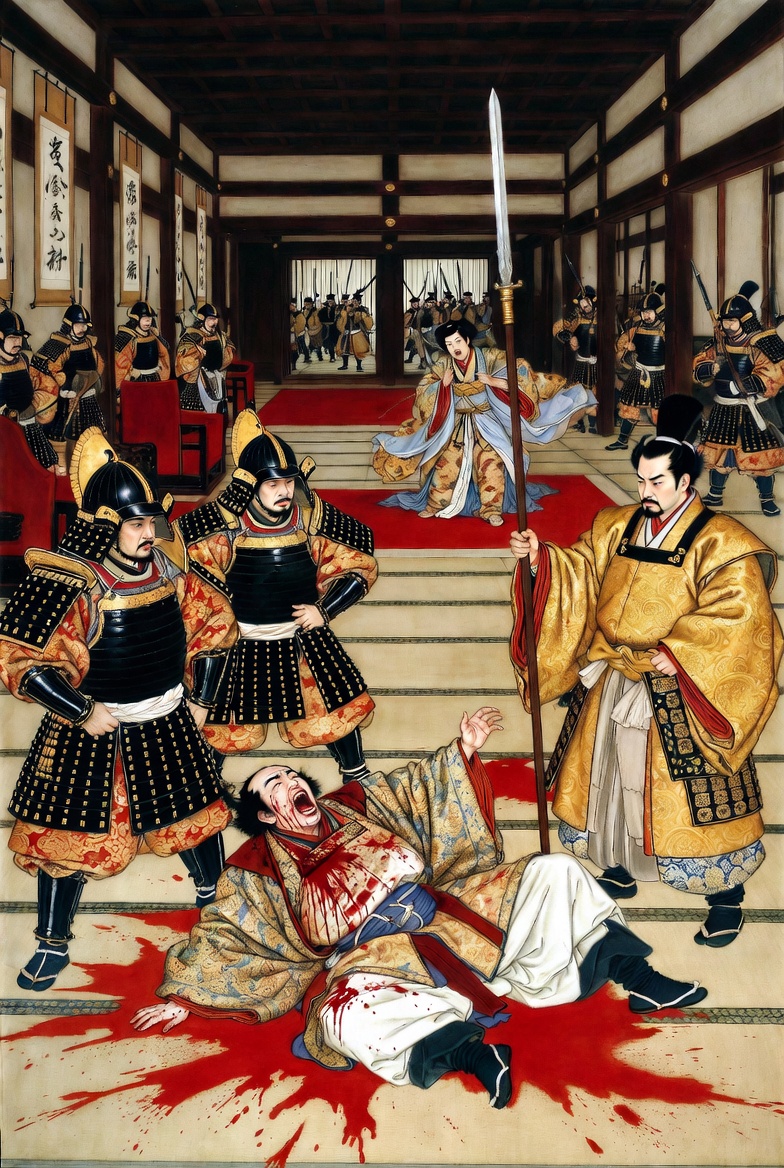
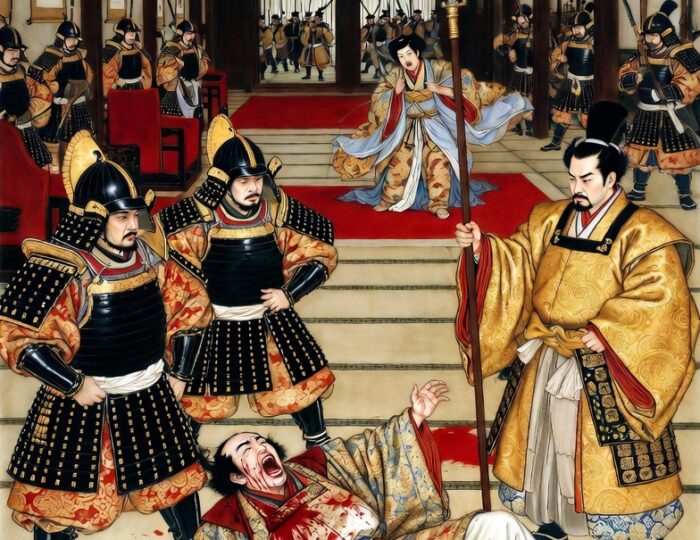
Picture the humid heat of an Asuka summer morning in the year 645. The imperial palace hums with the stiff formality of a court ceremony. Korean memorials from the Three Kingdoms are being read aloud. Courtiers stand in their places. Empress Kōgyoku sits in state. And then a young prince named Naka no Ōe decides that enough is enough. He grabs a spear that has been carefully hidden in the hall and drives it into the head and shoulder of the most powerful man in Japan, Soga no Iruka. Blood sprays across the polished floor. Iruka does not die immediately. He screams that he is innocent and demands an investigation. The hired assassins freeze in terror. The empress is horrified. And in that frozen, bloody second, Japanese history pivots on a single act of personal violence that no one else would commit.
This is the Isshi Incident—named for the sexagenary cycle year “Isshi”—and it remains one of the most dramatic, under-celebrated turning points in East Asian history. On July 10, 645, a conspiracy decades in the making finally exploded inside the palace, toppled the Soga clan that had effectively ruled Japan for generations, forced an empress to abdicate, and unleashed the Taika Reforms that dragged a loose federation of clans into something resembling a centralized state. The story is packed with cowardice, fire, suicide, lost books, Buddhist tonsures, and the raw nerve of a prince who, when his plan started to collapse, simply did the job himself.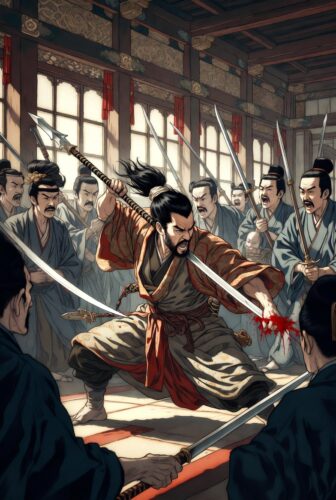
Let us walk through every grim, fascinating, and occasionally ridiculous detail.
### The Long Shadow of the Soga
To understand why a prince felt the need to open a man’s skull in front of the empress, you have to go back generations. In the Asuka period, Japan was not yet the tightly administered empire of later centuries. Power was a messy patchwork of uji—clans—bound by blood, marriage, and the occasional assassination. Among these, the Soga clan stood taller and more ruthless than the rest.
The Soga had risen through shrewd alliances with the imperial house and enthusiastic adoption of Buddhism and continental culture from Korea and China. Soga no Iname, then Soga no Umako, then Soga no Emishi, and finally Soga no Iruka stacked the court with their people. They married daughters into the imperial line. They controlled the great ministries. They decided which princes lived and which met unfortunate ends. Prince Shōtoku, the legendary statesman and Buddhist promoter of the early seventh century, had been a Soga ally, but after his death in 622 the clan’s grip tightened into something closer to monopoly. Emishi and his son Iruka treated the throne as a useful prop. When Prince Yamashiro no Ōe, a potential rival with Shotoku blood, became inconvenient, Iruka’s forces hunted him down and forced him and his family to suicide in 643. The message was clear: the Soga decided who got to breathe in the capital.
Nakatomi no Kamatari, head of a rival priestly clan that had traditionally handled Shinto rituals, watched this with growing fury. So did a young imperial prince, Naka no Ōe, son of the previous emperor and nephew (or close relative) of the reigning Empress Kōgyoku. The two men found each other. They shared a conviction that the imperial house had to reclaim real power or become a permanent puppet. They began recruiting. Quietly. Carefully. They won over Soga no Kurayamada no Ishikawa no Maro—himself a Soga but from a junior branch that resented the main line’s arrogance. They lined up a handful of warriors. They waited for the perfect stage.
### The Perfect Stage and the Perfect Failure
The perfect stage arrived on the twelfth day of the sixth month of 645—July 10 by modern reckoning. Envoys or memorials from the Three Kingdoms of Korea were to be presented. Ishikawa no Maro himself was scheduled to read them to the empress. The ceremony would gather the entire court, including the unarmed Iruka, inside the palace hall. Naka no Ōe’s preparations were meticulous in the extreme: the palace gates were to be closed and guarded by bribed men; a spear was concealed inside the hall; four armed assassins were positioned to strike the moment the reading began.
It almost went wrong in the most human way possible.
When the signal came, the four hired blades hesitated. Iruka’s prestige was so crushing that even men paid to kill him froze. Perspiration poured down one of them. The moment stretched. The reading continued. The plan teetered.
Naka no Ōe did not wait. He seized the spear himself, shouted, and charged. He slashed Iruka across the head and shoulder. Blood poured. Iruka staggered, still alive, and began protesting his innocence at the top of his lungs, demanding that the empress order an investigation into this outrageous attack. The hall erupted in chaos. Courtiers scrambled. The empress rose, shocked to her core by the violence committed in her presence—an act that, in Asuka-period thinking, polluted the sacred space around the sovereign.
Naka no Ōe now had to talk fast. He pleaded his case directly to Kōgyoku: Iruka was a tyrant who had murdered princes and stolen the realm. The empress, overwhelmed, withdrew into the inner palace to consider. The instant she left the room, the four previously useless assassins finally found their courage and finished Iruka off.
That was only the beginning of the day’s violence.
### Fire, Suicide, and Lost Histories
The next day, or very shortly thereafter depending on the exact chronology in the *Nihon Shoki*, Soga no Emishi learned that his son was dead and that the palace gates were held against him. He understood the game was finished. He ordered his residence set on fire and perished in the flames, taking with him a treasure trove of imperial records and treasures the Soga had “safeguarded.” Among the losses were a copy of the *Tennōki* (the imperial chronicles) and other irreplaceable documents. One quick-thinking official, Fune no Fubitoesaka, managed to snatch the burning *Kokki* (national history) from the fire and later delivered what remained of it to Naka no Ōe. Even so, entire chapters of early Japanese history went up in smoke that day because a clan chief preferred ashes to surrender.
With Emishi dead and the main Soga line extinguished, the court faced an immediate succession crisis. Empress Kōgyoku, polluted by the bloodshed and politically compromised, announced her intention to abdicate. She offered the throne first to Naka no Ōe himself. The prince, advised by the cool-headed Kamatari, refused. Accepting the throne so soon after murdering a minister in the palace would look like naked ambition and invite rebellion. Instead they turned to Kōgyoku’s younger brother, Prince Karu. On or around July 12–15, Karu ascended as Emperor Kōtoku. Naka no Ōe became crown prince. Kamatari received high office and the new family name Fujiwara. Another potential claimant, Furuhito no Ōe (Naka no Ōe’s brother), thoughtfully renounced any claim by shaving his head and becoming a Buddhist monk at Hōkō-ji temple. Problem solved with a razor.
### The Great Change: Taika Reforms
The blood had barely dried when the real work began. In 646 the new regime issued the Kaishin no Mikotonori—the Reform Edicts that gave the era its name, Taika, meaning “Great Change.” These were not mild suggestions. They were a deliberate attempt to import and adapt Tang Chinese models of centralized government and smash the old clan-based order forever.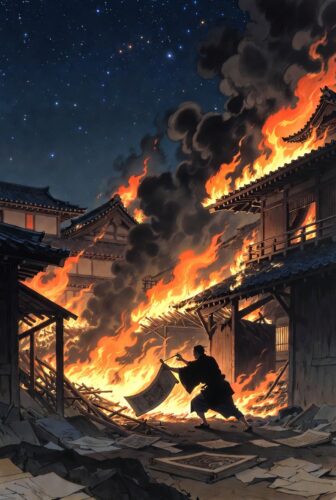
The four great articles and subsequent measures did the following, among much else:
All land and people were declared the property of the emperor. Private ownership of land and hereditary control of laborers by the uji were abolished. Land was to be surveyed, redistributed periodically according to household size, and returned to the state upon death. A new system of provincial governors (kuni no miyatsuko reorganized, later more fully bureaucratic) was imposed. Every free person over the age of six received an allotment of rice land in exchange for three taxes: so (a percentage of the harvest), yō (labor or alternative goods), and chō (special products or cloth). A census was ordered. Capital cities were planned on Chinese grid patterns. Official ranks and a rudimentary bureaucracy replaced pure hereditary privilege. Envoys and students were packed off to Tang China to study everything from law codes to architecture to court ritual.
The reforms were imperfectly enforced at first—old habits die hard, and local strongmen dragged their feet—but the direction was irreversible. Over the following decades and centuries the ritsuryō legal codes refined the system. The Fujiwara clan, founded by Kamatari, would dominate the court for five hundred years through marriage politics rather than open usurpation. The imperial house regained a theoretical monopoly on sovereignty that it has never fully lost, even through centuries of shoguns and modern constitutional monarchy. The Asuka and early Nara periods saw the flowering of a literate, Buddhist, administratively ambitious state that could build temples like Hōryū-ji and later the great capital at Heijō-kyō.
Without the spear on July 10, 645, none of that happens on the same timeline. The Soga might have continued their slow strangulation of the throne. Japan might have remained a looser collection of regional powers longer. The entire trajectory of Japanese state formation bends around that one decisive, messy, personal act.
The *Nihon Shoki* preserves the drama in laconic but vivid language. Iruka’s death, Emishi’s fiery suicide, the panicked courtiers, the empress’s withdrawal, the salvaged books—it is all there. Later chroniclers and artists would paint the scene: the prince mid-lunge, the blood, the frozen guards. It is one of the rare moments when the curtain of early Japanese history is ripped open and we see the raw mechanics of power: preparation, failure of nerve, individual will, irreversible consequence.
### Why It Still Matters Fourteen Centuries Later
The Isshi Incident is not just a colorful anecdote. It is a case study in how entrenched systems of control—family monopolies, administrative capture, cultural inertia—can be shattered by a small group that refuses to wait for permission. The Soga had the money, the marriages, the offices, and the terror. Their opponents had a plan, a spear, and one man willing to use it when everyone else choked. The result was not merely a change of personnel. It was a constitutional revolution that redefined what the Japanese state even was.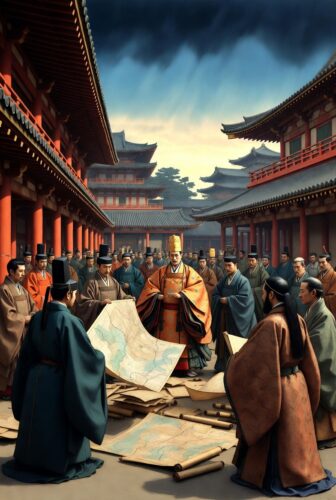
That is the historical core. Ninety percent of the story is the sweat, the steel, the fire, the lost manuscripts, the Buddhist razor, the land surveys, the Chinese models, the rise of the Fujiwara, the long shadow over everything that followed. The remaining ten percent is what any living person can steal from it.
### The Outcome Applied to Individual Life: Very Specific Bullets
– The Soga-style bottleneck in your life—whatever it is—does not usually fall to committees or polite requests. It falls when one person, at the critical ceremonial moment, decides the hired help is useless and grabs the spear themselves.
– Hesitation by others is not a reason to abort. It is the cue to act. The four assassins’ freeze was the exact second Naka no Ōe created history.
– Burning the old records (Emishi’s house) is messy and destroys some good things, but it also prevents the old power from reconstituting. Some bridges must be torched.
– Refusing the immediate crown (Naka no Ōe’s smart pass to Kōtoku) protects the long game. Seize the system, not the shiny title.
– Immediate, systemic redesign (Taika) locks in the gain. Killing the tyrant without rewriting the rules just installs a new tyrant.
### The Unique, Quick, Non-Self-Help Plan: The Spear of Personal Sovereignty Protocol
This is not morning pages, not habit stacking, not vision boarding, not any of the recycled listicles. This is a 72-hour historical reenactment protocol designed solely around the mechanics of the Isshi Incident. It is weird on purpose. It works because it hijacks the same psychological sequence that toppled a seventh-century clan.
**Hour 0 – Identify Your Iruka.**
Write one sentence naming the single entrenched force currently strangling your forward motion. It can be a job structure, a financial dependency, a toxic relational monopoly, a self-sabotaging routine, or a bureaucratic gatekeeper. Call it “Iruka” out loud. No metaphors. Name the actual thing.
**Hour 1–6 – The Closed Gates Ritual.**
Physically or digitally seal yourself off for six uninterrupted hours. Phone on airplane, door locked, no messages. During this time you prepare exactly three tools:
- One physical object that will serve as your “spear” (a pen, a letter, a key, a resignation draft, a delete button on an account, a plane ticket confirmation—something concrete).
- A short written indictment of Iruka’s crimes against your life, modeled on Naka no Ōe’s plea to the empress.
- A list of four “hired blades” who were supposed to help you and have not. Write their names. Then write “They will freeze.”
**Hour 6–24 – The Ceremony Simulation.**
Schedule or create a “court ceremony” moment—something formal and public enough that the old power structure feels secure. A weekly meeting, a family dinner, a project review, a bank appointment, a social media post window. You will bring the spear into that space.
**The Strike Window (exactly 90 seconds).**
When the moment arrives and the “reading of the memorials” (the usual polite talk) begins, you do not wait for consensus. You stand, deliver the indictment in 45 seconds or less, then execute the spear action immediately. If others freeze or protest, you finish the job yourself within the remaining 45 seconds. No debate. The empress (any authority figure present) can withdraw if she likes. You do not.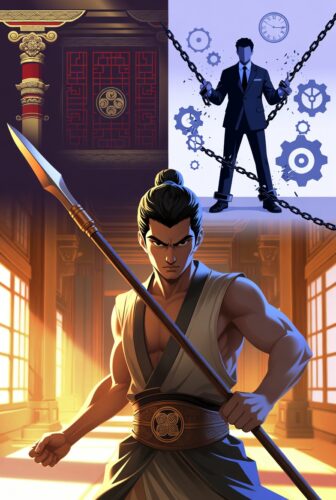
**Hour 24–48 – The Fire Protocol.**
Within 24 hours of the strike you destroy one tangible remnant of the old power: delete the email thread, burn the old contract copy, cancel the recurring payment, remove the photo, shred the document. Then you immediately issue your own mini-Taika edict: three new rules that redistribute “land and people” in your personal domain (time, money, attention, physical space). Write them on paper and post them where you will see them daily for 30 days.
**Hour 48–72 – The Tonsure and the New Calendar.**
Shave something symbolic (head optional; beard, nails, or just a dramatic haircut works). Then rename your personal era. Give the next 30 days a gengō-style name like “Great Unblocking” or “Spear Year One.” Announce it only to yourself or one trusted ally. Begin the first land survey: audit every hour of your week and reallocate at least 15 percent of previously “Soga-controlled” time to the new rules.
Repeat the full protocol only once every 90 days. It is not a daily habit. It is a surgical coup. The point is not endless self-improvement. The point is the occasional, irreversible seizure of sovereignty when the old clan has grown too comfortable.
Naka no Ōe did not meditate his way to a reformed Japan. He did not journal about abundance. He waited for the right ceremonial day, watched his support freeze, and then he grabbed the spear and opened a man’s head in front of the entire court. Everything that followed—the abdication, the fire, the reforms, the centuries of centralized power—flowed from that one ugly, decisive, personal act.
July 10, 645, was not polite. It was not gradual. It was not committee-approved. It was a prince deciding that the system would not reform itself, so he would reform it with steel and blood and then rewrite the rules so the old monsters could never return.
That is the history. That is the lesson. Grab the spear.
Share: