
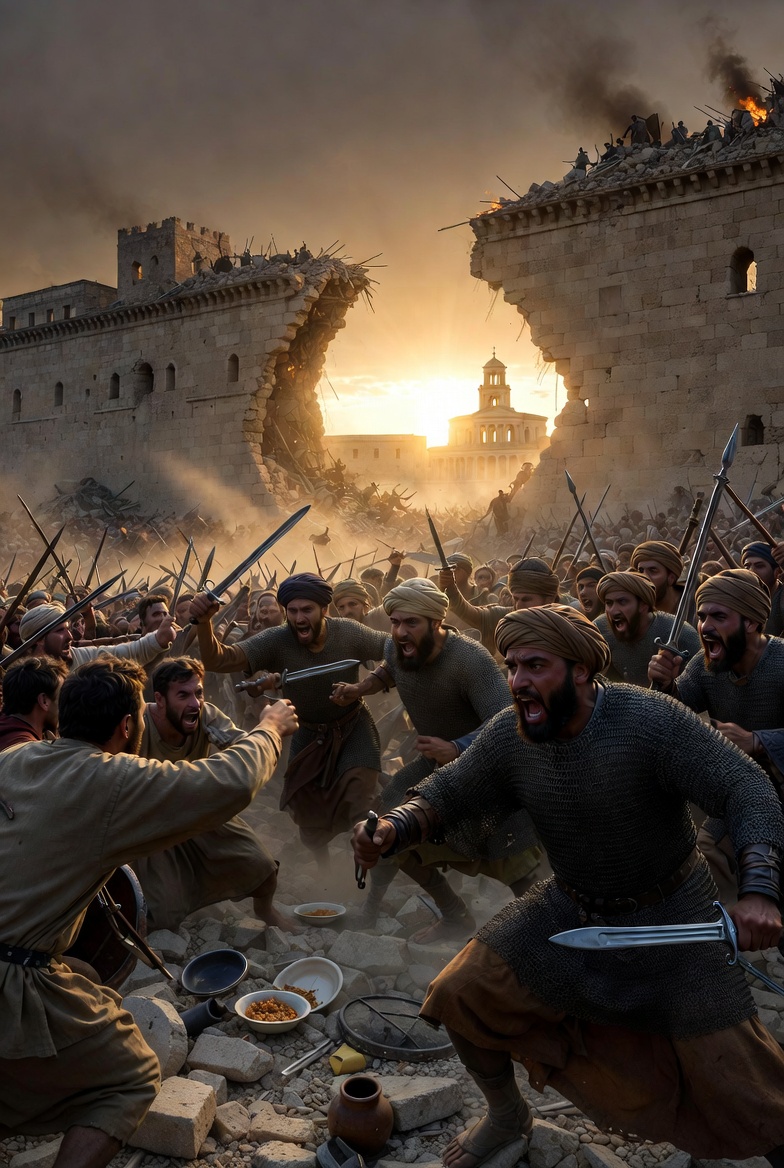
On May 21, 878, after nine grueling months of siege, the Aghlabid forces from North Africa smashed through the seaward walls of Syracuse, the once-mighty Byzantine capital of Sicily. The city fell in a chaotic dawn assault while many defenders were literally eating breakfast. Thousands were massacred, notables slaughtered by the thousands, survivors enslaved or worse, and a proud outpost of the Eastern Roman Empire crumbled into ruin. This wasn’t just another medieval conquest—it was the decisive blow in a decades-long struggle that handed Sicily to Muslim rule for centuries, reshaped Mediterranean trade, power balances, and even the cultural DNA of southern Europe. Distant history? Absolutely. Random yet profoundly significant? You bet. This event has raw, visceral details preserved by an eyewitness monk named Theodosios, who lived through the horror and later wrote a letter from captivity describing famine prices that make modern inflation look like a garage sale, desperate survival tactics, and the final betrayal of complacency. No fluffy legends here—just brutal reality from the front lines of history’s long game. Let’s dive deep into this forgotten cataclysm—90% pure historical grit, with the motivational payoff woven in because enduring nine months of hell only to lose at breakfast teaches lessons sharper than any self-help platitude.### The Long Road to the Siege: Sicily as the Mediterranean Prize To understand May 21, 878, rewind to the early 820s. The Aghlabids, a Sunni Muslim dynasty ruling Ifriqiya (modern Tunisia, eastern Algeria, western Libya) under nominal Abbasid oversight, launched their conquest of Sicily in 827. Why Sicily? It was the jewel of the Byzantine Empire in the West—fertile, strategically placed for raiding Italy and beyond, rich in grain, and a lingering echo of ancient Greek and Roman glory. Syracuse itself, founded by Corinthians in 734 BCE, had been a powerhouse: home to Archimedes, theaters, temples, and double harbors that made it nearly impregnable. The Aghlabids tried and failed multiple times: 827–828 (initial landing repulsed at Syracuse), then assaults in 868, 869, and 873. They nibbled away at the western and central parts of the island, establishing bases like Palermo (which became their capital). Byzantine Sicily held on, but cracks were showing. Emperors in Constantinople were distracted by Bulgarian wars, Arab raids on the mainland, and internal politics. Supplies and reinforcements trickled in sporadically. Enter 875: Ibrahim II becomes Aghlabid emir, a more aggressive leader. He appoints Ja’far ibn Muhammad as governor of Sicily with a mandate to finish the job. Ja’far raids eastern Byzantine territories, seizes outlying forts around Syracuse, and in August 877, the full siege begins. Aghlabid forces—Arabs, Berbers, and volunteers—blockade by land and sea. They bring advanced siege engines, including a new type of mangonel (traction catapult) capable of relentless bombardment. The defenders? Led by an unnamed *patrikios* (high-ranking Byzantine official), possibly Stavarakius or similar, with a garrison bolstered by locals and some elite units like Mardaites from the Peloponnese. Syracuse’s massive walls, built and reinforced over centuries, included seaward fortifications protecting the harbors. The city had cisterns, the famous Fountain of Arethusa for water, and stockpiles. But nine months is an eternity when help doesn’t come. ### Inside the Cauldron: Theodosios the Monk’s Eyewitness Hell Our best source is Theodosios the Monk, trapped inside during the siege and later captured. His letter, preserved and analyzed by historians, paints a picture that’s equal parts harrowing and darkly comedic in its extremity—like a medieval version of a survival reality show gone wrong. Starvation set in hard. Cut off from supplies, prices skyrocketed: a bushel of wheat for 150 gold *nomismata* (an insane sum—think paying thousands of dollars for a loaf of bread today). Flour at 200, an ox at 300, horse or donkey head at 15–20. Oil, fruit, cheese, fish, vegetables—all gone. People ate grass, animal skins, ground bones mixed with water. Theodosios reports worse: cannibalism, including eating the dead and even children. They drank from the Fountain of Arethusa when other water failed. Disease ravaged the population. Constant day-and-night attacks with siege engines wore them down. The Byzantine relief effort? A tragic joke. Emperor Basil I’s fleet was busy hauling marble for his fancy new Nea Ekklesia church in Constantinople. When it finally sailed under Admiral Adrianos, contrary winds pinned it at Monemvasia. A few ships showed up earlier and got swatted away. The central government in the East had other priorities. Syracuse was on its own.
Ja’far soon handed day-to-day operations to his son Abu Ishaq and returned to Palermo. The Aghlabids destroyed harbor fortifications, collapsed towers and walls with bombardment. The *patrikios* rallied defenders to hold a massive breach for twenty days. Bodies piled up. Yet the city held—barely. ### The Breakfast Betrayal: May 21, 878 Dawn on May 21. The defenders, exhausted after nine months, withdrew from the breach to rest and eat breakfast. Only a small guard under John Patrianos remained. The Aghlabids spotted the lapse, fired every siege engine at once, and charged. By the time the *patrikios* responded, the breach was lost. Arabs poured in, annihilated a detachment near the Church of the Saviour (massacring refugees inside), and overran the city. The *patrikios* held a tower with ~70 men before surrendering the next day—only to be executed a week later. Notables: over 4,000 killed. Theodosios was in the cathedral during liturgy when the news hit; he and the archbishop were captured but not immediately harmed (though treasures were looted). Mass slaughter, pillaging. The city was wrecked. Survivors enslaved. A few escaped to tell Adrianos, who learned via “demons” in one colorful miniature account. Aghlabids stayed two months, then left ruins. Ja’far was soon assassinated by slaves amid internal plots. Sicily’s conquest dragged on—full completion with Taormina in 902—but Syracuse’s fall was the psychological and strategic knockout. Byzantine power in the West never recovered the same way. Muslim Sicily became a center of learning, agriculture (new crops, irrigation), and a launchpad for raids into Italy, influencing everything from Norman conquests to culinary traditions. This wasn’t random violence; it was the culmination of strategic patience, superior logistics on one side, and fatal distraction plus complacency on the other. Distant history, but the mechanics echo through time.
### From 878 to Your Front Door: Applying the Siege Mindset History’s value isn’t nostalgia—it’s pattern recognition for personal victory. The Fall of Syracuse screams: **Preparation beats talent when talent stops preparing. Complacency kills at the moment of greatest fatigue. External help is unreliable—build your own fortress and relief fleet.** Here’s how that ancient catastrophe translates into hyper-specific, actionable benefits for your individual life today. No generic “be resilient” fluff—these are tailored, measurable, anti-self-help bullets that flip the script on modern advice. - **Build Redundant “Inner Walls” Against Life’s Blockades**: Syracuse had thick walls but relied on one main relief fleet that never arrived. In your life, identify your “seaward walls” (core income, health, key relationships). Create three independent backups for each. Example: If your job is your primary income wall, have a side hustle generating 20% of revenue, an emergency skill (freelance coding/certification), and passive assets (dividends or rental). Audit quarterly: What single point of failure could starve you out like Syracuse’s grain supplies? Fix it before the siege starts. - **Master the “Breakfast Breach” Discipline**: The fall happened because exhausted defenders broke for breakfast. Translate: During your longest “sieges” (intense work projects, fitness plateaus, relationship rough patches—usually month 6-9 when motivation dies), enforce a non-negotiable “breach guard” protocol. Set a 10-minute timer every morning for the highest-leverage task *before* coffee or scrolling. No exceptions. Track it in a simple log: “Breach held today?” This unique habit weaponizes fatigue instead of surrendering to it. Most self-help says “rest more”; this says guard the breach *while* tired—because that’s when empires fall.
- **Stockpile “Theodosios Supplies” for Famine Phases**: The monk documented hyper-inflation and desperate measures. In modern terms, build anti-fragile reserves that appreciate under pressure. Financial: 6-12 months expenses in liquid + inflation-hedged assets (not just cash). Health: Daily micro-habits (30g protein minimum, 7k steps, sleep tracking) that compound like siege rations. Knowledge: One “siege book” per quarter on adversarial skills (negotiation, coding, persuasion). Unique twist: Monthly “famine drill”—live 48 hours on 50% normal resources to test and refine. This isn’t hoarding; it’s turning scarcity into strategic advantage, unlike online minimalism that leaves you vulnerable. - **Diversify Your “Allies” and Stop Waiting for Constantinople**: Byzantium failed its outpost. Lesson: Never outsource your critical relief to flaky external powers (bosses, governments, partners who “might help someday”). Cultivate a personal “Aghlabid-level” network of 5-7 high-trust allies who owe you favors *now*. Specific plan: Quarterly value bombs—send opportunities, intros, or resources without asking. Track reciprocity. If one “fleet” delays like Adrianos, others sail. This creates sovereign independence, echoing Branimir’s near-contemporary pivot to papal recognition for autonomy (another May 21 echo, but secondary here). - **Exploit Post-Sack Rebuilding Like the Aghlabids (and Later Normans)**: After victory, the victors didn’t stagnate—internal rivalries slowed them, but Sicily thrived under new rule with innovations. In your life, after every “fall” (job loss, breakup, failure), enforce a 60-day “Aghlabid occupation protocol”: Document lessons brutally (Theodosios-style journal), repurpose ruins (transferable skills), introduce one new “crop” (habit, network, tool). Measure ROI at day 60. This turns defeats into cultural golden ages instead of lingering rubble. Funny how history’s winners often lost battles but won the long occupation. ### Your Unique “Breach Protocol” 30-Day Plan: The Syracuse Siege System This isn’t another 21-day habit challenge or vision-board nonsense. It’s a battlefield-derived, anti-fragile operating system designed to be *ungoogleable* in its specificity—blending medieval siege logic with modern execution, zero woo-woo, maximum edge. Commit for 30 days, then repeat cyclically. Track in one notebook: “Siege Log.” **Week 1: Fortify the Walls (Assessment & Redundancy)** - Day 1-2: Map your life’s Syracuse—list 3 core “cities” (career/finances, health/energy, relationships/legacy). For each, identify current walls and single points of failure. - Day 3-7: Build one redundant layer per city. Example: Finances—automate 10% extra savings transfer + launch micro-side experiment (sell one skill online). Health—add 10-min daily “breach guard” walk before breakfast. Log daily resistance felt. **Week 2: Simulate the Starvation (Famine Drills & Resource Mastery)** - Run two 24-hour “Theodosios drills”: Halve normal food budget/spending, document adaptations. Translate learnings: What cheap, high-value “grass and bones” habits sustain you? - Inventory knowledge weapons: Read one primary-source-style history excerpt daily (like siege accounts) for pattern recognition. Apply one tactic immediately (e.g., relentless small attacks = daily 1% improvements). **Week 3: Hold the Breach (Fatigue Discipline)** - Enforce breakfast breach guard every day: Highest-impact task first, no excuses. If you slip, restart the full 30 days (harsh? History was harsher). - Nightly review: “Did Arabs charge today? Breach held?” Rate energy 1-10; adjust rations (sleep, nutrition).
**Week 4: Prepare the Counter-Siege (Allies & Rebuild)** - Contact 3 potential allies with unsolicited value. Propose mutual “siege pacts.” - Design your post-fall protocol: Template for any setback—what to document, repurpose, innovate. Test on a small failure. - Day 30 audit: Measure progress in quantifiable terms (extra income, energy levels, logged habits held). Celebrate like a defender who outlasted expectations. Repeat quarterly. Scale: After 90 days, add team/city-level versions for business or family. This plan is unique because it treats life as an ongoing multi-year siege—not a linear self-improvement journey. It laughs at burnout culture by embracing fatigue as the proving ground. It demands sovereignty over victimhood. Syracuse fell, but you don’t have to—because you saw the breakfast coming. The Fall of Syracuse on May 21, 878, reminds us that empires, cities, and personal dreams die not from overwhelming force alone, but from eroded vigilance after prolonged pressure. The Aghlabids won through persistence, superior engines, and seizing the lapse. You can “win” your version by out-preparing, out-guarding, and out-rebuilding everyone else. History isn’t dusty—it’s ammunition. Load it. Hold the breach. Turn your May 21 into the day you stopped waiting for rescue and became the unrelenting force.
Share: