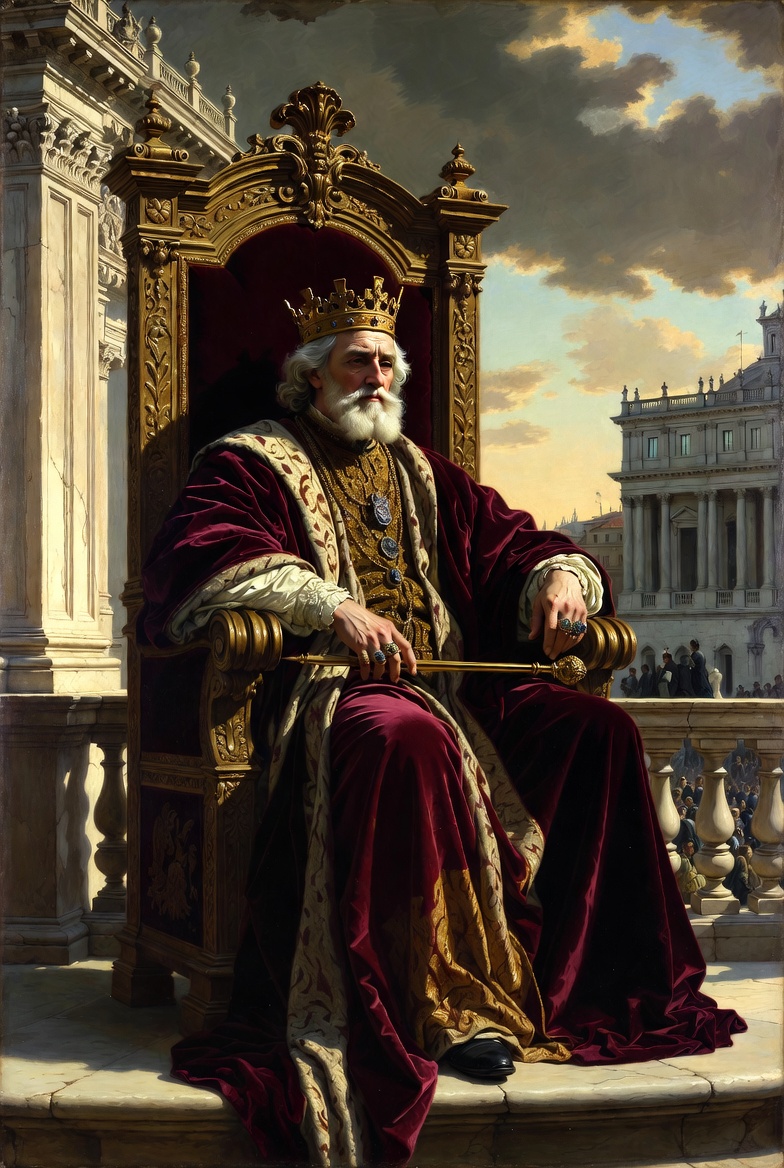
Deep within the structural chaos of the fourteenth century, Rome was not the majestic epicenter of open-air museums and artisanal gelato that we appreciate today. It was a terrifying, post-apocalyptic urban wasteland. The Popes had packed up their entire administrative apparatus and fled to Avignon, France, leaving the Eternal City to rot in its own glorious, classical filth. Rome’s population had cratered from over one million during the height of the Pax Romana down to a miserable, disease-ridden thirty thousand souls. Livestock grazed in the overgrown, structural shell of the Forum. Brambles choked out the once-regal walkways of the Palatine Hill, and the Colosseum was effectively treated as a glorified limestone quarry where local residents chipped away structural blocks to build pigsties. Worse than the structural decay was the absolute civil anarchy. Rome was completely hijacked by competing factions of aristocratic barons—most notably the Colonna and Orsini families. These barons operated like heavily armored, feudal warlords. They built massive, private stone fortresses directly into the classical monuments, hung iron chains across public streets to block commerce, and sent bands of mercenary thugs into the alleyways to rob local merchants, rape travelers, and murder anyone who looked at them wrong. There was no functioning court system, no public police force, and zero accountability. If a noble warlord stabbed your brother in broad daylight, your options for justice were precisely non-existent. Then came May 20, 1347. On this precise date, an extraordinarily strange, completely un-aristocratic millennial named Nicolas di Lorenzo—vulgarly known to history as Cola di Rienzo—pulled off one of the most stunning, completely bloodless civil coups in the annals of Western civilization. He did not achieve this historic feat with a massive vanguard of foreign mercenaries, a hidden cache of heavy siege weaponry, or an endorsement from the wealthy elite. He achieved it through sheer intellectual audacity, an unparalleled command of classical history, an obsessive study of ancient Roman ruins, and a brilliant mastery of civic propaganda. On Whit Sunday, May 20, 1347, Cola marched directly up the steps of the Capitoline Hill surrounded by symbolic banners of liberty, completely sidelined the terrifying noble families without spilling a single drop of blood, and proclaimed the buono stato—the Good State. He effectively restored the ancient Roman Republic overnight, transformed himself into the Tribune of the People, and forced the most fearsome warlords in southern Europe to kneel down and swear holy oaths of allegiance to the regular citizens of Rome. The structural details of how Cola orchestrated this spectacular political transformation provide a masterclass in long-term strategy, personal reinvention, and psychological leverage. By dissecting the precise historical anatomy of his rise, his administrative methods, and the exact legislative mechanisms he unveiled on May 20, we can extract an incredibly potent, completely non-traditional strategic framework for managing our modern lives, reclaiming our personal agency, and conquering the psychological warlords that keep us trapped in chaos. Part I: The Making of an Antiquarian Radical To understand the sheer madness of what happened on the Capitoline Hill on May 20, 1347, we must first examine the odd individual who engineered it. Cola di Rienzo was born in 1313 in the working-class Roman district of Rione Regola. His background was thoroughly ordinary, if not outright gritty: his father, Lorenzo, ran a humble local tavern, and his mother, Maddalena, washed laundry and carried water for a living. In a society where political power was strictly determined by ancestral bloodlines and massive real estate holdings, a tavern keeper’s son had about as much chance of ruling Rome as a stray cat. However, young Cola possessed a rare, obsessive intellectual curiosity. He was sent to Anagni—the historic hometown of Pope Boniface VIII—to live with relatives, where he received a rigorous education in Latin grammar, classical literature, and the ancient art of rhetoric. He devoured the complex works of Livy, Cicero, Seneca, and Valerius Maximus. While his peers were learning how to wield heavy iron broadswords or skim agricultural profits off peasant laborers, Cola was systematically decoding the syntax of ancient Roman statecraft. He eventually returned to Rome and established a highly professional practice as a public notary. In the fourteenth century, a notary was far more than a simple clerk who stamps official real estate documents; they were highly trained legal technicians who drafted formal state contracts, navigated complex statutory laws, and translated raw political intentions into precise Latin prose. This specific professional training proved to be Cola’s ultimate secret weapon. It gave him an intimate, granular understanding of how administrative systems function, how bureaucratic loopholes operate, and exactly how the human mind can be deeply moved by precise legal language.As he walked the dangerous, muddy streets of Rome to record mundane property deeds and domestic wills, Cola became deeply radicalized by the profound contrast between Rome’s current structural squalor and its ancient administrative majesty. He spent his free hours wandering through overgrown ruins, scraping thick green moss off crumbling marble monuments, and meticulously translating ancient Latin inscriptions that no one else in the city could read. To the illiterate local population and the arrogant, uneducated barons, these ancient inscriptions were merely decorative old stones. To Cola, they were a highly detailed, long-lost instructional manual for absolute human sovereignty. FOURTEENTH-CENTURY ROMAN POWER DYNAMICS (1347) +-------------------------------------------------------+ | THE ABSENTEE PAPACY (Avignon) | | - Spiritually supreme, logistically distant | | - Rules via weak local Vicars and shifting alliances | +-------------------------------------------------------+ | v +-------------------------------------------------------+ | THE FEUDAL BARONS (Warlords) | | - Colonna, Orsini, Savelli Families | | - Occupy classical ruins as private fortresses | | - Control mercenary armies, extort public commerce | +-------------------------------------------------------+ | v +-------------------------------------------------------+ | THE TRIBUTARY POPULATION (Plebeians) | | - Illiterate merchants, artisans, labor peasants | | - Zero legal protection, constant systemic extortion | +-------------------------------------------------------+ Cola’s personal animosity toward the aristocratic elite turned deeply personal when a violent street skirmish broke out between the Colonna and Orsini factions. In the chaotic crossfire of the melee, Cola’s younger brother was brutally struck down and killed. When Cola attempted to utilize his professional legal training to seek justice through the city's courts, the noble families openly mocked his efforts. The murderer walked completely free, insulated by the absolute systemic immunity of his aristocratic bloodline. At that exact moment, Cola realized that working within a completely broken, corrupted system was a fool's errand. He didn't just need to litigate within the current framework; he needed to completely rewrite the rules of Roman civilization. Part II: The Avignon Gambit and the Secret Weapon in Lateran Cola began systematically laying the groundwork for his revolution using a blend of high-level diplomacy and avant-garde public performance art. In 1343, the civic leaders of Rome’s weak, fragmented municipal government appointed Cola to serve as part of an official diplomatic embassy sent to Avignon to pitch a massive civic proposal to Pope Clement VI. When Cola arrived at the luxurious papal court in France, he did not behave like a timid, submissive provincial clerk. He stood before the Pope and delivered a dazzling, structurally brilliant Latin oration that pulled absolutely no punches. He explicitly denounced the Roman barons as a pack of bloodthirsty thieves, detailed the systemic rape of the city's economy, and argued that the Pope was losing his historic territory because he was letting these lawless aristocrats run completely amok. The powerful nobles in Avignon were furious, but Pope Clement VI was deeply enchanted by Cola’s incredible eloquence, his profound legal knowledge, and his magnetic personal charisma. Clement VI was looking for a convenient way to curb the exploding power of the Roman barons without spending an absolute fortune on a massive papal military campaign. The Pope officially appointed Cola to the highly lucrative, politically sensitive position of Papal Notary of the Roman Vicarship, sending him back to Rome with immense institutional legitimacy and a steady stream of income. Upon his return to the Eternal City in 1344, Cola did something highly unusual: he began using public art and archaeological discoveries to conduct a massive, multi-year psychological operations campaign against both the barons and the illiterate populace. He commissioned massive, allegorical paintings to be secretly rendered on the exterior walls of public buildings, such as the Marketplace and the Capitoline Palace. One of these massive public paintings depicted a terrifying, violent ocean storm where a majestic, symbolic woman clad in deep mourning garments—representing Rome—was drowning in the waves, while predatory beasts representing the greedy barons circled her. Cola would gather huge crowds of ordinary citizens in the streets, stand in front of these paintings wearing eccentric, theatrical robes of white silk, and deliver soaring, emotional speeches explaining the deep symbolic meaning of the artwork. The barons viewed Cola as a harmless, eccentric street performer—a amusing academic clown who gave entertaining speeches to the peasants but posed zero actual military threat to their heavy iron armor and stone castles. This was their fatal strategic error.
Cola’s absolute masterpiece of psychological subversion occurred in the early months of 1347 at the Basilica of Saint John Lateran. While exploring the ancient church, Cola discovered a massive, heavy bronze tablet that had been completely built into the structure of a medieval altar, with its inscribed face turned inward to hide it from view. Cola recognized it instantly: it was the legendary Lex Regia (specifically the Lex de Imperio Vespasiani), the long-forgotten imperial Roman decree from the first century AD that officially conferred absolute constitutional authority from the Roman senate and the people directly to Emperor Vespasian. THE STRUCTURAL ANATOMY OF COLA'S COUP (MAY 1347) [ ARCHAEOLOGICAL RECOVERY ] --> The discovery of the Lex Regia tablet at St. John Lateran. | v [ SYSTEMIC TRANSLATION ] --> Translating complex elite legal history into accessible public performance. | v [ TACTICAL TIMING ] --> Striking on Whit Sunday (Pentecost) while the primary warlord was away. | v [ STRUCTURAL CITIZEN FORCE ] --> The bloodless disarmament of barons via the new civic constitution. To the illiterate public, this heavy bronze tablet was just an old piece of scrap metal. To the arrogant barons, it was completely irrelevant history. But to a master notary like Cola, it was the ultimate legal proof that the ultimate sovereignty of Rome did not belong to the Popes in France, nor did it belong to the feudal warlords in their stone castles. According to the foundational constitutional laws of the Roman Empire, all legitimate political power originally resided directly in the hands of the Popolus Romanus—the regular citizens of Rome. Cola did not keep this world-shattering discovery hidden away in a dusty academic journal. Instead, he organized a massive, highly theatrical public event at the Basilica. He erected a large wooden stage, installed the massive bronze tablet in the center, and invited all the prominent intellectuals, merchants, and noble barons of Rome to attend. Cola walked onto the stage wearing an elaborate costume consisting of a bright red hat, a matching tunic of fine cloth, and a majestic black mantle. Using a long wooden pointer, he systematically read the ancient Latin text line by line, translating it in real-time into the local vulgar Roman dialect so every ordinary person in the room could understand it. He explicitly proved that the ancient majesty of the Roman Empire was built on the legal authority of regular citizens, and that the current barons were nothing more than lawless squatters occupying a stolen empire. The great barons sat in the front rows, openly laughing and treating the entire performance as an amusing theatrical comedy. They were so blinded by their own structural arrogance that they completely failed to realize that Cola had just systematically dismantled their entire psychological right to rule. Part III: Pentecost, 1347 — The Anatomy of the Perfect Coup By May of 1347, the social tension inside Rome had reached an absolute boiling point. The city was starving, the currency was completely debased, and the barons were completely distracted by a bitter, bloody escalating feud among themselves. Cola decided it was finally time to strike. He spent weeks secretly meeting with a dedicated core group of middle-class conspirators, including wealthy merchants, local artisans, and sympathetic parish priests. He secured a secret financial loan of several hundred gold florins to fund his operations. Crucially, Cola waited for the perfect tactical window of opportunity: Stefanello Colonna, the most fearsome, militarily capable older warlord of the dominant Colonna family, marched out of Rome with his primary contingent of heavily armored mercenary cavalry to forage for grain and secure territories near the city of Corneto. The city's primary military enforcement was gone. On the evening of May 19, 1347, Cola sent official town heralds throughout the winding alleyways of Rome with trumpets, ordering all citizens to assemble at the Capitoline Hill the following morning at dawn, completely unarmed, to witness a historic event concerning the "servitude and redemption of Rome." To ensure spiritual protection and psychological gravitas, Cola spent the entire night in the church of Sant'Angelo in Pescheria, fasting, praying, and undergoing successive holy masses of the Holy Spirit.
At dawn on Sunday, May 20, 1347—the holy feast day of Pentecost—Cola emerged from the church doors clad in full, glittering iron battle armor, but with his head completely bare to project vulnerability and transparency. He was flanked on his left side by Raymond, the Bishop of Orvieto and the official papal vicar, providing absolute institutional and religious legitimacy to his movement. Surrounding them were three massive, beautifully embroidered silk banners:
-
The first banner, made of rich red cloth with gold lettering, depicted a majestic woman holding the globe and a palm branch, representing Liberty and United Rome.
-
The second banner, made of pure white cloth, depicted the Apostle Saint Paul holding a naked sword of absolute justice, representing Civic Virtue and Protection.
-
The third banner, old and faded, depicted Saint Peter holding the keys of heaven, representing Peace and Concord.
A massive, roaring crowd of thousands of ordinary Roman citizens formed an impenetrable human wall around Cola as his procession slowly marched through the narrow streets, up the monumental steps, and directly into the central courtyard of the Capitoline Palace. The remaining noble barons, waking up to the thunderous roar of thousands of singing voices, looked out from their private stone towers and realized they were completely paralyzed. Their heavy cavalry and deadly broadswords were completely useless against an entire city that had peacefully occupied the civic heart of the capital before breakfast.

                  THE BUONO STATO RESTRUCTURING


     [ OLD CHAOS ]                         [ NEW BUONO STATO ]

  Private Warlord Fortresses   ======>   Public Seizure of Key Forts

  Chains Across Streets       ======>   Open, Taxable Public Commerce

  Baronial Private Armies     ======>   Unified Citizen Militia (1,300 Men)

  Arbitrary Warlord Murder    ======>   Strict, Universal Death Penalties

  Systemic Public Extortion   ======>   Fixed, Transparent Import Tariffs

Cola stepped onto the grand balcony of the Capitoline Palace, looked down at the massive sea of upturned faces, and delivered the most consequential speech of his life. He spoke with a fierce, hypnotic eloquence about the long-suffering servitude of Rome, the brutal tyranny of the barons, and the beautiful, imminent redemption of the republic. He did not ask the crowd to engage in a bloody, vengeful slaughter of the nobles. Instead, he pulled out a crisp, pre-written document containing a radical new constitution for the city: the Ordinances of the Buono Stato.

He read the ordinances aloud, one by one, demanding an immediate public vote from the assembled citizens. The new laws were stunningly precise, highly functional, and systematically engineered to strip the noble families of their structural leverage:
-
Universal Criminal Accountability: No Roman citizen, regardless of aristocratic bloodline or ancient title, was immune from the law. If a noble committed murder, they would face the exact same public gallows as a common thief.
-
The Demolition of Feudal Infrastructure: All private stone fortresses, defensive walls, and iron barricades erected by the barons within the city limits were to be immediately seized by the public public and systematically dismantled.
-
The Liberation of Public Commerce: The heavy iron chains blocking the public streets were to be permanently cut. All bridges, gates, and public highways were taken out of baronial control and placed under public administration, completely free from arbitrary baronial tolls.
-
The Establishment of a Public Safety Infrastructure: A permanent, publicly funded citizen militia of thirteen hundred heavily armed infantry and three hundred light cavalry was established, with one hundred men stationed in each of the city’s thirteen civic districts, completely replacing the barons' private mercenary armies.
-
The Modern Welfare State: A comprehensive system of public grain storage and fixed welfare subsidies was established to ensure that no ordinary Roman citizen would ever starve during a winter food shortage.
The massive crowd approved every single ordinance with thunderous, deafening shouts of acclamation. Within an hour, without a single sword being drawn or a single drops of blood spilled, the ancient Roman Republic was officially restored. When old Stefanello Colonna rushed back to Rome with his heavy cavalry later that afternoon, intending to easily crush what he assumed was a petty peasant riot, he found the city gates securely locked against him by the newly formed citizen militia. When he attempted to bluster and threaten the guards, Cola sent an official civic detachment to his private palace and handed him a direct ultimatum: submit completely to the new public constitution or face immediate asset liquidation and permanent exile. The proudest warlord in Europe looked at the thousands of armed citizens lining the walls, bowed his head, and signed the document. Within days, the rest of the great aristocratic families—the Orsini, the Savelli, the Caetani—marched one by one up the Capitoline Hill, completely unarmed, to swear a solemn oath on the Holy Gospels to serve the regular people of Rome. Part IV: The Downfall — The Peril of Becoming Your Own Warlord For roughly seven glorious months, Cola’s buono stato operated like an absolute miracle of medieval statecraft. The chroniclers of the era write that a golden age of peace descended on Italy overnight. Traveling merchants could drop a bag of gold coins in the middle of the highway and find it completely untouched days later. The city’s treasury exploded with revenue from newly opened, open public trade routes, and international kings from England to the Holy Roman Empire sent official diplomatic letters to the Capitoline Hill, recognizing Cola's stunning new authority. But Cola possessed a tragic, deeply human psychological vulnerability: he was completely addicted to symbolic theater, grandiose titles, and the intoxicating drug of his own personal mythos. Once he had successfully built a highly functional administrative system, he became completely bored by the mundane, day-to-day work of practical governance. He became deeply obsessed with the external trappings of absolute power. He began calling himself by increasingly eccentric, grand titles, culminating in: "Nicolas, the Severe and Merciful, Tribune of Peace, Freedom, and Justice, and the Deliverer of the Sacred Roman Republic." He refused to walk on regular ground, forcing his assistants to lay down expensive velvet fabrics wherever he stepped.On August 1, 1347, Cola organized an incredibly lavish, jaw-droppingly expensive civic ceremony at the Lateran Baptistery, where he publicly bathed in the ancient, sacred porphyry basin that had been used by Emperor Constantine the Great. He then had himself formally knighted as a "Soldier of the Holy Spirit." THE PSYCHOLOGICAL TRAJECTORY OF COLA DI RIENZO [ PHASE 1: THE INSURGENT ] --> Focus on data, deep structural research, public utility, and systematic planning. | v [ PHASE 2: THE GOVERNOR ] --> Execution of clean, universal rules, operational discipline, and clear boundaries. | v [ PHASE 3: THE CAESAR ] --> Obsession with identity vanity, ego theater, expensive aesthetics, and ultimate collapse. Worse, his behavioral patterns became increasingly erratic and paranoid. He would invite the great barons to an elegant public banquet, throw them directly into a dark dungeon on a whim of suspected treason, sentence them to immediate public execution, and then completely reverse his decision the next morning, releasing them with lavish gifts. This toxic cycle effectively alienated his core middle-class supporters while driving the noble families into a state of absolute, vengeful fury. To fund his increasingly extravagant public pageants and pay for the massive citizen militia, Cola was forced to break one of his most sacred foundational promises: he levied a heavy, highly unpopular public tax on salt and basic consumer goods. The regular citizens of Rome, looking at their empty pockets, realized that their beautiful, inspiring Tribune of Freedom had effectively transformed into just another expensive, high-maintenance warlord. On December 15, 1347, a minor, baronial counter-conspiracy broke out near the city gates. Instead of calmly deploying his highly functional citizen militia, Cola panicked, became paralyzed by his own internal fears, and began weeping uncontrollably on the balcony of the Capitoline Palace. He officially abdicated his position, snuck out of the city disguised as a humble monk, and spent years wandering the mountains of Europe as an isolated fugitive. Though he would briefly return to Rome years later in 1354 as an official papal senator, his original strategic brilliance had completely dissolved into paranoia and tyranny. On October 8, 1354, an angry, rioting Roman mob surrounded him on the Capitoline Hill—the exact same spot where he had unveiled his beautiful constitution on May 20, 1347. As he attempted to deliver one last hypnotic speech to save his life, the crowd refused to listen. They dragged him down from the grand balcony, hacked him to death with rusted knives, and left his body hanging from a butcher's hook for days. The profound tragedy of Cola di Rienzo’s life is that he was brilliant at using structural data and classical history to build a beautiful system, but he allowed his personal ego to completely destroy it from within. He conquered the external warlords of Rome, but he was completely defeated by the internal warlord of his own unchecked vanity. Part V: The Lex Regia Blueprint for Modern Personal Sovereignty Now, let us extract the profound structural lessons of May 20, 1347, and apply them directly to your individual life today. Look closely at your current daily existence. You are likely not fighting actual, chain-wielding medieval barons like the Colonna or Orsini, but you are almost certainly living in your own modern equivalent of a fractured, post-apocalyptic Rome. Your mental focus, your schedule, and your finite daily energy have been completely hijacked by modern, psychological warlords:
-
The Orsini of Digital Distraction: Red notification badges, endless algorithmic video feeds, and a hyper-reactive dopamine loop that loots your mental focus the second you wake up.
-
The Colonna of Institutional Creep: The endless onslaught of low-value professional emails, toxic corporate requests, and arbitrary social obligations that place heavy iron chains across your personal schedule.
-
The Squatter Barons of Creative Paralysis: The deep internal voices of imposter syndrome, historical inertia, and analytical anxiety that take up permanent residence within your mind, treating your grandest intellectual ambitions like an old limestone quarry to be chipped away for minor daily chores.
Most standard online "self-help" advice tells you to handle this chaos by fighting a series of exhausting, daily battles. They tell you to use raw, white-knuckled willpower to resist your phone, or to download a trendy new aesthetic planning app that requires hours of high-maintenance upkeep. This advice is the equivalent of sending an unarmed fourteenth-century peasant into a direct, head-on sword fight against a heavily armored knight. You will lose every single time because the structural power dynamics are completely rigged against you.Cola di Rienzo didn't fight the barons sword-for-sword. He used the Lex Regia Blueprint: he systematically changed the structural rules of the game using deep personal data, established clear boundaries, and built a bulletproof internal infrastructure that rendered the warlords completely powerless. Here is your highly specific, data-driven strategy to achieve absolute personal sovereignty over your life, modeled directly on the triumphs and failures of May 20, 1347. The Personal Buono Stato Strategic Framework
-
The Lateran Audit (Uncovering Your Hard Real-Time Data)
Cola didn't invent a new legal theory from scratch; he excavated an undeniable, hard physical data set—the Lex Regia bronze tablet—and used it to shatter the psychological illusions of the elite. To change your life, you must stop operating on vague, emotional feelings and excavate your own hard operational data.
-
Action Step: For the next forty-eight hours, run a zero-judgment, comprehensive time and attention audit. Every single hour, write down exactly where your minutes went onto a plain, physical piece of paper. Do not hide from the data.
-
The Target: Identify exactly how many minutes you spent actively building your own long-term creative assets versus how many minutes were systematically looted by the modern baronial forces of passive digital consumption and low-value administrative tasks. This raw data sheet is your physical bronze tablet. It is your undeniable proof of exactly where your sovereignty is being leaked.
-
The Dismantling of Baronial Infrastructure (Cutting the Chains)
The very first thing Cola did on May 20 was cut the physical iron chains blocking the public streets and strip the noble families of their defensive infrastructure. You must immediately identify and systematically eliminate the structural mechanisms that allow external distractions to seamlessly access your brain.
-
Action Step: Intentionally design high-friction barriers that lock out the warlords during your peak cognitive hours. Move your mobile phone charger entirely out of your bedroom; your phone does not get to cross the border of your sleeping space.
-
Execution: Use advanced technical applications to permanently block all social media, news, and communication platforms from your laptop between the critical hours of 5:00 AM and 9:00 AM. If a digital platform wants to access your focus during that window, it must face a complex, multi-layered password entry system. You are effectively tearing down the private castles of distraction and forcing your focus to flow through open, publicly accountable channels.
-
The 1,300-Man Internal Militia Rule (The Fixed Daily Budget)
Cola knew that vague, polite requests for peace were completely useless without a permanent, robust public enforcement mechanism. He built a highly organized, district-by-district civic militia. You must establish an unyielding, non-negotiable structural boundary for your core creative work that cannot be altered by shifting emotional states.
-
Action Step: Establish a rigid, daily cognitive defense window of precisely ninety minutes. This time block is your personal internal militia. It must occur at the exact same time every single day, completely independent of whether you feel deeply inspired or profoundly exhausted.
-
The Mandate: During this fixed window, your sole operational directive is to work exclusively on your primary long-term creative project—whether that is drafting a comprehensive script, producing a complex audio track, or building a scalable business architecture. The outside world can scream, rage, and throw frantic tantrums outside your closed door; your internal militia is securely holding the gates.
-
The Anti-Constantine Protocol (The Death of Vanity Theater)
This is the ultimate cautionary lesson derived directly from Cola’s spectacular personal downfall. You must ruthlessly separate your actual, high-value productive output from the expensive, low-value aesthetics of personal vanity and organizational theater.
-
Action Step: Ban all high-maintenance, hyper-aesthetic planning rituals from your workflow. Do not spend hours setting up complex color-coded calendars, customizing digital workspace templates, or curating the perfect desktop background. This behavior is the exact psychological equivalent of Cola bathing in Constantine’s expensive porphyry basin—it is an expensive, self-indulgent illusion of progress that actively drains your real operational capital.
-
The Law: Your productivity system must remain incredibly basic, raw, and thoroughly anti-fragile: a plain text file, a cheap physical notebook, and zero decorative fluff. True personal sovereignty is validated exclusively by your actual volume of finished work, never by the visual beauty of your planning tools.
The 72-Hour Personal Sovereignty Action Plan

This plan is explicitly designed to be completely unique against standard online advice. It requires zero emotional visualization, zero lifestyle changes, and zero expensive subscriptions. It is a raw, cold-blooded exercise in institutional restructuring.

                   THE 72-HOUR SOVEREIGNTY TIMELINE


  [ HOUR 0-24: THE INSURGENT AUDIT ]

  - Execute the hard physical time audit.

  - Locate and write down the exact sources of systemic focus leaks.


  [ HOUR 24-48: THE INFRASTRUCTURE PURGE ]

  - Sever all digital notifications.

  - Relocate physical tech chargers completely out of your sleep space.


  [ HOUR 48-72: THE COMMAND DECLARATION ]

  - Deploy the fixed 90-minute daily creative window.

  - Execute raw, unfiltered work with zero aesthetic optimization.

Hour 0 – 24: The Insurgent Audit
-
06:00 AM: Place a plain index card next to your workspace. Every time you switch tasks or check a notification out of habit, make a dark tally mark on the card.
-
09:00 PM: Review the index card. Multiply your total tally marks by two; this is the exact number of cognitive minutes you completely surrendered to the barons today. Look at that number with absolute, clear-eyed realism. Let the raw indignity of that data radicalize you, exactly how Cola was radicalized by the lawless streets of Rome.
Hour 24 – 48: The Infrastructure Purge
-
07:00 PM: Turn off every single non-human notification on your electronic devices. If a notification does not come from a live human being requiring immediate emergency coordination, it is permanently silenced.
-
08:00 PM: Physically move your smartphone charger into a hallway closet or a distant bathroom. Buy a cheap, basic digital alarm clock that possesses zero internet connectivity and place it on your nightstand. You have officially reclaimed the sacred borders of your morning mind.
Hour 48 – 72: The Command Declaration
-
05:00 AM: Wake up, drink a glass of water, and immediately sit down at your desk. Do not check your email, do not look at the news, and do not review your social feeds.
-
05:10 AM – 06:40 AM: Execute ninety minutes of raw, uninterrupted, unglamorous work on your primary creative project. If your mind attempts to wander or procrastinate, calmly remind yourself that your internal militia is currently on duty at the gates.
-
06:45 AM: Step back and look at your completed work. You have officially run the exact same structural play that Cola di Rienzo executed on May 20, 1347. You didn't waste your energy pleading with the modern barons for permission; you quietly walked up the steps of your own internal Capitoline Hill, restructured the fundamental rules of your day, and claimed your absolute personal sovereignty before the rest of the world even opened its eyes.
Share: