
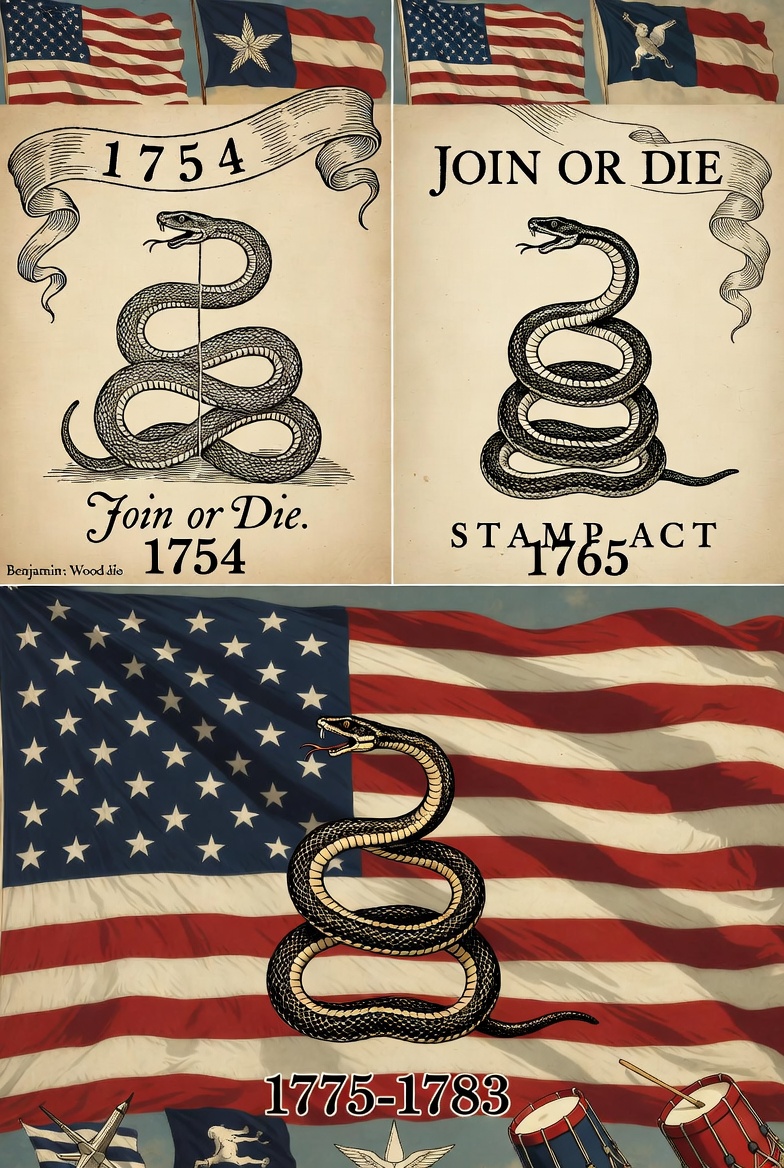
Picture this: It’s May 9, 1754, in a bustling print shop on Market Street in Philadelphia. The air smells of fresh ink and woodsmoke. Benjamin Franklin, age 48, successful printer, postmaster, inventor of the lightning rod (and a few practical jokes), wipes his hands on his apron and stares at a fresh woodcut block. He’s just carved a snake chopped into eight wriggling pieces, each labeled with colonial abbreviations: N.E. for New England, N.Y., N.J., P. for Pennsylvania, M. for Maryland, V. for Virginia, N.C., and S.C. Above the severed reptile, in bold capital letters, he sets the type: JOIN, or DIE. No fanfare. No press conference. Just one woodcut dropped into that day’s edition of *The Pennsylvania Gazette*, Franklin’s own newspaper, alongside an editorial hammering home the “disunited state” of the British colonies. Little did he know he had just published America’s first political cartoon—and planted a seed that would sprout into a nation. This wasn’t some abstract doodle. It was a desperate, witty, slightly macabre plea for survival amid the gathering storm of the French and Indian War. And on this random, specific, wildly significant day in distant American history, Franklin gave us a lesson in unity that still bites harder than any rattlesnake.Let’s slither back into the thick underbrush of 1754 to understand why this cartoon mattered so much—and why its message feels eerily tailored for anyone today whose life feels chopped into disconnected pieces. The French and Indian War (or the North American theater of the Seven Years’ War, if you want to sound fancy at parties) was already simmering like a pot of venison stew left too long on the fire. The root cause? Real estate. The fertile Ohio Valley—prime hunting grounds, fur-trading routes, and future farmland—sat smack between French Canada and the British colonies. France claimed it by right of exploration and a string of forts from the Great Lakes down to the Mississippi. Britain’s restless colonists, hungry for land speculation and westward expansion, saw dollar signs (or rather, pounds sterling). Native American nations, particularly the Iroquois Confederacy, played both sides like master diplomats, extracting concessions and playing empires against each other. Tensions had boiled over the previous year. In 1753, Virginia’s Lieutenant Governor Robert Dinwiddie sent a 21-year-old major named George Washington into the wilderness with a polite but firm message to the French: “Get out.” The French laughed, built more forts, and Washington returned empty-handed but wiser. Early 1754 saw Washington back in the Ohio Country with a small force of Virginia militia and some Iroquois allies. On May 28—just nineteen days after Franklin’s cartoon hit the streets—Washington’s men ambushed a French patrol in what became known as the Jumonville Glen skirmish. The French commander was killed, and the incident escalated into full-scale war. But news traveled slow in those days; Franklin was reacting to earlier reports of French encroachments and colonial foot-dragging when he carved that snake. The colonies were a mess of rivalries, jealousies, and mismatched priorities. Massachusetts and New York bickered over borders and trade. Pennsylvania’s Quaker-dominated assembly leaned pacifist, refusing to fund defenses that might “offend the Indians.” Virginia wanted to lead the charge but expected everyone else to pay. South Carolina worried more about Spanish threats from Florida. Communication was glacial—letters took weeks, assemblies met sporadically, and there was no central authority beyond the distant British Crown. Franklin, who had just been appointed a commissioner to the upcoming Albany Congress (a meeting of colonial delegates called for June 1754 to negotiate with the Iroquois and coordinate defense), saw the disaster coming. In his editorial that May 9, he laid it out plain: the French operated under “one Direction, with one Council, and one Purse,” while the British colonies struggled with “extreme difficulty of bringing so many different Governments and Assemblies to agree in any speedy and effectual Measures for our common defense and Security.” Enter the snake. Franklin didn’t invent the severed-serpent motif out of thin air. He drew on an old European emblem book from 1685 by Nicolas Verrien, which showed a snake cut in two with the motto “Se rejoindre ou mourir”—join or die. But Franklin Americanized it brilliantly. The superstition he invoked was pure colonial folklore: people believed that a glass snake (or any serpent) chopped into pieces would magically reassemble and revive itself if the parts were laid together before sunset. It was the perfect visual metaphor—gruesome, memorable, impossible to ignore. The eight segments represented the major colonies that shared a common “American” vulnerability: New England (lumping Massachusetts, Connecticut, New Hampshire, and Rhode Island together as one wriggling unit), New York, New Jersey, Pennsylvania, Maryland, Virginia, North Carolina, and South Carolina. Georgia was omitted (too new and peripheral), and Delaware was folded into Pennsylvania. No fancy shading or perspective—just stark black lines on newsprint, the 18th-century equivalent of a viral meme.
The cartoon wasn’t subtle. It screamed that a divided colony was a dead colony. French forces and their Native allies could pick off the pieces one by one, like a hawk snatching field mice. United, the snake could strike back with coordinated militias, shared supply lines, unified Indian diplomacy, and a common war chest. Franklin had been pushing this idea for years. As a young man he’d organized the Junto, a mutual-improvement club where Philadelphia tradesmen swapped ideas and helped each other. He’d founded the first subscription library, the American Philosophical Society, and a fire company—all experiments in voluntary cooperation. Now he was scaling it up to continental size. The Albany Congress convened in June 1754 with delegates from seven colonies. Franklin arrived with his plan already drafted: the Albany Plan of Union. It proposed a “Grand Council” with representatives proportional to colonial population and tax contributions, plus a President-General appointed by the Crown. This super-government would handle Indian affairs, raise troops, build forts, levy taxes for defense, and regulate trade with Native nations. It was bold, federalist, and decades ahead of its time—essentially a rough draft of the later Articles of Confederation and even the Constitution. The delegates debated, amended, and ultimately approved it. The Iroquois leaders, who had their own powerful confederacy of six nations (the Haudenosaunee), watched with interest; Franklin had studied their model of union and openly admired how the “savages” managed collective decision-making better than the “civilized” English. But the plan died in committee back home. Colonial assemblies feared losing autonomy. Britain’s Board of Trade rejected it outright, worried that a united America might grow too powerful and independent. Franklin was disappointed but not surprised. In a letter he quipped that the colonies were “like the separate sticks in the fable of the old man and his sons—strong only when bundled together.” The war dragged on for nine bloody years. Braddock’s defeat in 1755, the fall of Fort Duquesne, Pontiac’s Rebellion in 1763—each chapter proved Franklin’s point. The British eventually won, but at enormous cost, and the experience of wartime cooperation planted seeds of American identity that would bloom in the Revolution.
The cartoon itself refused to stay dead. It was reprinted in newspapers from Boston to Charleston. During the Stamp Act crisis of 1765, patriots revived it with the slogan tweaked to “Unite or Die,” turning it against British taxation without representation. Paul Revere engraved a version for the masthead of the *Massachusetts Spy* in 1774. During the Revolution it appeared on flags, broadsides, and even playing cards. Loyalists mocked it as a symbol of treasonous deceit (snakes being biblical bad guys), but patriots embraced the serpent as a clever, vigilant American creature. By the 19th century it had been repurposed for both Union and Confederate causes in the Civil War, proving its flexibility. Original copies are now rare treasures; the Library of Congress holds one of the few surviving May 9, 1754 issues. Franklin, ever the pragmatist, didn’t stop at cartoons. He invented bifocals, mapped the Gulf Stream, negotiated French alliance during the Revolution, and signed the Declaration of Independence and Constitution. But on that ordinary May morning in 1754, he gave America its first visual rallying cry. It wasn’t pretty. It wasn’t polite. It was a chopped-up reptile staring back at readers over their morning coffee (or whatever passed for coffee in 1754). And it worked—slowly, imperfectly, but it worked—because it tapped into something primal: the terror and exhilaration of realizing that alone you’re lunch, together you’re a force. Fast-forward 272 years. The French aren’t building forts in the Ohio Valley anymore, but your life probably feels just as chopped up. Work demands one piece of you. Family another. Health, finances, hobbies, social media, side hustles, and that nagging dream you keep postponing—all scattered segments lying on the table, sunset approaching. The modern world is designed to divide and conquer: algorithms feed you echo chambers, employers pit departments against each other, even your own brain wages civil war between “I should” and “I want to.” Disunity isn’t just inefficient; it’s deadly to momentum, joy, and potential. Here’s where Franklin’s serpent slithers into your present-day reality with surprising relevance. The same principle that could have saved the colonies can save your scattered self. Unity isn’t about becoming a bland blob; it’s about reassembling your distinct parts into something stronger, faster, and impossible to defeat. When your “internal colonies” align—when your career skills support your health goals, your relationships fuel your creativity, and your daily habits reinforce your long-term vision—you stop leaking energy and start generating power. Consider the specific payoffs: - **Resilience against modern ambushes**: Just as a lone colony was easy prey for French raiders, a fragmented person crumbles under one bad quarter, health scare, or relationship hiccup. United, you absorb shocks. Your fitness routine feeds mental clarity for work, which funds better nutrition, which improves sleep, which sharpens decision-making. The snake lives to fight another day. - **Exponential results instead of additive drudgery**: Separate efforts yield linear progress. Joined efforts create synergy. One hour spent networking while pursuing a passion project can open doors that months of solo grinding never would. Franklin’s Grand Council wasn’t about erasing colonial differences; it was about leveraging them for collective strength. Your life works the same: your analytical brain and your creative brain stop fighting and start tag-teaming problems. - **Clarity and momentum that feel almost magical**: When pieces are scattered, decision fatigue reigns. Reassembled, priorities snap into focus. You stop saying yes to everything and start advancing the whole organism. The cartoon’s genius was its simplicity—eight clear labels, one blunt message. Apply that to your calendar and watch procrastination evaporate.
- **Legacy that outlives you**: The colonies’ disunity nearly cost them everything; their eventual union birthed a superpower. Your personal union creates ripple effects—kids who see modeled coherence, colleagues inspired by your integrated approach, a community strengthened because you’re not showing up half-present. - **Sheer fun and reduced self-sabotage**: Internal civil wars are exhausting and ridiculous (like Pennsylvania Quakers refusing to fund forts while French-allied warriors burned farms). When you join your parts, life stops feeling like a grim tug-of-war and starts feeling like an adventure. You laugh more because you’re not constantly at odds with yourself. Now for the part no other self-help guru is offering—the Franklin’s Serpent Reassembly Protocol. This isn’t vision-board fluff or 75-hard bootcamp. It’s a quick, quirky, experiment-driven system inspired directly by the 1754 cartoon, Albany Plan, and Franklin’s own pragmatic wit. It treats your life as a literal snake you get to carve, label, chop where necessary, and deliberately rejoin before sunset (metaphorically, of course—don’t actually wait for actual sunsets or you’ll never get anything done). Do it in under 21 days and you’ll feel the power of unity without the usual self-help guilt trips or generic goal-setting. **Week 1: Carve Your Snake (Mapping the Segments)** Grab a big sheet of paper or open a digital sketch app. Draw a single long snake body. Chop it into 6–8 realistic segments representing the core “colonies” of your life right now—Career/Income, Health & Energy, Primary Relationships, Personal Growth/Learning, Creative Passions, Community/Impact, Finances/Stewardship, and Rest/Recovery. Label each honestly, like Franklin labeled his colonies. Be brutally specific: not “Health” but “Morning Movement + Blood Sugar Stability.” For each segment, jot one current weakness (the “cut”) and one hidden strength. Franklin didn’t pretend the colonies were perfect; he just refused to let their flaws stay isolated. Do this exercise with a cup of coffee and a sense of humor—call your procrastination segment “The Quaker Assembly” if it makes you chuckle. **Week 2: Hold Your Personal Albany Congress (The Treaty Negotiations)** Schedule three 20-minute “council meetings” with yourself (or a trusted ally if you want real Iroquois-style diplomacy). Treat each pair of segments like rival colonies forced to negotiate. Example: How can your Career segment support your Health segment without one dominating? Maybe a standing desk meeting or walking calls instead of endless Zoom marathons. Write mini-treaties: “Article 1: The Finance colony shall allocate 7% of monthly surplus to the Rest colony’s vacation fund.” Franklin’s plan had proportional representation; yours gets proportional time. Test one small join per day—combine reading with a walk, or meal-prep while listening to a growth podcast. Track what feels alive versus forced. If it flops, laugh and recut the snake; Franklin revised his plan multiple times.
**Week 3: Join Before Sunset (Daily Reassembly Ritual + Measurement)** Every evening before dinner (your personal sunset), spend 90 seconds doing the “Woodcut Review.” Look at your snake map. Pick one segment that felt isolated that day and perform one deliberate join—send a message linking two areas, move your body in a way that serves multiple goals, or cross off a task that benefits the whole. Rate the day’s “union strength” on a 1–10 scale, Franklin-style, with a one-sentence witty note (“Today the snake rattled but didn’t strike—tomorrow we add coffee to the alliance”). At the end of the week, celebrate with something absurdly colonial: a feast, a bonfire, or simply printing your map and tacking it up like a 1754 broadside. The protocol’s secret sauce? It’s experimental and forgiving. No perfection required—just momentum. Franklin would approve; he loved practical tests over lofty theories. Repeat the cycle quarterly or whenever life feels chopped again. Unlike every other online plan that demands you become a morning-person monk who journals gratitude for 47 minutes, this one leans into your existing chaos and simply insists the pieces talk to each other. It’s fast, visual, slightly ridiculous, and ridiculously effective because it mirrors how real power has always been built: not by pretending divisions don’t exist, but by forcing them into productive alliance. On May 9, 1754, Benjamin Franklin didn’t know he was helping birth a nation, but he knew one truth that still holds: a snake in pieces is just meat for the buzzards. Joined, it becomes legend. Your life works exactly the same way. So grab your metaphorical woodcut block, label your segments, and join—or watch the pieces wither. The choice, as Franklin so bluntly reminded his readers, is yours. And the payoff? A version of you that’s not just surviving the modern wilderness, but ruling it with coordinated, unstoppable force. Now go reassemble that snake. Sunset’s coming.
Share: