
On May 7, 1253, a burly Flemish Franciscan friar named William of Rubruck stepped aboard a ship in Constantinople and sailed into the Black Sea—known then as the Sea of Pontus—bound for a world that most Europeans still pictured as a nightmare of endless horsemen, boiled enemies, and endless grass. No maps worth trusting. No guarantees of return. Just a royal commission from King Louis IX of France, a few companions, some letters, and a stubborn belief that even the terror of the East might be ripe for conversion, alliance, or at least a really good report back home. What followed was one of the most vivid, unflinching, and downright hilarious travelogues of the entire Middle Ages: Rubruck’s *Itinerarium*, a 40-chapter Latin dispatch that reads like a medieval buddy-road-trip crossed with an anthropologist’s field notes and a stand-up routine about cultural whiplash. This wasn’t some half-remembered footnote. It was the fourth major European mission to the Mongols in less than a decade, but the only one written by a man with the observational powers of a spy, the bluntness of a Flemish peasant, and the theological stubbornness of a friar who once preached eternal damnation straight to a khan’s face over fermented mare’s milk. The journey covered roughly 9,000 miles round-trip. It lasted nearly three years. And on that specific Tuesday in May 1253, it officially began—the moment a minor cleric from Flanders rode straight into the unknown and came back with knowledge that would quietly reshape how the West understood Asia.To understand why this particular departure on this particular date matters, we have to rewind a bit into the chaotic 13th century. The Mongol Empire, forged by Genghis Khan earlier in the century, had already shattered the old certainties of Eurasia. By the 1240s the Golden Horde under Batu Khan controlled the steppes north of the Black Sea and Caspian, while the Great Khan’s court sat far to the east in Karakorum. Europe had felt the Mongol lash: in 1241–42 they had devastated Hungary and Poland, only to withdraw as suddenly as they came when Ögedei Khan died. Panic gave way to opportunistic curiosity. Rumors swirled of Nestorian Christian communities deep in the Mongol ranks—perhaps even khans sympathetic to the faith. King Louis IX, fresh from the disaster of the Seventh Crusade and still nursing dreams of reclaiming the Holy Land, saw a strategic opening. If he could turn the Mongols into allies against the Muslims, or better yet convert them, the balance of power in the East would flip overnight. Enter William of Rubruck. Born around 1220 in Rubrouck, Flanders, he was already a veteran of Louis’s crusade. Tough, literate, and apparently built like the oxen he would later regret traveling with, William was no wide-eyed innocent. He had seen the Holy Land, survived the brutal politics of the Crusader states, and possessed the rare medieval combination of genuine piety and razor-sharp curiosity. Louis didn’t send him as an official ambassador—Franciscans were supposed to be poor and non-political—but as a missionary with letters of introduction. William’s party was small: fellow friar Bartholomew of Cremona, an interpreter nicknamed “Homo Dei” (Servant of God), and a few attendants. They carried gifts—wine, biscuits, fruit from Constantinople—to smooth the way with local officials. On May 7 they sailed from the great city that still called itself the New Rome, passed the Bosphorus, and entered the Black Sea. By May 21 they had landed at Soldaia (modern Sudak) in the Crimea, a bustling Genoese trading post where merchants from every corner of the known world swapped furs, silks, and slaves. The real adventure began when they left the coast. William had been advised by merchants to use ox-drawn carts rather than horses for the slow trek across the steppes. It seemed sensible—carry all your gear without unloading every night. Big mistake. The carts were ponderous, the oxen slower than snails on a bad day, and the journey to the camp of Sartach (Batu Khan’s son) dragged on for two agonizing months. William later admitted the regret with typical dry humor: he would have been far better off on horseback. Along the way they first encountered the Mongols proper. “When I came among them,” he wrote, “I felt as if I had been transported into another world.” These were no fairy-tale barbarians. They were a highly organized nomadic society with strict rules, intricate social hierarchies, and a pragmatic tolerance for other faiths that shocked a European cleric raised on holy war.
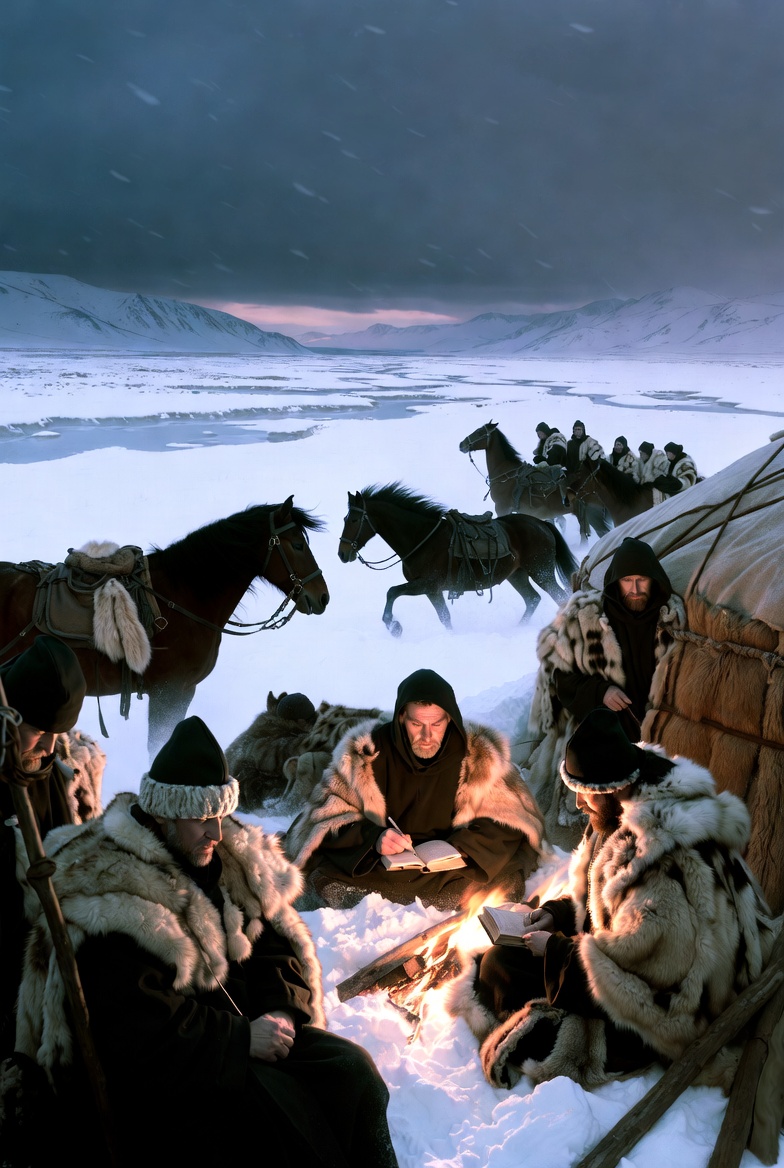
The Mongols lived in enormous felt-covered yurts (they called them *ger* or *orda*) mounted on carts that could be 30 feet wide and pulled by teams of up to 22 oxen. Rich lords like Batu had entire mobile towns of 200+ carts. Women rode astride like men, painted their faces with a greasy concoction that William found simultaneously hideous and fascinating, and wore towering headdresses called *bocca* decorated with peacock feathers and quills. Men shaved the tops of their heads square and let the sides grow into long braids. Food was whatever the herds provided: mutton sliced thin and shared among dozens, dried meat strips, horse intestines stuffed into sausages, and above all *cosmos*—fermented mare’s milk. William’s first taste was an acquired horror that eventually became a guilty pleasure. He described the churning process in loving (and slightly queasy) detail: skins filled with milk, beaten with a stick until it fermented into a tangy, intoxicating drink that lords consumed by the gallon. “It is pungent and very intoxicating,” he noted, while confessing it made him feel “very joyful.” The man had clearly never met a microbrew he didn’t like. By late July they reached Sartach’s camp. Rumors back in Europe had painted him as a secret Christian. William arrived with Bibles, vestments, and a Psalter, chanting hymns and swinging incense like a one-man liturgical show. Sartach inspected the cross politely but made it clear he was no convert. He sent them on to his father, Batu Khan, whose enormous *ordu* on the Volga River looked like a city on wheels. The audience with Batu was pure theater. William, barefoot and bareheaded as custom demanded, preached the Gospel with Franciscan fire, warning the khan of eternal damnation if he refused Christ. Batu smiled, asked a few pointed questions about the King of France and the Pope, then—rather than executing the bold friar—ordered him forwarded to the Great Khan Möngke in Karakorum. It was the medieval equivalent of being told, “Interesting pitch, kid. Take it up with corporate.” The trek east was brutal. From September 1253 onward they rode through the steppes north of the Caspian, crossed the Ural River, passed through the lands of the Cangle and into the territory of the Uighurs and beyond. Winter hit like a hammer. Frost split trees. Horses died. Hunger and thirst were constant companions. William and his companions sometimes went days with nothing but *cosmos* and the occasional bit of millet gruel. They endured language barriers— their interpreter was often drunk or incompetent—constant begging from Mongol hosts, and the casual brutality of nomadic justice. Yet William never stopped observing. He noted how the Mongols divided the world into cardinal directions with ritual precision: masters sat north, women east, men west. Fire was sacred; one never stepped between two fires or threw dirty water on them. Funerals involved wailing for days, then leaving the dead with horse-skin poles and offerings while the family avoided the tent for a year. Marriage was arranged with bride-prices; widows returned to the first husband in the afterlife; polygamy was common and practical. The religious landscape was a revelation. Far from the monolithic “pagan horde” Europeans imagined, the Mongols practiced a live-and-let-live pluralism that would make a modern diversity officer blush. Nestorian Christians, Muslims, Buddhists (the “Tuins” with their shaved heads and saffron robes), and traditional shamanic diviners all coexisted. William watched idol temples where priests chanted “Om mani padme hum” and prostrated before gilt statues. He debated them fiercely, arguing for the unity of God against what he saw as superstition. In one memorable exchange he asked a Buddhist priest how an invisible God could be represented by an image; the priest replied that the statues were memorials for the dead, not gods themselves. William countered that the soul inside the body is invisible yet real—classic medieval gotcha.
They finally reached Karakorum in late December 1253. The Great Khan’s capital was smaller than legend suggested—more a large village with a mud wall and four gates than an imperial metropolis—but it was a cosmopolitan wonder. Separate quarters housed Muslim and Chinese artisans. A French goldsmith named Guillaume Boucher had built an astonishing silver tree fountain for the palace: an angel atop it blew a trumpet when drinks were needed, powered by hidden mechanisms. William met Europeans who had been swept up in the Mongol machine—a woman from Lorraine who cooked him Easter dinner, an English bishop’s nephew, Hungarian clerics. On January 4, 1254, he had his audience with Möngke Khan himself. The Great Khan, medium-built and dressed in seal-skin, listened courteously while William again preached. Möngke’s reply was pragmatic: “We Mongols believe there is only one God… but just as God gave different fingers to the hand, so he gave different ways to men.” No mass conversion, but no execution either. The high point came in May 1254 during a grand religious debate ordered by the Khan himself. Christians, Muslims, and Buddhists squared off in front of the court. William, armed with theology and a bad interpreter, held his own. He later described the Nestorians as boastful drunks and the shamans as charlatans who summoned “devils” with drums and meat offerings. Yet he respected the Mongols’ raw power and organizational genius. He confirmed the Caspian Sea was landlocked, not an arm of the northern ocean. He mapped routes, peoples, and customs with a precision that would later impress Roger Bacon. By July 1254 the mission was over. William received a letter from Möngke to Louis IX—essentially a polite “thanks but no thanks, and don’t try conquering us”—and began the long trek home. He reached the Crusader county of Tripoli on August 15, 1255, having traveled through Persia and Armenia. The *Itinerarium* he wrote for Louis is a masterpiece: honest, detailed, sometimes exasperated, often funny, and always human. It never became a bestseller like Marco Polo’s later book, but scholars and kings read it. It gave Europe its clearest picture yet of the Mongol world—not monsters, but a sophisticated, mobile empire with its own logic, rituals, and surprising openness. Rubruck’s journey did not convert the khans or forge a grand alliance. But it succeeded spectacularly in the one thing that truly mattered: it replaced fear with knowledge. It showed that curiosity, resilience, and meticulous documentation could turn a dangerous gamble into a lasting legacy. And that is the part that still echoes across the centuries. Now imagine taking the exact same spirit—the one that let a 13th-century friar survive 9,000 miles of steppe, cultural whiplash, and horse-milk hangovers—and applying it to your own life in 2026. The outcome of Rubruck’s odyssey proves that the greatest rewards come not from staying safe in Constantinople but from deliberately sailing into the unknown, observing without judgment, documenting ruthlessly, and turning every failure into fuel. Here is how any person today can reap the exact same benefits: - **Embrace the “Black Sea Moment” of deliberate departure**: Rubruck didn’t drift into adventure—he picked a date, packed light, and left the comforts of the known world. In your life this means setting a firm calendar date (today works) to launch one major “expedition” you’ve been postponing—whether switching careers, moving cities, starting a side venture, or confronting a difficult relationship. The specificity of the date creates irreversible momentum, exactly as May 7, 1253, forced Rubruck forward.
- **Swap ox-carts for horses when the terrain demands it**: Rubruck’s initial cart choice slowed him for months until he adapted. Identify the outdated “vehicle” you’re using—old habits, toxic routines, or comfort-zone tools—and ruthlessly upgrade. The plan becomes immediate: audit your daily systems this week and replace one clunky method with a faster, leaner alternative. Adaptation isn’t optional; it’s what kept him alive. - **Turn cultural shock into data, not drama**: Every Mongol custom—from face-grease to *cosmos* rituals—shocked William, yet he recorded it all without losing his mind. Today, treat every discomfort (new boss, foreign market, unfamiliar technology, awkward networking event) as raw material for your personal *Itinerarium*. Keep a daily log: what surprised you, what worked, what didn’t, and one lesson extracted. Over months this turns confusion into mastery. - **Preach boldly but listen harder**: Rubruck’s fiery sermons to Batu and Möngke were memorable precisely because they were fearless—yet the khans’ responses taught him more than any sermon ever could. In modern terms, state your vision or boundaries clearly in every important conversation, then shut up and absorb the reply. The unique edge: schedule “debate days” where you deliberately invite opposing views on your biggest goal and treat them as intelligence, not threats. - **Build your own silver-tree network**: Rubruck found unexpected allies—a French goldsmith in Karakorum, a Lorraine cook, Nestorian clerics. Map and cultivate three “bridge people” outside your usual circle this month: one with skills you lack, one with access, one with a wildly different worldview. Offer value first (a skill, an introduction, a genuine observation) and watch the network compound exactly as Rubruck’s contacts multiplied across the steppes. - **Document like your legacy depends on it—because it does**: The *Itinerarium* outlived Rubruck by centuries because he wrote with brutal honesty and obsessive detail. Start a private “Rubruck Journal” today: every evening record one observation about the world, one about yourself, and one actionable insight. No fluff, no filters. In six months you will possess a personal archive that reveals patterns no self-help app could ever generate. The quick, unique plan—no vision boards, no 75 Hard clones, no generic affirmations—is the **Rubruck Steppe Protocol**, a 21-day “mission cycle” designed to replicate the friar’s exact process in miniature: **Days 1–3: The Departure Phase** – Choose one specific “unknown” (a skill, relationship, or opportunity). Write the equivalent of Louis IX’s commission: a one-paragraph manifesto stating exactly why you are going and what success looks like. Pack light—remove three distractions (apps, commitments, excuses). On day 3, publicly declare the start date to at least one person. Momentum begins.
**Days 4–10: The Cart-to-Horse Adaptation** – Force daily micro-discomforts that mirror steppe travel: cold showers, no caffeine, 45-minute walks with no podcast, one new food you’ve never tried (bonus points if it tastes weird). Each night log what broke, what adapted, and what you learned about your own limits. This is not masochism; it is engineering faster travel. **Days 11–17: The Observation and Debate Sprint** – Engage three new “cultures”: talk to someone from a completely different background, read one primary source on a topic you know nothing about, and schedule one honest debate with a friend or colleague about your mission. Record every cultural shock and every insight without editing. The goal is data, not validation. **Days 18–21: The Karakorum Synthesis** – Compile your logs into a short *Itinerarium*-style report: what you saw, what surprised you, what the “khans” (obstacles or authority figures) actually said, and the single best next step. Share the distilled one-page version with one trusted ally. End with a small ritual feast—something symbolic that celebrates the journey, not just the result. Repeat the 21-day cycle every quarter. It is deliberately short, brutally specific, and impossible to fake. No one else online is running a medieval-Mongol-inspired reconnaissance protocol built around fermented-milk-level discomfort and 13th-century note-taking discipline. It works because it weaponizes the exact traits that turned Rubruck’s “failed” mission into historical gold: relentless curiosity, radical adaptability, and the refusal to let discomfort write the ending. William of Rubruck sailed on May 7, 1253, into a world that terrified his contemporaries. He returned with a map no one had drawn before and a story that still reminds us: the steppes are waiting, the kumiss is an acquired taste, and the greatest empires—personal or otherwise—begin the moment you push off from the shore. Your own May 7 can start right now. The unknown is not the enemy. It is the only place worth going.
Share: