

Imagine waking up to the ground beneath you convulsing like a living beast, the sea rising in rebellion, and ancient wonders crumbling in an instant. On August 8, 1303, that’s exactly what happened when a massive earthquake struck the island of Crete, unleashing chaos across the Mediterranean. This wasn’t just a tremor; it was a cataclysm that reshaped coastlines, toppled empires’ symbols, and left a scar on history that’s often overlooked in the annals of time. But why dive into this distant disaster? Because buried in its rubble are lessons of survival, adaptation, and human ingenuity that can supercharge your life today. In this blog, we’ll unearth the gritty details of that fateful day—far more history than pep talk, I promise—before distilling its essence into actionable ways to fortify your own world against modern “earthquakes,” be they personal crises or unexpected upheavals. Buckle up; this is history with a motivational kick.
### The Historical Backdrop: Crete in the 14th Century
To understand the 1303 earthquake, we need to set the stage in the turbulent world of the early 14th century. Crete, the largest Greek island, was a jewel in the Mediterranean crown, strategically positioned between Europe, Africa, and Asia. By 1303, it had been under Venetian control for nearly a century, following the Fourth Crusade’s sack of Constantinople in 1204. The Venetians renamed the capital Heraklion to Candia and turned the island into a thriving trade hub, exporting wine, olive oil, and grains while importing luxury goods from the East. Castles dotted the landscape, serving as administrative centers and fortresses against pirates and rival powers like the Genoese.
The broader Mediterranean was a powder keg. The Byzantine Empire was in decline, the Mamluk Sultanate ruled Egypt with an iron fist, and seismic activity was a constant threat due to the Hellenic Arc—a tectonic boundary where the African Plate subducts beneath the Aegean Sea Plate. This geological hotspot had spawned earthquakes before, but none in recorded history matched the ferocity of 1303. The region was no stranger to natural disasters; ancient texts mention quakes destroying Minoan palaces around 1700 BC, and more recent ones in 365 AD had devastated Crete and Alexandria. Yet, in 1303, humanity’s vulnerability was laid bare anew.
Society on Crete was a mix of Greek Orthodox locals, Venetian colonists, and a smattering of Jewish and Muslim traders. Life revolved around agriculture, maritime commerce, and religious festivals. Women managed households, children played in olive groves, and men toiled in fields or sailed treacherous seas. Little did they know that dawn on August 8 would shatter this fragile equilibrium.
### The Earthquake Strikes: Dawn of August 8, 1303
It began just as the first light pierced the horizon, around 5 or 6 a.m. local time. The epicenter was likely offshore, between Crete and Rhodes, at coordinates approximately 35° N, 27° E. Modern estimates peg the magnitude at around 8.0 on the Richter scale—a behemoth capable of releasing energy equivalent to thousands of atomic bombs. The shaking registered IX on the Mercalli intensity scale, meaning violent tremors that could hurl people to the ground, crack foundations, and collapse poorly built structures.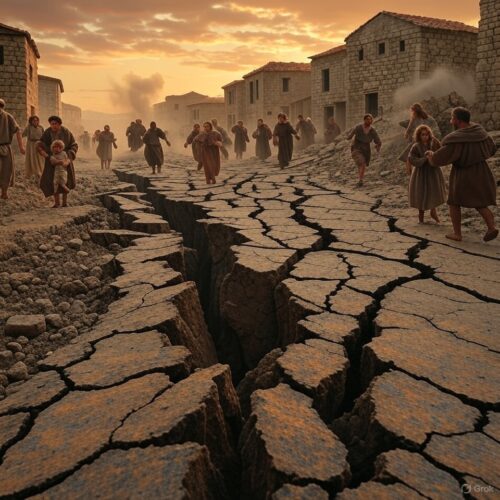
Eyewitness accounts, though sparse, paint a vivid picture. Venetian officials in Candia penned urgent dispatches that day and again on August 28, detailing the horror. The ground heaved for what felt like an eternity—likely 30 to 60 seconds of primary shaking, followed by aftershocks. Stone buildings, including grand Venetian castles like those in Chania and Rethymno, cracked like eggshells. In Candia, public edifices such as the ducal palace and churches suffered extensive damage; walls tumbled, roofs caved in, and towers leaned precariously. Rural areas fared no better: villages built on unstable soil saw homes reduced to rubble, burying livestock and crops under debris.
Casualties were heartbreakingly skewed. Reports noted that most victims were women and children, caught indoors as they prepared for the day. Men, often already in fields or at sea, escaped the worst. Exact death tolls are lost to time, but estimates suggest hundreds, if not thousands, perished on Crete alone. The island’s rugged terrain amplified the destruction; landslides blocked roads, and fissures swallowed wells, contaminating water supplies.
But the earthquake was only the opening act. Within minutes, the sea stirred ominously.
### The Tsunami’s Wrath: A Wall of Water Across the Mediterranean
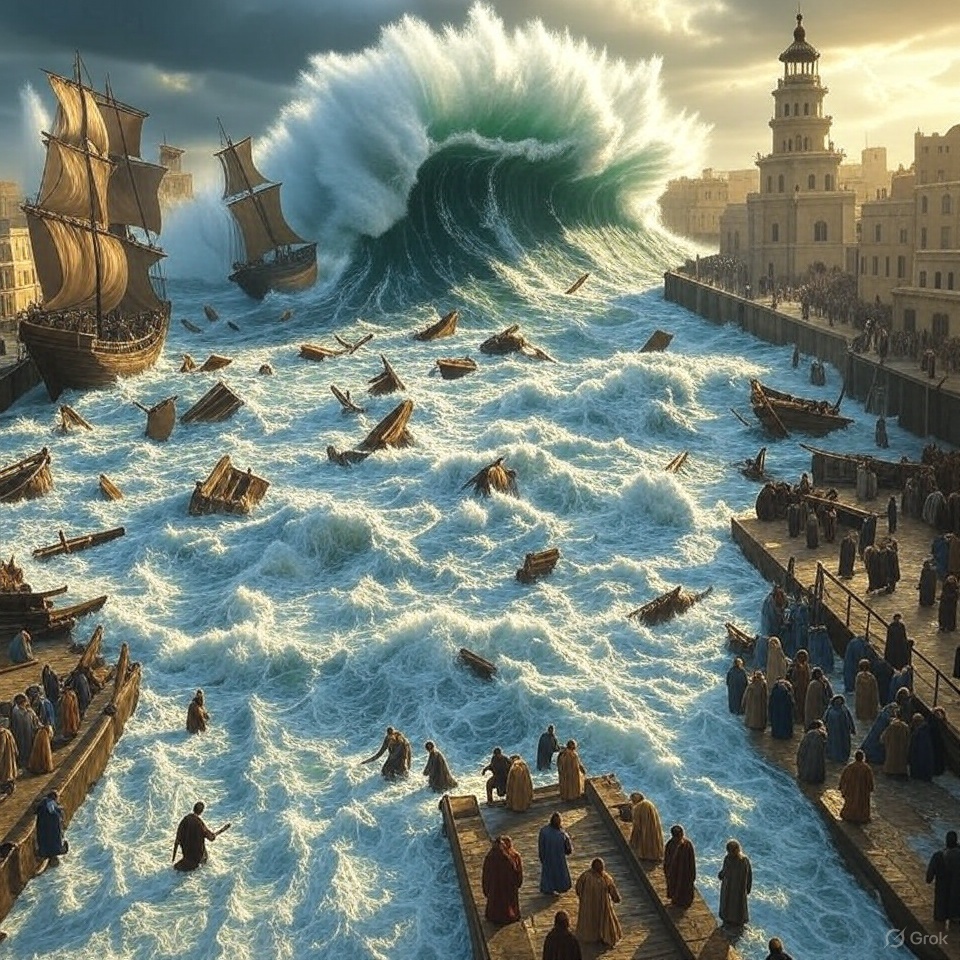
The subduction zone’s violent slip displaced massive volumes of seawater, birthing a tsunami that propagated at speeds up to 500 mph. Modern simulations, based on bathymetric data and historical records, indicate waves reaching heights of 9 meters (30 feet) at Alexandria, with run-ups varying by coastline. On Crete, the tsunami struck the northern shores first, flooding harbors and sweeping away fishing boats. In Candia, surges inundated low-lying areas, drowning survivors who had fled collapsing buildings.
The wave’s journey southward was relentless. It took about 40 minutes to reach Alexandria, Egypt’s bustling port under Mamluk rule. There, the tsunami manifested as a series of towering walls of water. Eyewitness chronicles from Arab historians like al-Maqrizi describe the sea retreating initially—a deceptive calm—before roaring back with fury. Ships in the harbor were lifted like toys; some were hurled two miles inland, splintering against city walls. The port’s infrastructure—docks, warehouses, and arsenals— was obliterated. Homes along the waterfront collapsed under the onslaught, killing scores. The famous Lighthouse of Alexandria, already weakened by prior quakes, suffered critical damage: its upper tiers cracked, and parts of the structure tumbled into the sea. This Pharos, one of the Seven Wonders of the Ancient World, standing over 100 meters tall, had guided mariners for centuries; after 1303, it began its slow decline, fully collapsing in the 14th century.
Further east, in Acre (modern Akko, Israel), under Crusader remnants and Mamluk control, the tsunami destroyed buildings and swept people into the depths. Damascus and Antioch felt the ground shake but escaped the waves, while Cyprus, Rhodes, and even distant Constantinople reported tremors. In Cairo, 500 km inland, the quake dislodged white limestone casing from the Great Pyramid of Giza, scattering blocks that locals later repurposed. Minarets on mosques toppled, and city walls cracked.
The tsunami’s reach was astonishing: effects were noted as far as the Adriatic coast, possibly Venice itself, over 1,600 km away, though these may have been minor swells or exaggerated reports. In Tunis, 1,500 km west, faint shaking was felt. This event underscored the interconnectedness of the Mediterranean world— a disaster in one corner rippled across empires.
### Aftermath and Recovery: Rebuilding Amid Ruin
The immediate aftermath was grim. On Crete, Venetian authorities scrambled to assess damage. The August 8 dispatch from Candia begged for aid from Venice, listing ruined castles and pleading for engineers and funds. By August 28, a follow-up report cataloged repairs: provisional wooden supports shored up walls, debris was cleared, and food rations distributed to prevent famine. Plague often followed such disasters, but records don’t mention outbreaks here, perhaps due to the island’s isolation.
In Egypt, Sultan al-Nasir Muhammad ordered reconstructions. Alexandria’s walls were rebuilt stronger, incorporating lessons from the collapse. The lighthouse received patchwork repairs, but its glory faded. Economic fallout was severe: lost ships disrupted trade routes, spiking prices for goods like spices and silk. Crete’s agriculture suffered; olive groves flooded with saltwater yielded poor harvests for years.
Historically, this earthquake fits into a pattern of seismic events along the Hellenic Arc. Predecessors like the 365 AD Crete quake, which raised the island by 9 meters in places, and successors like the 1856 event, show the region’s volatility. Modern seismologists use the 1303 quake as a model for hazard assessment. Studies in the Journal of Seismology (1997) and Physics and Chemistry of the Earth (2006) reconstruct the scenario: a thrust fault rupture, perhaps 100 km long, generated the tsunami. Tsunami deposits in coastal sediments confirm wave heights, and paleoseismology reveals recurrence intervals of 800-1,000 years for similar events.
Culturally, the quake inspired awe and fear. Medieval chroniclers saw it as divine wrath—perhaps punishment for Venetian hubris or Mamluk conquests. In folklore, tales of swallowed villages persisted. Scientifically, it predated systematic study, but Arab scholars like Ibn Taghribirdi documented it meticulously, aiding later historians.
The 1303 event also highlighted human resilience. Venetians fortified Crete’s defenses, incorporating earthquake-resistant designs like flexible mortar. In Alexandria, harbor improvements followed, boosting trade. Long-term, it may have accelerated the lighthouse’s demise, symbolizing the shift from ancient to medieval worlds.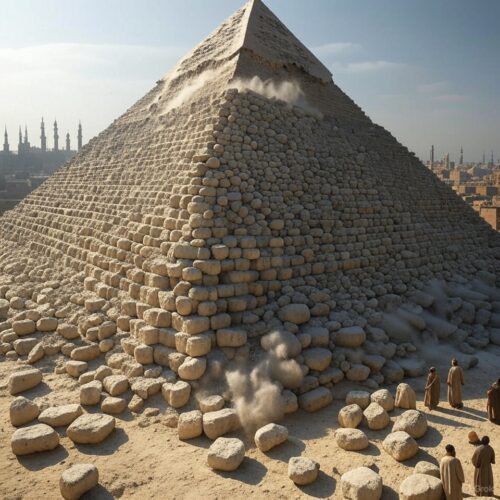
### Deeper Dive: Geological Mechanics and Comparative Analysis
Delving deeper into the science, the Hellenic Arc is a convergent boundary where the African Plate dives under the Eurasian Plate at 35-40 mm per year. The 1303 quake likely involved a reverse fault, where the overriding plate thrust upward, displacing the seafloor. This vertical motion is key to tsunami generation—unlike strike-slip quakes, which rarely produce waves.
Comparative events illuminate its scale. The 365 AD quake, magnitude 8.3+, uplifted western Crete permanently and spawned a tsunami that killed tens of thousands across the Mediterranean. The 1303 event, while smaller, mirrored this in damage pattern. Fast-forward to modern times: the 2004 Indian Ocean tsunami (magnitude 9.1) killed 230,000, but shared mechanics with 1303—subduction zone slip. The 1956 Amorgos quake (7.7) in Greece caused a local tsunami, but nothing as far-reaching.
Historical records from Venetian archives, preserved in the State Archives of Venice, provide granular data. Letters describe specific castles: in Sitia, the fortress walls split; in Ierapetra, battlements fell. Rural hamlets like those near Mount Ida saw entire communities wiped out by landslides. In Egypt, al-Maqrizi’s “History of the Ayyubids and Mamluks” notes the sea’s retreat exposing fish, luring people to collect them before the wave struck—a classic tsunami warning sign ignored in panic.
The quake’s felt area was vast, implying shallow depth (10-20 km). Intensity maps, reconstructed by seismologists, show VIII-IX on Crete, VII in Cairo, V in Damascus. This attenuation pattern suggests the energy propagated efficiently through the crust.
Economically, Crete’s recovery took decades. Venetian investments poured in, but taxes rose, sparking unrest among locals. In Egypt, the Mamluks diverted funds from military campaigns to rebuild, possibly delaying expansions.
Culturally, the event influenced art and literature. Illuminated manuscripts depicted apocalyptic scenes, and prayers for protection from earthquakes became common in Orthodox liturgies.
### Global Ripples: Impacts Beyond the Epicenter
The quake’s influence extended to politics. In Venice, news arrived weeks later, prompting Senate debates on colonial defense. Resources shifted from wars with Genoa to fortifying outposts. In the Holy Land, Acre’s damage weakened Mamluk garrisons, indirectly aiding lingering Crusader hopes, though the last stronghold fell in 1291.
In Constantinople, the Byzantine Emperor Andronikos II felt the tremors, interpreting them as omens amid Turkish threats. Cyprus, under Lusignan kings, reported minor damage but used the event to bolster alliances with Venice.
Scientific legacy: The 1303 quake is a benchmark for Mediterranean tsunami risk. EU-funded projects like TRANSFER (2006-2009) model similar scenarios, predicting inundation zones for modern cities like Heraklion (population 170,000+). Early warning systems, absent in 1303, now use buoys and seismographs to detect threats.
Archaeological evidence supports accounts. Excavations in Alexandria reveal 14th-century debris layers with ship fragments inland. On Crete, castle ruins show repair phases post-1303, with distinct masonry styles.
This disaster also underscores gender disparities in vulnerability—women and children’s higher death rates reflect societal roles, a pattern seen in later events like the 2004 tsunami.
### Lessons from the Rubble: Applying 1303 to Your Life Today
Now, shifting gears to the motivational side—though remember, history dominates this tale. The 1303 Crete earthquake teaches us that sudden upheavals can strike anyone, but preparation and resilience turn victims into victors. The outcome? A blueprint for building unshakeable foundations in your personal life, whether facing job loss, health scares, or relationship quakes. Here’s how this ancient event benefits you today:
– **Embrace Proactive Preparation**: Just as Venetians rebuilt stronger castles, anticipate life’s tremors by creating an emergency fund covering 6-12 months of expenses. Start by auditing your finances weekly, cutting non-essentials like unused subscriptions, and automating savings transfers on payday.
– **Cultivate Adaptability in Crisis**: The tsunami’s survivors fled high ground; similarly, develop flexibility by learning new skills annually—enroll in an online course on coding or public speaking to pivot careers if needed.
– **Strengthen Community Ties**: Cretans relied on Venetian aid; build your network by joining local groups or online forums, scheduling monthly check-ins with friends to offer mutual support during tough times.
– **Prioritize Mental Fortitude**: Amid rubble, people rebuilt; practice daily mindfulness meditation for 10 minutes to reframe setbacks as growth opportunities, journaling three gratitudes each evening.
– **Invest in Long-Term Stability**: The lighthouse’s gradual decline warns against neglect; conduct annual “life audits” reviewing health, relationships, and goals, adjusting like scheduling doctor visits or date nights.
A Step-by-Step Plan to Apply These Lessons:
- **Week 1: Assess Vulnerabilities** – List potential “earthquakes” in your life (e.g., financial instability) and rate their likelihood. Research one historical recovery story, like post-1303 Crete, for inspiration.
- **Week 2: Build Defenses** – Set up a basic emergency kit (physical and metaphorical): stock water/food for disasters, and create a resume backup for career shakes.
- **Week 3: Practice Response** – Simulate a crisis, like a “no-spend day,” to test adaptability. Reflect on what worked.
- **Week 4: Reinforce and Review** – Connect with a mentor for feedback, then repeat the plan quarterly to evolve.
By channeling the spirit of 1303 survivors, you’ll not just endure but thrive, turning history’s chaos into your personal triumph. Remember, the ground may shake, but your resolve won’t.