
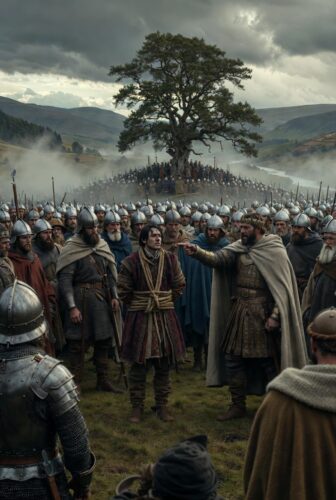
Picture a misty spring morning in the Welsh hills near Bala, 1230. A crowd of more than eight hundred Welsh warriors, farmers, and nobles gathers around an oak tree at a place called Crogen. The air hums with tension. A richly dressed Norman lord, William de Braose—known to the Welsh as Gwilym Ddu, or Black William—stands bound, his face pale but defiant. Moments later, at the command of Prince Llywelyn ap Iorwerth, the greatest unifier Wales had ever seen, the rope tightens. Black William swings. It is May 2, and this public execution isn’t just personal revenge. It is a calculated masterstroke of power, honor, and cold political calculus that helped cement Llywelyn’s golden age of Welsh independence.
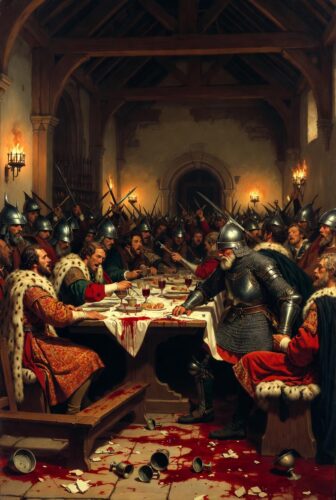
This wasn’t some random feudal spat. It was the explosive climax of decades of border intrigue, royal bloodlines, betrayed alliances, and one very ill-timed Easter tryst. Llywelyn had captured de Braose two years earlier, ransomed him, and even sealed a marriage pact between de Braose’s daughter Isabella and Llywelyn’s own heir, Dafydd. Then, during a court visit to finalize the deal, de Braose was caught red-handed in the prince’s own bedchamber with Llywelyn’s wife, Joan—illegitimate daughter of King John of England herself. The scandal could have shattered Llywelyn’s carefully built empire. Instead, he turned it into a demonstration of iron-fisted authority that echoed across the Marches and beyond. The marriage alliance still went ahead. Joan was briefly imprisoned but later forgiven and restored. Wales stayed strong. What makes this obscure May 2 event from eight centuries ago worth resurrecting today? Because buried in the blood and politics is a timeless blueprint for handling betrayal, enforcing boundaries, and forging unbreakable long-term wins even when emotions scream for chaos. In the next several thousand words we’ll dive deep into the real, gritty history—Llywelyn’s improbable rise from exile, the brutal world of the Marcher lords, the diplomatic genius of Princess Joan, the de Braose family’s bloody legacy, the exact mechanics of the 1228 capture and 1230 hanging, and the political chess moves that followed. Only after that rich historical feast will we extract the motivational gold: specific ways a modern person can apply Llywelyn’s blend of decisive justice and strategic pragmatism to their own life. No fluffy affirmations. No generic “set boundaries” advice you’ve read a thousand times. Just a quick, weirdly specific, medieval-flavored personal protocol that stands out from every self-help echo chamber online. Let’s travel back to the late 12th century, when Wales was a fractured puzzle of petty kingdoms constantly gnawing at each other while Norman Marcher lords nibbled away at the edges like hungry wolves. The Marches—those wild borderlands between England and Wales—were a lawless playground where kings granted ambitious Norman families semi-independent fiefdoms in exchange for keeping the “wild Welsh” in check. These Marcher lords operated under their own customs, built massive castles, and often treated Welsh princes as inconvenient neighbors to be raided, married into, or crushed. One family stood out for sheer ruthlessness: the de Braoses. The de Braose dynasty traced its roots to Normandy but had sunk deep claws into the Welsh Marches by the 1170s. William de Braose’s grandfather (also named William) earned eternal Welsh hatred in 1175 with the infamous Abergavenny Massacre. He invited local Welsh lords, including Seisyll ap Dyfnwal, to a Christmas feast at Abergavenny Castle under the guise of peace talks. Once the guests were drunk and disarmed inside the hall, de Braose’s men slaughtered them. Not content with that, the lord later hunted down and killed Seisyll’s seven-year-old son. The Welsh nicknamed the family “the Og of Abergavenny” and never forgot. Gerald of Wales, the chronicler, tried to soften the story by praising the elder William’s piety and donations to local priories, but the blood feud lingered for generations. By the time our William de Braose the Younger (sometimes called the 4th Lord of Bramber or 10th Baron Abergavenny) inherited the titles around the early 1200s, the family controlled vast swaths of land including Brecknock, Builth, Radnor, Gower, and more—prime real estate that Llywelyn wanted for his expanding Welsh realm. Enter Llywelyn ap Iorwerth, born around 1173 in the royal manor near Dolwyddelan in Gwynedd. His father Iorwerth Drwyndwn (“the flat-nosed”) died when Llywelyn was an infant amid the chaotic civil wars that ripped Gwynedd apart after the death of Owain Gwynedd in 1170. Owain’s legitimate sons fought like cats in a sack; illegitimate branches complicated everything. Welsh law at the time treated all sons equally regardless of birth status, a custom Llywelyn would later fight to change. Young Llywelyn grew up partly in exile or under the shadow of uncles Dafydd and Rhodri, who had carved up Gwynedd with English help. Chronicler Gerald of Wales noted that by age twelve, the boy was already “molesting” his uncles—raiding, plotting, and claiming his birthright with ferocious determination.By 1194, at just twenty-one, Llywelyn allied with cousins and crushed uncle Dafydd at the Battle of Aberconwy. Rhodri died in 1195. In 1197 Llywelyn captured Dafydd and sent him packing to England, where he died in 1203. On Epiphany 1199, Llywelyn routed his remaining rivals in Arfon and captured Mold Castle the same day. He issued a charter the next morning styling himself “prince of the whole of North Wales.” Gwynedd was his. But he didn’t stop there. Over the next three decades Llywelyn became the first Welsh ruler since the days of the ancient Britons to exert real suzerainty over most of Wales. He built sophisticated stone castles—Criccieth, Dolbadarn, Dolwyddelan—symbols of permanent power rather than the old wooden motte-and-bailey forts. He fostered trade, founded abbeys like Aberconwy, and issued laws that centralized authority. He played the great powers of Europe against each other: allying with King John when convenient, rebelling when John grew tyrannical, even coordinating with French and Scottish interests. The crown jewel of his diplomacy was his 1205 marriage to Joan, natural daughter of King John of England. Illegitimate but acknowledged, Joan brought royal English blood, diplomatic savvy, and a direct line to the Plantagenet court. She wasn’t just a trophy wife; contemporary records show her acting as mediator, warning her father of invasions, negotiating treaties, and even interceding during the 1211 crisis when John invaded Gwynedd. Llywelyn and Joan had several children, including the crucial heir Dafydd. Llywelyn also had an older illegitimate son, Gruffudd, by a Welsh mistress Tangwystl, but he worked hard to tilt succession toward legitimate heirs—a radical move in Welsh custom that required papal approval in 1222. This family structure gave Llywelyn leverage on both sides of the border. Tensions with the Marcher lords simmered constantly. In 1228, during one of the periodic flare-ups along the border, Llywelyn’s forces captured William de Braose near Montgomery. Black William was no minor knight; he held huge estates and had inherited the family’s reputation for cunning and violence. Llywelyn didn’t execute him on the spot. Instead, he extracted a massive ransom—reportedly £2,000, a fortune—and, crucially, negotiated a marriage alliance: de Braose’s daughter Isabella would wed Llywelyn’s son and heir Dafydd. It was classic medieval realpolitik. The de Braose lands would eventually feed into Gwynedd’s orbit, the alliance would neutralize a dangerous rival, and Llywelyn could claim he was merciful and strategic. William was released and sent home.
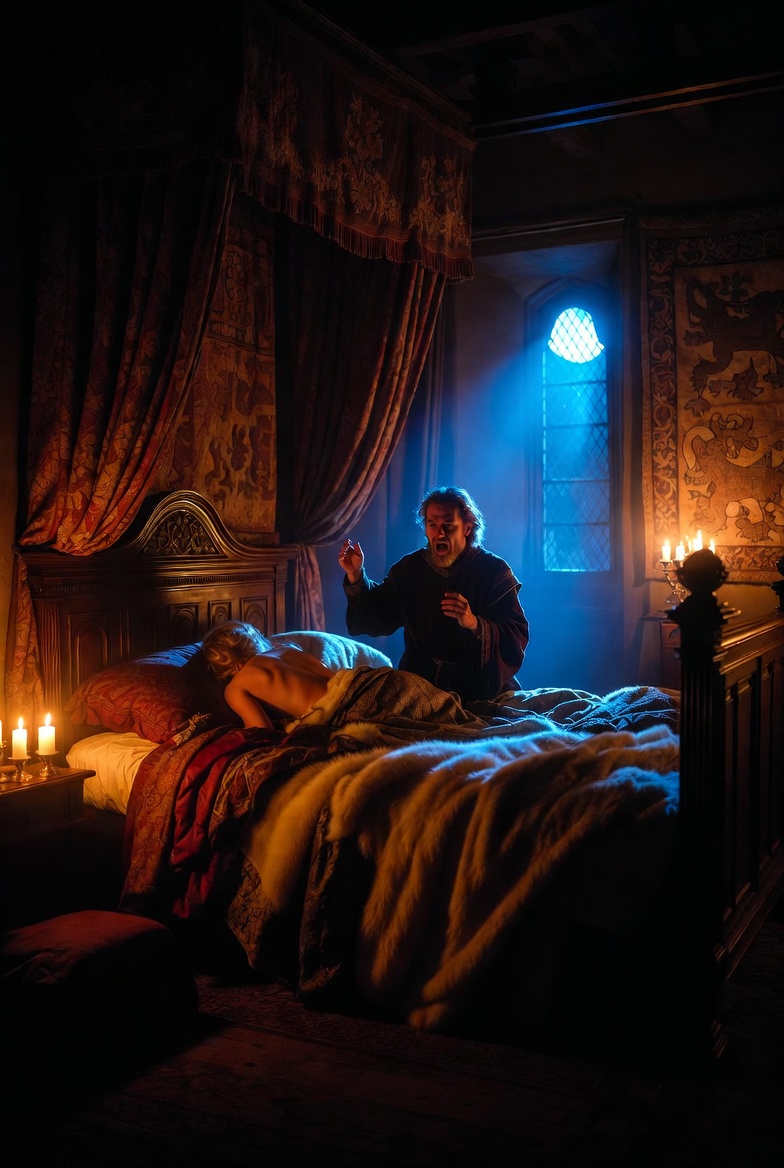
Fast-forward to Easter 1230. William returned to Llywelyn’s court, ostensibly to finalize wedding details and perhaps negotiate the release of any remaining retainers captured with him. The visit seemed cordial—until one night Llywelyn (or his men) discovered William in the prince’s own bedchamber with Joan. The exact circumstances remain tantalizingly vague in the chronicles. Was it consensual passion? Coercion? A calculated political seduction? Welsh chroniclers like the Brut y Tywysogion simply state that William “had been caught in Llywelyn’s chamber with the king of England’s daughter, Llywelyn’s wife.” English and French sources echo the shock. Whatever the truth, the breach of hospitality, honor, and royal marriage was catastrophic. In Welsh princely custom, adultery with the ruler’s wife was among the gravest insults imaginable. Llywelyn acted with lightning speed but surprising restraint. William was arrested and imprisoned. Joan was placed under house arrest. Rather than fly into a blind rage and risk alienating English allies or destabilizing the marriage pact, Llywelyn convened a council of his lords. They tried William formally. On May 2, 1230, the sentence was carried out publicly at Crogen (or possibly Gwern y Grog near Abergwyngregyn, depending on local tradition). The Abbott of Vaudey recorded that William was hanged “openly and in the broad daylight, in the presence of more than 800 men assembled to behold the piteous and melancholy spectacle.” It wasn’t a private midnight murder; it was theater. Llywelyn was sending a message to every Marcher lord, every Welsh noble, and every potential rival: cross me in my own house and you swing—publicly, unmistakably. Yet here’s the pragmatic genius: Llywelyn wrote to William’s widow Eva Marshal asking whether the marriage between Isabella and Dafydd should still proceed. It did, in 1231. Joan endured about a year of confinement but was eventually forgiven, restored to favor, and continued as a key diplomat until her death in 1237. Llywelyn had enforced personal honor without torching the strategic alliance. The execution sent ripples across Britain. King Henry III (John’s son) was furious but couldn’t afford full-scale war while dealing with his own barons. Other Marcher families took note. Llywelyn’s authority in Wales reached its zenith. He continued building, legislating, and expanding influence until a stroke felled him in 1237—the same year Joan died. He passed in 1240 at Aberconwy Abbey, which he had founded, and was buried there in monastic habit. His legitimate son Dafydd succeeded him, though the English crown quickly moved to limit Welsh power. Llywelyn’s grandson Llywelyn ap Gruffudd would later be called the last Prince of Wales before Edward I’s conquest in 1282. But for a generation, Llywelyn the Great had created something rare: a nearly unified Wales that punched above its weight against the mightiest kingdom in Europe. Historians debate the exact location of the hanging—some say Crogen near Bala, others a site called “Crokein” or Gwern y Grog. The Welsh chronicles are terse; English ones express outrage at the “barbarity.” Yet all agree on the date: May 2, 1230. This single day encapsulated Llywelyn’s entire philosophy—ruthless when necessary, but always calculated to preserve the bigger prize. He didn’t let emotion destroy the marriage alliance that would bring de Braose lands and English goodwill into his orbit. He didn’t quietly poison the offender in a dungeon; he made an example that reinforced his image as a just and fearsome ruler. And he didn’t divorce or execute Joan, whose royal blood and negotiating skills had repeatedly saved his skin during crises with her father King John.The de Braose family, for their part, survived the scandal. Isabella did marry Dafydd. The Marcher lordships continued their predatory ways until Edward I eventually brought the whole border under tighter royal control. But on that May morning in 1230, Llywelyn had drawn a line in the misty Welsh soil that no one could ignore. Now, fast-forward eight centuries. You’re not a medieval prince with an army and a gibbet, but you face your own versions of border raiders, treacherous “allies,” and high-stakes betrayals every day—in toxic work relationships, flaky business partners, draining personal habits, or family dynamics that threaten your long-term goals. Llywelyn’s story isn’t about literal revenge; it’s about the rare art of decisive boundary enforcement paired with unflinching strategic pragmatism. Most self-help tells you to “forgive and forget” or “cut toxic people out cold.” Llywelyn did neither exclusively. He hanged the immediate threat publicly for all to see, then preserved the alliance that served his kingdom. That combination—visible justice plus calculated mercy where it counts—is almost nonexistent in modern advice. It’s the missing middle path that builds empires instead of echo chambers. Here’s how a modern person benefits today by internalizing the outcome of May 2, 1230: - **You gain unbreakable personal sovereignty.** Llywelyn didn’t tolerate violation of his inner sanctum (literally his bedchamber). Translating that: you stop letting people or habits trespass on your core values, time, or peace without consequence. The public hanging made the rule clear to everyone watching; your version creates social proof that you mean business. - **You master the art of selective pragmatism.** Killing the alliance would have been easy rage. Keeping it despite the betrayal turned a personal loss into territorial gain. Today that means firing the toxic client but keeping the referral network, or ending a draining friendship while preserving the shared professional circle that still serves your goals. - **You build legacy-level resilience.** Llywelyn’s Wales survived his death longer than most expected because he had institutionalized power through laws, castles, and alliances. Your life version: decisions that outlast your emotions create systems (habits, contracts, networks) that keep winning even when you’re having a bad week. - **You develop a reputation that deters future invaders.** Word of the Crogen hanging spread. Future Marcher lords thought twice. In modern terms, people treat you differently once they see you enforce boundaries visibly and consistently—without descending into drama.
To make this concrete and unlike anything else online, here is the quick, unique “Llywelyn Crogen Protocol”—a 7-day action plan you can run anytime life feels like a swarm of Marcher lords nibbling your borders. It’s not a 30-day habit tracker or vision-board nonsense. It’s a medieval-flavored campaign of reconnaissance, public accountability, strategic mercy, and kingdom-building that feels weirdly fun and ridiculously effective because it draws directly from the historical mechanics of 1230 without the actual rope. **Day 1 – Scout the Borders (Reconnaissance):** List every “de Braose” in your life—people, habits, commitments, or distractions that keep crossing into your core territory (time, energy, values, money). Write them on a single sheet titled “Marcher Threats.” Be brutally specific: “Colleague who dumps last-minute work on Fridays” or “doom-scrolling that eats 90 minutes nightly.” Rate each on a 1–10 scale of damage to your “Gwynedd” (your big goals). **Day 2 – Convene the Council (Private Trial):** For each threat, gather “your lords”—trusted advisors, journal, or even a voice memo—and ask: Does this violate my inner chamber (non-negotiables)? Is there a hidden alliance value I’ve been ignoring? Decide: full execution (cut completely), ransom (set strict new terms), or marriage pact (transform into something useful). **Day 3 – The Public Hanging (Visible Accountability):** Pick the top 1–2 threats and make the execution public in a controlled way. Tell a friend, post a (vague but firm) social update, or create a visible ritual like deleting the app in front of your accountability partner. The spectacle matters—Llywelyn didn’t do it in secret. Public commitment multiplies enforcement power. **Day 4 – Check the Marriage Pact (Strategic Mercy Audit):** For any threat you didn’t fully execute, ask Llywelyn’s question: Can this still serve my heir (long-term goal)? Renegotiate terms ruthlessly but fairly. Example: keep the business contact but only via scheduled calls, no after-hours texts. Write the new “treaty” and date it. **Day 5 – Build the Stone Castles (Systematize Defense):** Translate the day’s decisions into permanent infrastructure. New calendar blocks, auto-replies, written agreements, or even a “Gwynedd Charter” document listing your core laws. Llywelyn built castles; you build repeatable systems that defend you when motivation fades. **Day 6 – Restore the Queen (Reintegration and Forgiveness Check):** If you chose mercy anywhere, test it. Spend time with the “reformed” element (person or habit) under the new rules. If it holds, integrate fully like Joan’s return. If not, back to the gibbet—no second chances after the public spectacle. **Day 7 – Expand the Realm (Legacy Review):** Survey your new “unified Wales.” What territory have you reclaimed? Celebrate with a tangible reward that reinforces the win (a new tool for your craft, a trip to somewhere inspiring). Then look outward: what new alliance or conquest becomes possible now that your borders are secure? Run this protocol once a quarter or whenever chaos creeps in. It’s fast, memorable, and weirdly motivating because it turns self-improvement into a historical role-play with real stakes. No one else online is telling you to “hang your excuses at Crogen” or “treat your calendar like Llywelyn treated Marcher lords.” The result? You stop leaking power to betrayers and start ruling a more cohesive, prosperous version of your own life—just as Llywelyn turned fractured Gwynedd into a force that made kings nervous. The hanging at Crogen on May 2, 1230, wasn’t the end of Welsh independence; it was one of the moments that prolonged and strengthened it. Llywelyn died in 1240, but his example of blending ferocity with foresight outlived him. Apply even a fraction of that spirit today and watch your personal kingdom consolidate, expand, and endure. The oak tree is long gone, but the lesson still stands tall: enforce the boundary publicly, preserve the alliance strategically, and rule like your legacy depends on it—because it does.
Share: