
Picture this: April 25, 1185. The narrow Kanmon Straits off the southern tip of Honshū churn like a pot of boiling miso. Thousands of wooden warships slam together in a chaos of arrows, crashing oars, and desperate screams. Samurai in lacquered armor leap from deck to deck. Women in silk court robes clutch a six-year-old emperor and hurl themselves into the sea rather than surrender. A sacred sword vanishes beneath the waves forever. Crabs scuttling on the seafloor today still wear the furious faces of dead warriors—nature’s own memorial to the losers. This wasn’t some Hollywood pirate flick. This was the Battle of Dan-no-ura, the final, cataclysmic clash of the Genpei War, and it changed Japan—and the entire concept of power in East Asia—forever.Most people have never heard of it. While Western history buffs rattle off Agincourt or Waterloo, this single day in distant medieval Japan marked the violent death of the elegant, poetry-obsessed Heian court and the violent birth of the samurai shogunate that would rule for nearly seven centuries. It is a story soaked in blood, betrayal, Buddhist philosophy, superhuman leaps, and one of history’s greatest military underdog triumphs. And today, on this exact calendar date more than 840 years later, its lessons sit there waiting like a perfectly timed rip tide—ready to pull you out of whatever personal mess you’re in and deposit you on the shores of your own quiet victory. Let’s dive deep into the history first, because 90 percent of what happened that day is pure, unfiltered medieval drama that deserves every gory, glorious detail. To understand Dan-no-ura you have to rewind to the Heian period, Japan’s golden age of refined aristocracy that began around 794. The imperial court in Kyoto (then Heian-kyō) was a world of silk kimonos, moon-viewing parties, calligraphy contests, and tanka poetry so exquisite it could make a warlord weep. Real power, however, had quietly slipped away from the emperors into the hands of two colossal warrior clans: the Taira (also called Heike) and the Minamoto (Genji). These weren’t ragtag bandits; they were aristocratic families who had spent generations serving as the muscle for the court while slowly building private armies of mounted archers and sword-wielding retainers—the very first samurai. By the mid-12th century the Taira clan, led by the ruthless and brilliant Taira no Kiyomori, had seized control. Kiyomori wasn’t content with being the emperor’s general. He married his daughter into the imperial family, placed relatives in every key government post, and basically turned the court into a Taira family business. He lived like a rock star: lavish palaces, fleets of ships, and a personal army that made rivals tremble. But arrogance has a way of breeding enemies. The Minamoto clan, longtime rivals, seethed in the shadows. Their leader, Minamoto no Yoritomo, was exiled to the remote eastern provinces as a boy after an earlier failed rebellion. There, among the horse-riding warriors of the Kantō plain, he quietly built alliances, trained fighters, and waited for the moment the Taira would overreach.
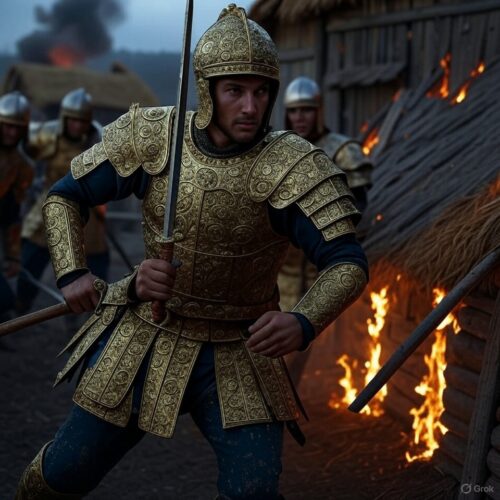
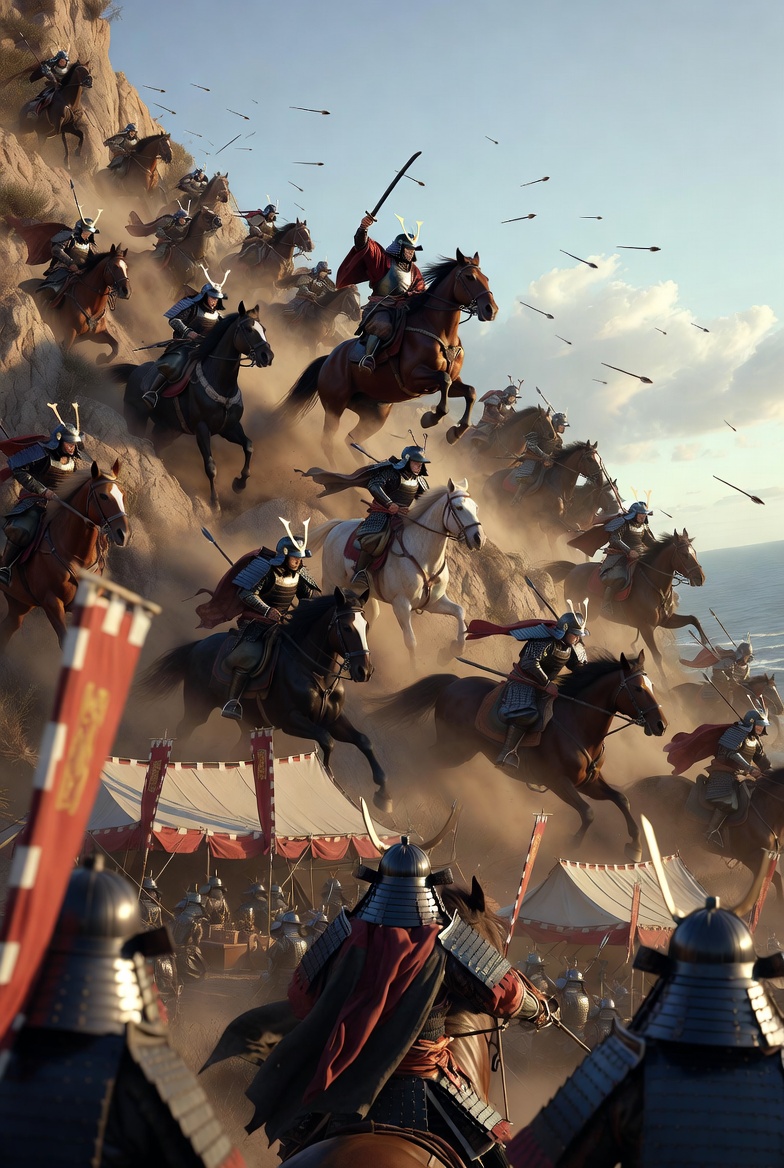
That moment came in 1180. The retired emperor Go-Shirakawa, tired of being a Taira puppet, secretly called on the Minamoto to rise up. What followed was five years of brutal civil war—the Genpei War—fought across mountains, rivers, and finally the sea. It wasn’t just clan versus clan; it was a tectonic shift from courtly elegance to raw military rule. Early battles were small and scattered. Minamoto forces under Yoritomo’s half-brother Yoshitsune—a brilliant, almost mythical young general—began scoring impossible victories. Yoshitsune was the 12th-century equivalent of a special-forces legend: short, fierce, strategically insane. He once led a cavalry charge down a near-vertical cliff at the Battle of Ichi-no-tani in 1184, catching the Taira completely off guard while they were picnicking in luxury tents. The Taira fled in panic, abandoning their finery and their pride. By early 1185 the Taira were on the run. Their leader Taira no Munemori had retreated to their ancestral heartland in western Japan, dragging along the child Emperor Antoku (only six years old) and the three sacred Imperial Regalia: the sword Kusanagi-no-Tsurugi, the jewel Yasakani no Magatama, and the mirror Yata no Kagami. These objects weren’t just symbols; they were the literal proof of divine imperial legitimacy. Without them, the emperor was just a kid in fancy robes. The Taira fleet—some accounts say 500 ships, others up to 1,000—anchored at Dan-no-ura in the Kanmon Straits, a narrow, treacherous channel where the tides are ferocious and the currents can flip a boat like a leaf. They knew the local waters intimately. Their fighters were southern seamen, experts at naval archery and ship-to-ship combat. They split their fleet into three squadrons and waited, confident that geography and the morning rip tide would let them surround and annihilate the pursuing Minamoto. The Minamoto arrived on April 25 with a larger but less experienced fleet—perhaps 800 ships according to the official Azuma Kagami chronicle, or as many as 3,000 in the more dramatic Tale of the Heike, the great medieval epic poem that immortalized the war. Yoshitsune commanded the naval assault while his brother Noriyori handled land support. They had spies, including the turncoat Taira vassal Taguchi Shigeyoshi, whose son was being held hostage by the Minamoto. The Taira had been warned not to trust him, but Munemori brushed off the advice. Big mistake. Dawn broke with the tide running strongly in the Taira’s favor. They used it like a weapon, letting the current carry their ships into the Minamoto lines while their archers unleashed volleys of long-range arrows. The Minamoto answered in kind. For hours the straits echoed with the twang of bowstrings and the thud of arrows into wood and flesh. Then the battle turned intimate and ugly: ships rammed, grappling hooks flew, and samurai boarded enemy vessels for sword fights at arm’s length. The Taira fought with the desperation of men who knew their entire world was sinking. But the tide doesn’t wait for anyone. By early afternoon the current reversed, now pushing the Taira ships backward and bunching them together in a helpless cluster. Yoshitsune’s forces exploited the chaos. Their archers targeted not the warriors but the helmsmen and rowers, crippling the Taira’s ability to maneuver. Taguchi Shigeyoshi’s squadron suddenly turned traitor, attacking the Taira from the rear exactly as the Minamoto had planned. Panic rippled through the Heike ranks.
The most heartbreaking scenes unfolded around the imperial ship. Young Emperor Antoku, dressed in full court regalia, sat terrified amid his grandmother, the formidable Nun of the Second Rank (Nii no Ama, Taira no Tokiko). As defeat became obvious, the Taira nobles began the ritual of honorable suicide. Taira no Tomomori tied himself to an anchor and leaped overboard. Others followed, plunging into the sea in their heavy armor. Nii no Ama took the child emperor in her arms. According to the Tale of the Heike, she told him, “In the depths of the ocean is our capital.” Then she jumped, carrying the boy and the regalia with her. The emperor drowned. The jewel and sword were hurled overboard to deny them to the enemy; divers later recovered the jewel, but the sacred Kusanagi sword was lost forever—some say it still lies on the seabed, guarded by sea dragons and angry ghosts. Not everyone went quietly. Taira warriors fought to the last breath. One commander, Taira no Noritsune, supposedly tried to drag Yoshitsune into the water with him. Yoshitsune allegedly escaped by leaping across eight boats in a single bound—an exploit so ridiculous that later storytellers turned it into pure legend, the medieval version of a superhero stunt. Whether he actually cleared multiple vessels or just one dramatic jump, the image stuck: the young general dancing across a sea of death while the old order sank behind him. By nightfall the straits ran red. The Taira fleet was annihilated. Most of their senior leaders—Munemori’s brothers and uncles—were dead or captured. The few survivors were paraded through Kyoto and later executed or exiled. The Minamoto had won total command of Japan. What happened next was even more revolutionary than the battle itself. Yoritomo, the elder brother who had stayed behind in the east, used the victory to establish the Kamakura shogunate in 1192. He didn’t overthrow the emperor; he simply moved real power 300 miles east to his military headquarters in Kamakura. The emperor remained a figurehead in Kyoto, but the shogun now ruled through a network of loyal samurai vassals who owed him direct feudal allegiance. This was the birth of Japan’s feudal system—land grants in exchange for military service, a warrior code that would evolve into bushidō, and a government run by men who valued swords over poetry. The elegant, effete Heian court never recovered. The age of the samurai had begun, and it would shape Japanese culture, politics, and warfare until the 19th century. The Tale of the Heike, compiled a century later by blind monks who chanted it to the biwa lute, turned the whole tragedy into one of the world’s great epics. Its opening lines are some of the most famous in Japanese literature: “The sound of the Gion Shōja bells echoes the impermanence of all things… The proud ones do not last long, but are like a spring night’s dream.” Buddhist themes of mujō—impermanence—permeate every page. The Taira rose high and fell hard, a warning that no glory is permanent. Yet the epic also celebrates loyalty, courage, and the beauty of a well-fought death. It became required reading for every later samurai, influencing Noh plays, Kabuki theater, woodblock prints, and even modern anime and video games. The straits themselves spawned folklore: to this day, local fishermen catch Heike crabs whose shells bear eerie patterns resembling angry samurai faces. Legend says the spirits of the drowned Taira warriors reincarnated into these crabs, forever patrolling the site of their defeat.
Even the Imperial Regalia carried lasting mystery. The lost sword was eventually “replaced” (historians still debate whether it was recovered, remade, or magically delivered by the gods), and the mirror and jewel remain among Japan’s most sacred treasures, brought out only for coronations. The battle site near Shimonoseki is today a peaceful tourist spot with monuments, but divers still search the currents for artifacts, and the ghosts refuse to stay quiet. So that’s the history—raw, cinematic, and packed with lessons that no dusty textbook can fully capture. Now comes the part that actually matters for you sitting here in 2026: how does the outcome of one bloody day in 12th-century Japan hand you a genuine edge in your own life? The Taira lost because they clung to outdated advantages—familiar waters, court connections, past glory—while the Minamoto adapted, timed their moves with the changing tide, exploited every defection and weakness, and refused to let early setbacks define them. Yoshitsune didn’t win by being stronger; he won by being smarter, faster, and willing to rewrite the rules mid-battle. That same adaptability, strategic patience, and bold execution can become your personal superpower today. Here is exactly how you apply it with very specific, actionable steps that no generic self-help guru is preaching: - **Scan the Tides Every Morning (3-minute ritual)**: Before you check your phone, stand at a window or step outside and literally ask, “What is the current direction of the forces around me—work deadlines, family tensions, market shifts, health signals?” Write one sentence describing the “morning tide” and one predicting the afternoon reversal. Yoshitsune didn’t fight the current; he waited for it to flip. You train your brain to spot natural momentum instead of brute-forcing everything. - **Target the Helmsmen, Not the Crew**: In any conflict—negotiation, project, argument—identify the single point of control that actually steers the outcome. Is it your boss’s calendar, your partner’s stress trigger, or the one key habit derailing your fitness? Fire metaphorical arrows there first. The Minamoto crippled ships by disabling the rowers; you disable problems at the root instead of spraying effort everywhere. - **Cultivate Your Own Taguchi Defections**: Build quiet alliances with people who have one foot in the opposing camp. Send one unexpected value-adding message per week to someone who could switch sides in your favor—a colleague at a rival firm, a family member stuck in old patterns, even your own inner critic. The Taira ignored the warning signs; you reward loyalty and harvest intelligence before the battle lines harden.
- **Practice the Eight-Boat Leap Once a Week**: Once every seven days, force yourself to do one audacious, slightly ridiculous action that bridges an impossible gap—cold-email a hero, launch a micro-project in 48 hours, or publicly commit to a scary goal. Yoshitsune’s legendary jump wasn’t about strength; it was about committing fully when retreat wasn’t an option. You build the muscle of decisive courage that turns “impossible” into “done.” - **Release the Regalia When Necessary**: Identify one thing you are clutching— a toxic relationship, an outdated identity, a sunk-cost project—and ceremonially let it go. Write it on paper, read it aloud, then destroy the paper (safely). The Taira tried to hide the symbols of power and lost everything; you free yourself by refusing to drown with your baggage. The full, quick, unique plan I call the **Dan-no-ura Tidal Turnaround Protocol**. It takes 15 minutes a day for 21 days and is deliberately designed to feel nothing like the vision-board-and-affirmation crowd. Day 1–7: Tide Scan + Helmsman Targeting (journal the morning assessment and pick one root lever to pull). Day 8–14: Defection Outreach + Weekly Leap (send the alliance message and execute the bold action). Day 15–21: Regalia Release + Full Battle Reenactment (let one thing go and review every victory as if chanting the Tale of the Heike—write a one-paragraph epic summary of your week). At the end you will have a personal “shogunate”—a new internal power structure where you, not circumstances, rule through strategy and calm adaptation. The beauty is its speed and its historical grounding. No crystals, no 75 Hard challenges, no toxic positivity. Just the same ruthless clarity that let a smaller force rewrite an empire on April 25, 1185. You don’t need to be born into power. You don’t need perfect conditions. You only need to read the tides, strike the right targets, gather allies, leap when the moment demands, and release what no longer serves. So on this ordinary Saturday in 2026, remember the crabs with samurai faces still marching across the seafloor. They remind us that even the mightiest can fall, but the smart ones turn the fall into legend. Your personal Dan-no-ura is happening right now—some problem, some opportunity, some inner court of outdated beliefs is about to meet its tides. Read them. Strike. Leap. And when the water closes over the old you, make sure the new you surfaces holding the sword of your own future. The straits are waiting. The current is already turning. Jump.
Share: