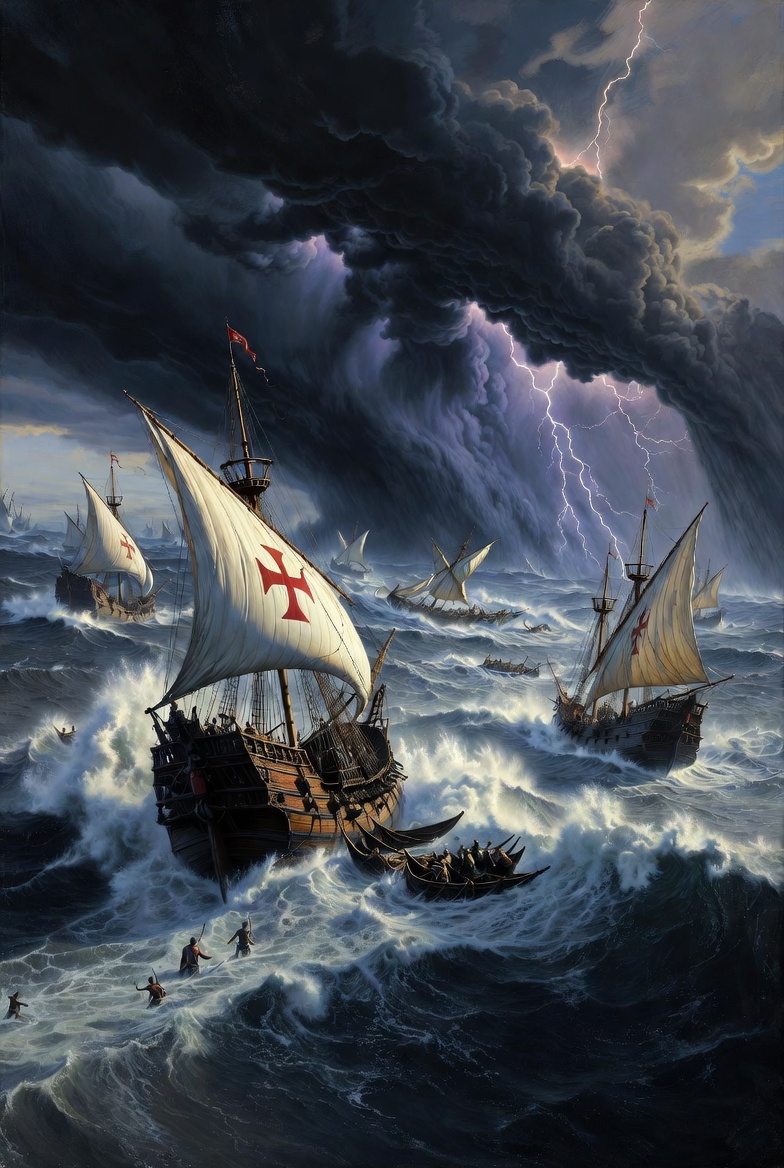
On April 22, 1500, a Portuguese nobleman named Pedro Álvares Cabral wasn’t trying to discover anything new. He was trying to get to India for spices, gold, and glory, following the route blazed by Vasco da Gama two years earlier. Instead, his massive fleet of thirteen ships—packed with over a thousand men, cannons, trade goods, and enough supplies for eighteen months—drifted westward on South Atlantic currents and slammed straight into the coast of what we now call Brazil. They sighted a towering mountain they named Monte Pascoal, dropped anchor near what became Porto Seguro in Bahia, and within days Cabral was planting a cross, hearing the first Catholic Mass on South American soil, and claiming the entire land for Portugal as “Ilha de Vera Cruz,” the Island of the True Cross.
It was one of the most spectacular navigational “oops” moments in human history. Cabral thought he’d found an island en route to the Indies. The locals, Tupiniquim people living in a sophisticated network of villages with advanced agriculture, fermented drinks, and intricate social rituals, probably thought these pale, overdressed Europeans were the strangest visitors they’d ever seen. Yet that single wrong turn, officially recorded in a vivid eyewitness letter written aboard the flagship, kick-started Portuguese colonization of a continent-sized territory, reshaped global trade, fueled the Age of Exploration’s wildest ambitions, and left a linguistic, cultural, and economic legacy that still echoes from Rio to Lisbon today.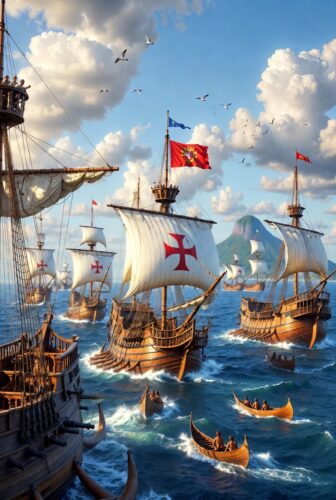 This isn’t some dusty textbook footnote. It’s a rollicking tale of ambition, storms, culture clashes, cannon fire, and sheer dumb luck that turned a detour into an empire. And buried in the 90 percent pure historical grit of that story is a razor-sharp lesson for anyone alive in 2026 who’s ever watched their carefully planned route suddenly veer off-course: the greatest victories often hide in the places you never meant to go. Stick with me through the full saga—because by the end, you’ll have a dead-simple, wildly original plan to treat your own unexpected detours like Cabral treated Brazil: scout them, claim them, profit from them, and never look back.
Let’s rewind to late 15th-century Portugal, a tiny kingdom on the edge of Europe that had spent decades turning itself into the world’s most aggressive maritime superpower. King Manuel I, who had just inherited the throne in 1495, was obsessed with one thing: breaking the Venetian-Arab monopoly on Eastern spices. Pepper, cinnamon, cloves—these weren’t luxuries; they were liquid gold. Vasco da Gama’s 1498 voyage around the Cape of Good Hope had proven the sea route to India was possible, but it was brutal, expensive, and risky. Manuel wanted a follow-up fleet bigger, better armed, and ready to establish permanent trading posts. He chose Cabral, a 32-year-old courtier from a minor noble family in Belmonte, as captain-major. Cabral had the right mix of military training, court connections, and loyalty—no one expected him to become the accidental father of a new continent.
The fleet that sailed from Lisbon on March 9, 1500, was the largest and most expensive armada Europe had ever seen for a single voyage. Thirteen vessels: nine massive naus (the heavy cargo ships of the era), three nimble caravels for scouting, and one supply ship. Over 1,500 men—soldiers, sailors, priests, merchants, and even a few Florentine bankers looking for profit. The flagship alone carried Cabral, his secretaries, and the royal standard. Bartolomeu Dias, the man who had first rounded the Cape of Good Hope in 1488, was there as an advisor. Nicolau Coelho, a veteran of da Gama’s trip, commanded another ship. They carried crossbows, bombards, trade goods like cloth and beads, and instructions to be polite but firm with any locals they met. Vasco da Gama himself had briefed Cabral on signaling with cannon fire to keep the fleet together.
This isn’t some dusty textbook footnote. It’s a rollicking tale of ambition, storms, culture clashes, cannon fire, and sheer dumb luck that turned a detour into an empire. And buried in the 90 percent pure historical grit of that story is a razor-sharp lesson for anyone alive in 2026 who’s ever watched their carefully planned route suddenly veer off-course: the greatest victories often hide in the places you never meant to go. Stick with me through the full saga—because by the end, you’ll have a dead-simple, wildly original plan to treat your own unexpected detours like Cabral treated Brazil: scout them, claim them, profit from them, and never look back.
Let’s rewind to late 15th-century Portugal, a tiny kingdom on the edge of Europe that had spent decades turning itself into the world’s most aggressive maritime superpower. King Manuel I, who had just inherited the throne in 1495, was obsessed with one thing: breaking the Venetian-Arab monopoly on Eastern spices. Pepper, cinnamon, cloves—these weren’t luxuries; they were liquid gold. Vasco da Gama’s 1498 voyage around the Cape of Good Hope had proven the sea route to India was possible, but it was brutal, expensive, and risky. Manuel wanted a follow-up fleet bigger, better armed, and ready to establish permanent trading posts. He chose Cabral, a 32-year-old courtier from a minor noble family in Belmonte, as captain-major. Cabral had the right mix of military training, court connections, and loyalty—no one expected him to become the accidental father of a new continent.
The fleet that sailed from Lisbon on March 9, 1500, was the largest and most expensive armada Europe had ever seen for a single voyage. Thirteen vessels: nine massive naus (the heavy cargo ships of the era), three nimble caravels for scouting, and one supply ship. Over 1,500 men—soldiers, sailors, priests, merchants, and even a few Florentine bankers looking for profit. The flagship alone carried Cabral, his secretaries, and the royal standard. Bartolomeu Dias, the man who had first rounded the Cape of Good Hope in 1488, was there as an advisor. Nicolau Coelho, a veteran of da Gama’s trip, commanded another ship. They carried crossbows, bombards, trade goods like cloth and beads, and instructions to be polite but firm with any locals they met. Vasco da Gama himself had briefed Cabral on signaling with cannon fire to keep the fleet together.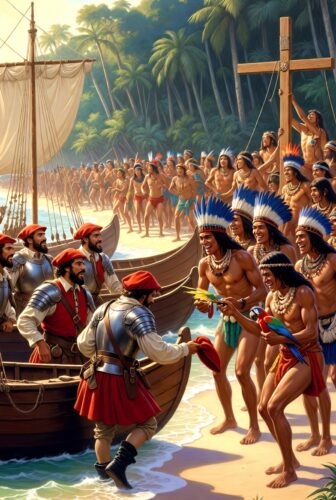 The departure was pure spectacle. Priests blessed the ships at the Monastery of Belém. Crowds cheered. King Manuel handed Cabral a sealed letter for the Zamorin of Calicut demanding trade rights. Then they were off, hugging the African coast at first. By March 14 they passed the Canary Islands. On March 22 they reached Cape Verde, the last friendly stop before the open Atlantic. Already the voyage had its first tragedy: one nau under Vasco de Ataíde vanished in a storm, never to be seen again—eighty men gone before they even hit the equator.
They swung southwest, using the “volta do mar” technique Portuguese navigators had perfected—riding the trade winds in a giant arc to avoid the doldrums. By April 9 they crossed the equator. The water turned warmer, the air thicker. On April 21, lookouts spotted seaweed and birds—classic signs of land nearby. The next morning, April 22, 1500, a sailor on the lead caravel shouted the cry that would echo through centuries: “Terra à vista!” Land in sight. First a high, rounded mountain rising like a sentinel—Monte Pascoal. Then lower hills and a dense green forest stretching south. Cabral ordered soundings: twenty-five fathoms, clean bottom, perfect anchorage. They dropped anchor six leagues offshore as the sun set.
What they didn’t know yet was that they had just bumped into the easternmost bulge of a continent no European had formally claimed under the rules that mattered. A Spanish captain, Vicente Yáñez Pinzón, had actually touched land farther north near Cape Santo Agostinho on January 26, 1500, but he hadn’t planted a flag or sent word back in a way that stuck. The 1494 Treaty of Tordesillas had drawn an imaginary north-south line about 370 leagues west of the Cape Verde Islands. Everything east of it was Portugal’s to claim. Cabral’s accidental landfall sat squarely in the Portuguese zone.
For the next ten days the fleet explored. On April 23 they sailed north along the coast, finding a safer harbor at what they called Porto Seguro. Small boats went ashore. The first contact with the Tupiniquim people was pure comedy gold by modern standards. The locals—tall, bronze-skinned, completely naked except for feather headdresses and shell necklaces—walked right up to the boats carrying bows and arrows but laid them down when signaled. They traded a feathered headdress for a red cap. They examined the Portuguese clothes with polite curiosity but showed zero interest in the heavy wool tunics or metal armor. One sailor offered wine; the natives sipped, made faces, and politely declined. They loved shiny trinkets and a ship’s parrot. Pero Vaz de Caminha, the fleet’s secretary and official scribe, watched everything and scribbled notes that would become Brazil’s birth certificate.
The departure was pure spectacle. Priests blessed the ships at the Monastery of Belém. Crowds cheered. King Manuel handed Cabral a sealed letter for the Zamorin of Calicut demanding trade rights. Then they were off, hugging the African coast at first. By March 14 they passed the Canary Islands. On March 22 they reached Cape Verde, the last friendly stop before the open Atlantic. Already the voyage had its first tragedy: one nau under Vasco de Ataíde vanished in a storm, never to be seen again—eighty men gone before they even hit the equator.
They swung southwest, using the “volta do mar” technique Portuguese navigators had perfected—riding the trade winds in a giant arc to avoid the doldrums. By April 9 they crossed the equator. The water turned warmer, the air thicker. On April 21, lookouts spotted seaweed and birds—classic signs of land nearby. The next morning, April 22, 1500, a sailor on the lead caravel shouted the cry that would echo through centuries: “Terra à vista!” Land in sight. First a high, rounded mountain rising like a sentinel—Monte Pascoal. Then lower hills and a dense green forest stretching south. Cabral ordered soundings: twenty-five fathoms, clean bottom, perfect anchorage. They dropped anchor six leagues offshore as the sun set.
What they didn’t know yet was that they had just bumped into the easternmost bulge of a continent no European had formally claimed under the rules that mattered. A Spanish captain, Vicente Yáñez Pinzón, had actually touched land farther north near Cape Santo Agostinho on January 26, 1500, but he hadn’t planted a flag or sent word back in a way that stuck. The 1494 Treaty of Tordesillas had drawn an imaginary north-south line about 370 leagues west of the Cape Verde Islands. Everything east of it was Portugal’s to claim. Cabral’s accidental landfall sat squarely in the Portuguese zone.
For the next ten days the fleet explored. On April 23 they sailed north along the coast, finding a safer harbor at what they called Porto Seguro. Small boats went ashore. The first contact with the Tupiniquim people was pure comedy gold by modern standards. The locals—tall, bronze-skinned, completely naked except for feather headdresses and shell necklaces—walked right up to the boats carrying bows and arrows but laid them down when signaled. They traded a feathered headdress for a red cap. They examined the Portuguese clothes with polite curiosity but showed zero interest in the heavy wool tunics or metal armor. One sailor offered wine; the natives sipped, made faces, and politely declined. They loved shiny trinkets and a ship’s parrot. Pero Vaz de Caminha, the fleet’s secretary and official scribe, watched everything and scribbled notes that would become Brazil’s birth certificate.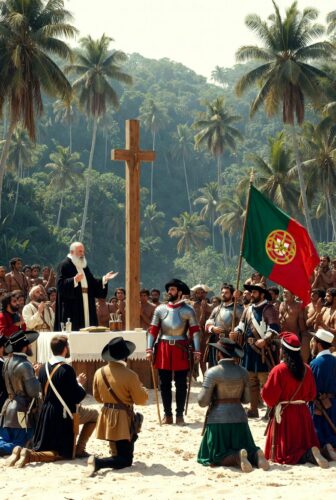 Caminha’s letter to King Manuel, dated May 1, 1500, from “Porto Seguro of the Island of Vera Cruz,” is one of the most vivid, human documents of the entire Age of Discovery. He describes the land in almost poetic terms: “The country is so well-favored that if it were rightly cultivated, it would yield everything.” He notes the natives’ “good bodies and good faces” and their complete lack of shame about nudity—“of which they have none.” He records their gestures, their laughter, their quick learning. When the Portuguese showed them a rosary, the locals seemed fascinated by the cross but treated it like any pretty object. Caminha even admits the sailors’ wild optimism: some thought the natives were hinting at gold because they touched metal objects, but Caminha dryly notes it was probably wishful thinking. The letter is funny in its honesty, respectful in its detail, and completely Eurocentric in its assumptions that this new land was ripe for the taking.
On April 26, the fleet held the first formal Mass on Brazilian soil. Friar Henrique de Coimbra preached under a makeshift altar while hundreds of Tupiniquim watched from the trees. Cabral had a tall wooden cross erected. They sang hymns. The natives joined in the kneeling and standing parts out of curiosity, not conversion. Cabral formally took possession in the name of Portugal, naming the place Ilha de Vera Cruz. He ordered one ship—probably commanded by Gaspar de Lemos—back to Lisbon immediately with Caminha’s letter and samples of the local wood, birds, and a few natives who volunteered (or were persuaded) to go see the king. The rest of the fleet reprovisioned with fresh water, fruit, and game, then turned east again toward India on April 26 or 27.
The Brazil stop had been peaceful, productive, and strangely optimistic. But the real test was still ahead. As the fleet sailed southeast, they followed the Brazilian coast long enough to realize this was no island—it was a massive continent. Then disaster struck. Around May 23 or 24, somewhere in the South Atlantic, a violent storm ripped the formation apart. Four ships went down with all hands—over 380 men, including the legendary Bartolomeu Dias himself. The remaining vessels scattered. Some limped to East Africa. Cabral’s flagship and a few others regrouped off Mozambique, repaired, and pressed on.
They reached Calicut in September. Negotiations with the Zamorin went south fast. Local Arab merchants saw the Portuguese as a direct threat. On December 16-17, a mob attacked the Portuguese factory, killing more than fifty men. Cabral retaliated the only way he knew how: he seized ten Arab ships, slaughtered their crews, bombarded the city, then sailed south to Cochin and Cannanore where local rulers, happy to undermine Calicut, offered alliance and pepper at good prices. The fleet loaded up and headed home in January 1501. More losses followed—one ship burned, another vanished—but the survivors limped into Lisbon in July 1501 with enough spices to make an 800 percent profit. King Manuel was thrilled. Cabral received honors, a pension, and the right to import pepper duty-free. He never commanded another fleet, retired quietly, and died around 1520, largely forgotten until 19th-century Brazilian nationalists rediscovered him.
The long-term ripple effects were enormous. That single claim under the Treaty of Tordesillas gave Portugal legal cover for Brazil while Spain grabbed the rest of the Americas. Later expeditions in 1501 and 1503 confirmed the land was continental and rich in brazilwood—the red dye tree that eventually gave the country its name. Portuguese settlers arrived, intermarried with indigenous groups, imported African slaves for sugar plantations, and turned Brazil into the crown jewel of their empire. The Tupiniquim and other groups formed shifting alliances, sometimes fighting alongside the Portuguese against rivals, sometimes resisting fiercely. Diseases, slavery, and warfare devastated native populations, but the cultural fusion created something entirely new: a Portuguese-speaking, Catholic, yet deeply syncretic society that still shapes Brazil today.
Caminha’s letter to King Manuel, dated May 1, 1500, from “Porto Seguro of the Island of Vera Cruz,” is one of the most vivid, human documents of the entire Age of Discovery. He describes the land in almost poetic terms: “The country is so well-favored that if it were rightly cultivated, it would yield everything.” He notes the natives’ “good bodies and good faces” and their complete lack of shame about nudity—“of which they have none.” He records their gestures, their laughter, their quick learning. When the Portuguese showed them a rosary, the locals seemed fascinated by the cross but treated it like any pretty object. Caminha even admits the sailors’ wild optimism: some thought the natives were hinting at gold because they touched metal objects, but Caminha dryly notes it was probably wishful thinking. The letter is funny in its honesty, respectful in its detail, and completely Eurocentric in its assumptions that this new land was ripe for the taking.
On April 26, the fleet held the first formal Mass on Brazilian soil. Friar Henrique de Coimbra preached under a makeshift altar while hundreds of Tupiniquim watched from the trees. Cabral had a tall wooden cross erected. They sang hymns. The natives joined in the kneeling and standing parts out of curiosity, not conversion. Cabral formally took possession in the name of Portugal, naming the place Ilha de Vera Cruz. He ordered one ship—probably commanded by Gaspar de Lemos—back to Lisbon immediately with Caminha’s letter and samples of the local wood, birds, and a few natives who volunteered (or were persuaded) to go see the king. The rest of the fleet reprovisioned with fresh water, fruit, and game, then turned east again toward India on April 26 or 27.
The Brazil stop had been peaceful, productive, and strangely optimistic. But the real test was still ahead. As the fleet sailed southeast, they followed the Brazilian coast long enough to realize this was no island—it was a massive continent. Then disaster struck. Around May 23 or 24, somewhere in the South Atlantic, a violent storm ripped the formation apart. Four ships went down with all hands—over 380 men, including the legendary Bartolomeu Dias himself. The remaining vessels scattered. Some limped to East Africa. Cabral’s flagship and a few others regrouped off Mozambique, repaired, and pressed on.
They reached Calicut in September. Negotiations with the Zamorin went south fast. Local Arab merchants saw the Portuguese as a direct threat. On December 16-17, a mob attacked the Portuguese factory, killing more than fifty men. Cabral retaliated the only way he knew how: he seized ten Arab ships, slaughtered their crews, bombarded the city, then sailed south to Cochin and Cannanore where local rulers, happy to undermine Calicut, offered alliance and pepper at good prices. The fleet loaded up and headed home in January 1501. More losses followed—one ship burned, another vanished—but the survivors limped into Lisbon in July 1501 with enough spices to make an 800 percent profit. King Manuel was thrilled. Cabral received honors, a pension, and the right to import pepper duty-free. He never commanded another fleet, retired quietly, and died around 1520, largely forgotten until 19th-century Brazilian nationalists rediscovered him.
The long-term ripple effects were enormous. That single claim under the Treaty of Tordesillas gave Portugal legal cover for Brazil while Spain grabbed the rest of the Americas. Later expeditions in 1501 and 1503 confirmed the land was continental and rich in brazilwood—the red dye tree that eventually gave the country its name. Portuguese settlers arrived, intermarried with indigenous groups, imported African slaves for sugar plantations, and turned Brazil into the crown jewel of their empire. The Tupiniquim and other groups formed shifting alliances, sometimes fighting alongside the Portuguese against rivals, sometimes resisting fiercely. Diseases, slavery, and warfare devastated native populations, but the cultural fusion created something entirely new: a Portuguese-speaking, Catholic, yet deeply syncretic society that still shapes Brazil today.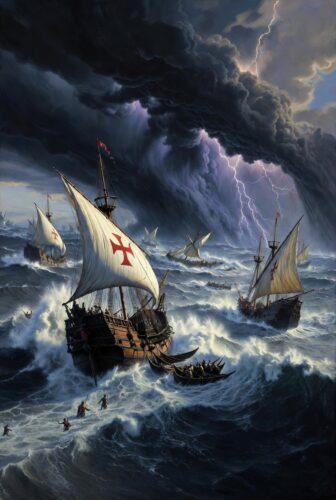 Historians still debate whether Cabral’s landfall was pure accident or a deliberate westward swing ordered by the king to check Tordesillas territories. Some point to Duarte Pacheco Pereira’s writings hinting at secret pre-1500 voyages. Others note the fleet’s course was exactly the kind of arc that would naturally hit Brazil if you followed the currents da Gama had used. Either way, Cabral acted with decisive boldness. He didn’t panic and turn around. He explored, documented, claimed, and kept the mission going despite losing a third of his ships and hundreds of men. That combination of flexibility and iron will is what separates footnote explorers from history-makers.
Now, fast-forward more than five centuries. You’re not commanding a caravel fleet, but you’re navigating your own version of the South Atlantic every single day. Career plans derail. Relationships shift. Markets crash. A “wrong turn” at work or in life can feel like those April 1500 storms that sank four ships. Most self-help advice tells you to “pivot” or “stay positive” with generic platitudes. That’s not Cabral’s way. His story gives us something sharper, funnier, and far more effective: treat every detour as potential empire territory.
Here’s how the outcome of April 22, 1500, hands you a concrete, repeatable advantage in your individual life today. The historical fact proves that unexpected territory can be claimed, mapped, and monetized faster than anyone back home expects—if you act with Cabral-level decisiveness.
- **Spot the “Monte Pascoal” in your detour**: Just as lookouts noticed seaweed and birds before the mountain appeared, train yourself to read the early warning signs of an off-course moment. A project cancellation, a sudden layoff, a health scare, or even a random conversation at a conference—these are your seaweed. Cabral’s crew didn’t curse the currents; they sounded the depths and dropped anchor. You benefit by keeping a literal “detour log” in your phone: note the date, the deviation, and one surprising positive feature of the new “coast.” This turns anxiety into reconnaissance.
- **Plant your cross immediately**: Cabral didn’t wait for permission from Lisbon to claim Vera Cruz. On day four he held Mass and raised the flag. In your life, that means publicly committing to the new territory within 72 hours of the detour. Tell your network, post a short declaration (LinkedIn, family chat, whatever), and define the new land in one sentence. “This career shift is now my Vera Cruz—focused on X skill in Y industry.” The act of claiming creates momentum and allies exactly like the Tupiniquim who showed up curious and eventually traded.
- **Send your Caminha letter home early**: The secretary’s detailed report reached King Manuel before the fleet even finished the India leg. You replicate this by documenting your detour findings obsessively in the first week—voice memos, photos, data, lessons. Share a polished one-page summary with mentors or your “king” (boss, investor, spouse). This builds credibility and turns the detour into shared narrative capital. Cabral’s letter is still quoted 524 years later; yours could be the origin story of your next big win.
- **Reprovision and press on despite losses**: After ten days in Brazil the fleet sailed east knowing four more ships might sink. You do the same by auditing resources after the detour—cut dead weight, restock skills or cash—and then execute the original mission with the new assets. The Brazil stop gave them fresh water and intelligence; your detour might give you a new network or skill that makes the “India” goal easier.
- **Turn the brazilwood into profit**: The dye tree wasn’t the original target, but it became the namesake and early cash crop. Identify the unexpected resource your detour reveals—maybe a side talent, a new market gap, a relationship—and extract value from it immediately. Cabral’s men traded beads for feathers; you trade your new knowledge for opportunities. One month of deliberate extraction can yield returns that dwarf the original plan.
The unique, quick plan that no other self-help guru is peddling—because it’s forged straight from Cabral’s logbooks and Caminha’s letter—is the **Seven-Day Vera Cruz Protocol**. It’s not a vision board, not a gratitude journal, not another 5 a.m. routine. It’s a naval claim operation you run like a 16th-century captain who just spotted unexpected land.
Historians still debate whether Cabral’s landfall was pure accident or a deliberate westward swing ordered by the king to check Tordesillas territories. Some point to Duarte Pacheco Pereira’s writings hinting at secret pre-1500 voyages. Others note the fleet’s course was exactly the kind of arc that would naturally hit Brazil if you followed the currents da Gama had used. Either way, Cabral acted with decisive boldness. He didn’t panic and turn around. He explored, documented, claimed, and kept the mission going despite losing a third of his ships and hundreds of men. That combination of flexibility and iron will is what separates footnote explorers from history-makers.
Now, fast-forward more than five centuries. You’re not commanding a caravel fleet, but you’re navigating your own version of the South Atlantic every single day. Career plans derail. Relationships shift. Markets crash. A “wrong turn” at work or in life can feel like those April 1500 storms that sank four ships. Most self-help advice tells you to “pivot” or “stay positive” with generic platitudes. That’s not Cabral’s way. His story gives us something sharper, funnier, and far more effective: treat every detour as potential empire territory.
Here’s how the outcome of April 22, 1500, hands you a concrete, repeatable advantage in your individual life today. The historical fact proves that unexpected territory can be claimed, mapped, and monetized faster than anyone back home expects—if you act with Cabral-level decisiveness.
- **Spot the “Monte Pascoal” in your detour**: Just as lookouts noticed seaweed and birds before the mountain appeared, train yourself to read the early warning signs of an off-course moment. A project cancellation, a sudden layoff, a health scare, or even a random conversation at a conference—these are your seaweed. Cabral’s crew didn’t curse the currents; they sounded the depths and dropped anchor. You benefit by keeping a literal “detour log” in your phone: note the date, the deviation, and one surprising positive feature of the new “coast.” This turns anxiety into reconnaissance.
- **Plant your cross immediately**: Cabral didn’t wait for permission from Lisbon to claim Vera Cruz. On day four he held Mass and raised the flag. In your life, that means publicly committing to the new territory within 72 hours of the detour. Tell your network, post a short declaration (LinkedIn, family chat, whatever), and define the new land in one sentence. “This career shift is now my Vera Cruz—focused on X skill in Y industry.” The act of claiming creates momentum and allies exactly like the Tupiniquim who showed up curious and eventually traded.
- **Send your Caminha letter home early**: The secretary’s detailed report reached King Manuel before the fleet even finished the India leg. You replicate this by documenting your detour findings obsessively in the first week—voice memos, photos, data, lessons. Share a polished one-page summary with mentors or your “king” (boss, investor, spouse). This builds credibility and turns the detour into shared narrative capital. Cabral’s letter is still quoted 524 years later; yours could be the origin story of your next big win.
- **Reprovision and press on despite losses**: After ten days in Brazil the fleet sailed east knowing four more ships might sink. You do the same by auditing resources after the detour—cut dead weight, restock skills or cash—and then execute the original mission with the new assets. The Brazil stop gave them fresh water and intelligence; your detour might give you a new network or skill that makes the “India” goal easier.
- **Turn the brazilwood into profit**: The dye tree wasn’t the original target, but it became the namesake and early cash crop. Identify the unexpected resource your detour reveals—maybe a side talent, a new market gap, a relationship—and extract value from it immediately. Cabral’s men traded beads for feathers; you trade your new knowledge for opportunities. One month of deliberate extraction can yield returns that dwarf the original plan.
The unique, quick plan that no other self-help guru is peddling—because it’s forged straight from Cabral’s logbooks and Caminha’s letter—is the **Seven-Day Vera Cruz Protocol**. It’s not a vision board, not a gratitude journal, not another 5 a.m. routine. It’s a naval claim operation you run like a 16th-century captain who just spotted unexpected land.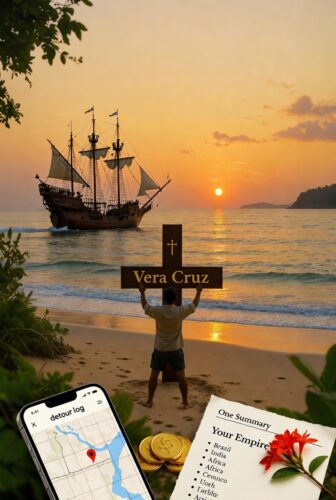 **Day 1 – Sighting**: The moment the detour hits, drop everything and log the coordinates. Write one paragraph describing the “mountain” (the obvious new opportunity) and the “forest” (hidden resources). No judgment, just observation. Cabral’s crew did this within hours.
**Day 2 – Anchor and Scout**: Send two “boats” ashore—make two short calls or DMs to people already living in this new territory. Ask one question: “What’s the best thing about this place that outsiders miss?” Record answers verbatim. Cabral’s men traded hats for intelligence.
**Day 3 – First Mass (Public Commitment)**: Draft and send your Caminha letter—a 300-word email or post declaring the new territory yours and naming it something memorable. “Project Vera Cruz: turning this layoff into a launchpad for independent consulting.” Copy three key people. The public claim is the cross in the sand.
**Day 4 – Claim the Beach**: Physically mark the territory. Buy the domain, register the LLC, schedule the first meeting, or book the course. Do one irreversible action that says “this land is now Portuguese.” No overthinking.
**Day 5 – Reprovision**: List what you lost in the detour and what you gained. Ruthlessly cut one old habit or expense. Add one new daily practice tied to the new land (30 minutes mapping the brazilwood equivalent). Restock like sailors filling water casks.
**Day 6 – Alliance Building**: Identify one “Tupiniquim” group—people who already thrive in this space—and offer genuine value with zero expectation of return. Share your fresh outsider perspective. Cabral’s peaceful first contact created future trading partners.
**Day 7 – Sail East with New Cargo**: Recommit to your original “India” goal but now carrying the new resources. Schedule the first revenue-generating action using the detour’s gifts. Book the client call, launch the micro-product, apply for the grant. Then celebrate exactly like the crew did—with a symbolic toast and a log entry noting the profit already visible on the horizon.
Run this protocol once and you’ll discover what Cabral proved on April 22, 1500: the ocean doesn’t care about your original course. It only rewards the captain brave enough to drop anchor, plant the flag, write the letter, and keep sailing richer than before. Your next wrong turn isn’t a failure—it’s Monte Pascoal rising on the horizon, waiting for someone with the guts to name it Vera Cruz and turn it into an empire.
The history is 90 percent of the story because that’s where the power lives. The remaining 10 percent is your move. So the next time life blows you off-course, smile, check the plumb line, and remember the Portuguese captain who accidentally found a continent and made it stick. Your Vera Cruz is out there. Go claim it.
**Day 1 – Sighting**: The moment the detour hits, drop everything and log the coordinates. Write one paragraph describing the “mountain” (the obvious new opportunity) and the “forest” (hidden resources). No judgment, just observation. Cabral’s crew did this within hours.
**Day 2 – Anchor and Scout**: Send two “boats” ashore—make two short calls or DMs to people already living in this new territory. Ask one question: “What’s the best thing about this place that outsiders miss?” Record answers verbatim. Cabral’s men traded hats for intelligence.
**Day 3 – First Mass (Public Commitment)**: Draft and send your Caminha letter—a 300-word email or post declaring the new territory yours and naming it something memorable. “Project Vera Cruz: turning this layoff into a launchpad for independent consulting.” Copy three key people. The public claim is the cross in the sand.
**Day 4 – Claim the Beach**: Physically mark the territory. Buy the domain, register the LLC, schedule the first meeting, or book the course. Do one irreversible action that says “this land is now Portuguese.” No overthinking.
**Day 5 – Reprovision**: List what you lost in the detour and what you gained. Ruthlessly cut one old habit or expense. Add one new daily practice tied to the new land (30 minutes mapping the brazilwood equivalent). Restock like sailors filling water casks.
**Day 6 – Alliance Building**: Identify one “Tupiniquim” group—people who already thrive in this space—and offer genuine value with zero expectation of return. Share your fresh outsider perspective. Cabral’s peaceful first contact created future trading partners.
**Day 7 – Sail East with New Cargo**: Recommit to your original “India” goal but now carrying the new resources. Schedule the first revenue-generating action using the detour’s gifts. Book the client call, launch the micro-product, apply for the grant. Then celebrate exactly like the crew did—with a symbolic toast and a log entry noting the profit already visible on the horizon.
Run this protocol once and you’ll discover what Cabral proved on April 22, 1500: the ocean doesn’t care about your original course. It only rewards the captain brave enough to drop anchor, plant the flag, write the letter, and keep sailing richer than before. Your next wrong turn isn’t a failure—it’s Monte Pascoal rising on the horizon, waiting for someone with the guts to name it Vera Cruz and turn it into an empire.
The history is 90 percent of the story because that’s where the power lives. The remaining 10 percent is your move. So the next time life blows you off-course, smile, check the plumb line, and remember the Portuguese captain who accidentally found a continent and made it stick. Your Vera Cruz is out there. Go claim it.