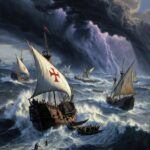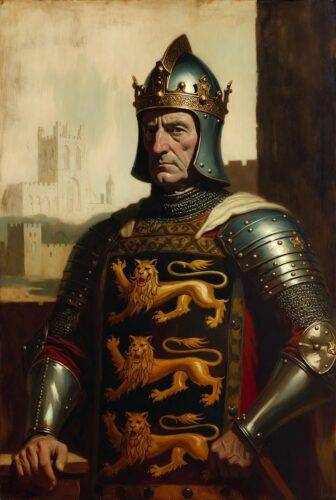

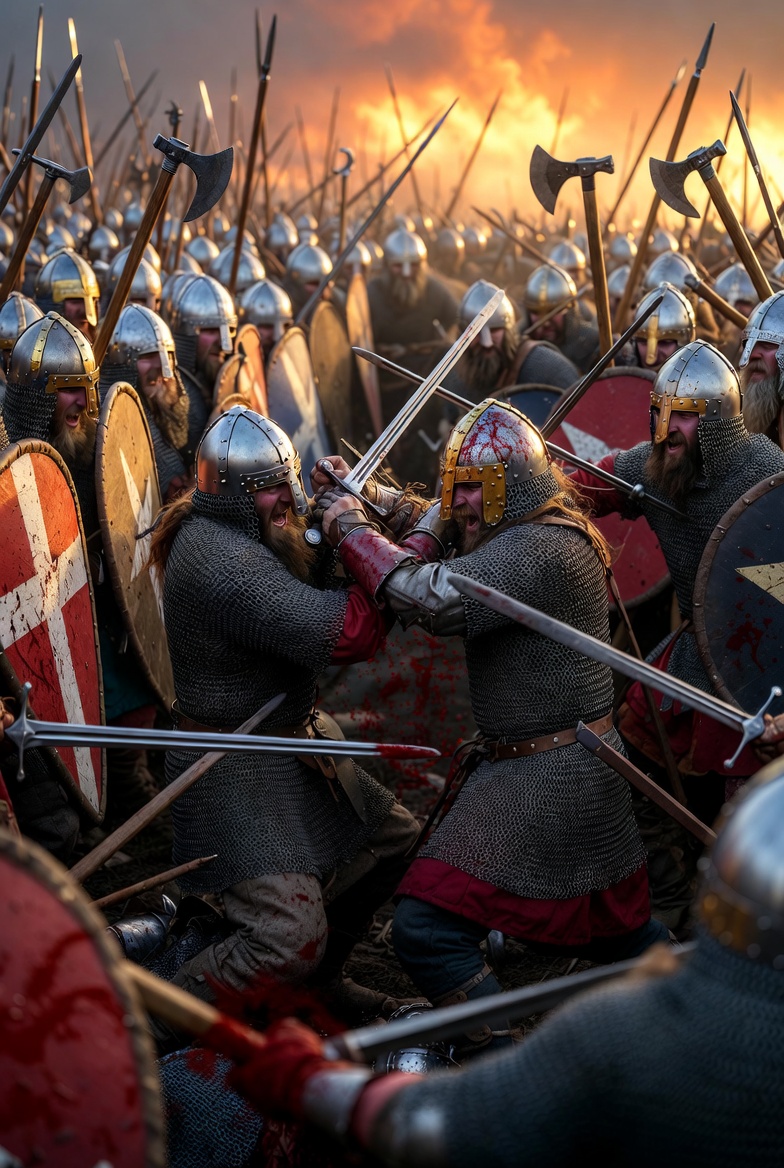
Picture this: April 23, 1014. Good Friday. The sun rises over the windswept flats north of Dublin, where the River Tolka meets the sea in a muddy, blood-soaked embrace. Two armies, numbering thousands, slam into each other in a clash so brutal that the waves themselves turn red by high tide. On one side, an aging Irish high king named Brian Boru—gray-haired, battle-scarred, praying quietly in a tent while his sons and nephews carve through mail-clad Vikings like axes through butter. On the other, a ragtag coalition of Norse raiders from Orkney, the Isle of Man, and beyond, backed by Irish traitors who’d rather sell out their own island than bow to a upstart from the west. By sunset, over 7,000 men lie dead. The Vikings’ power in Ireland is shattered forever. Brian himself is slain in his tent by a rogue axe-wielding giant named Brodir. And yet, from that pyrrhic bloodbath emerges a legend that still whispers through Irish annals, Norse sagas, and the very soil of Clontarf today.This isn’t some Hollywood Viking flick with horned helmets and dragon ships for show. This is raw, documented medieval mayhem—the Battle of Clontarf, or *Cath Chluain Tarbh* in the old Irish tongue, meaning “the battle of the bull’s meadow.” It’s distant history at its most vivid: a real, random, razor-sharp pivot point where one man’s relentless grind against foreign domination and domestic betrayal flipped the script on Ireland’s future. And here’s the kicker: the lessons baked into its gore and glory aren’t dusty relics for history nerds. They’re a stealthy, no-nonsense toolkit for anyone today staring down their own “Vikings”—those relentless invaders of time, toxic influences, self-sabotage, or soul-crushing routines that pillage your potential. Stick with me through the epic (and I mean *epic*) backstory, because 90 percent of this tale is pure, unfiltered history: the politics, the players, the betrayals, the tactics, the screams across the battlefield. Only at the end do we flip it into a laser-focused, laugh-out-loud unique plan that’ll make every generic self-help guru blush. No fluff. No “manifest your destiny” mantras. Just Clontarf-caliber strategy applied to your Tuesday afternoon. To understand Clontarf, you’ve got to rewind the tape on Ireland’s fractured world in the late 10th and early 11th centuries. Ireland wasn’t a unified nation back then—it was a patchwork of feuding kingdoms, or *tuatha*, ruled by petty kings who spent more time cattle-raiding each other than building empires. At the top sat the High King, or *Ard Rí*, traditionally drawn from the powerful Uí Néill dynasty in the north. Their claim went back centuries, rooted in ancient lore and the sacred hill of Tara. But by the 900s, cracks were showing. Viking longships had been terrorizing the coasts since the 790s, sacking monasteries like Iona and Lindisfarne for their gold and glory. These weren’t just smash-and-grab pirates; by the 840s, they’d planted permanent bases—*longphorts*—that grew into thriving towns like Dublin (founded 841), Waterford, Limerick, and Wexford. These Hiberno-Norse (or Norse-Gael) settlers weren’t always pure invaders anymore. Many had intermarried, converted (sort of) to Christianity, and turned their ports into bustling trade hubs linking Ireland to the Viking world from Iceland to Normandy. But they still demanded tribute, backed rival Irish kings, and launched raids when it suited them. Dublin’s kings, like the cunning Amlaíb Cuarán in the late 900s, played both sides—raiding one day, allying the next. Enter Brian Boru, born around 941 in the modest Dál gCais kingdom of Thomond, way out in County Clare. He wasn’t born to the purple. His father, Cennétig mac Lorcáin, was just a local king of a minor sept. Brian was one of many sons—legend says the twelfth—but early on, he showed the fire. His older brother Mathgamain (Mahon) became King of Munster in 976 after their father’s death, but the real spark came from Viking pressure and Eóganacht rivals who’d dominated Munster for generations. Brian cut his teeth leading guerrilla bands in the wilds of Clare, fortifying crannogs (lake dwellings) and hitting Viking raiders hard. When Mathgamain was assassinated in 976—likely by Eóganacht plotters working with Limerick Vikings—Brian took the throne of Munster with a vengeance. He wasn’t some noble idealist; he was a pragmatic warlord who understood power. First, he crushed the Vikings of Limerick in a series of savage campaigns, burning their longphort and scattering their fleets. Then he turned east, subjugating Leinster and Connacht through a mix of battles, hostages, and shrewd diplomacy.
The big break came in 997 at Clonfert, where Brian and the Uí Néill High King Máel Sechnaill mac Domnaill hammered out a deal: split Ireland north and south, Brian ruling the south with Munster, Leinster, and the Norse ports. It was a fragile truce. Together they smashed a Dublin-Leinster-Viking alliance at the Battle of Glenmama in 999, capturing Sigtrygg Silkbeard (King of Dublin) and forcing submissions. But Brian wasn’t content sharing the crown. By 1000, he was marching on Tara itself. Máel Sechnaill, abandoned by his northern kin, held out until 1002, when Brian took hostages at Athlone and claimed the High Kingship outright—the first non-Uí Néill to do so in centuries. He styled himself *Imperator Scottorum* (Emperor of the Irish) in the Book of Armagh, a bold flex that signaled unity under one strong hand. Brian’s reign wasn’t all sunshine and submission. He toured Ireland twice, extracting hostages from every province, building roads, fostering learning in monasteries, and even sending envoys abroad. But resentment simmered. The Uí Néill in the north chafed—especially Flaithbertach Ua Néill of Cenél nEógain, who launched raids in 1012. Leinster’s king, Máel Mórda mac Murchada, had old grudges from Glenmama humiliations. And Dublin’s Sigtrygg Silkbeard—son of Amlaíb Cuarán—had been playing the long game. In 1013, while Brian’s army camped outside Dublin for months, Sigtrygg sailed off to recruit heavy hitters. He promised the kingship of Ireland to two big fish: Sigurd the Stout, Earl of Orkney (a battle-hardened Viking lord who’d converted to Christianity but still raided like a pagan), and Brodir of Man (a massive, axe-wielding renegade described in sagas as a sorcerer with enchanted armor). Fleets from the Orkneys, the Hebrides, and the Isle of Man converged on Dublin by Holy Week 1014. Irish annals like the *Annals of Ulster* and *Annals of Inisfallen* paint it as a gathering storm of “foreigners” and “Leinstermen.” Brian answered the call. He mustered his core from Munster—the fierce Dál gCais warriors under his son Murchad mac Briain and grandson Toirdelbach. They were joined by contingents from the Déisi, Uí Liatháin, and even Connacht kings like Mael Ruanaidh Ua hEidhin and Tadhg Ua Cellaigh. Máel Sechnaill brought Meath forces, though later sources hint at divided loyalties. Brian’s army numbered around 5,000; the coalition opposing him swelled to about 7,000. The stage was set for Clontarf, a flat, open plain ideal for the shield-wall melees Vikings loved but deadly when tides trapped the losers. Dawn on April 23 broke with prayers. Brian, now in his early 70s and too old for the front lines, retired to his tent to fast and pray—Good Friday piety mixed with strategic command. His troops had already plundered the Viking-held Fine Gall lands north of Dublin for supplies. The enemy advanced: Sigtrygg stayed behind Dublin’s walls with his wife (Brian’s own daughter Sláine, talk about family drama) watching from the ramparts. Out front came the foreign Vikings under Sigurd and Brodir—mail-clad elites with axes, swords, and spears—followed by Dubliners and Leinstermen under Máel Mórda. The fighting erupted in a roar that the *Cogadh Gáedel re Gallaib* (a propagandistic saga written a century later for Brian’s descendants) calls “remarkably loud and bloody.” It opened with single combat straight out of legend: Plait, a Viking champion, dueled Domnall mac Eimín (a Scottish ally of Brian). They stabbed each other through the heart simultaneously, clutching hair in death like frozen wrestlers. Then the lines crashed. Murchad, Brian’s hot-headed son, allegedly hacked down a hundred foes single-handedly, his sword arm a blur. Connacht warriors traded blows with Dubliners in a scrum so tight that only a handful survived on each side. Spears flew; axes crunched mail; the air filled with Gaelic war-cries and Norse battle-songs.
Tactics favored the Irish initially. Brian’s forces used lighter gear for mobility, while Vikings relied on heavy armor and shield-walls. But the real decider was the battlefield itself and that infamous tide. The River Tolka and sea inlet meant that as the day wore on, retreating Vikings toward their ships found themselves cut off by rising waters. Calculations by 19th-century scientist Samuel Haughton later confirmed high tide around 5:30 a.m. and again near sunset—trapping the fleeing enemy in a deadly squeeze between Irish spears and drowning waves. Toirdelbach, Brian’s grandson, chased foes into the sea and was swept away by a freak wave at a weir. Murchad slew Sigurd the Stout in a heroic clash before collapsing himself. Máel Mórda fell too. Brodir, spotting Brian’s lightly guarded tent, burst in and axed the praying king—only to be hunted down and disemboweled by Brian’s brother Ulf the Quarrelsome (yes, that was his actual nickname—medieval shade at its finest). By nightfall, the field was a slaughterhouse. Brian’s side lost around 4,000, including the high king, his heir Murchad, Toirdelbach, nephews, and key lords like Domnall mac Diarmata and the Connacht chieftains. The coalition lost nearly 6,000—devastating for the Norse. No major Meath nobles died, fueling later whispers that Máel Sechnaill held back. Bodies piled so high that survivors waded through blood. The *Njáls saga* from Iceland spins it with omens: ravens, boiling seas, and Valkyries claiming the slain. Irish sources like the *Cogadh* add banshee-like spirits—Aibhill warning Brian of his doom—and heroic last stands. But the annals keep it grounded: lists of the fallen, terse and grim. The aftermath? A pyrrhic Irish win that reshaped everything. Viking power in Ireland never recovered; Dublin shrank to a client town under Irish overlords. Sigtrygg hung on until 1036 but never threatened the high kingship again. Máel Sechnaill reclaimed the title until his death in 1022. Brian’s body was carried in honor to Armagh for burial beside saints, mourned for twelve days. His dynasty—the O’Briens—endured, but Ireland fragmented again into provincial wars. No more unified “emperor” for centuries. Historians debate the spin: the *Cogadh* hypes it as a holy war against pagan foreigners to glorify Brian’s line, ignoring how Irish fought on both sides and how Vikings had long integrated. Modern views see it as more civil war than crusade, yet the popular memory—as a stand against invasion—stuck through British rule and into 20th-century nationalism. Reenactments in 2014 drew thousands; the battlefield is now a Dublin suburb where joggers pass plaques remembering the bull’s meadow turned red. Legends layered on thick over time. Norse sagas like *Orkneyinga* and *Brennu-Njáls* portray Brian as a saintly king whose death summoned supernatural fury. Irish folklore ties it to the Ulster Cycle heroes, with Brian as a latter-day Conchobar. One tale claims ravens feasted for weeks. Another has Brian’s ghost walking the tide line. But strip away the myth, and the raw facts endure: a 73-year-old king unified fractious realms through grit, alliances, and one decisive (if costly) stand. He turned Ireland’s chaos into a fleeting moment of sovereignty. Vikings got the message—raids tapered, trade shifted, and the island’s story bent toward Gaelic resilience. Now, fast-forward a millennium-plus to your life in 2026. That Clontarf outcome—foreign domination broken not by solo heroics but by forged coalitions, battlefield timing, sacrificial leadership, and refusing to let traitors or tides dictate the end—delivers a direct, no-BS payoff today. It shows how one focused campaign against “invaders” (bad habits, draining relationships, scattered focus) can cascade into lasting freedom, even if it costs you in the short term. The victory wasn’t clean or eternal, but it reset the board. Apply it right, and your personal empire gets the same edge: less Viking-level overwhelm, more high-king command.
Here’s the hyper-specific payoff in bullet-point form, tied straight to Clontarf’s mechanics: - **Forge unlikely coalitions like Brian did with Connacht and Meath lords**: Stop solo-grinding against your obstacles. Identify three “rival kingdoms” in your life (a skeptical coworker, a family member with different values, an old habit you hate) and recruit them for one shared “raid”—a joint project that aligns their interests against your common enemy, like procrastination or financial leaks. The result? You multiply your force without begging for buy-in. - **Time your charges for the tide, not convenience**: Brian waited for Holy Week symbolism and used the literal tide to trap foes. Pinpoint one “high tide” window in your week (that 30-minute commute, post-dinner wind-down) and launch a decisive strike against your biggest invader—delete the app, make the hard call, ship the project—when external forces (deadlines, energy dips) naturally hem it in. - **Pray in the tent while your front line fights**: Brian delegated the melee to Murchad and stayed strategic. Build a 10-minute daily “tent ritual” where you step back from execution mode, review the battlefield map of your day (what advanced, what retreated), and issue one calm order—no multitasking, just pure command presence. It keeps you alive and directing when chaos hits. - **Accept pyrrhic costs for permanent resets**: The battle killed Brian’s heirs but ended Viking supremacy. Accept one short-term “casualty” (skipping a social event, losing sleep on a deadline) to permanently weaken a chronic drain—like auditing subscriptions or confronting a toxic tie. The blood price buys you sovereignty no half-measure ever could. - **Turn internal traitors into cautionary ghosts**: Máel Mórda and wavering allies nearly sank the effort. Run a quarterly “Leinster audit” on your inner circle and routines: flag the subtle saboteurs (that “harmless” doom-scrolling account, the friend who drains without giving) and either convert them or cut the supply lines before they join the enemy charge. That brings us to the plan—quick, detailed, and engineered to be utterly unlike the recycled self-help slop online. No vision boards, no morning routines copied from billionaires, no “affirmations in the mirror.” This is the **Boru Blitz: A 72-Hour Clontarf Reset**—a hyper-specific, saga-style micro-campaign you run once a month (or whenever invaders mass). It’s battle-tested on real history’s messiness: alliances on the fly, timing with natural forces, sacrifice without self-pity, and leadership from the tent. Do it, and you’ll feel like you just waded through Tolka waves with Murchad at your side.
**Day 1 (Scout and Coalition-Build – Morning of Your “Good Friday”)**: Wake up and map your personal Clontarf. Grab a single sheet of paper (no apps). List your top three “Viking invaders” (e.g., endless notifications, energy vampires at work, that nagging debt). Next to each, note one “unlikely ally” from your life who could help smash it—someone you’ve never teamed with before. Send one short, non-beggy message or call: “Hey, we both hate [shared pain point]. Want to team up for 20 minutes this week to fix it?” By noon, you’ve got at least one coalition locked. Laugh at how ridiculous it feels—like Brian allying with former Uí Néill rivals. End with a 5-minute tent prayer: sit quietly, visualize the tide turning, and commit one non-negotiable charge. **Day 2 (The Melee Charge – Full Assault)**: Launch at your identified “high tide” slot. Execute the hard action against all three invaders simultaneously—no sequential baby steps. Delete/block the apps, have the confrontation call, transfer the money or cancel the subscription. Bring a “shield-brother” (your new ally) for accountability—text them live updates like battlefield runners. Channel Murchad: go all-in for 60-90 minutes straight. Feel the gore? Good. That’s the pyrrhic part. Reward with zero guilt—Brian didn’t apologize for the bodies. **Day 3 (Tent Command and Tide Check – Consolidation)**: Step back like the old king. Review what drowned and what escaped. Write one “saga line” reframing the win as epic history: “On April 23, 2026, I slew the notification horde with [ally’s name] at my flank.” Then issue the next order: schedule the follow-up to lock in the victory (e.g., weekly check-in with your coalition). Burn or delete the scout sheet—symbolic burial like Brian’s at Armagh. If a traitor slipped through, audit and neutralize before the next cycle. Run this Blitz monthly and watch the pattern: invaders weaken, your “high kingship” over your own days solidifies, and life stops feeling like endless raids. It’s funny how simple it is—no $97 courses required—just medieval steel applied to modern mud. Brian Boru didn’t live to see a perfect Ireland, but he died knowing he’d changed the tide. You don’t need a tent on a Dublin beach. You just need to pick April 23 (or any day) as your Clontarf, charge smart, and claim your sovereignty. The Vikings never came back the same. Neither will your chaos. Now go make history—your own bloody, brilliant kind.
Share: