
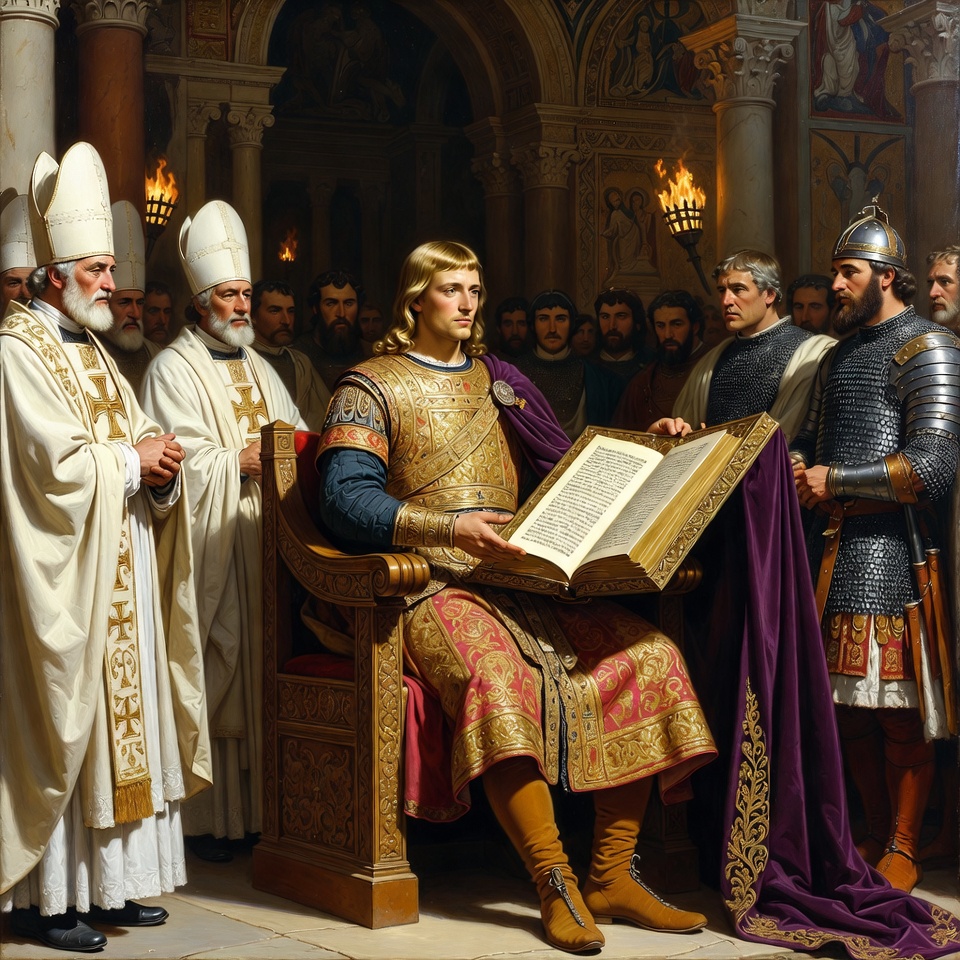
On February 2, 506, in the Visigothic capital of Toulouse, a king with the most unintentionally metal name in history—Alaric II—did something no one saw coming from a “barbarian” ruler. Instead of raiding, conquering, or flexing military might, he gathered bishops, nobles, and legal experts and said, in effect, “Let’s publish a book.” Not a saga of battles. Not a boastful chronicle. A law book. A simplified, user-friendly digest of centuries of Roman legal wisdom, designed specifically for the Roman citizens living under his rule.Yes, the grandson (by lineage of the same warrior tradition) of the guy who sacked Rome in 410 decided that what his kingdom really needed was better bureaucracy. And in one of the great ironies of history, this act by a Germanic Arian king helped preserve Roman law through the chaos of the early Middle Ages when almost everything else classical was disappearing. The document was called the *Breviarium Alaricianum*—the Breviary of Alaric. It wasn’t flashy. It didn’t win any battles on its own. But it quietly became one of the most important bridges between the ancient and medieval worlds. And the lessons baked into its creation—radical simplification, respectful adaptation, and deliberate clarity—are pure gold for anyone trying to bring order to a chaotic modern life. Let’s spend most of our time in 506 and the centuries around it, because the story is wild, fascinating, and far richer than the one-paragraph blurbs it usually gets. Then, at the end, we’ll pull the single most powerful takeaway and turn it into an actionable plan you can start today. ### The Long, Messy Collapse That Set the Stage To understand why Alaric II’s move was so remarkable, we have to zoom out to the slow-motion car crash that was the fall of the Western Roman Empire. By the late 400s, the western half of the empire was less a functioning state and more a patchwork of warlords, local strongmen, and Germanic kingdoms that had moved in with varying degrees of permission. The last Western emperor, a teenager named Romulus Augustulus, was deposed in 476 by the Herulian chieftain Odoacer, who promptly sent the imperial regalia to Constantinople with a polite note that said, in essence, “One emperor is enough, thanks.” But the Visigoths had been players in this drama for over a century already. They started as a confederation of Gothic tribes who crossed the Danube in 376 fleeing the Huns, got mistreated by Roman officials, rebelled, and crushed Emperor Valens at the Battle of Adrianople in 378—one of the most catastrophic defeats in Roman history. From there they roamed the Balkans and Italy under their charismatic leader Alaric I. Alaric I became famous (or infamous) for sacking Rome in 410—the first time in 800 years a foreign army had breached the city’s walls. It sent shockwaves through the ancient world; St. Jerome wrote from Bethlehem, “The city which had taken the whole world was itself taken.” Yet Alaric’s sack was surprisingly restrained by ancient standards—no wholesale massacre, no burning of the city. His men looted, but the Visigoths were already halfway Christian (albeit the Arian version Rome considered heretical). After Alaric I died suddenly in southern Italy later that year, his brother-in-law Wallia led the Visigoths into a treaty with the Western emperor Honorius. In 418 they were settled as *foederati*—allied troops—in Aquitaine in southwestern Gaul, with Toulouse as their center. Their job: keep other barbarians out. In exchange they got land and a degree of autonomy. Over the next decades the Visigothic kingdom expanded dramatically. Under King Euric (466–484), widely regarded as the real founder of the independent Visigothic state, they conquered most of the Iberian Peninsula and pushed their borders deep into Gaul. Euric was a conqueror, but also a lawgiver: he issued the *Code of Euric*, one of the earliest written Germanic law codes, applying to his Gothic subjects. This created a dual legal system: Goths were judged by Germanic customary law, Romans by Roman law. It was a practical compromise, but also a constant reminder that the two peoples were not fully fused.
### Enter Alaric II: The Diplomat on a Tightrope Alaric II inherited the throne in 484 at around age twenty. He was cultured, spoke Latin fluently, and had grown up surrounded by Roman administrators and bishops. Unlike his grandfather’s generation, he wasn’t a nomadic warrior-king; he ruled from cities and palaces. His reign coincided with two massive pressures. First, religious tension. The Visigoths were Arian Christians, who believed the Son was subordinate to the Father—a view condemned as heresy by the Council of Nicaea in 325. The vast majority of their Hispano-Roman and Gallo-Roman subjects were Catholic. This created constant friction. Catholic bishops were powerful local leaders, and many looked to the orthodox Frankish king Clovis across the Loire River as a potential liberator. Second, military threat. Clovis I, having unified the Franks and—crucially—converted to Catholic Christianity around 496 (legend says after a battlefield vow at the Battle of Tolbiac), was now the champion of the Catholic Church in the West. He had his eyes on Visigothic Gaul. Alaric tried diplomacy first. He married a daughter of Theodoric the Great, the Ostrogothic king of Italy, who was the most successful barbarian ruler of the era and a master of balancing Roman and Gothic interests. Theodoric acted as a kind of senior advisor to Alaric, urging moderation and respect for Roman institutions.
But diplomacy only buys time. Alaric needed the active loyalty of the Roman elite—senators, landowners, bishops—if he was going to face Clovis with any chance of success. ### The Genius Idea: Give the Romans Better Law Roman law under the late empire had become monstrously complex. The Theodosian Code, published in 438, was already a massive compilation, and emperors kept issuing new constitutions (*novellae*). Local judges—often poorly trained—struggled to apply it consistently. There were conflicting texts, obsolete provisions, and endless interpretive disputes. Alaric decided to fix this. He appointed a commission of legal experts (probably Gallo-Roman jurists familiar with both classical and late Roman law) to produce a clear, concise, authoritative digest for use in his kingdoms. The result was the Breviary of Alaric. What they did was brilliant in its restraint: - They took the sixteen books of the Theodosian Code and kept only the parts still relevant, summarizing or omitting the rest. - They included abridged versions of earlier codes (Gregorian and Hermogenian). - They added the Institutes of Gaius—a classic 2nd-century textbook of Roman law—with explanatory notes. - They incorporated the Sentences of Paul, another key jurisprudential text. - They appended some post-Theodosian imperial novellas. - Crucially, they added *interpretationes*—plain-language explanations of difficult passages. - And in a deft political touch, they stripped out references to specific emperors to avoid any implication that the Visigothic king was claiming imperial authority. The final product was about half the length of the original Theodosian Code and infinitely more usable. The Breviary was formally approved by an assembly of Catholic bishops and Visigothic nobles, then officially promulgated on February 2, 506. Imagine the scene: a mixed crowd of long-haired Gothic warriors in trousers (scandalous to Romans) and toga-wearing Roman aristocrats, listening while the new law code is read aloud. Alaric essentially saying, “Here, my Roman friends, is your law—cleaned up, clarified, and endorsed by me.”
It was a masterstroke of soft power. Catholic bishops praised it. Gallo-Roman landowners felt respected. It bought Alaric political capital at exactly the moment he needed it most. ### The Immediate Aftermath—and the Long Legacy Sadly for Alaric, the military storm broke the very next year. In 507 Clovis invaded. The two armies met at Vouillé, near Poitiers. Alaric was killed in hand-to-hand combat (legend says by Clovis himself), and the Visigoths were crushed. They lost almost all their territory north of the Pyrenees, retaining only the narrow strip called Septimania. But the Breviary outlived the battlefield defeat. The Visigoths retreated to Spain, where the code continued to govern Roman subjects until the unified *Liber Iudiciorum* in 654. More importantly, copies spread into Frankish Gaul. Merovingian and later Carolingian judges used it. Manuscripts were copied throughout the early Middle Ages. When Charlemagne wanted to revive Roman law in the 8th–9th centuries, the Breviary was one of the few accessible sources available in the West. It influenced the development of regional customary laws in southern France (the *pays de droit écrit*). Scholars have traced its fingerprints in canon law collections and even in later medieval compilations. In a delicious twist, the full Theodosian Code itself survived in the West primarily through manuscripts descended from or related to Alaric’s abbreviated version. The “barbarian” king’s project became the lifeline for Roman legal tradition during centuries when almost no one could read the originals. Justinian’s great Corpus Juris Civilis (published in the East between 529–534) would eventually overshadow everything, but in the Latin West, Alaric’s Breviary was the practical bridge that kept Roman law alive until the 11th–12th century revival of legal studies. All because one king, facing existential threats, chose clarity over conquest—on one specific day in 506.
### Turning Ancient Bureaucracy into Modern Superpower So what does a 1,500-year-old legal digest have to do with your life in 2026? Everything. The core insight of Alaric’s project was ruthless, respectful simplification. Take a vast, intimidating body of wisdom (Roman law), strip away the obsolete and redundant, clarify the confusing parts, and present the essence in a form people can actually use. Modern life is drowning in complexity: thousands of productivity apps, endless self-help content, conflicting health advice, financial options, social expectations. We have more “laws” to live by than any late Roman judge ever dreamed of. The people who thrive aren’t the ones who consume the most information—they’re the ones who distill it into a short, clear, personal code they can actually follow every day. Alaric gave his subjects a usable version of an ancient tradition. You can do the same for yourself. Your own “Personal Breviary” is a short document—ideally no more than a few pages—that contains the distilled principles, habits, and decision rules that govern your life. It becomes your operating system. Here are the specific benefits you gain:
-
Drastically reduced decision fatigue—you stop debating the same choices over and over.
-
Instant alignment—when faced with temptation or uncertainty, you have a pre-written reference.
-
Faster progress—clear rules compound like interest.
-
Greater resilience—when life hits hard, you have an anchor that isn’t dependent on motivation or mood.
-
Quiet confidence—you know exactly who you are and how you operate.
### Your Step-by-Step Plan to Create Your Personal Breviary


Do this over the next 30–60 days. It’s worth the investment.
-
Week 1: Reflection and Raw Material Gathering
   Spend 10–15 minutes each evening journaling answers to:

   - What decisions or habits have produced my best results in the past?

   - Where do I repeatedly stumble or feel scattered?

   - What advice from books, mentors, or experience has proven reliably true for me?

   Collect quotes, principles, routines—everything goes into a running note.
-
Week 2–3: Core Life Domains Audit
   Divide your life into 5–7 major domains (common ones: Health & Energy, Relationships, Work/Career, Finances, Learning/Growth, Purpose/Spirituality, Fun & Recreation).

   For each domain, write 3–7 candidate principles or rules that feel non-negotiable based on your reflection. Keep them short and actionable.

   Example for Health: “Move intentionally every day—no zero days.” “Eat protein and plants at every meal.” “Sleep 7.5–8.5 hours or adjust the next day.”
-
Week 4: Ruthless Simplification (The Alaric Move)
   Cut mercilessly. Aim for no more than 20–30 total rules across all domains. If a rule feels nice-to-have rather than transformative, delete it.

   Add short “interpretations”—one-sentence explanations or examples so future-you understands the spirit.

   Remove anything outdated or aspirational that doesn’t match your actual track record.
-
Final Assembly
   Format it cleanly—one page if possible, max three. Use bold headings for domains, bullet points for rules, italics for interpretations.

   Title it something personal: “My Breviary – Version 1.0 – February 2026.”
-
Promulgation Ritual
On a specific date (pick one with meaning—maybe the next February 2), read it aloud to yourself. Sign and date it. Save digital and printed copies in places you’ll see daily (phone lock screen, desk, journal).
-
Implementation System
   - Morning: Read or skim the entire Breviary (takes 2–4 minutes).

   - Evening: Score yourself 0–10 on adherence that day; note one adjustment.

   - Weekly: 15-minute review—celebrate wins, tweak language if needed.

   - Annual: Full revision on the anniversary. Burn or archive the old version ceremonially.
-
Iteration Rule
   You are allowed to amend only during scheduled reviews. This prevents constant tinkering and forces you to live with your choices.


That’s it.


You now possess something kings and emperors rarely had: a clear, written, personal operating system drawn from the best wisdom available to you and tailored exactly to your life.


Alaric II couldn’t save his kingdom on the battlefield, but his deliberate act of simplification preserved something far larger than territory. You may not be able to control the chaos of the world, but you can absolutely control the clarity of your own realm.


Start compiling.


Your future self—and the legacy you leave—will thank you.
Share: