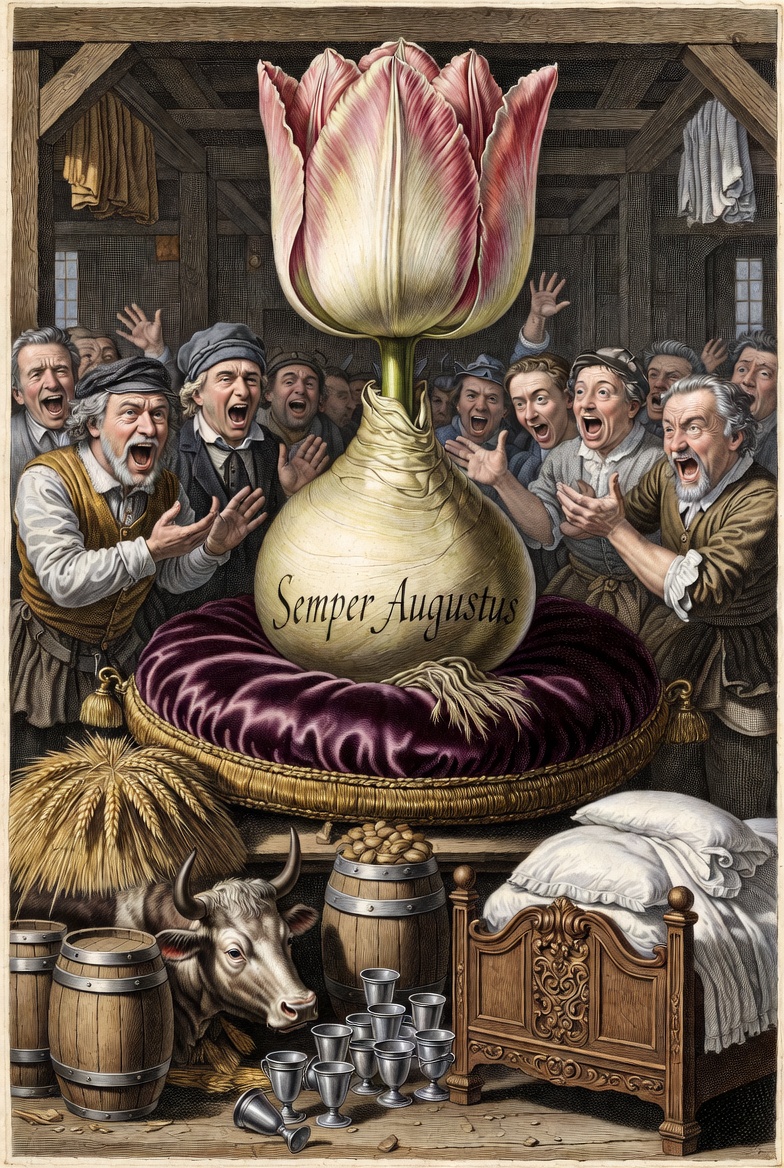
Picture this: It's the winter of 1636-1637 in the Dutch Republic, the glittering heart of Europe's Golden Age. Merchants sip gin in smoky taverns, artisans craft masterpieces that would make modern museums drool, and ships loaded with spices, silks, and silver sail into Amsterdam's harbors, making the city richer than a dragon's hoard. Everyone's flush with cash, confidence is sky-high, and the hottest investment opportunity isn't gold, land, or even those fancy East India Company shares. No, it's... flower bulbs.
Yes, tulip bulbs. Those humble things you plant in your garden and forget about until spring. But in the Netherlands of the 1630s, certain tulips – the ones with flame-like streaks of color caused by a harmless virus – became the ultimate status symbol. Wealthy burghers displayed them like Ferraris. Speculators traded contracts for bulbs that hadn't even been dug up yet. Prices soared to absurd heights: a single rare bulb could buy a canal house in Amsterdam, a team of horses, or enough beer to float a ship. And then, on a chilly February day in 1637, it all came crashing down faster than a drunk sailor off a gangplank. February 3, 1637, marks the moment when the world's first recorded speculative bubble popped in spectacular fashion. At an auction in the city of Alkmaar (some accounts point to Haarlem), eager sellers gathered with their tulip contracts, expecting another frenzy of bidding. Instead, silence. No buyers showed up. Word spread like wildfire through the trading taverns: prices were plummeting. Panic set in. Within days, bulbs that had fetched thousands of guilders were worthless. Fortunes evaporated overnight. Grown men wept in the streets over flowers.
This wasn't just a quirky footnote in history – it was a full-blown economic frenzy that gripped an entire nation, revealing the hilarious (and terrifying) power of human greed, herd mentality, and the delusion that something ordinary can become infinitely valuable just because everyone says so. Tulip Mania remains the archetype of all financial bubbles, from the South Sea Bubble to dot-com madness to today's crypto rollercoasters. And the best part? It's absurdly funny in retrospect – people mortgaging their homes for plants that rot if you look at them wrong – while packing profound lessons that can save your financial bacon today.
Let's dive deep into the petals of this story, because understanding exactly how Tulip Mania bloomed, boomed, and busted on that fateful February day will arm you against the modern equivalents trying to separate you from your money.
The origins of the tulip craze trace back centuries before the Dutch ever got involved. Tulips originated in the steppes of Central Asia, where nomadic tribes admired their hardy beauty. By the 10th century, they had spread to Persia, where poets rhapsodized about them as symbols of perfect love and divine beauty. The name "tulip" comes from the Persian word for turban, "dulband," because the flower's shape resembled the elegant headwear favored in the Ottoman court.
February 3, 1637, marks the moment when the world's first recorded speculative bubble popped in spectacular fashion. At an auction in the city of Alkmaar (some accounts point to Haarlem), eager sellers gathered with their tulip contracts, expecting another frenzy of bidding. Instead, silence. No buyers showed up. Word spread like wildfire through the trading taverns: prices were plummeting. Panic set in. Within days, bulbs that had fetched thousands of guilders were worthless. Fortunes evaporated overnight. Grown men wept in the streets over flowers.
This wasn't just a quirky footnote in history – it was a full-blown economic frenzy that gripped an entire nation, revealing the hilarious (and terrifying) power of human greed, herd mentality, and the delusion that something ordinary can become infinitely valuable just because everyone says so. Tulip Mania remains the archetype of all financial bubbles, from the South Sea Bubble to dot-com madness to today's crypto rollercoasters. And the best part? It's absurdly funny in retrospect – people mortgaging their homes for plants that rot if you look at them wrong – while packing profound lessons that can save your financial bacon today.
Let's dive deep into the petals of this story, because understanding exactly how Tulip Mania bloomed, boomed, and busted on that fateful February day will arm you against the modern equivalents trying to separate you from your money.
The origins of the tulip craze trace back centuries before the Dutch ever got involved. Tulips originated in the steppes of Central Asia, where nomadic tribes admired their hardy beauty. By the 10th century, they had spread to Persia, where poets rhapsodized about them as symbols of perfect love and divine beauty. The name "tulip" comes from the Persian word for turban, "dulband," because the flower's shape resembled the elegant headwear favored in the Ottoman court. In the 16th century, the Ottoman Empire turned tulips into a cultural obsession. Sultan Suleiman the Magnificent and his successors bred thousands of varieties in the imperial gardens of Constantinople (modern Istanbul). The most prized were the ones with multicolored petals – vivid streaks of red on white, purple flames on yellow – created unknowingly by a virus transmitted by aphids. This "breaking" pattern made each bulb unique, like natural works of art. Ottoman nobles hosted lavish tulip festivals, and the flowers became emblems of wealth and refinement.
European diplomats and merchants first encountered these exotic beauties in the Ottoman lands during the 1550s. Ogier Ghiselin de Busbecq, the Austrian ambassador to the Ottoman court, sent bulbs and seeds back to Vienna in 1554, marveling at their elegance. From there, they spread to botanical gardens across Europe. Carolus Clusius, a Flemish botanist, received some in 1593 while directing the imperial gardens in Vienna and later moved to Leiden in the Netherlands, bringing his precious collection with him.
Clusius planted tulips in the Hortus Botanicus at Leiden University, intending them for scientific study and medicine (some believed they cured everything from headaches to heartbreak). But the Dutch, ever practical and commercially minded, saw something else: opportunity. By the late 1590s, tulips were escaping the academic gardens into private collections. Wealthy merchants in Haarlem, Amsterdam, and Utrecht began cultivating them as luxury items. The flower's short blooming period – just a week or two in spring – added to their allure; they were fleeting treasures.
In the 16th century, the Ottoman Empire turned tulips into a cultural obsession. Sultan Suleiman the Magnificent and his successors bred thousands of varieties in the imperial gardens of Constantinople (modern Istanbul). The most prized were the ones with multicolored petals – vivid streaks of red on white, purple flames on yellow – created unknowingly by a virus transmitted by aphids. This "breaking" pattern made each bulb unique, like natural works of art. Ottoman nobles hosted lavish tulip festivals, and the flowers became emblems of wealth and refinement.
European diplomats and merchants first encountered these exotic beauties in the Ottoman lands during the 1550s. Ogier Ghiselin de Busbecq, the Austrian ambassador to the Ottoman court, sent bulbs and seeds back to Vienna in 1554, marveling at their elegance. From there, they spread to botanical gardens across Europe. Carolus Clusius, a Flemish botanist, received some in 1593 while directing the imperial gardens in Vienna and later moved to Leiden in the Netherlands, bringing his precious collection with him.
Clusius planted tulips in the Hortus Botanicus at Leiden University, intending them for scientific study and medicine (some believed they cured everything from headaches to heartbreak). But the Dutch, ever practical and commercially minded, saw something else: opportunity. By the late 1590s, tulips were escaping the academic gardens into private collections. Wealthy merchants in Haarlem, Amsterdam, and Utrecht began cultivating them as luxury items. The flower's short blooming period – just a week or two in spring – added to their allure; they were fleeting treasures.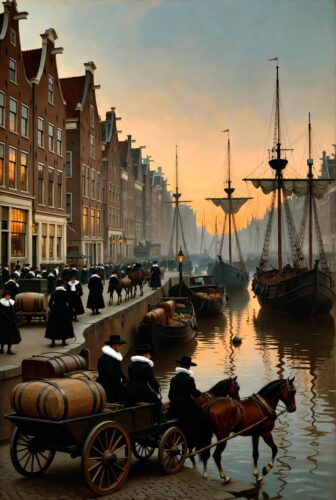 At first, tulips were genuinely rare and expensive, accessible only to the elite. A connoisseur could pay hundreds of guilders for a single bulb of a prized variety like Semper Augustus, with its blood-red flames on snow-white petals. But as cultivation techniques improved and more bulbs multiplied (each offset producing new ones), supply increased. What turned a luxury hobby into manic speculation was a perfect storm of economic, social, and psychological factors in the young Dutch Republic.
The Netherlands in the early 17th century was booming. Having won independence from Spain in the Eighty Years' War (with a truce in 1609), the republic became a global trading superpower. The Dutch East India Company (VOC), founded in 1602, was the world's first publicly traded company, raking in massive profits from Asian spices. Amsterdam replaced Antwerp as Europe's financial capital. Wealth flowed in: merchants built grand canal houses, artists like Rembrandt and Vermeer flourished, and a new middle class of artisans, shopkeepers, and small traders had disposable income for the first time.
Into this prosperous, optimistic atmosphere came the tulip. By the 1620s, breeding had produced hundreds of varieties, categorized by patterns: Couleren (multicolored), Rosen (red or pink on white), and Violetten (purple on white). The rarest "broken" bulbs – those with the viral streaks – fetched the highest prices. Names like Admirael van der Eyck, Gouda, or the legendary Semper Augustus became famous among connoisseurs.
Trading started innocently enough in the 1620s and early 1630s, mostly among wealthy florists (the term then meant tulip enthusiasts, not flower sellers). Bulbs were bought and sold in summer when dormant, weighed in "aesen" (a unit roughly a fraction of a gram for rare ones). Prices rose steadily as demand grew. But the real explosion began in 1634-1635.
Several factors accelerated the mania. First, the plague outbreak in 1636 kept people indoors, with time and money to speculate. Second, the Dutch economy's abundance of credit – low interest rates and easy loans – fueled borrowing for investments. Third, and crucially, the development of futures trading.
Traditionally, tulip sales happened in summer after bulbs were lifted from the ground. But speculators wanted in year-round. Enter "windhandel" – wind trade – where contracts were traded for future delivery of bulbs that remained in the ground. These were essentially forward contracts, bought with small down payments (2.5-10% typically, called "wine money"). No physical bulbs changed hands until summer; traders flipped contracts for profit as prices rose.
This innovation democratized the market. Suddenly, not just rich merchants but weavers, bakers, farmers, and even chimney sweeps could participate. Trading moved from formal colleges of florists to tavern "colleges" in towns like Haarlem, Utrecht, and Alkmaar. Innkeepers hosted auctions, charging fees. Drink flowed freely, bids escalated in the heat of competition.
By late 1636, prices had gone parabolic. Common bulbs that cost 10-20 guilders a few years earlier now fetched hundreds. Rare ones soared into the thousands. Documented examples from the peak period stun even today:
- A single Semper Augustus bulb sold for 5,200 guilders in 1637 (before the crash). For context, a skilled craftsman earned about 300 guilders a year. A nice Amsterdam canal house cost 6,000-10,000 guilders. One recorded offer for a Semper Augustus included 12 acres of building land, a coach with horses, and assorted goods.
- A Viceroy bulb fetched 3,000-4,200 guilders, sometimes including bundles of goods like wheat, rye, oxen, pigs, wine, silver cups, and even a bed.
- In one famous trade, a brewer in Utrecht swapped his entire brewery for a handful of bulbs.
Contemporary pamphlets marveled (and mocked) the insanity. One listed what a rare bulb could buy: two lasts of wheat, four of rye, four fat oxen, eight pigs, twelve sheep, two hogsheads of wine, four barrels of beer, two tons of butter, a thousand pounds of cheese, a complete bed, a suit of clothes, and a silver drinking cup. All for one plant.
At first, tulips were genuinely rare and expensive, accessible only to the elite. A connoisseur could pay hundreds of guilders for a single bulb of a prized variety like Semper Augustus, with its blood-red flames on snow-white petals. But as cultivation techniques improved and more bulbs multiplied (each offset producing new ones), supply increased. What turned a luxury hobby into manic speculation was a perfect storm of economic, social, and psychological factors in the young Dutch Republic.
The Netherlands in the early 17th century was booming. Having won independence from Spain in the Eighty Years' War (with a truce in 1609), the republic became a global trading superpower. The Dutch East India Company (VOC), founded in 1602, was the world's first publicly traded company, raking in massive profits from Asian spices. Amsterdam replaced Antwerp as Europe's financial capital. Wealth flowed in: merchants built grand canal houses, artists like Rembrandt and Vermeer flourished, and a new middle class of artisans, shopkeepers, and small traders had disposable income for the first time.
Into this prosperous, optimistic atmosphere came the tulip. By the 1620s, breeding had produced hundreds of varieties, categorized by patterns: Couleren (multicolored), Rosen (red or pink on white), and Violetten (purple on white). The rarest "broken" bulbs – those with the viral streaks – fetched the highest prices. Names like Admirael van der Eyck, Gouda, or the legendary Semper Augustus became famous among connoisseurs.
Trading started innocently enough in the 1620s and early 1630s, mostly among wealthy florists (the term then meant tulip enthusiasts, not flower sellers). Bulbs were bought and sold in summer when dormant, weighed in "aesen" (a unit roughly a fraction of a gram for rare ones). Prices rose steadily as demand grew. But the real explosion began in 1634-1635.
Several factors accelerated the mania. First, the plague outbreak in 1636 kept people indoors, with time and money to speculate. Second, the Dutch economy's abundance of credit – low interest rates and easy loans – fueled borrowing for investments. Third, and crucially, the development of futures trading.
Traditionally, tulip sales happened in summer after bulbs were lifted from the ground. But speculators wanted in year-round. Enter "windhandel" – wind trade – where contracts were traded for future delivery of bulbs that remained in the ground. These were essentially forward contracts, bought with small down payments (2.5-10% typically, called "wine money"). No physical bulbs changed hands until summer; traders flipped contracts for profit as prices rose.
This innovation democratized the market. Suddenly, not just rich merchants but weavers, bakers, farmers, and even chimney sweeps could participate. Trading moved from formal colleges of florists to tavern "colleges" in towns like Haarlem, Utrecht, and Alkmaar. Innkeepers hosted auctions, charging fees. Drink flowed freely, bids escalated in the heat of competition.
By late 1636, prices had gone parabolic. Common bulbs that cost 10-20 guilders a few years earlier now fetched hundreds. Rare ones soared into the thousands. Documented examples from the peak period stun even today:
- A single Semper Augustus bulb sold for 5,200 guilders in 1637 (before the crash). For context, a skilled craftsman earned about 300 guilders a year. A nice Amsterdam canal house cost 6,000-10,000 guilders. One recorded offer for a Semper Augustus included 12 acres of building land, a coach with horses, and assorted goods.
- A Viceroy bulb fetched 3,000-4,200 guilders, sometimes including bundles of goods like wheat, rye, oxen, pigs, wine, silver cups, and even a bed.
- In one famous trade, a brewer in Utrecht swapped his entire brewery for a handful of bulbs.
Contemporary pamphlets marveled (and mocked) the insanity. One listed what a rare bulb could buy: two lasts of wheat, four of rye, four fat oxen, eight pigs, twelve sheep, two hogsheads of wine, four barrels of beer, two tons of butter, a thousand pounds of cheese, a complete bed, a suit of clothes, and a silver drinking cup. All for one plant. Speculation reached fever pitch in January 1637. Auctions drew huge crowds. Prices doubled weekly. Newcomers poured in, convinced the boom would never end – after all, tulips were beautiful, the Dutch loved them, and foreigners (especially the French) would always buy at higher prices. Herd mentality ruled: if your neighbor made a fortune flipping contracts, why not you?
But bubbles, by definition, can't last. Supply was increasing as offsets multiplied. Professional growers, sensing the peak, began selling heavily. Doubts crept in: what if buyers defaulted on contracts? What if the French didn't materialize?
The turning point came in early February 1637. Accounts vary slightly on the exact location and date, but contemporary records and later historians pinpoint auctions in the first week of February as the trigger. One key event occurred in Haarlem or Alkmaar around February 3: sellers arrived with quantities of common bulbs (like Switsers or Croenen), expecting brisk bidding. Instead, bids were sparse and low. In some cases, no bids at all.
News raced along trade networks. By February 5-7, full-blown panic gripped the markets. In tavern after tavern, prices collapsed. Rare bulbs that changed hands for 5,000 guilders days earlier couldn't find buyers at 500. Contracts became worthless paper. Many speculators had bought on margin with tiny deposits; now they owed huge sums they couldn't pay.
The aftermath was chaotic but not apocalyptic. Courts were flooded with disputes. In April 1637, authorities in Haarlem and elsewhere intervened, declaring that outstanding contracts could be settled for 3.5-10% of the original price – a massive haircut for sellers but relief for buyers. Many deals were simply voided. No widespread bankruptcies crippled the Dutch economy; the VOC continued thriving, and the Golden Age rolled on.
Later historians, notably Charles Mackay in his 1841 book *Extraordinary Popular Delusions and the Madness of Crowds*, sensationalized the story, claiming ruined nobles and economic devastation. Modern research (like Anne Goldgar's *Tulipmania*) shows the mania involved fewer people than thought – mostly professional traders and middle-class speculators, not the entire nation. Actual money lost was limited compared to the overall economy. Still, the psychological shock was real, and the episode entered legend as the cautionary tale of irrational exuberance.
What makes February 3, 1637, so pivotal is that it wasn't a gradual decline – it was the day the illusion shattered. One failed auction exposed the emperor's new clothes: tulip prices weren't based on intrinsic value but pure speculation. When confidence vanished, so did the market.
Speculation reached fever pitch in January 1637. Auctions drew huge crowds. Prices doubled weekly. Newcomers poured in, convinced the boom would never end – after all, tulips were beautiful, the Dutch loved them, and foreigners (especially the French) would always buy at higher prices. Herd mentality ruled: if your neighbor made a fortune flipping contracts, why not you?
But bubbles, by definition, can't last. Supply was increasing as offsets multiplied. Professional growers, sensing the peak, began selling heavily. Doubts crept in: what if buyers defaulted on contracts? What if the French didn't materialize?
The turning point came in early February 1637. Accounts vary slightly on the exact location and date, but contemporary records and later historians pinpoint auctions in the first week of February as the trigger. One key event occurred in Haarlem or Alkmaar around February 3: sellers arrived with quantities of common bulbs (like Switsers or Croenen), expecting brisk bidding. Instead, bids were sparse and low. In some cases, no bids at all.
News raced along trade networks. By February 5-7, full-blown panic gripped the markets. In tavern after tavern, prices collapsed. Rare bulbs that changed hands for 5,000 guilders days earlier couldn't find buyers at 500. Contracts became worthless paper. Many speculators had bought on margin with tiny deposits; now they owed huge sums they couldn't pay.
The aftermath was chaotic but not apocalyptic. Courts were flooded with disputes. In April 1637, authorities in Haarlem and elsewhere intervened, declaring that outstanding contracts could be settled for 3.5-10% of the original price – a massive haircut for sellers but relief for buyers. Many deals were simply voided. No widespread bankruptcies crippled the Dutch economy; the VOC continued thriving, and the Golden Age rolled on.
Later historians, notably Charles Mackay in his 1841 book *Extraordinary Popular Delusions and the Madness of Crowds*, sensationalized the story, claiming ruined nobles and economic devastation. Modern research (like Anne Goldgar's *Tulipmania*) shows the mania involved fewer people than thought – mostly professional traders and middle-class speculators, not the entire nation. Actual money lost was limited compared to the overall economy. Still, the psychological shock was real, and the episode entered legend as the cautionary tale of irrational exuberance.
What makes February 3, 1637, so pivotal is that it wasn't a gradual decline – it was the day the illusion shattered. One failed auction exposed the emperor's new clothes: tulip prices weren't based on intrinsic value but pure speculation. When confidence vanished, so did the market. The Dutch learned quickly. They returned to sane trading, and tulips became ordinary garden flowers again (though the Netherlands remains the tulip capital). The episode influenced economic thought for centuries, warning against unchecked speculation.
Now, fast-forward nearly 400 years. Crypto winters, meme stocks, housing bubbles, Beanie Babies, NFTs – the pattern repeats. Hype builds, FOMO drives prices skyward, reality intrudes, crash. The outcome of Tulip Mania's collapse? A timeless reminder that crowds can be catastrophically wrong, and true wealth comes from understanding value, not chasing illusions.
Here's how you, in your everyday life, can turn this 1637 fiasco into personal superpower. By avoiding the tulip traders' mistakes, you'll build lasting financial security while everyone else panics over the next shiny "opportunity."
### Your Bulletproof Anti-Bubble Life Plan: Specific Steps to Financial Wisdom Inspired by February 3, 1637
- **Educate yourself relentlessly on real value versus hype.** The Dutch didn't understand the tulip virus or future supply – they just followed the crowd. Today, before investing in anything trendy (crypto, AI stocks, whatever's viral), spend at least 20 hours researching fundamentals. Read balance sheets, understand the technology or business model, calculate realistic growth. Make a rule: never invest more than 5% of your portfolio in something you can't explain simply in five minutes.
- **Build an emergency fund first – the anti-panic shield.** Many tulip speculators borrowed heavily on margin. When prices fell, they were wiped out. Aim for 6-12 months of living expenses in cash or safe equivalents. This lets you sleep through crashes and even buy bargains when others sell in terror.
- **Diversify like your wealth depends on it (because it does).** Tulip traders put everything into one asset class. Spread across stocks, bonds, real estate, commodities, and cash. Use low-cost index funds tracking broad markets. Rebalance yearly: sell winners, buy losers to maintain allocation.
- **Set strict rules against FOMO buying.** The tavern auctions thrived on competitive bidding and alcohol-fueled excitement. Today, social media and Reddit pump the same frenzy. Create a 48-hour cooling-off rule: if tempted by a hot investment, wait two days, then reassess coldly. Journal why you're buying – if it's "everyone's doing it," walk away.
- **Focus on income-producing assets over speculative flips.** Rare tulip bulbs promised quick riches but produced nothing until planted. Prioritize dividend stocks, rental properties, or your own career skills that generate steady cash flow. Aim to increase your active income 10% yearly through side hustles or raises, and invest the surplus.
- **Track your net worth monthly and celebrate slow progress.** The Dutch chased overnight fortunes and ignored building gradual wealth. Use free tools to monitor assets minus liabilities. Set milestones: every 10% growth, reward yourself modestly (a nice dinner, not a yacht). Compound interest is your friend – starting at age 30 with $500 monthly at 7% average return grows to over $1 million by 65.
- **Learn from crashes without experiencing them personally.** Study past bubbles (this one, 1929, 2000, 2008, 2022 crypto). When the next one hits – and it will – have cash ready to buy quality assets at discount prices. The tulip crash survivors who bought low in summer 1637 did fine.
- **Teach these principles to your circle.** The mania spread through tavern talk. Counter it by sharing calm, evidence-based advice with friends and family. You'll reinforce your own discipline and maybe save them from ruin.
Follow this plan consistently, and you'll laugh at future bubbles the way we chuckle at tulip traders today. February 3, 1637, wasn't the end of the Dutch Golden Age – it was a hiccup that taught resilience. Make it your turning point: turn historical folly into your personal fortune. Steady wins, always.
The Dutch learned quickly. They returned to sane trading, and tulips became ordinary garden flowers again (though the Netherlands remains the tulip capital). The episode influenced economic thought for centuries, warning against unchecked speculation.
Now, fast-forward nearly 400 years. Crypto winters, meme stocks, housing bubbles, Beanie Babies, NFTs – the pattern repeats. Hype builds, FOMO drives prices skyward, reality intrudes, crash. The outcome of Tulip Mania's collapse? A timeless reminder that crowds can be catastrophically wrong, and true wealth comes from understanding value, not chasing illusions.
Here's how you, in your everyday life, can turn this 1637 fiasco into personal superpower. By avoiding the tulip traders' mistakes, you'll build lasting financial security while everyone else panics over the next shiny "opportunity."
### Your Bulletproof Anti-Bubble Life Plan: Specific Steps to Financial Wisdom Inspired by February 3, 1637
- **Educate yourself relentlessly on real value versus hype.** The Dutch didn't understand the tulip virus or future supply – they just followed the crowd. Today, before investing in anything trendy (crypto, AI stocks, whatever's viral), spend at least 20 hours researching fundamentals. Read balance sheets, understand the technology or business model, calculate realistic growth. Make a rule: never invest more than 5% of your portfolio in something you can't explain simply in five minutes.
- **Build an emergency fund first – the anti-panic shield.** Many tulip speculators borrowed heavily on margin. When prices fell, they were wiped out. Aim for 6-12 months of living expenses in cash or safe equivalents. This lets you sleep through crashes and even buy bargains when others sell in terror.
- **Diversify like your wealth depends on it (because it does).** Tulip traders put everything into one asset class. Spread across stocks, bonds, real estate, commodities, and cash. Use low-cost index funds tracking broad markets. Rebalance yearly: sell winners, buy losers to maintain allocation.
- **Set strict rules against FOMO buying.** The tavern auctions thrived on competitive bidding and alcohol-fueled excitement. Today, social media and Reddit pump the same frenzy. Create a 48-hour cooling-off rule: if tempted by a hot investment, wait two days, then reassess coldly. Journal why you're buying – if it's "everyone's doing it," walk away.
- **Focus on income-producing assets over speculative flips.** Rare tulip bulbs promised quick riches but produced nothing until planted. Prioritize dividend stocks, rental properties, or your own career skills that generate steady cash flow. Aim to increase your active income 10% yearly through side hustles or raises, and invest the surplus.
- **Track your net worth monthly and celebrate slow progress.** The Dutch chased overnight fortunes and ignored building gradual wealth. Use free tools to monitor assets minus liabilities. Set milestones: every 10% growth, reward yourself modestly (a nice dinner, not a yacht). Compound interest is your friend – starting at age 30 with $500 monthly at 7% average return grows to over $1 million by 65.
- **Learn from crashes without experiencing them personally.** Study past bubbles (this one, 1929, 2000, 2008, 2022 crypto). When the next one hits – and it will – have cash ready to buy quality assets at discount prices. The tulip crash survivors who bought low in summer 1637 did fine.
- **Teach these principles to your circle.** The mania spread through tavern talk. Counter it by sharing calm, evidence-based advice with friends and family. You'll reinforce your own discipline and maybe save them from ruin.
Follow this plan consistently, and you'll laugh at future bubbles the way we chuckle at tulip traders today. February 3, 1637, wasn't the end of the Dutch Golden Age – it was a hiccup that taught resilience. Make it your turning point: turn historical folly into your personal fortune. Steady wins, always.