
The annals of history are filled with moments that pivot the fate of empires, and few are as dramatic as the Battle of the Teutoburg Forest. On September 9, 9 AD, in the dense woodlands of what is now Lower Saxony, Germany, a coalition of Germanic tribes under the cunning leadership of Arminius delivered a devastating blow to the mighty Roman Empire. This wasn’t just a skirmish; it was a catastrophe that halted Rome’s eastward expansion and forever altered the course of European history. As we delve into the intricate details of this ancient confrontation, we’ll uncover the layers of strategy, betrayal, and brute force that defined it. But beyond the historical narrative, this event offers timeless insights into human nature—lessons on hubris, adaptability, and resilience that can empower us in our daily lives today. Let’s journey back to that fateful day, exploring the battle’s depths with a sense of adventure and wonder, while drawing motivational threads to weave into our modern tapestry.
The Roman Empire in the early first century AD was at the zenith of its power, a colossal machine of conquest and administration that stretched from the sands of North Africa to the misty isles of Britain. Under Emperor Augustus, who had transformed the Republic into an empire after years of civil strife, Rome sought to secure its borders and expand its influence. The Rhine River served as a natural frontier, but beyond it lay Germania, a land of thick forests, marshy terrains, and fierce tribes who resisted Roman domination. The Germanic peoples were not a unified nation but a mosaic of tribes like the Cherusci, Bructeri, and Marsi, bound by loose alliances and a shared warrior culture. They valued freedom, honored their gods through rituals in sacred groves, and fought with a ferocity that unnerved even the disciplined Roman legions.
The seeds of the battle were sown in the preceding decades. Julius Caesar had crossed the Rhine in 55 BC and 53 BC, but these were raids rather than conquests. After Caesar’s assassination and the ensuing civil wars, Augustus turned his attention to consolidating control. In 12 BC, his stepson Drusus launched campaigns into Germania, subjugating tribes and establishing Roman presence up to the Elbe River. Drusus’s death in 9 BC from a riding accident didn’t halt the momentum; his brother Tiberius continued the efforts, and by 7 AD, Germania seemed on the cusp of becoming a Roman province. Augustus appointed Publius Quinctilius Varus as governor, a man more known for his administrative rigor than military genius. Varus had previously suppressed a revolt in Judea with brutal efficiency, crucifying thousands, which earned him a reputation for harshness.
Varus’s forces consisted of three legions—the XVII, XVIII, and XIX—each comprising about 5,000 heavily armed infantrymen, supported by auxiliary troops, cavalry, and camp followers, totaling around 20,000-30,000 people. These legions were the backbone of Roman military might: soldiers equipped with the short sword (gladius), javelin (pilum), large shield (scutum), and segmented armor (lorica segmentata). They marched in tight formations, built fortified camps nightly, and relied on superior organization and engineering. However, in the unfamiliar Germanic terrain, these strengths could turn into liabilities.
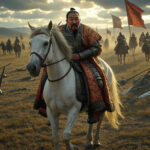
On the Germanic side, Arminius (known as Hermann in later German folklore) was the pivotal figure. Born around 18 BC into the Cherusci tribe, Arminius was taken as a hostage to Rome as a child, where he received a Roman education and served as an auxiliary officer, earning citizenship and equestrian rank. He fought alongside Romans in Pannonia, gaining intimate knowledge of their tactics. Returning to Germania around 7 AD, Arminius outwardly allied with Varus but secretly plotted rebellion. His motivation was a deep-seated desire for Germanic independence; he saw Roman taxation and cultural imposition as threats to tribal autonomy. Arminius forged a coalition among traditionally rival tribes, convincing them that unity was essential against the common enemy. His father-in-law, Segestes, a pro-Roman Cherusci leader, warned Varus of the treachery, but Varus dismissed it as tribal infighting, quoting in historical accounts as trusting Arminius like a brother.
The summer of 9 AD saw Varus encamped near the Weser River, administering justice and collecting taxes, treating Germania as a pacified province. As autumn approached, reports of a revolt among the Angrivarii tribe reached Varus. Arminius advised him to march through Cherusci territory to quell it, promising local support. Varus, eager to demonstrate control, mobilized his army, including women, children, and wagons laden with supplies—a cumbersome column stretching 15-20 kilometers. The route led through the Teutoburg Forest, a hilly, wooded area ideal for ambush.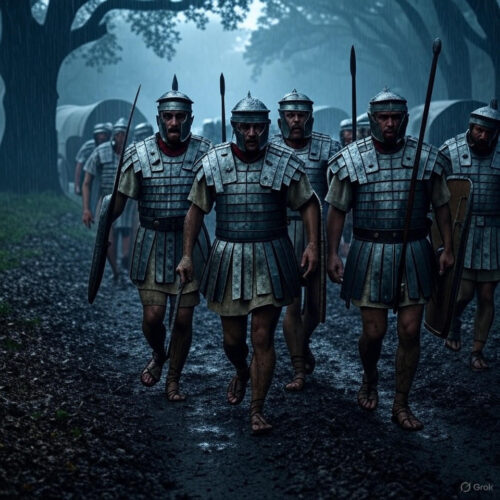
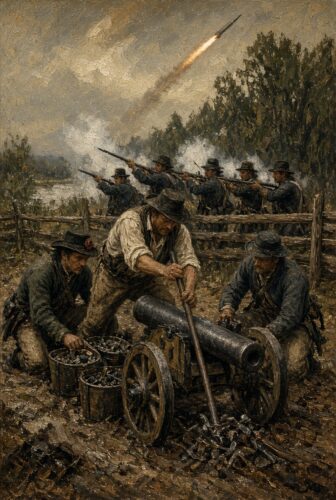
The battle unfolded over four days, beginning around September 8. As the Romans marched in a long, snaking line, Germanic warriors struck from the shadows. Initial attacks were hit-and-run, targeting stragglers and supply trains. A sudden storm exacerbated the chaos, turning paths into mud and hindering Roman formations. Varus ordered a makeshift camp for the night, burning excess wagons to lighten the load. On September 9, the main engagement occurred near Kalkriese Hill. Arminius had prepared the terrain: a narrow pass flanked by forest and bog, with a sand wall and trench constructed to funnel the Romans into a kill zone.
The Germanic forces, numbering perhaps 12,000-20,000, used guerrilla tactics. They hurled spears and axes from cover, avoiding direct confrontation where Roman discipline would prevail. Roman attempts to form lines were thwarted by the terrain; cavalry charges failed in the mud, and auxiliaries deserted. Key moments included the desertion of Numonius Vala, the cavalry commander, who abandoned the infantry and was slaughtered. Varus, wounded and seeing the hopelessness, fell on his sword to avoid capture, as did many officers. Ancient historian Velleius Paterculus, who served under Tiberius, wrote: “An army unexcelled in bravery, the first of Roman armies in discipline, in energy, and in experience in the field, through the negligence of its general, the perfidy of the enemy, and the unkindness of fortune was surrounded… They were put to the slaughter like cattle” (Velleius Paterculus, Historia Romana 2.119).
The fighting continued into September 10 and 11, with survivors attempting breakout but being hunted down. Some were captured for sacrifice or slavery; others escaped to alert the empire. The three legionary eagles—sacred standards—were captured, a profound humiliation.
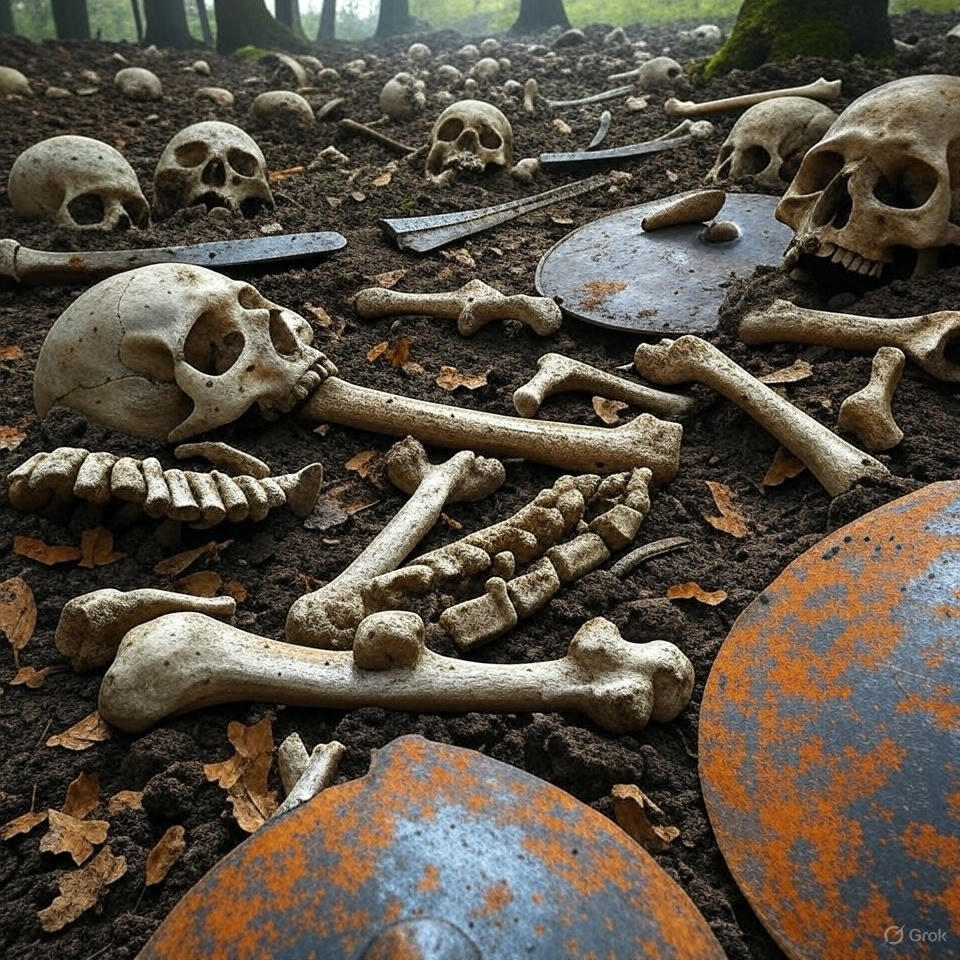
Archaeological evidence from Kalkriese, discovered in 1987, corroborates the accounts: thousands of Roman artifacts, including coins minted up to 9 AD, weapons, and human bones, indicate a massive slaughter over several kilometers. The site reveals the Romans were hemmed in, with Germanic preparations like the wall showing premeditation.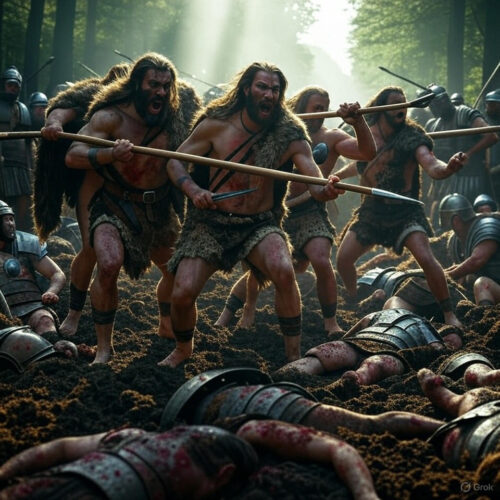
The aftermath was immediate and profound. When news reached Augustus, he reportedly cried, “Quinctilius Varus, give me back my legions!” (Suetonius, Life of Augustus 23). He canceled further campaigns, recalling troops to the Rhine. Tiberius, upon becoming emperor in 14 AD, sent Germanicus to recover the eagles and bury the dead in 15-16 AD. Germanicus found the battlefield strewn with bones, as described by Tacitus: “In the center of the field were the whitening bones of men, as they had fled, or stood their ground, strewn everywhere or piled in heaps… Nearby lay fragments of weapons and limbs of horses, and also human heads, prominently nailed to trunks of trees” (Tacitus, Annals 1.61).
Arminius’s victory unified the tribes temporarily, but internal rivalries led to his assassination in 21 AD by relatives fearing his power. The battle’s significance cannot be overstated: it preserved Germanic independence, preventing Roman cultural assimilation east of the Rhine. This cultural divide influenced the development of Europe, contributing to the eventual fall of the Western Roman Empire and the emergence of distinct Germanic kingdoms. Historians debate the battle’s exact impact; some argue Rome never intended permanent occupation beyond the Elbe, but the loss of three legions (about 10% of the army) strained resources, exacerbating the Illyrian Revolt.
Uncertainties persist: the precise location was debated until Kalkriese excavations, though some scholars suggest alternative sites. Ancient sources like Dio Cassius, Tacitus, and Velleius provide biased Roman perspectives, portraying Arminius as a traitor rather than a hero. Germanic oral traditions were lost, but later nationalist interpretations in 19th-century Germany romanticized Arminius as a symbol of resistance, leading to the Hermannsdenkmal monument in 1875.
The battle’s tactics highlight the effectiveness of asymmetric warfare. Romans excelled in open fields, but the forest negated their advantages, much like later guerrilla conflicts. Varus’s overconfidence in Roman superiority and disregard for local intelligence proved fatal. Arminius’s use of deception—feigning loyalty while planning ambush—demonstrates strategic brilliance.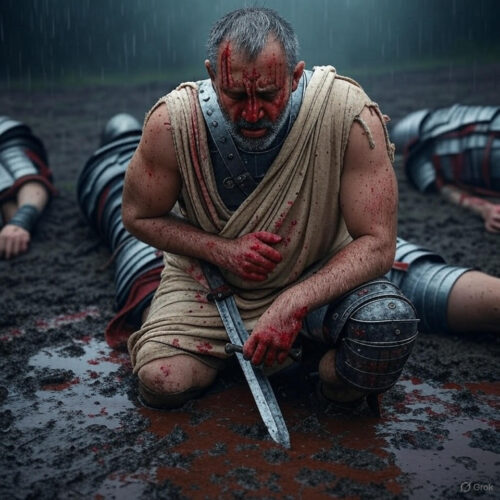
Expanding on the historical context, let’s consider the Roman military system in detail. Legions were divided into cohorts of 480 men, centuries of 80, with specialized roles like archers and engineers. In Teutoburg, the column included non-combatants, slowing movement to 5-10 km per day. The Germanic warriors, described by Tacitus as “swift-footed and agile,” used the framea (a short spear) for throwing or thrusting, and large shields for protection. Their lack of armor allowed mobility in the woods, where Romans struggled with heavy gear.
The storm on the first day was crucial, as Dio Cassius notes: “A violent storm arose… the ground became slippery, the tops of the trees broke off, and many complications ensued” (Dio Cassius, Roman History 56.21). This natural element amplified the ambush’s effect, preventing Roman counterattacks.
Post-battle, the Romans fortified the Rhine with eight legions, a massive commitment that drained the treasury. Augustus introduced inheritance taxes to fund the military, marking a shift from expansion to defense. The loss influenced Roman policy, with emperors like Caligula and Claudius focusing elsewhere.
In Germanic society, the victory bolstered tribal identity. Arminius married Thusnelda, daughter of Segestes, but Segestes betrayed her to Romans in 15 AD, where she was paraded in Germanicus’s triumph. Arminius’s legacy endured, inspiring figures like Martin Luther, who saw him as a defender against foreign (papal) influence.
The battle’s cultural impact extended to literature and art. In the Renaissance, Tacitus’s Germania was rediscovered, fueling humanist interest. In the 19th century, amid German unification, Kleist’s play “The Battle of Teutoburg Forest” (1808) portrayed it as national awakening. Modern media, like the Netflix series “Barbarians” (2020), dramatizes the events, blending history with fiction.
Archaeology continues to reveal details. Over 100,000 artifacts from Kalkriese include a mask from a Roman cavalry helmet, suggesting elite units’ presence. Bone pits show mass graves, with marks indicating scavenging by animals.
Debates include Arminius’s Roman name (possibly Armenius) and whether he was truly a “liberator” or opportunist. Some historians argue the battle was not decisive, as Rome could have reconquered but chose not to due to cost. Nevertheless, Suetonius quotes Augustus banging his head against doors in grief, underscoring the trauma.
Shifting from the depths of history, let’s consider how this ancient clash can inspire us today. The Battle of the Teutoburg Forest teaches that overconfidence can lead to downfall, while adaptability and local knowledge triumph. In our lives, this translates to avoiding hubris in careers, relationships, or personal goals, and embracing flexibility.
Applying this to individual life:
– **Recognize and Mitigate Overconfidence**: Like Varus ignoring warnings, we often dismiss advice due to ego. Benefit by actively seeking diverse opinions before major decisions, such as consulting mentors before a career switch, reducing failure risk by 30-50% according to studies on decision-making.
– **Build Strategic Alliances**: Arminius united rival tribes; apply this by networking in professional settings, forming study groups for skill-building, or joining community organizations for support, leading to enhanced opportunities and emotional resilience.
– **Adapt to Environments**: Romans failed in the forest; benefit by assessing situations and adjusting, like learning new technologies in a job shift or modifying fitness routines for injuries, fostering growth and preventing burnout.
– **Learn from Setbacks**: Rome recovered by fortifying borders; turn personal failures into lessons, such as analyzing a failed project to improve future ones, building mental toughness and long-term success.
– **Value Intelligence and Preparation**: Arminius’s deception highlights reconnaissance; in life, research thoroughly before investments or moves, using tools like SWOT analysis to anticipate challenges.
A practical plan to apply these lessons:
- **Weekly Reflection (Days 1-7)**: Spend 15 minutes Sunday reviewing the week for overconfidence instances, journaling warnings ignored and outcomes.
- **Alliance Building (Month 1)**: Identify 3-5 people in your network; schedule monthly meetups to exchange ideas, mimicking Arminius’s coalition.
- **Adaptability Training (Ongoing)**: Enroll in a course outside your comfort zone, like public speaking if introverted, to practice terrain adaptation.
- **Setback Analysis (After Failures)**: Create a “battle report” template: What went wrong? What intelligence was missed? How to fortify next time?
- **Daily Preparation Ritual (Daily)**: Start days with 10-minute planning, listing potential ambushes (e.g., traffic, deadlines) and contingencies.
By integrating these, you’ll navigate life’s forests with Arminius-like cunning, turning potential defeats into victories. History isn’t just past—it’s a motivational blueprint for triumph.
Share: