On June 22, 217 BC, near the dusty border town of Raphia (modern Rafah, just north of Gaza), two of the ancient world’s largest armies slammed together in one of history’s most spectacular and least predictable slugfests. Ptolemy IV Philopator, the pleasure-loving king of Ptolemaic Egypt, faced off against Antiochus III the Great, the ambitious young conqueror of the Seleucid Empire. Both men commanded forces that would have made Alexander the Great’s veterans nod in respect: tens of thousands of sarissa-wielding phalangites, swarms of mercenary cavalry and light infantry from across the known world, and—most dramatically—over 170 war elephants.
This was not a skirmish. It was one of the biggest battles of the entire Hellenistic era, involving roughly 140,000 men and the only recorded clash in history between African and Indian war elephants. The outcome decided who would control Coele-Syria—the strategic, fertile corridor that is today Israel, Lebanon, and parts of Syria and Jordan. The winner would dominate trade routes, grain supplies, and the eastern Mediterranean power game for years.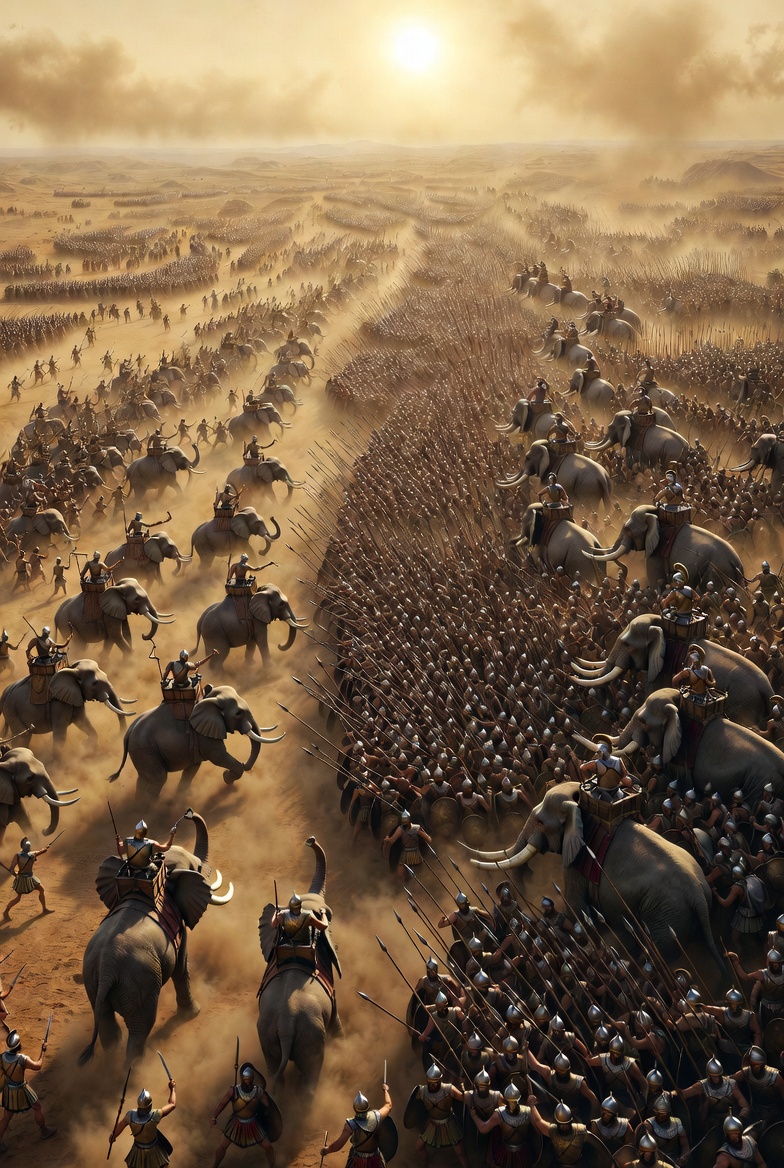 What makes Raphia unforgettable is not just the scale. It is the glorious, chaotic, almost comedic way the battle unfolded. The elephants—those ancient tanks—did not behave like obedient weapons. They panicked, stampeded through their own lines, and turned a carefully planned charge into a dusty, tusked bar brawl. Yet the side whose “secret weapons” caused the most friendly chaos still won. Decisively.
The story of that single June day, drawn from the eyewitness-level account of the historian Polybius, is packed with lessons about preparation meeting reality, about what happens when flashy tools fail, and about how disciplined core strength can turn a potential rout into an empire-saving victory. Here is the full, vivid tale—and exactly how its outcome can arm any person today with a sharper, stranger, and more effective way to handle modern setbacks than anything peddled in generic self-help.
### The Long Road to the Dusty Plain
After Alexander the Great’s death in 323 BC, his generals carved up the empire like vultures at a feast. Two of the biggest pieces became rival superpowers: the Ptolemaic kingdom in Egypt, ruled from the glittering new city of Alexandria, and the Seleucid Empire, stretching from Syria deep into Asia. They fought a series of “Syrian Wars” over the same prize—Coele-Syria—because whoever held it controlled the land bridge between Egypt and the riches of the north and east.
By 219 BC the Fourth Syrian War had begun. Antiochus III, barely in his thirties but already proving himself a military prodigy, was busy reclaiming territories his predecessors had lost. He swept through the region with energy and cunning. Ptolemy IV, meanwhile, had a very different reputation. Ancient writers describe him as more interested in lavish banquets, theatrical displays, and court favorites than in soldiering. He was no coward, but he was no Alexander either. His court was full of intrigue, and many expected him to fold when the Seleucid storm arrived.
Instead, Ptolemy and his ministers did something quietly radical. They expanded the army beyond the usual Greek and Macedonian elite. They recruited and rigorously trained thousands of native Egyptians in the deadly Macedonian phalanx formation—teaching them to lock 18-foot sarissas into an unbreakable hedge of spear points. This was not charity. It was necessity. Mercenaries were expensive and sometimes unreliable. Local manpower, properly drilled, could be both cheaper and more motivated when fighting for home soil.
What makes Raphia unforgettable is not just the scale. It is the glorious, chaotic, almost comedic way the battle unfolded. The elephants—those ancient tanks—did not behave like obedient weapons. They panicked, stampeded through their own lines, and turned a carefully planned charge into a dusty, tusked bar brawl. Yet the side whose “secret weapons” caused the most friendly chaos still won. Decisively.
The story of that single June day, drawn from the eyewitness-level account of the historian Polybius, is packed with lessons about preparation meeting reality, about what happens when flashy tools fail, and about how disciplined core strength can turn a potential rout into an empire-saving victory. Here is the full, vivid tale—and exactly how its outcome can arm any person today with a sharper, stranger, and more effective way to handle modern setbacks than anything peddled in generic self-help.
### The Long Road to the Dusty Plain
After Alexander the Great’s death in 323 BC, his generals carved up the empire like vultures at a feast. Two of the biggest pieces became rival superpowers: the Ptolemaic kingdom in Egypt, ruled from the glittering new city of Alexandria, and the Seleucid Empire, stretching from Syria deep into Asia. They fought a series of “Syrian Wars” over the same prize—Coele-Syria—because whoever held it controlled the land bridge between Egypt and the riches of the north and east.
By 219 BC the Fourth Syrian War had begun. Antiochus III, barely in his thirties but already proving himself a military prodigy, was busy reclaiming territories his predecessors had lost. He swept through the region with energy and cunning. Ptolemy IV, meanwhile, had a very different reputation. Ancient writers describe him as more interested in lavish banquets, theatrical displays, and court favorites than in soldiering. He was no coward, but he was no Alexander either. His court was full of intrigue, and many expected him to fold when the Seleucid storm arrived.
Instead, Ptolemy and his ministers did something quietly radical. They expanded the army beyond the usual Greek and Macedonian elite. They recruited and rigorously trained thousands of native Egyptians in the deadly Macedonian phalanx formation—teaching them to lock 18-foot sarissas into an unbreakable hedge of spear points. This was not charity. It was necessity. Mercenaries were expensive and sometimes unreliable. Local manpower, properly drilled, could be both cheaper and more motivated when fighting for home soil.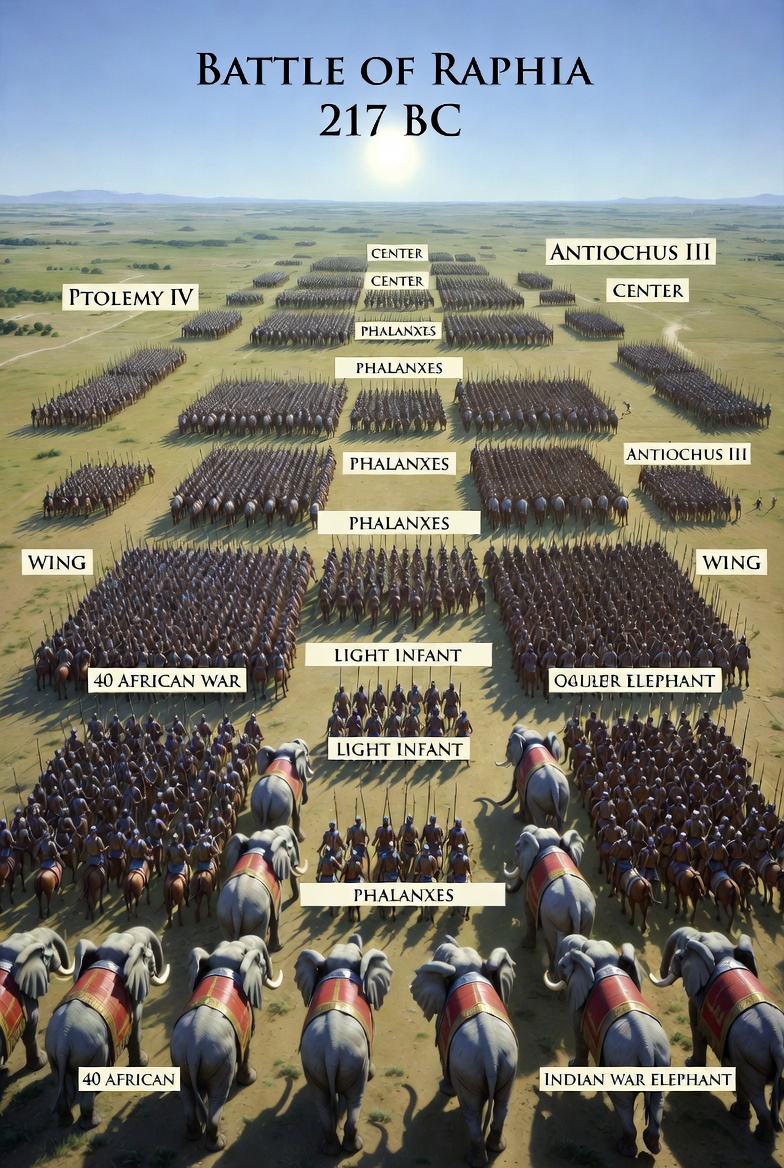 By spring 217 BC both kings had assembled colossal forces and marched toward each other. Ptolemy moved his army up from Alexandria through the coastal route, past Pelusium, and into the borderlands. Antiochus gathered his own host and advanced to meet him. For five tense days the two armies camped within sight of one another near Raphia, skirmishing, probing, and watching. Then, on the morning of June 22, they formed for battle.
### The Armies Array Themselves
Polybius gives us the numbers and the layout with soldierly precision.
Ptolemy fielded about 70,000 infantry, 5,000 cavalry, and 73 elephants—mostly the smaller African forest variety. Antiochus brought roughly 62,000 infantry, 6,000 cavalry, and 102 larger Indian elephants. On paper the forces were comparable, but the Indian elephants were widely considered superior: bigger, stronger, and more aggressive in combat.
Both kings placed their heavy phalanxes in the center. These were the “tanks” of ancient infantry—dense blocks of men whose 18-foot spears projected five rows deep in front, making frontal assault suicidal. On the wings came the more mobile troops: cavalry, light infantry, mercenaries from Gaul, Thrace, Crete, Arabia, and beyond. The elephants were stationed in front of the infantry on the wings, intended to smash holes in the enemy line or at least disorder it before the phalanxes closed.
Ptolemy took personal command on his left wing, accompanied by his sister (and queen) Arsinoe. Antiochus positioned himself on his own right wing, opposite the Egyptian king. Both men rode along their lines delivering speeches—promising glory, rewards, and reminding their polyglot troops why they should risk their lives for foreign kings. Then the trumpets sounded.
### The Charge That Turned Into a Bar Fight
The battle opened with the elephant charge, exactly as planned. On Ptolemy’s left, his smaller African elephants lumbered forward. Opposite them, Antiochus’ larger Indian elephants advanced under their mahouts, carrying towers or howdahs packed with pikemen and archers.
What happened next was pure chaos.
Most of Ptolemy’s African elephants refused to close properly. The larger, more aggressive Indian elephants terrified them. Some turned and bolted straight back through their own supporting infantry, trampling men and shattering the careful formation. Tusks locked, trunks flailed, and the howdah fighters stabbed at each other in a bizarre aerial duel while the beasts themselves pushed forehead-to-forehead like drunken wrestlers trying to decide who owed whom money. Dust rose in choking clouds. Wounded elephants trumpeted in pain and rage. The neat battle lines on Ptolemy’s left dissolved into a panicked, bloody scrum.
By spring 217 BC both kings had assembled colossal forces and marched toward each other. Ptolemy moved his army up from Alexandria through the coastal route, past Pelusium, and into the borderlands. Antiochus gathered his own host and advanced to meet him. For five tense days the two armies camped within sight of one another near Raphia, skirmishing, probing, and watching. Then, on the morning of June 22, they formed for battle.
### The Armies Array Themselves
Polybius gives us the numbers and the layout with soldierly precision.
Ptolemy fielded about 70,000 infantry, 5,000 cavalry, and 73 elephants—mostly the smaller African forest variety. Antiochus brought roughly 62,000 infantry, 6,000 cavalry, and 102 larger Indian elephants. On paper the forces were comparable, but the Indian elephants were widely considered superior: bigger, stronger, and more aggressive in combat.
Both kings placed their heavy phalanxes in the center. These were the “tanks” of ancient infantry—dense blocks of men whose 18-foot spears projected five rows deep in front, making frontal assault suicidal. On the wings came the more mobile troops: cavalry, light infantry, mercenaries from Gaul, Thrace, Crete, Arabia, and beyond. The elephants were stationed in front of the infantry on the wings, intended to smash holes in the enemy line or at least disorder it before the phalanxes closed.
Ptolemy took personal command on his left wing, accompanied by his sister (and queen) Arsinoe. Antiochus positioned himself on his own right wing, opposite the Egyptian king. Both men rode along their lines delivering speeches—promising glory, rewards, and reminding their polyglot troops why they should risk their lives for foreign kings. Then the trumpets sounded.
### The Charge That Turned Into a Bar Fight
The battle opened with the elephant charge, exactly as planned. On Ptolemy’s left, his smaller African elephants lumbered forward. Opposite them, Antiochus’ larger Indian elephants advanced under their mahouts, carrying towers or howdahs packed with pikemen and archers.
What happened next was pure chaos.
Most of Ptolemy’s African elephants refused to close properly. The larger, more aggressive Indian elephants terrified them. Some turned and bolted straight back through their own supporting infantry, trampling men and shattering the careful formation. Tusks locked, trunks flailed, and the howdah fighters stabbed at each other in a bizarre aerial duel while the beasts themselves pushed forehead-to-forehead like drunken wrestlers trying to decide who owed whom money. Dust rose in choking clouds. Wounded elephants trumpeted in pain and rage. The neat battle lines on Ptolemy’s left dissolved into a panicked, bloody scrum.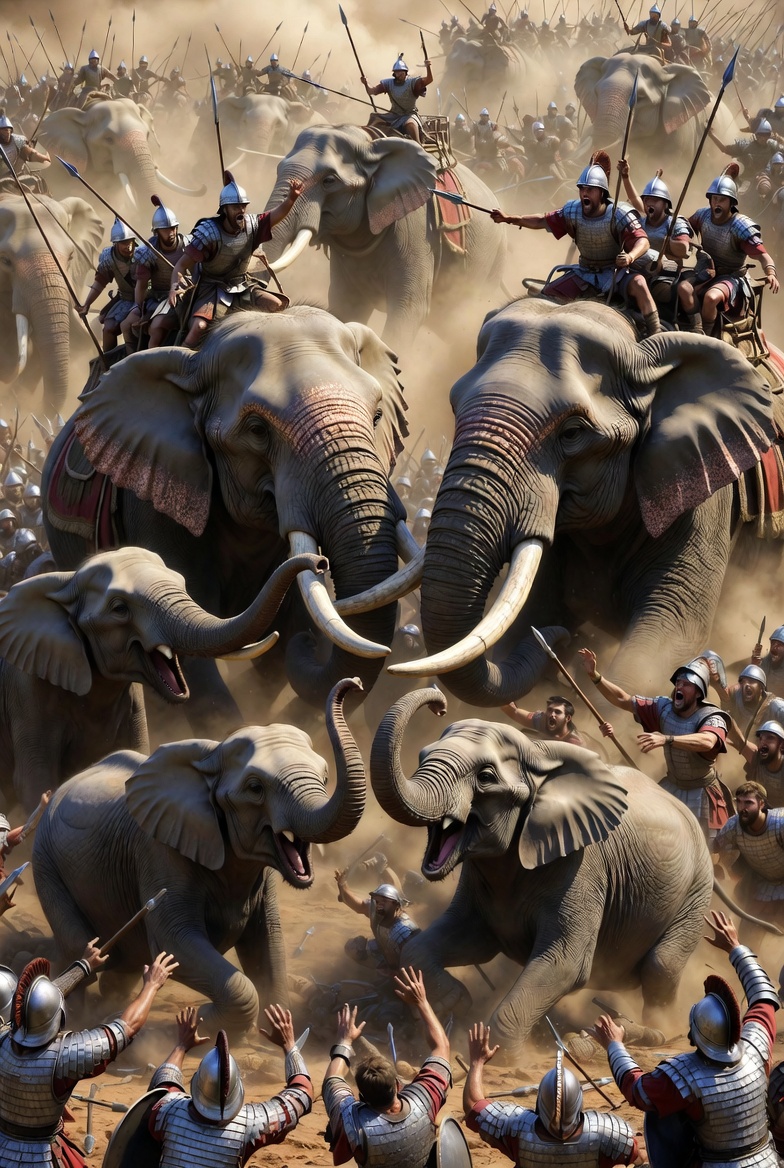 Antiochus, seeing the disorder, charged forward with his right-wing cavalry and guard. He smashed through the disrupted Egyptian left and began pursuing the fleeing troops with the enthusiasm of a man who believed the day was already his. This was the classic ancient-battle mistake: getting carried away chasing routers while the rest of the army still fought.
Meanwhile, in the center and on the other wing, things did not go Antiochus’ way. Ptolemy’s phalanx—bolstered by those newly trained Egyptian troops—held its ground or advanced. The Seleucid center began to buckle. When Antiochus finally looked back from his pursuit, he saw his own army collapsing behind him. His phalanx was in trouble, his left wing was being rolled up, and the momentum had flipped entirely.
He tried to rally his men, but it was too late. The rout became general. Seleucid losses were catastrophic: around 10,000 infantry killed and another 4,000 captured, plus most of their elephants either dead or taken. Ptolemaic losses were far lighter—roughly 1,500 infantry and 700 cavalry. The field, the town of Raphia, and with it control of Coele-Syria belonged to Ptolemy.
### Why the “Loser’s” Tools Still Won
The elephants had failed Ptolemy spectacularly. His flashy, expensive, terrifying secret weapons had caused more damage to his own side than to the enemy. Yet he won. Why?
Three interlocking reasons stand out, and they are the heart of what makes Raphia useful today.
First, the core formation held. While the elephants on one wing caused friendly chaos, the phalanx in the center—drilled, disciplined, and now including large numbers of motivated native Egyptians—did its job. It did not need the elephants to succeed. It only needed the elephants not to destroy it completely before it could engage.
Second, Ptolemy’s side had diversified its forces. By training Egyptians in the phalanx, the kingdom stopped relying solely on expensive foreign mercenaries or a narrow Greco-Macedonian elite. When the “high-tech” elephant wing faltered, the broader base of the army could still deliver victory. That decision to “recruit the natives” proved more decisive than any single weapon.
Antiochus, seeing the disorder, charged forward with his right-wing cavalry and guard. He smashed through the disrupted Egyptian left and began pursuing the fleeing troops with the enthusiasm of a man who believed the day was already his. This was the classic ancient-battle mistake: getting carried away chasing routers while the rest of the army still fought.
Meanwhile, in the center and on the other wing, things did not go Antiochus’ way. Ptolemy’s phalanx—bolstered by those newly trained Egyptian troops—held its ground or advanced. The Seleucid center began to buckle. When Antiochus finally looked back from his pursuit, he saw his own army collapsing behind him. His phalanx was in trouble, his left wing was being rolled up, and the momentum had flipped entirely.
He tried to rally his men, but it was too late. The rout became general. Seleucid losses were catastrophic: around 10,000 infantry killed and another 4,000 captured, plus most of their elephants either dead or taken. Ptolemaic losses were far lighter—roughly 1,500 infantry and 700 cavalry. The field, the town of Raphia, and with it control of Coele-Syria belonged to Ptolemy.
### Why the “Loser’s” Tools Still Won
The elephants had failed Ptolemy spectacularly. His flashy, expensive, terrifying secret weapons had caused more damage to his own side than to the enemy. Yet he won. Why?
Three interlocking reasons stand out, and they are the heart of what makes Raphia useful today.
First, the core formation held. While the elephants on one wing caused friendly chaos, the phalanx in the center—drilled, disciplined, and now including large numbers of motivated native Egyptians—did its job. It did not need the elephants to succeed. It only needed the elephants not to destroy it completely before it could engage.
Second, Ptolemy’s side had diversified its forces. By training Egyptians in the phalanx, the kingdom stopped relying solely on expensive foreign mercenaries or a narrow Greco-Macedonian elite. When the “high-tech” elephant wing faltered, the broader base of the army could still deliver victory. That decision to “recruit the natives” proved more decisive than any single weapon.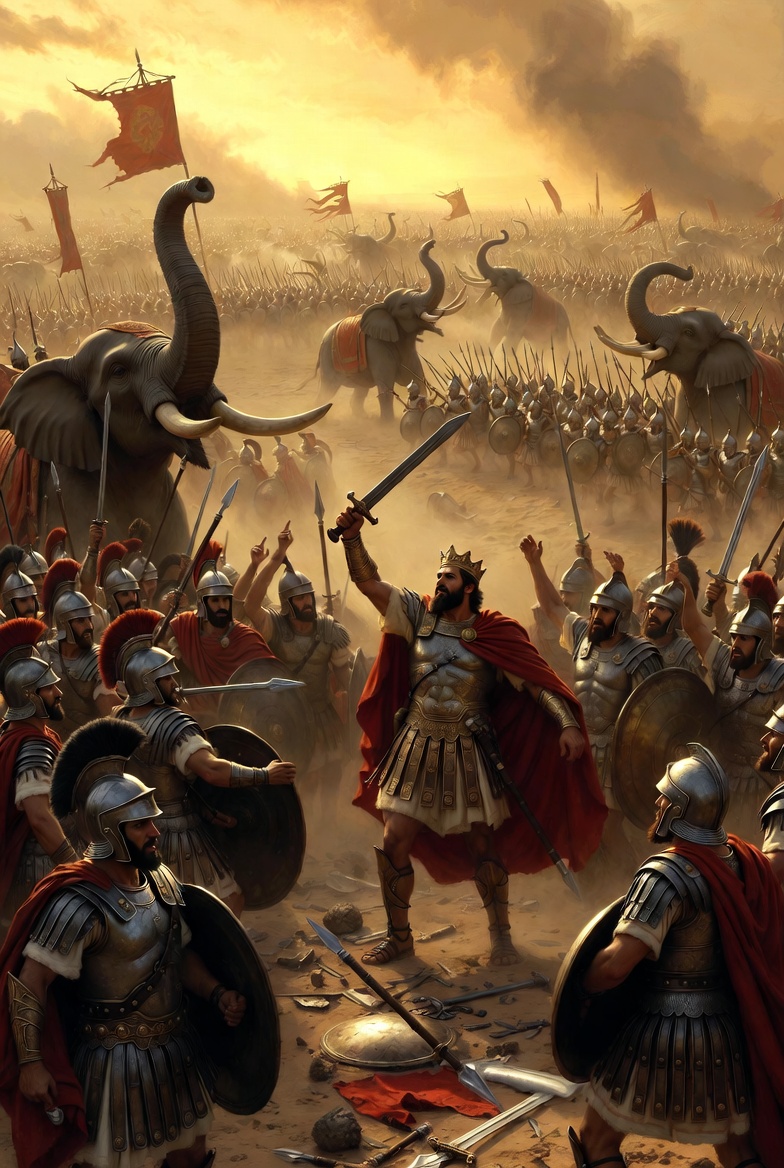 Third, Antiochus over-pursued. He let the excitement of a successful local breakthrough carry him away from the main fight. In doing so he lost the ability to influence the battle elsewhere. One wing’s success blinded him to the collapse of his center and other wing.
The battle did more than decide a border. It marked a turning point inside Ptolemaic Egypt itself. Native Egyptians had fought effectively in the phalanx and expected recognition. Their increased influence in the army and administration accelerated a gradual “Egyptianization” of the kingdom’s culture and power structures. Short-term, this strengthened the state. Long-term, it contributed to internal tensions and later revolts. But on that June day in 217 BC, it helped save the dynasty from conquest.
Ptolemy did not become a legendary general overnight. He remained a flawed, luxury-loving ruler. But his kingdom’s system—its ability to absorb new manpower, maintain a solid center, and recover from a self-inflicted elephant disaster—proved stronger than the personal brilliance of his rival on that particular field.
### How Raphia’s Outcome Arms You Today
The historical fact that a king whose own war elephants stampeded his own lines still won a decisive victory is not just colorful ancient trivia. It is a precise, usable template for anyone facing modern equivalents of “my best tools just caused friendly fire.”
Here are the concrete, individual-level benefits that flow directly from what actually happened on June 22, 217 BC:
- You gain antifragility to tool failure. When your fanciest app, strategy, investment, or productivity system panics and disrupts your day, you already know from Raphia that the battle is not automatically lost. The center can still hold.
- You stop outsourcing your core strength. Ptolemy’s victory accelerated the inclusion of native Egyptians because relying only on expensive external “mercenaries” (elite troops or, today, gurus, apps, or agencies) is fragile. Training and empowering what you already have—your own skills, your local network, your unglamorous daily disciplines—creates a phalanx that does not need perfect conditions.
- You learn to recognize and contain the “pursuit trap.” Antiochus’ overcommitment on one successful wing cost him the war. In daily life this appears as obsessing over one metric, one opportunity, or one dramatic fix while the rest of your responsibilities collapse. Raphia teaches you to celebrate a local win without abandoning the main formation.
Third, Antiochus over-pursued. He let the excitement of a successful local breakthrough carry him away from the main fight. In doing so he lost the ability to influence the battle elsewhere. One wing’s success blinded him to the collapse of his center and other wing.
The battle did more than decide a border. It marked a turning point inside Ptolemaic Egypt itself. Native Egyptians had fought effectively in the phalanx and expected recognition. Their increased influence in the army and administration accelerated a gradual “Egyptianization” of the kingdom’s culture and power structures. Short-term, this strengthened the state. Long-term, it contributed to internal tensions and later revolts. But on that June day in 217 BC, it helped save the dynasty from conquest.
Ptolemy did not become a legendary general overnight. He remained a flawed, luxury-loving ruler. But his kingdom’s system—its ability to absorb new manpower, maintain a solid center, and recover from a self-inflicted elephant disaster—proved stronger than the personal brilliance of his rival on that particular field.
### How Raphia’s Outcome Arms You Today
The historical fact that a king whose own war elephants stampeded his own lines still won a decisive victory is not just colorful ancient trivia. It is a precise, usable template for anyone facing modern equivalents of “my best tools just caused friendly fire.”
Here are the concrete, individual-level benefits that flow directly from what actually happened on June 22, 217 BC:
- You gain antifragility to tool failure. When your fanciest app, strategy, investment, or productivity system panics and disrupts your day, you already know from Raphia that the battle is not automatically lost. The center can still hold.
- You stop outsourcing your core strength. Ptolemy’s victory accelerated the inclusion of native Egyptians because relying only on expensive external “mercenaries” (elite troops or, today, gurus, apps, or agencies) is fragile. Training and empowering what you already have—your own skills, your local network, your unglamorous daily disciplines—creates a phalanx that does not need perfect conditions.
- You learn to recognize and contain the “pursuit trap.” Antiochus’ overcommitment on one successful wing cost him the war. In daily life this appears as obsessing over one metric, one opportunity, or one dramatic fix while the rest of your responsibilities collapse. Raphia teaches you to celebrate a local win without abandoning the main formation.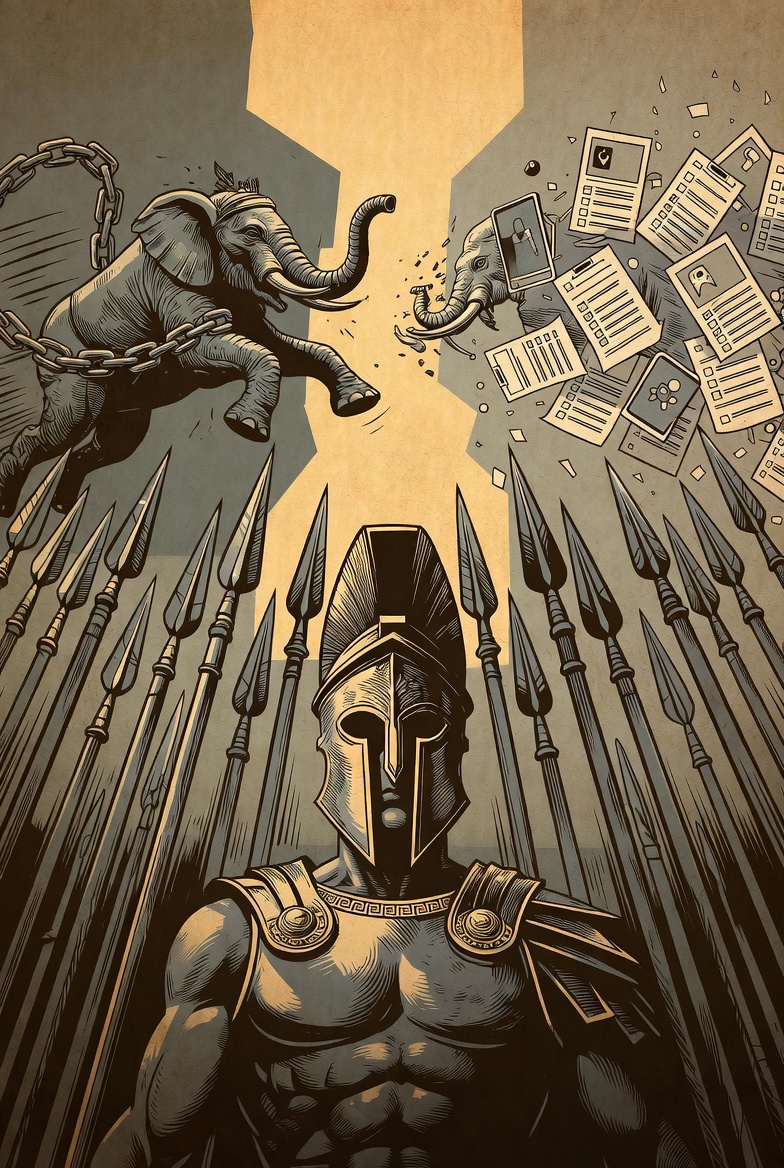 - You build hybrid systems instead of all-or-nothing bets. The battle showed the danger of putting too much faith in one dramatic weapon (elephants) while also showing the power of combining it with something more reliable (the phalanx). Modern translation: pair high-variance experiments with unbreakable basics rather than going all-in on either.
- You turn setbacks into recruitment opportunities. The chaos on Ptolemy’s left did not just get cleaned up; it highlighted the value of the Egyptian troops who stood firm elsewhere. When your own plan creates mess, examine what (or who) performed despite the mess. That is your new native strength to develop.
- You practice calm command under chaos. Ptolemy stayed on the field on a wing that was literally being trampled by his own elephants. He did not need to be perfect; he needed to remain present and let the rest of his army do what it was trained to do. That is a repeatable leadership skill.
- You gain strategic patience after victory. Ptolemy retook Raphia and the surrounding towns methodically rather than launching a reckless deep invasion. Quick, contained consolidation often beats dramatic overextension.
- You develop “elephant-proof” routines. Knowing that even the best-laid charges can backfire, you design daily systems with multiple layers so that failure in one layer does not cascade into total collapse.
- You stop waiting for perfect conditions or perfect tools. Ptolemy was not a military genius and his elephants were inferior. He won anyway because his core formation was solid and his opponent made a classic overpursuit error. Waiting for ideal elephants (or ideal circumstances) is a luxury most people cannot afford.
- You acquire a vivid, memorable mental model. “Raphia moment” becomes shorthand in your mind for “my flashy plan just stampeded my own progress—time to lock the phalanx and look for the overpursuit elsewhere.” Memorable historical metaphors stick better than abstract advice.
### The Raphia Recovery Protocol: A Quick, Unique, Battle-Tested 7-Day Plan
Most self-help plans are either too vague (“think positive”) or too long (“90-day transformation”). This one is deliberately short, specific, and weirdly fun because it is built directly from the actual events of June 22, 217 BC. You can run the entire protocol in under an hour most days. It requires no special equipment, no apps you will abandon, and no belief in ancient magic. It only requires treating your own goals like a Hellenistic army that just watched its elephants run amok.
**Day 1 – Scout the Field (20 minutes)**
Write down your current “Syrian Wars”: the 2–3 big challenges or goals you are facing. For each, identify your “elephants” (the flashy, high-variance tools or strategies that could spectacularly backfire—new app, big purchase, dramatic lifestyle change, all-or-nothing diet, etc.) and your “phalanx” (the 3–4 non-negotiable daily disciplines that actually move the needle regardless of drama: 30 minutes focused work, movement, sleep window, financial review, whatever is truly core for you). Be brutally honest. Most people have more elephants than they admit.
**Day 2 – Train the Natives (25 minutes)**
List five “native Egyptian” assets you have been under-using: skills you already possess but ignore, local resources or people you could activate instead of outsourcing, personal strengths you dismiss because they are not shiny. Pick one and give it a 15-minute activation mission today. Example: instead of buying another course, you spend 15 minutes teaching yourself one micro-skill from a free source or practicing a neglected strength in public. This is recruitment, not consumption.
**Day 3 – Simulate the Stampede (15–30 minutes)**
Deliberately create a tiny, controlled “elephant panic” inside one of your normal tasks. Start a focused work block, then introduce a 5-minute disruption (loud environment, phone notification you cannot ignore, minor physical discomfort). Practice the Raphia response: do not abandon the field. Breathe once, re-lock your personal phalanx (your pre-chosen core action), and finish the block anyway. The goal is not comfort. It is proving to yourself that disruption does not have to become rout.
**Day 4 – Array the Wings and Spot the Pursuit Trap (20 minutes)**
Map your current goals onto a simple left-wing / center / right-wing diagram. Which area is your natural strong side (the wing where you already have momentum or talent)? Plan one contained, aggressive action there this week—no more than 90 minutes total. Then identify your personal “Antiochus overpursuit”: the distraction, metric, or rabbit hole you tend to chase too far when one thing goes well. Set a hard boundary (time, money, or energy cap) around it for the rest of the week.
**Day 5 – Lock the Phalanx (45 minutes)**
Execute one “center phalanx” session: a single block of deep, uninterrupted work on your highest-leverage task. Pre-load everything you need (water, notes, timer, accountability if it helps). No multitasking. No chasing side wins. If chaos arrives anyway (it will), treat it like the elephant panic—acknowledge, do not panic, keep the spears pointed forward. This is the formation that wins even when the fancy stuff fails.
**Day 6 – Occupy Raphia, Do Not Chase Antiochus (20 minutes)**
Review the previous day’s wins, however small. Write a one-paragraph “battle dispatch” describing what held and what panicked. Then do the Ptolemaic thing: consolidate. Pick one modest, immediate follow-up action that locks in yesterday’s progress instead of launching a dramatic new campaign. No heroics. Just occupy the ground you actually took.
**Day 7 – Write the Victory Dispatch and Plan the Next Campaign (25 minutes)**
Produce a short written review answering three questions only:
- You build hybrid systems instead of all-or-nothing bets. The battle showed the danger of putting too much faith in one dramatic weapon (elephants) while also showing the power of combining it with something more reliable (the phalanx). Modern translation: pair high-variance experiments with unbreakable basics rather than going all-in on either.
- You turn setbacks into recruitment opportunities. The chaos on Ptolemy’s left did not just get cleaned up; it highlighted the value of the Egyptian troops who stood firm elsewhere. When your own plan creates mess, examine what (or who) performed despite the mess. That is your new native strength to develop.
- You practice calm command under chaos. Ptolemy stayed on the field on a wing that was literally being trampled by his own elephants. He did not need to be perfect; he needed to remain present and let the rest of his army do what it was trained to do. That is a repeatable leadership skill.
- You gain strategic patience after victory. Ptolemy retook Raphia and the surrounding towns methodically rather than launching a reckless deep invasion. Quick, contained consolidation often beats dramatic overextension.
- You develop “elephant-proof” routines. Knowing that even the best-laid charges can backfire, you design daily systems with multiple layers so that failure in one layer does not cascade into total collapse.
- You stop waiting for perfect conditions or perfect tools. Ptolemy was not a military genius and his elephants were inferior. He won anyway because his core formation was solid and his opponent made a classic overpursuit error. Waiting for ideal elephants (or ideal circumstances) is a luxury most people cannot afford.
- You acquire a vivid, memorable mental model. “Raphia moment” becomes shorthand in your mind for “my flashy plan just stampeded my own progress—time to lock the phalanx and look for the overpursuit elsewhere.” Memorable historical metaphors stick better than abstract advice.
### The Raphia Recovery Protocol: A Quick, Unique, Battle-Tested 7-Day Plan
Most self-help plans are either too vague (“think positive”) or too long (“90-day transformation”). This one is deliberately short, specific, and weirdly fun because it is built directly from the actual events of June 22, 217 BC. You can run the entire protocol in under an hour most days. It requires no special equipment, no apps you will abandon, and no belief in ancient magic. It only requires treating your own goals like a Hellenistic army that just watched its elephants run amok.
**Day 1 – Scout the Field (20 minutes)**
Write down your current “Syrian Wars”: the 2–3 big challenges or goals you are facing. For each, identify your “elephants” (the flashy, high-variance tools or strategies that could spectacularly backfire—new app, big purchase, dramatic lifestyle change, all-or-nothing diet, etc.) and your “phalanx” (the 3–4 non-negotiable daily disciplines that actually move the needle regardless of drama: 30 minutes focused work, movement, sleep window, financial review, whatever is truly core for you). Be brutally honest. Most people have more elephants than they admit.
**Day 2 – Train the Natives (25 minutes)**
List five “native Egyptian” assets you have been under-using: skills you already possess but ignore, local resources or people you could activate instead of outsourcing, personal strengths you dismiss because they are not shiny. Pick one and give it a 15-minute activation mission today. Example: instead of buying another course, you spend 15 minutes teaching yourself one micro-skill from a free source or practicing a neglected strength in public. This is recruitment, not consumption.
**Day 3 – Simulate the Stampede (15–30 minutes)**
Deliberately create a tiny, controlled “elephant panic” inside one of your normal tasks. Start a focused work block, then introduce a 5-minute disruption (loud environment, phone notification you cannot ignore, minor physical discomfort). Practice the Raphia response: do not abandon the field. Breathe once, re-lock your personal phalanx (your pre-chosen core action), and finish the block anyway. The goal is not comfort. It is proving to yourself that disruption does not have to become rout.
**Day 4 – Array the Wings and Spot the Pursuit Trap (20 minutes)**
Map your current goals onto a simple left-wing / center / right-wing diagram. Which area is your natural strong side (the wing where you already have momentum or talent)? Plan one contained, aggressive action there this week—no more than 90 minutes total. Then identify your personal “Antiochus overpursuit”: the distraction, metric, or rabbit hole you tend to chase too far when one thing goes well. Set a hard boundary (time, money, or energy cap) around it for the rest of the week.
**Day 5 – Lock the Phalanx (45 minutes)**
Execute one “center phalanx” session: a single block of deep, uninterrupted work on your highest-leverage task. Pre-load everything you need (water, notes, timer, accountability if it helps). No multitasking. No chasing side wins. If chaos arrives anyway (it will), treat it like the elephant panic—acknowledge, do not panic, keep the spears pointed forward. This is the formation that wins even when the fancy stuff fails.
**Day 6 – Occupy Raphia, Do Not Chase Antiochus (20 minutes)**
Review the previous day’s wins, however small. Write a one-paragraph “battle dispatch” describing what held and what panicked. Then do the Ptolemaic thing: consolidate. Pick one modest, immediate follow-up action that locks in yesterday’s progress instead of launching a dramatic new campaign. No heroics. Just occupy the ground you actually took.
**Day 7 – Write the Victory Dispatch and Plan the Next Campaign (25 minutes)**
Produce a short written review answering three questions only:
Which of my elephants caused the most friendly disruption this week, and what did I do about it?
Which native asset performed better than expected when things got messy?
Where did I almost overpursue, and how did I stop?
End with one specific order for the next seven days. Keep it short enough to fit on one page. Read it aloud once. You have just completed your personal Raphia after-action report.


This protocol is deliberately narrow and historical rather than inspirational. It does not promise transformation. It promises that when your own best tools create chaos—as they did for Ptolemy IV on June 22, 217 BC—you already know the formation that can still win. The elephants may panic. The dust may rise. Your rival may think the day is his. But if your center holds, if you have trained more than just the flashy weapons, and if you refuse to chase one breakthrough all the way off the field, the field can still be yours.


History does not repeat, but it does hand out excellent metaphors to people willing to study the actual events instead of the slogans. On this date in 217 BC, an imperfect king with inferior elephants and a recently expanded army defeated a more glamorous conqueror because his core formation endured and his opponent got carried away. That outcome is still available. The only question is whether you will form your own phalanx or keep hoping your elephants behave perfectly this time.


The plain outside Raphia is long gone. The lesson is not. Lock the spears. Hold the center. And when the tusks start swinging, remember: the side that recovers fastest usually keeps the kingdom.