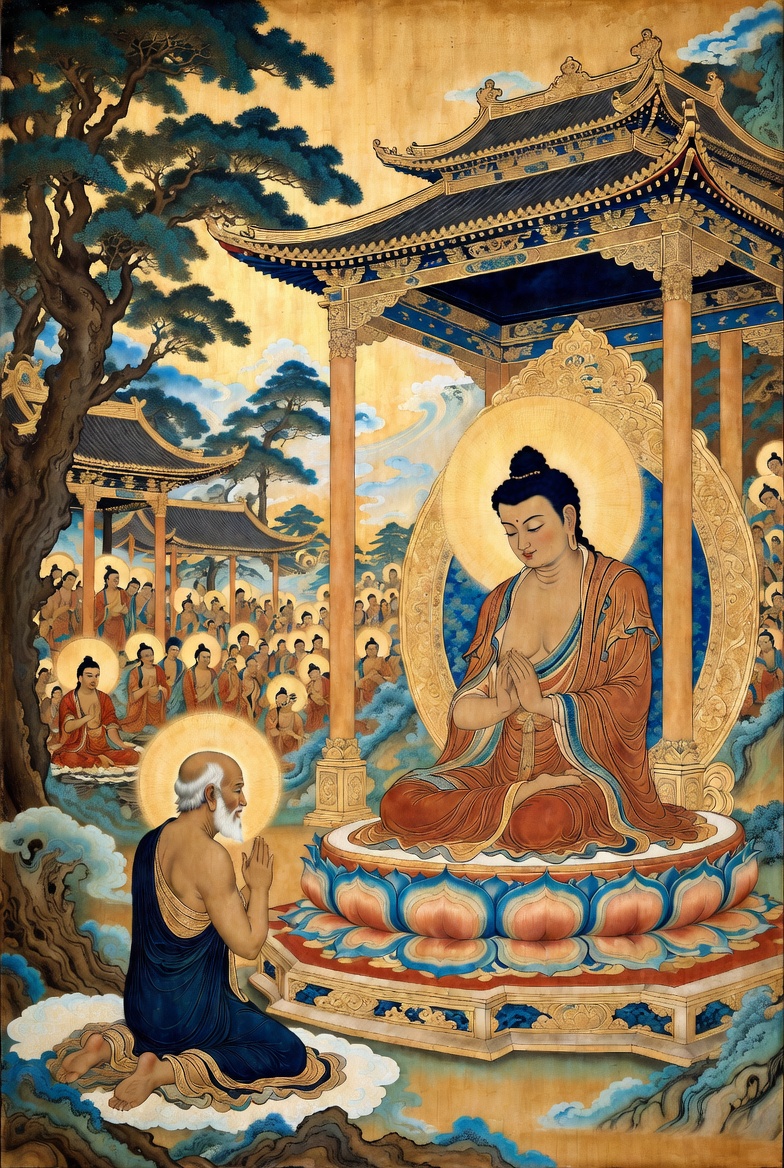
On May 11, 868 CE, in the bustling workshops of northern China during the waning years of the Tang Dynasty’s Xiantong era, a modest merchant named Wang Jie did something quietly revolutionary. He commissioned a team of skilled artisans to carve and ink a complete copy of the Vajracchedikā Prajñāpāramitā Sūtra—better known as the Diamond Sutra—onto seven long strips of yellow-dyed paper. These strips were pasted end-to-end into a scroll over five meters long. At the end, a colophon was printed in crisp characters: “Reverently made for universal free distribution by Wang Jie on behalf of his two parents on the 15th day of the 4th month of the 9th year of Xiantong.” That Gregorian calendar date? May 11, 868.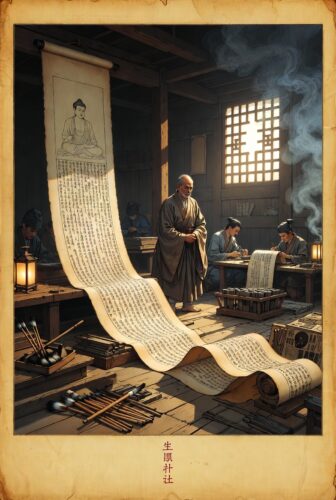 This wasn’t some royal decree or battlefield clash. It was a humble act of filial devotion and Buddhist merit-making. Yet it produced the world’s oldest surviving dated printed book—a complete, functional text that predates Gutenberg’s Bible by nearly six centuries. The scroll survived wars, desert sands, cave-sealing monks, treasure-hunting explorers, and international controversy to land in the British Library today. Its frontispiece shows the Buddha preaching to the elder Subhuti under a canopy of trees, the figures rendered with astonishing clarity from a single carved woodblock. The ink is still legible after 1,158 years.
This story isn’t just about ink and paper. It’s about the first time humanity figured out how to mass-produce wisdom itself, freeze it in time, and fling it into the future for free. Ninety percent of what follows dives deep into the Tang Dynasty world that birthed it, the Buddhist revolution it represented, the technological miracle of woodblock printing, the cave that hid it for a millennium, and the empire-shaping forces that made it possible. Only at the end will we pivot to how this single printed scroll’s outcome—preserving and freely distributing profound insight through chaos—can transform your individual life today with razor-sharp specificity. No generic self-help fluff. Just a unique, quick plan forged from the scroll’s own DNA.
Let’s travel back to the Tang Dynasty, the glittering peak of Chinese civilization often called the “Golden Age.” By 868, the empire under Emperor Yizong (reigned 859–873) was still riding the afterglow of earlier Tang glory, even as cracks were showing. The dynasty had begun in 618 when Li Yuan overthrew the Sui, but it truly exploded under Taizong and Xuanzong into a cosmopolitan superpower stretching from Central Asia to Korea. Chang’an, the capital, was the largest city on Earth, home to over a million people, with Persian merchants, Japanese monks, Korean artists, and Turkic generals rubbing shoulders in markets fragrant with spices and silk.
Buddhism had been woven into the fabric of Chinese life for centuries by then. It arrived via the Silk Road around the 1st century CE, carried by monks translating Sanskrit sutras into Chinese. By the Tang, it was state-sponsored luxury. Emperors patronized massive monasteries, and lay devotees like Wang Jie commissioned art and texts for karmic merit. But it wasn’t always smooth. In 845, Emperor Wuzong launched the Huichang Persecution, smashing thousands of temples, melting bronze statues for coin, and forcing monks and nuns back to lay life. Why? Economic pressure—monasteries owned vast tax-free lands—and a push for native Daoism and Confucianism. Buddhism survived, though bruised, and rebounded under Yizong’s more tolerant rule. Monasteries became centers of learning, printing, and charity.
This wasn’t some royal decree or battlefield clash. It was a humble act of filial devotion and Buddhist merit-making. Yet it produced the world’s oldest surviving dated printed book—a complete, functional text that predates Gutenberg’s Bible by nearly six centuries. The scroll survived wars, desert sands, cave-sealing monks, treasure-hunting explorers, and international controversy to land in the British Library today. Its frontispiece shows the Buddha preaching to the elder Subhuti under a canopy of trees, the figures rendered with astonishing clarity from a single carved woodblock. The ink is still legible after 1,158 years.
This story isn’t just about ink and paper. It’s about the first time humanity figured out how to mass-produce wisdom itself, freeze it in time, and fling it into the future for free. Ninety percent of what follows dives deep into the Tang Dynasty world that birthed it, the Buddhist revolution it represented, the technological miracle of woodblock printing, the cave that hid it for a millennium, and the empire-shaping forces that made it possible. Only at the end will we pivot to how this single printed scroll’s outcome—preserving and freely distributing profound insight through chaos—can transform your individual life today with razor-sharp specificity. No generic self-help fluff. Just a unique, quick plan forged from the scroll’s own DNA.
Let’s travel back to the Tang Dynasty, the glittering peak of Chinese civilization often called the “Golden Age.” By 868, the empire under Emperor Yizong (reigned 859–873) was still riding the afterglow of earlier Tang glory, even as cracks were showing. The dynasty had begun in 618 when Li Yuan overthrew the Sui, but it truly exploded under Taizong and Xuanzong into a cosmopolitan superpower stretching from Central Asia to Korea. Chang’an, the capital, was the largest city on Earth, home to over a million people, with Persian merchants, Japanese monks, Korean artists, and Turkic generals rubbing shoulders in markets fragrant with spices and silk.
Buddhism had been woven into the fabric of Chinese life for centuries by then. It arrived via the Silk Road around the 1st century CE, carried by monks translating Sanskrit sutras into Chinese. By the Tang, it was state-sponsored luxury. Emperors patronized massive monasteries, and lay devotees like Wang Jie commissioned art and texts for karmic merit. But it wasn’t always smooth. In 845, Emperor Wuzong launched the Huichang Persecution, smashing thousands of temples, melting bronze statues for coin, and forcing monks and nuns back to lay life. Why? Economic pressure—monasteries owned vast tax-free lands—and a push for native Daoism and Confucianism. Buddhism survived, though bruised, and rebounded under Yizong’s more tolerant rule. Monasteries became centers of learning, printing, and charity.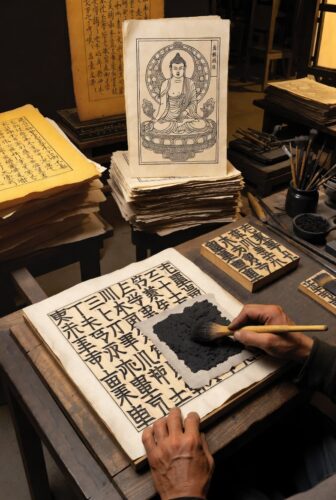 Enter woodblock printing. The Chinese had been experimenting with seals and stamps for centuries—rubbing ink onto carved stones or wood to duplicate official seals or charms. By the 7th century, Buddhist texts were being block-printed to meet demand. Monasteries needed thousands of copies for chanting, study, and merit distribution. A single woodblock could produce hundreds of impressions before wearing out. The process was labor-intensive but scalable: artisans carved characters in reverse into pear or jujube wood, inked the block, pressed damp paper onto it, and repeated. Colors were simple—black ink on paper dyed with yellow ochre for preservation. The Diamond Sutra scroll used exactly this method. Seven blocks (one per sheet) were carved, printed, and joined with paste. The frontispiece illustration—Buddha on a throne, surrounded by disciples and heavenly beings—was carved with exquisite detail: flowing robes, serene expressions, architectural canopies that echo the grand temples of Chang’an.
Wang Jie was no emperor or monk. He was likely a pious layman, perhaps a merchant or official with enough means to fund the project. His colophon reveals everything: filial piety (a core Confucian value blended with Buddhism), the desire for “universal free distribution,” and the hope that printing the sutra would generate merit to benefit his deceased parents in the afterlife. In Tang Buddhism, copying or printing scriptures was a high form of dana (generosity). One copy could “plant seeds” of enlightenment for countless readers. The sutra itself encourages this: it promises incalculable merit to anyone who memorizes, recites, or propagates even four lines of the text. Wang Jie took that literally and technologically.
Now, what exactly is the Diamond Sutra? It’s a short Mahayana text, part of the vast Prajñāpāramitā (“Perfection of Wisdom”) literature composed in India between the 2nd and 5th centuries CE. The version Wang Jie printed uses the elegant 401 CE translation by the great Central Asian monk Kumārajīva—the one still chanted today in temples from Beijing to Kyoto. The sutra is a dialogue in the Jetavana grove near Śrāvastī. The Buddha has finished his daily alms round and sits with his disciple Subhuti. Subhuti asks the million-dollar question for any bodhisattva (enlightenment-seeker): How should one who has set out on the path of awakening stand, proceed, and control the mind?
The Buddha’s answer is a radical demolition of all fixed concepts. He teaches emptiness (śūnyatā) without ever using the word directly—he uses negation, paradox, and “the logic of not.” All phenomena are empty of inherent self or essence. A bodhisattva should liberate all beings yet not perceive any “being” to liberate. Give gifts without seeing giver, gift, or recipient. Seek enlightenment without grasping at “I have attained something.” The famous four-line verse at the end captures it: “All conditioned phenomena are like a dream, an illusion, a bubble, a shadow, like dew or a flash of lightning; thus shall we perceive them.” The sutra hammers home non-attachment. Even the Dharma itself must not be clung to—clinging turns wisdom into dogma.
Enter woodblock printing. The Chinese had been experimenting with seals and stamps for centuries—rubbing ink onto carved stones or wood to duplicate official seals or charms. By the 7th century, Buddhist texts were being block-printed to meet demand. Monasteries needed thousands of copies for chanting, study, and merit distribution. A single woodblock could produce hundreds of impressions before wearing out. The process was labor-intensive but scalable: artisans carved characters in reverse into pear or jujube wood, inked the block, pressed damp paper onto it, and repeated. Colors were simple—black ink on paper dyed with yellow ochre for preservation. The Diamond Sutra scroll used exactly this method. Seven blocks (one per sheet) were carved, printed, and joined with paste. The frontispiece illustration—Buddha on a throne, surrounded by disciples and heavenly beings—was carved with exquisite detail: flowing robes, serene expressions, architectural canopies that echo the grand temples of Chang’an.
Wang Jie was no emperor or monk. He was likely a pious layman, perhaps a merchant or official with enough means to fund the project. His colophon reveals everything: filial piety (a core Confucian value blended with Buddhism), the desire for “universal free distribution,” and the hope that printing the sutra would generate merit to benefit his deceased parents in the afterlife. In Tang Buddhism, copying or printing scriptures was a high form of dana (generosity). One copy could “plant seeds” of enlightenment for countless readers. The sutra itself encourages this: it promises incalculable merit to anyone who memorizes, recites, or propagates even four lines of the text. Wang Jie took that literally and technologically.
Now, what exactly is the Diamond Sutra? It’s a short Mahayana text, part of the vast Prajñāpāramitā (“Perfection of Wisdom”) literature composed in India between the 2nd and 5th centuries CE. The version Wang Jie printed uses the elegant 401 CE translation by the great Central Asian monk Kumārajīva—the one still chanted today in temples from Beijing to Kyoto. The sutra is a dialogue in the Jetavana grove near Śrāvastī. The Buddha has finished his daily alms round and sits with his disciple Subhuti. Subhuti asks the million-dollar question for any bodhisattva (enlightenment-seeker): How should one who has set out on the path of awakening stand, proceed, and control the mind?
The Buddha’s answer is a radical demolition of all fixed concepts. He teaches emptiness (śūnyatā) without ever using the word directly—he uses negation, paradox, and “the logic of not.” All phenomena are empty of inherent self or essence. A bodhisattva should liberate all beings yet not perceive any “being” to liberate. Give gifts without seeing giver, gift, or recipient. Seek enlightenment without grasping at “I have attained something.” The famous four-line verse at the end captures it: “All conditioned phenomena are like a dream, an illusion, a bubble, a shadow, like dew or a flash of lightning; thus shall we perceive them.” The sutra hammers home non-attachment. Even the Dharma itself must not be clung to—clinging turns wisdom into dogma.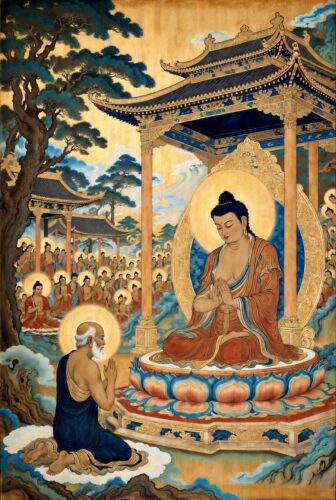 This wasn’t abstract philosophy for Tang readers. It was practical medicine for a chaotic world. The Tang had seen rebellions, famines, and persecutions. The Diamond Sutra’s message—that everything is impermanent, that true freedom comes from letting go—offered solace and power. Chan (Zen) masters like Huineng, who lived earlier in the dynasty, credited hearing the sutra with his sudden awakening. Monasteries printed and distributed copies precisely because the text itself commands propagation. Wang Jie’s scroll was one link in a chain stretching back to India and forward to every East Asian temple that ever chanted it.
The physical object itself is a marvel of engineering and art. Unrolled, the scroll is 17.5 feet long and about 10.5 inches wide. The paper, made from mulberry or hemp, was treated to resist insects and humidity. The ink—a soot-based formula mixed with glue—penetrated just enough to last. The frontispiece is the earliest known printed illustration in a book: Buddha seated on a lotus throne, right hand in teaching mudra, Subhuti kneeling respectfully. Background trees, clouds, and attendants show sophisticated composition rivaling hand-painted murals in the Mogao Caves themselves. Every character is uniform, proof of skilled carving. This wasn’t crude; it was high craft, the Tang equivalent of a finely typeset first edition.
After production, copies like Wang Jie’s circulated among monasteries along the Silk Road. Dunhuang, the oasis town at the eastern end of the Taklamakan Desert, was the perfect crossroads. Known as the “Gateway to the West,” it thrived on trade in silk, horses, jade, and ideas. The Mogao Caves—also called the Caves of the Thousand Buddhas—were carved into a sandstone cliff starting in 366 CE by a monk named Le Zun who saw a vision of a thousand Buddhas in golden light. Over centuries, pilgrims, merchants, and rulers sponsored more than 500 caves filled with breathtaking murals and statues. Monks lived, studied, and prayed there. By the late 10th century, as the Tang fragmented into the Five Dynasties and Song rose, threats loomed: invading Tanguts of the Western Xia, shifting trade routes, and political instability.
Around 1000–1035 CE, the monks of Dunhuang sealed a side chamber—Cave 17, the “Library Cave”—with nearly 60,000 manuscripts, paintings, textiles, and printed texts. Why? Scholars debate. Perhaps to protect sacred materials from invaders, or as a ritual “retirement” of worn-out holy objects, or simply a storeroom that got walled up and forgotten. The cave stayed sealed for nearly 900 years, preserving its treasures in the dry desert air like a time capsule.
Fast-forward to 1900. A Daoist monk named Wang Yuanlu had taken up residence at the neglected Mogao site, clearing sand and restoring caves for pilgrims. One day, while clearing debris in Cave 16, he noticed a crack in the wall. Behind it: the Library Cave, packed floor-to-ceiling with scrolls. Wang Yuanlu saw opportunity—and perhaps divine favor. He began showing samples to officials and travelers. Enter British-Hungarian explorer Aurel Stein in 1907. On his second Central Asian expedition, funded partly to map ancient Silk Road routes, Stein heard rumors of the hoard. Through negotiation, persuasion, and what some call outright purchase under duress (he paid about £130, the equivalent of a modest sum today), Stein acquired thousands of manuscripts, including the Diamond Sutra scroll. He shipped it to the British Museum (later British Library). Chinese nationalists later decried it as looting; Stein’s defenders called it rescue from obscurity. The truth is messy—colonial archaeology meets desperate preservation—but the scroll survived. Today, you can view high-resolution digital versions online courtesy of the British Library’s Turning the Pages project. Conservators have stabilized it; the paper remains supple, the ink vivid.
This wasn’t abstract philosophy for Tang readers. It was practical medicine for a chaotic world. The Tang had seen rebellions, famines, and persecutions. The Diamond Sutra’s message—that everything is impermanent, that true freedom comes from letting go—offered solace and power. Chan (Zen) masters like Huineng, who lived earlier in the dynasty, credited hearing the sutra with his sudden awakening. Monasteries printed and distributed copies precisely because the text itself commands propagation. Wang Jie’s scroll was one link in a chain stretching back to India and forward to every East Asian temple that ever chanted it.
The physical object itself is a marvel of engineering and art. Unrolled, the scroll is 17.5 feet long and about 10.5 inches wide. The paper, made from mulberry or hemp, was treated to resist insects and humidity. The ink—a soot-based formula mixed with glue—penetrated just enough to last. The frontispiece is the earliest known printed illustration in a book: Buddha seated on a lotus throne, right hand in teaching mudra, Subhuti kneeling respectfully. Background trees, clouds, and attendants show sophisticated composition rivaling hand-painted murals in the Mogao Caves themselves. Every character is uniform, proof of skilled carving. This wasn’t crude; it was high craft, the Tang equivalent of a finely typeset first edition.
After production, copies like Wang Jie’s circulated among monasteries along the Silk Road. Dunhuang, the oasis town at the eastern end of the Taklamakan Desert, was the perfect crossroads. Known as the “Gateway to the West,” it thrived on trade in silk, horses, jade, and ideas. The Mogao Caves—also called the Caves of the Thousand Buddhas—were carved into a sandstone cliff starting in 366 CE by a monk named Le Zun who saw a vision of a thousand Buddhas in golden light. Over centuries, pilgrims, merchants, and rulers sponsored more than 500 caves filled with breathtaking murals and statues. Monks lived, studied, and prayed there. By the late 10th century, as the Tang fragmented into the Five Dynasties and Song rose, threats loomed: invading Tanguts of the Western Xia, shifting trade routes, and political instability.
Around 1000–1035 CE, the monks of Dunhuang sealed a side chamber—Cave 17, the “Library Cave”—with nearly 60,000 manuscripts, paintings, textiles, and printed texts. Why? Scholars debate. Perhaps to protect sacred materials from invaders, or as a ritual “retirement” of worn-out holy objects, or simply a storeroom that got walled up and forgotten. The cave stayed sealed for nearly 900 years, preserving its treasures in the dry desert air like a time capsule.
Fast-forward to 1900. A Daoist monk named Wang Yuanlu had taken up residence at the neglected Mogao site, clearing sand and restoring caves for pilgrims. One day, while clearing debris in Cave 16, he noticed a crack in the wall. Behind it: the Library Cave, packed floor-to-ceiling with scrolls. Wang Yuanlu saw opportunity—and perhaps divine favor. He began showing samples to officials and travelers. Enter British-Hungarian explorer Aurel Stein in 1907. On his second Central Asian expedition, funded partly to map ancient Silk Road routes, Stein heard rumors of the hoard. Through negotiation, persuasion, and what some call outright purchase under duress (he paid about £130, the equivalent of a modest sum today), Stein acquired thousands of manuscripts, including the Diamond Sutra scroll. He shipped it to the British Museum (later British Library). Chinese nationalists later decried it as looting; Stein’s defenders called it rescue from obscurity. The truth is messy—colonial archaeology meets desperate preservation—but the scroll survived. Today, you can view high-resolution digital versions online courtesy of the British Library’s Turning the Pages project. Conservators have stabilized it; the paper remains supple, the ink vivid.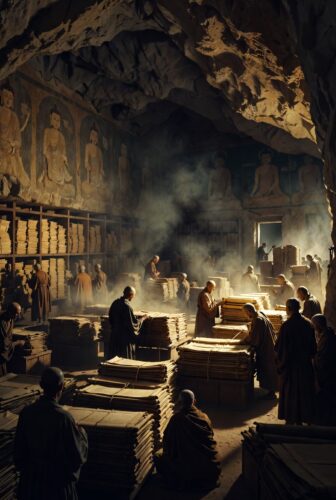 The Diamond Sutra’s significance ripples far beyond one artifact. It proves printing wasn’t a European invention but a Chinese one refined over centuries for religious purposes. It democratized knowledge: no more hand-copying errors or scarcity. Monasteries could flood the world with identical sutras. This paved the way for later Song Dynasty printing booms—encyclopedias, Confucian classics, even novels. Without Tang Buddhist block printing, East Asia’s literacy and cultural unity would look very different. The sutra’s teachings influenced Zen, Pure Land, and Tibetan traditions. Its emphasis on emptiness shaped philosophy from Huineng’s Platform Sutra to modern mindfulness. And its survival in the cave reminds us how fragile—and resilient—human knowledge is. Empires rose and fell (Tang collapsed in 907), yet this scroll outlasted them all because someone chose to print it and monks chose to protect it.
Wang Jie never imagined his devotional act would be studied 1,158 years later. He just wanted to honor his parents and spread the dharma. The outcome? A technology that conquered time. A philosophy that cuts through illusion like a diamond. A tangible proof that small, intentional acts of creation and generosity can echo across centuries.
Now, apply this historical fact to your individual life. The Diamond Sutra’s core outcome—creating something repeatable, distributing it freely, and trusting impermanence to carry it forward—offers a blueprint for personal power that no other self-help system replicates. Most online advice peddles quick dopamine or rigid routines. This is different: it’s the “Diamond Carving Protocol,” a system built on carving your own “blocks” of wisdom, printing (repeating) them without attachment, and freely distributing their benefits while embracing the bubble-and-dream nature of results. It’s quick (under 30 minutes daily), unique (no vision boards, no hustle culture mantras), and forged directly from 868 CE mechanics.
Here are very specific ways this historical fact benefits you today, translated into bullet-point actions you can take immediately:
- **Carve one “woodblock” daily instead of chasing endless ideas**: Just as artisans carved only seven blocks for an entire sutra, pick one core life principle (your personal “four-line gatha”) each morning—something like “I act with full effort and release full outcome.” Write it, refine it once, then “print” it by repeating the principle in three real actions that day. This prevents the modern disease of shiny-object syndrome and builds unbreakable consistency.
- **Ink it with zero attachment to praise or perfection**: Wang Jie printed for universal free distribution, not fame. When you share a skill, insight, or help (a LinkedIn post, a mentoring note, a favor), do it anonymously or without expecting likes/replies. Track only the act, not the echo. This kills anxiety over metrics and turns every output into pure merit.
- **Distribute freely to create karmic compounding**: The sutra’s merit multiplied because it was given away. Identify one piece of your knowledge (a recipe, a productivity hack, a lesson from failure) and give it away completely—no paywall, no “in exchange for.” Do this weekly. Watch how opportunities return multiplied, exactly as the sutra promises.
- **View every setback as a “bubble” or “flash of lightning”**: When a project fails, job ends, or relationship shifts, recite the sutra’s closing verse out loud or mentally. It reframes loss as natural impermanence rather than personal catastrophe. This builds emotional antifragility faster than any gratitude journal because it’s rooted in radical acceptance.
- **Seal your “library cave” for future rediscovery**: Like the monks who walled up the manuscripts, keep a private digital or paper “cave” journal of your carved principles and printed actions. Review it only once per quarter. The hidden archive becomes your personal time capsule that rewards you with clarity years later.
- **Blend traditions like the Tang did**: The Diamond Sutra mixed Indian wisdom with Chinese printing and filial piety. In your life, deliberately fuse unrelated strengths—e.g., combine a fitness habit with a creative skill or business tactic with a spiritual practice. The hybrid “blocks” you carve become uniquely powerful and hard to copy.
The Diamond Sutra’s significance ripples far beyond one artifact. It proves printing wasn’t a European invention but a Chinese one refined over centuries for religious purposes. It democratized knowledge: no more hand-copying errors or scarcity. Monasteries could flood the world with identical sutras. This paved the way for later Song Dynasty printing booms—encyclopedias, Confucian classics, even novels. Without Tang Buddhist block printing, East Asia’s literacy and cultural unity would look very different. The sutra’s teachings influenced Zen, Pure Land, and Tibetan traditions. Its emphasis on emptiness shaped philosophy from Huineng’s Platform Sutra to modern mindfulness. And its survival in the cave reminds us how fragile—and resilient—human knowledge is. Empires rose and fell (Tang collapsed in 907), yet this scroll outlasted them all because someone chose to print it and monks chose to protect it.
Wang Jie never imagined his devotional act would be studied 1,158 years later. He just wanted to honor his parents and spread the dharma. The outcome? A technology that conquered time. A philosophy that cuts through illusion like a diamond. A tangible proof that small, intentional acts of creation and generosity can echo across centuries.
Now, apply this historical fact to your individual life. The Diamond Sutra’s core outcome—creating something repeatable, distributing it freely, and trusting impermanence to carry it forward—offers a blueprint for personal power that no other self-help system replicates. Most online advice peddles quick dopamine or rigid routines. This is different: it’s the “Diamond Carving Protocol,” a system built on carving your own “blocks” of wisdom, printing (repeating) them without attachment, and freely distributing their benefits while embracing the bubble-and-dream nature of results. It’s quick (under 30 minutes daily), unique (no vision boards, no hustle culture mantras), and forged directly from 868 CE mechanics.
Here are very specific ways this historical fact benefits you today, translated into bullet-point actions you can take immediately:
- **Carve one “woodblock” daily instead of chasing endless ideas**: Just as artisans carved only seven blocks for an entire sutra, pick one core life principle (your personal “four-line gatha”) each morning—something like “I act with full effort and release full outcome.” Write it, refine it once, then “print” it by repeating the principle in three real actions that day. This prevents the modern disease of shiny-object syndrome and builds unbreakable consistency.
- **Ink it with zero attachment to praise or perfection**: Wang Jie printed for universal free distribution, not fame. When you share a skill, insight, or help (a LinkedIn post, a mentoring note, a favor), do it anonymously or without expecting likes/replies. Track only the act, not the echo. This kills anxiety over metrics and turns every output into pure merit.
- **Distribute freely to create karmic compounding**: The sutra’s merit multiplied because it was given away. Identify one piece of your knowledge (a recipe, a productivity hack, a lesson from failure) and give it away completely—no paywall, no “in exchange for.” Do this weekly. Watch how opportunities return multiplied, exactly as the sutra promises.
- **View every setback as a “bubble” or “flash of lightning”**: When a project fails, job ends, or relationship shifts, recite the sutra’s closing verse out loud or mentally. It reframes loss as natural impermanence rather than personal catastrophe. This builds emotional antifragility faster than any gratitude journal because it’s rooted in radical acceptance.
- **Seal your “library cave” for future rediscovery**: Like the monks who walled up the manuscripts, keep a private digital or paper “cave” journal of your carved principles and printed actions. Review it only once per quarter. The hidden archive becomes your personal time capsule that rewards you with clarity years later.
- **Blend traditions like the Tang did**: The Diamond Sutra mixed Indian wisdom with Chinese printing and filial piety. In your life, deliberately fuse unrelated strengths—e.g., combine a fitness habit with a creative skill or business tactic with a spiritual practice. The hybrid “blocks” you carve become uniquely powerful and hard to copy.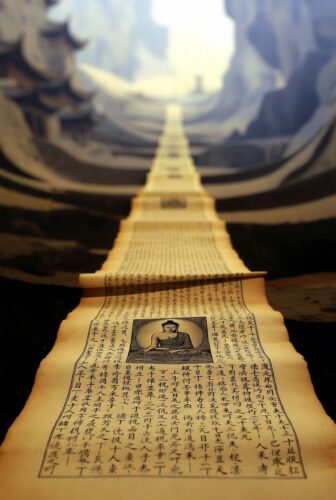 The detailed, quick, unique plan—the Diamond Carving Protocol—takes everything above and condenses it into a repeatable 7-day cycle you can run forever. It’s not a 90-day transformation slog or a paid course. It’s a self-sustaining loop designed to feel like carving and printing: intentional, repeatable, and liberated from outcome-chasing. No apps required beyond a notebook and pen (the original technology).
**Week 1 (and every week after)**:
Day 1 – Carve: Spend 10 minutes identifying and writing one “woodblock” principle. Make it concise, actionable, and non-attached (e.g., “I train my body three times this week and release the scale numbers”).
Day 2–6 – Print: Apply the principle in three specific, measurable micro-actions each day. At night, note only what you did, not how you felt about results.
Day 7 – Distribute & Seal: Freely share one insight or help derived from the week (email, conversation, anonymous note). Then file the week’s notes in your private “cave” folder or journal. Recite the four-line verse. Reset for next week’s new block.
Run this for 30 days and you’ll have 30 carved principles, hundreds of printed actions, and a growing cave of sealed wisdom. The magic? Because you practice non-attachment built into every step, motivation never crashes. Failures become bubbles. Successes become dew—beautiful but temporary. Your life becomes the living Diamond Sutra: wisdom cut into durable form, freely given, surviving every storm.
Wang Jie didn’t seek empire or immortality. He carved, inked, and released. More than a millennium later, his scroll still teaches. Do the same with your days, and your own legacy—quiet, repeatable, impermanent yet eternal—will outlast every empire you’ll ever face. Start carving tomorrow. The wood is waiting. The ink is yours. The future is already reading what you print today.
The detailed, quick, unique plan—the Diamond Carving Protocol—takes everything above and condenses it into a repeatable 7-day cycle you can run forever. It’s not a 90-day transformation slog or a paid course. It’s a self-sustaining loop designed to feel like carving and printing: intentional, repeatable, and liberated from outcome-chasing. No apps required beyond a notebook and pen (the original technology).
**Week 1 (and every week after)**:
Day 1 – Carve: Spend 10 minutes identifying and writing one “woodblock” principle. Make it concise, actionable, and non-attached (e.g., “I train my body three times this week and release the scale numbers”).
Day 2–6 – Print: Apply the principle in three specific, measurable micro-actions each day. At night, note only what you did, not how you felt about results.
Day 7 – Distribute & Seal: Freely share one insight or help derived from the week (email, conversation, anonymous note). Then file the week’s notes in your private “cave” folder or journal. Recite the four-line verse. Reset for next week’s new block.
Run this for 30 days and you’ll have 30 carved principles, hundreds of printed actions, and a growing cave of sealed wisdom. The magic? Because you practice non-attachment built into every step, motivation never crashes. Failures become bubbles. Successes become dew—beautiful but temporary. Your life becomes the living Diamond Sutra: wisdom cut into durable form, freely given, surviving every storm.
Wang Jie didn’t seek empire or immortality. He carved, inked, and released. More than a millennium later, his scroll still teaches. Do the same with your days, and your own legacy—quiet, repeatable, impermanent yet eternal—will outlast every empire you’ll ever face. Start carving tomorrow. The wood is waiting. The ink is yours. The future is already reading what you print today.