
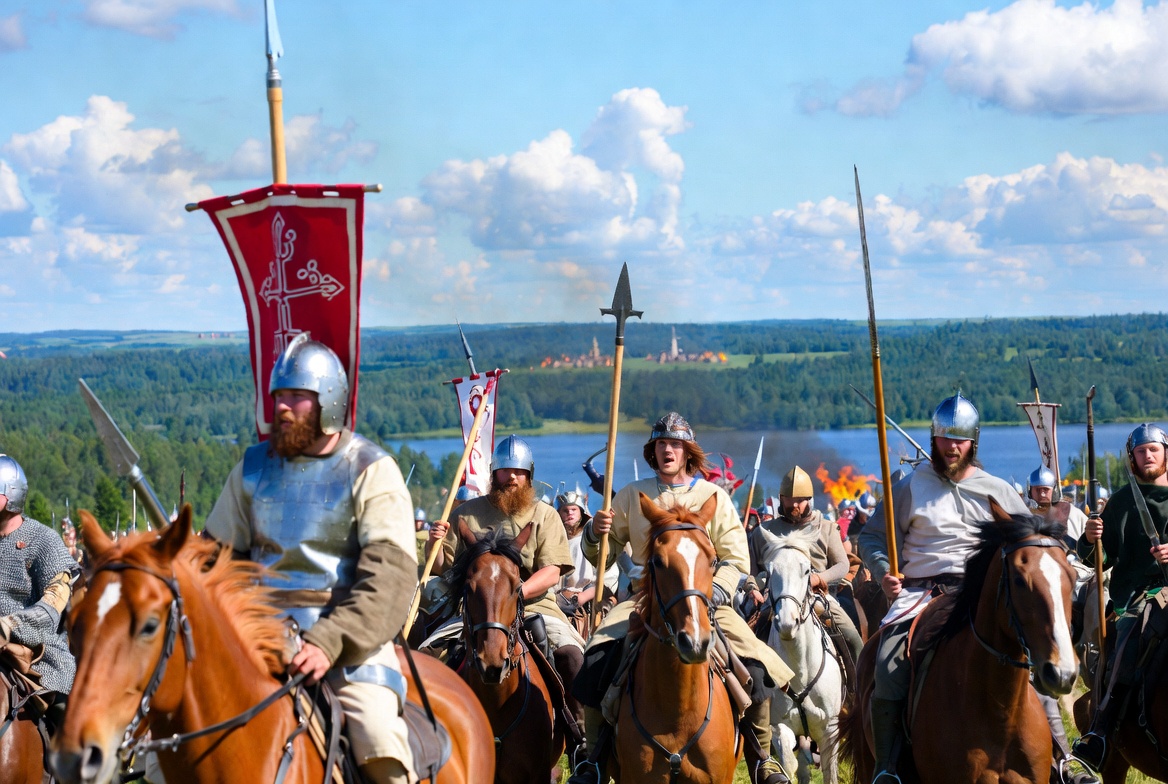
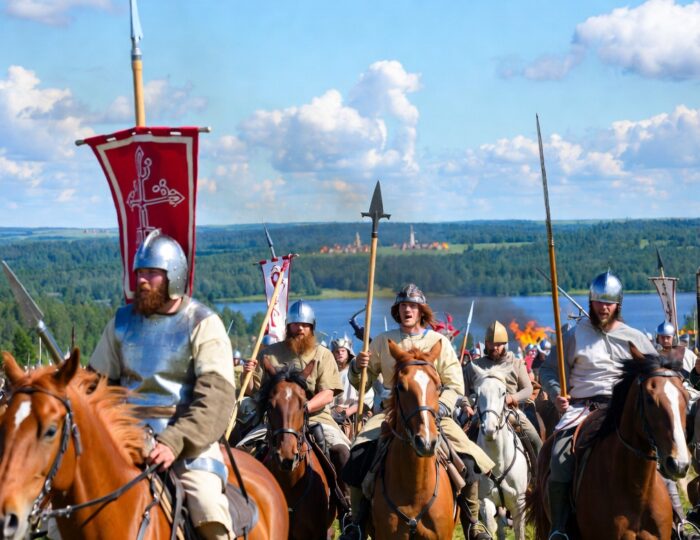
On a summer day in 1260, by the quiet waters of Durbe Lake in what is now western Latvia, one of the most lopsided military disasters of the 13th century unfolded. A massive, heavily armored Christian army — knights of the Livonian Order and their Prussian brethren, plus Danish, Swedish, and local levies — marched out expecting to crush pagan raiders. Instead, they walked into a slaughter that killed roughly 150 of their own brother-knights in a single afternoon, triggered years of regional rebellion, and set the Baltic crusades back by decades. The victors were not a rival empire or a disciplined professional force. They were Samogitian pagans — lighter, faster, fighting on home ground — aided at the decisive moment by their supposed allies, the Curonians, who abruptly turned their spears around and attacked the knights from behind.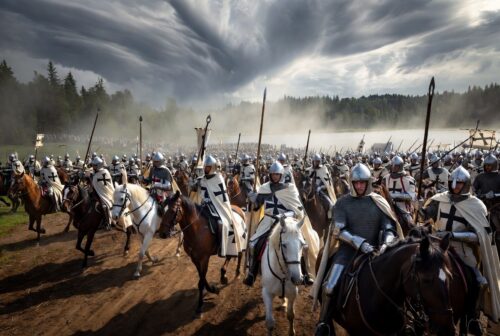
This was no glorious last stand. It was a messy, treacherous, terrain-savvy ambush of overconfidence. The Teutonic and Livonian brothers had spent years building stone castles, securing papal bulls, and hammering “barbarian” tribes into submission. On July 13 they discovered that armor, ideology, and numerical superiority mean surprisingly little when your own coalition fractures and the enemy knows exactly where to push.
The story of the Battle of Durbe deserves to be told in full because it is one of history’s cleanest demonstrations of asymmetric reversal: how a smaller, motivated force can turn an enemy’s greatest strengths into liabilities through positioning, patience, and ruthless exploitation of internal divisions. And because the lessons translate with uncomfortable clarity to anyone today who feels outmatched by “heavy” systems — entrenched habits, bureaucratic walls, financial pressure, or any opponent that looks invincible until it isn’t.
### The Baltic Crucible: Why Samogitia Mattered
By the mid-13th century the Teutonic Order had carved out a formidable state along the southern Baltic. After conquering Prussia, they looked north and east toward Livonia and the still-pagan lands of the Lithuanians. The Livonian Order, a related branch, operated from Riga and pushed into Estonia, Latvia, and the borderlands. Between their Prussian holdings and their Livonian ones sat Samogitia — a forested, river-laced region whose people stubbornly refused baptism and whose territory formed a strategic wedge preventing the two halves of the Order from linking up securely.
The Samogitians were not passive victims. They raided, burned, and killed knights when opportunities arose. In 1257 they destroyed a force near Memel. A short truce followed, but when it expired the Samogitians invaded Curonia (the coastal region of modern Latvia) and won another victory at Skuodas in 1259. That success encouraged neighboring Semigallians to rebel. The knights responded by building new forts deeper into contested territory, including Georgenburg, meant to control key routes and overawe the locals. Samogitian warbands promptly surrounded and starved the garrison, turning the new castle into a liability.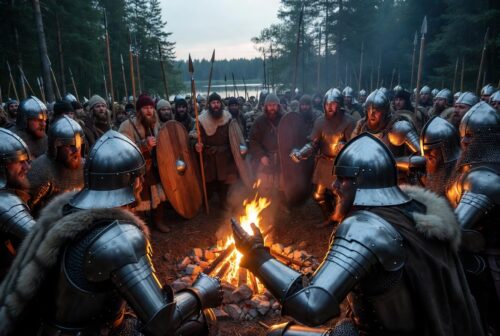
Into this simmering war stepped the combined might of both branches of the Teutonic Order. In January 1260 they secured a fresh papal bull authorizing the crusade. They gathered troops at Memel Castle: brother-knights in full plate and mail, mounted sergeants, crossbowmen, Danish and Swedish contingents, Old Prussian levies, and Curonian auxiliaries whose lands had already been “pacified.” Estimates put the total force around 8,000 men, including perhaps 150–190 brother-knights — the professional core whose training, equipment, and religious discipline made them the medieval equivalent of heavy tanks.
The Samogitians fielded perhaps 4,000. On paper the disparity looked decisive.
### The March and the Fatal Dispute
The knights’ plan was straightforward. They would relieve pressure on Georgenburg and punish the latest Samogitian incursion into Curonia. Marching inland, they learned that a substantial pagan raiding force was operating in Curonian territory. The army changed direction to intercept.
Here the first cracks appeared. The terrain near Durbe Lake and the Durbe River included wet ground, woods, and open fields — classic conditions where heavy cavalry could dominate if it could close the distance, but where lighter infantry with local knowledge could harass and withdraw. Some allied contingents, particularly the Danes, reportedly resisted orders to dismount in marshier sections, unwilling to abandon the shock power of their warhorses.
More dangerously, the Curonians in the army carried a burning grievance. Samogitian raiders had taken Curonian captives — wives, children, kin. In the war council before battle the Curonians demanded that any victory include the return of their people. The knights and other allies reportedly refused, preferring to keep the captives as war booty or slaves. The dispute was not philosophical; it was immediate and personal. The Curonians were being asked to risk their lives for an army that would not prioritize recovering their families.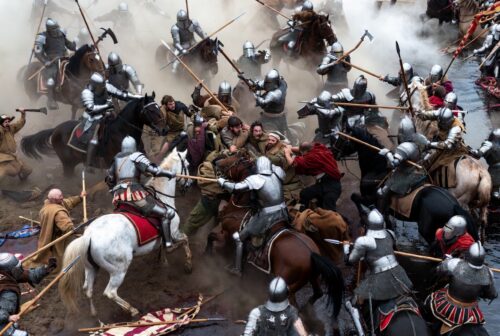
On July 13 the two forces met near the lake. The Samogitians took up a position that used the water and river as partial flank protection. The knights deployed in their usual aggressive formation, expecting their armored charge to shatter the lighter pagan line. What happened next is preserved in the Livonian Rhymed Chronicle and Peter of Dusburg’s chronicle, both written from the Christian side and therefore inclined to blame “treachery” rather than tactical failure.
As the battle opened and pressure mounted, the Curonians turned. Instead of pressing the Samogitians, they attacked the knights’ rear or simply melted away, removing a crucial part of the line. Other local levies — Estonians among them — soon followed. The professional core of brother-knights suddenly found itself surrounded or fighting on multiple fronts. In the close-quarters chaos that followed, the very weight of their equipment became a liability. Horses could be hamstrung or panicked in the press; once unhorsed, an armored man was slow to rise and vulnerable to spears and axes wielded by men who had trained for exactly this kind of fight on this kind of ground.
By the end of the day roughly 150 brother-knights lay dead, including Livonian Master Burkhard von Hornhausen and the Prussian land marshal Heinrich Botel. Total Christian losses ran into the hundreds of mounted men and many more infantry. The Samogitians suffered unknown but far lighter casualties. They collected their loot, including captured banners and equipment, and withdrew in good order back toward Samogitia. They did not linger to besiege castles or occupy territory. They had achieved their immediate objective and left the Order to deal with the political and military earthquake they had caused.
### The Aftershocks: Rebellions Ignite
News of the disaster spread rapidly. Within weeks and months the Great Prussian Uprising erupted across the Order’s Prussian territories and lasted until 1274. Semigallians, Couronians, and Oeselians launched or renewed revolts. The Curonians who had fought at Durbe largely abandoned the Christian cause; their surrender came only years later in 1267. The Livonian Order lost effective control over large stretches of territory it had spent two decades conquering. Restoring that control took roughly thirty years in Livonia and fifteen in Prussia.
The battle did not destroy the Teutonic Order — it was too wealthy, too well connected to the papacy and the Holy Roman Empire, and too militarily professional for one defeat to end it. But it exposed the limits of a conquest model that relied on a thin layer of armored brothers ruling over resentful, recently subjugated populations whose loyalty was always conditional. The “civilizing” mission had created its own fifth column.
Samogitian success also bought precious time for the broader Lithuanian polity. The region’s most powerful pagan ruler, Mindaugas, had briefly converted and accepted a crown from the pope; after Durbe the pressure eased and he (or his successors) could reconsider that alignment. Treniota, a Samogitian leader associated with the victory in later chronicles, reportedly influenced the shift back toward open resistance. The breathing room helped the Grand Duchy of Lithuania consolidate and eventually become the serious regional power that would later crush the Order at Tannenberg in 1410.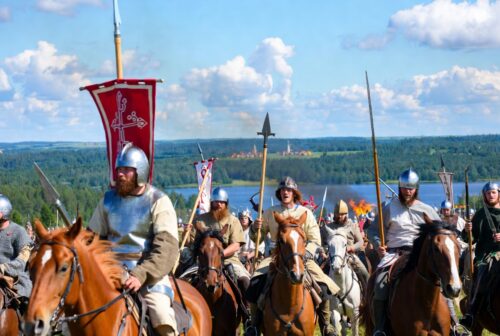
In short, a single afternoon’s fighting by a numerically inferior pagan force, aided by one timely defection, reset the strategic clock across the entire eastern Baltic for a generation.
### Why This Defeat Was So Complete
The knights were not incompetent. They were among the best-trained and best-equipped warriors in Europe. Their failure stemmed from three interlocking problems that appear again and again in history when powerful organizations overextend:
First, they treated local allies as expendable auxiliaries rather than stakeholders whose grievances had to be managed. The Curonian demand about captives was not a minor detail; it was a live loyalty test. When the knights failed it, they converted potential force multipliers into active enemies at the worst possible moment.
Second, they assumed their technological and doctrinal superiority would compensate for fighting on ground the enemy knew intimately and in a cause that did not inspire the same desperate commitment. Heavy cavalry and stone castles are magnificent tools until the war becomes a contest of raids, ambushes, and political will rather than set-piece battles.
Third, they had no effective answer to the psychological shock of seeing their own side collapse from within. Once the Curonians turned, the remaining contingents lost cohesion. Panic spread faster than any order could contain it.
The Samogitians, by contrast, fought with clear, limited objectives: punish the incursion, protect their homeland, and demonstrate that the “invincible” knights could be beaten. They positioned defensively, waited for the fracture they had helped create through prior raids, and then exploited it with speed and local knowledge. After victory they did not overreach; they withdrew with their gains intact and let the political consequences do the rest of the work.
### Applying Durbe to Life Today: The Benefits of Fighting Like the Side That Actually Wins
The historical record is clear: rigid, heavily armored, ideologically certain forces can be dismantled by lighter, more agile opponents who understand terrain, manage alliances ruthlessly, and strike when internal contradictions explode. That pattern is not limited to 1260.
A person facing any large, entrenched obstacle — chronic health constraints, financial pressure, career stagnation, toxic systems, or simply the accumulated weight of habits that no longer serve — can draw direct, practical value from Durbe’s lessons without romanticizing violence or pretending medieval warfare maps neatly onto spreadsheets.
**Specific, usable benefits include:**
– You stop treating every problem as a frontal assault that requires matching the opponent’s resources or formality. Instead you scout for fractures — divided incentives, resentments, outdated rules, or internal conflicts inside the “opposing coalition” — and prepare to exploit them.
– You learn to value and maintain relationships with the “Curonians” in your own life: the people, skills, or parts of yourself that are currently aligned with the problem but carry hidden grievances. Addressing or leveraging those grievances can flip them from drag to decisive advantage far faster than trying to overpower everything directly.
– You internalize the power of terrain and positioning. Rather than fighting every battle in the open field where heavy, formal systems have the advantage, you deliberately operate where your speed, knowledge, or unconventional tools matter most.
– You gain permission to use limited, high-impact actions (the Samogitian raid model) instead of exhausting yourself in prolonged sieges or endless grinding. One well-timed strike that exposes weakness can achieve more than months of steady pressure.
– You understand the multiplier effect of visible, morale-shifting victories. Durbe did not just kill knights; it inspired a cascade of rebellions. A single clear win against an overconfident obstacle often loosens other constraints that previously felt immovable.
– You develop strategic patience combined with ruthless opportunism. The Samogitians did not need to destroy the entire Order in one day. They needed to create a situation where the Order’s own structure punished itself. That mindset — create the conditions, then move decisively when they ripen — is far more sustainable than constant heroic effort.
### The Lake Durbe Personal Insurgency Protocol: A Quick, Unique, Anti-Generic Plan
Most self-help advice hands you heavier armor: more planners, more accountability partners, more optimization frameworks that ultimately weigh you down the same way plate mail slowed the knights in wet Baltic ground. The Durbe Protocol does the opposite. It is deliberately lightweight, map-driven, and built around identifying and triggering fractures rather than out-muscling them. It can be set up in one focused afternoon and then run on 15–30 minutes of daily action.
**Step 1: Draw the 1260 Campaign Map of Your Current Siege (30–45 minutes)**
On paper or a simple digital whiteboard, list every “force” arrayed against your goal: specific debts, health symptoms, workplace politics, internal habits, external regulations, unsupportive relationships. For each, note its apparent strength and — crucially — any visible or suspected fractures (competing incentives, internal contradictions, people within it who are unhappy, rules that are inconsistently enforced). This is your enemy coalition map. The goal is not completeness; it is to stop seeing the obstacle as a monolithic wall and start seeing it as a collection of parts that can be pried apart.
**Step 2: Identify and “Interview” Your Curonians (20 minutes)**
List the elements currently on the “other side” that carry latent grievances or divided loyalties. These might be colleagues who are also frustrated by the same bureaucracy, body signals you have been overriding, family members whose support is conditional on certain changes, or even parts of your own identity (the part that wants security versus the part that wants freedom). Write down what each would need to flip or at least stand aside. Do not judge; document incentives. This step alone often reveals leverage points you have been ignoring because you assumed everyone and everything was uniformly hostile.
**Step 3: Choose Your Durbe Lake — Your Defensible, High-Leverage Terrain (15 minutes)**
Pick one narrow area where you already have disproportionate advantage or home-field knowledge: a specific skill, a network, a time of day, a communication channel, or a creative format. This is where you will operate almost exclusively for the next phase. You are not trying to win everywhere at once. You are choosing the ground where your lighter, faster approach can actually matter and where the “heavy knights” of the problem are least comfortable.
**Step 4: Stage a Controlled Raid to Test and Provoke (ongoing, 15 minutes/day for 3–5 days)**
Design and execute one small, low-risk action that probes the mapped fractures without committing your full resources. Examples: send a precisely worded message that surfaces an inconsistency in a policy or relationship; deliberately break one minor rigid rule in a safe context to observe the reaction; publish or share one piece of work that highlights a tension the “system” prefers to ignore. The purpose is intelligence and provocation — make the opposing coalition react so its internal divisions become visible. Log what happens without emotional investment. You are gathering data on where the Curonians might actually flip.
**Step 5: Prepare the Decisive Flip Move in Advance (one 30-minute session)**
While the raids are running, design your equivalent of the moment the Curonians turned: the single action you will take the instant a fracture widens. It should be asymmetric — faster, cheaper, or more public than the opponent expects — and aimed at consolidating the exposed weakness rather than destroying everything. Write it down in concrete terms (who you will contact, what document you will submit, what boundary you will enforce, what small project you will launch). Pre-commitment removes hesitation when the window opens.
**Step 6: Execute, Fade, and Seed the Next Uprising (the strike day + 7 days follow-up)**
When the fracture appears — and it usually does once you have been probing — execute your pre-planned move cleanly and without overcommitting. Then immediately consolidate: document the win, protect the new ground, and communicate the result in a way that encourages parallel action elsewhere in your life. One visible reversal often loosens constraints in adjacent areas (the “Great Prussian Uprising” effect). Spend the following week reinforcing the gain and identifying the next, smaller target rather than launching a general offensive.
**Step 7: Institutionalize the Lightweight Rhythm (ongoing weekly ritual)**
Once a week, spend 20 minutes updating your campaign map with new intelligence and running a miniature version of steps 4–6 on a fresh micro-target. The habit prevents you from ever again treating obstacles as immovable monoliths. You become the side that travels light, knows the ground, and waits for the moment when the other side’s own weight and internal contradictions do most of the work.
This protocol is deliberately short on inspiration and long on reconnaissance and timing. It does not promise that every battle will be won or that the “Order” will disappear overnight. It promises that you will stop exhausting yourself charging uphill in full plate while the actual levers of change sit unused in the woods. The Samogitians did not need to be stronger than the Teutonic Order. They needed to be right about where and when the Order was weakest — and they needed the discipline to strike, then step back and let consequences unfold.
History’s underdogs win when they refuse to play the game the heavies have optimized for themselves. On July 13, 1260, by a lake in a land most people have never heard of, a few thousand pagans and one well-timed defection reminded the most powerful military organization in northern Europe that armor and certainty are not the same thing as security. The same reminder is available to anyone willing to map the fractures, choose better ground, and move when the moment arrives.
The knights learned it the hard way. You do not have to.
Share: