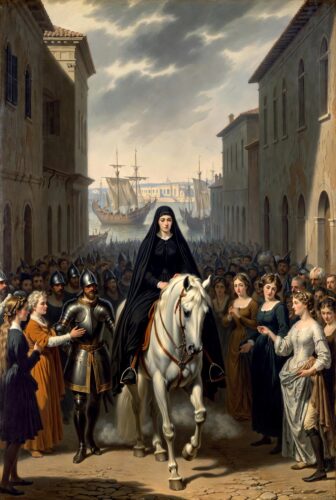

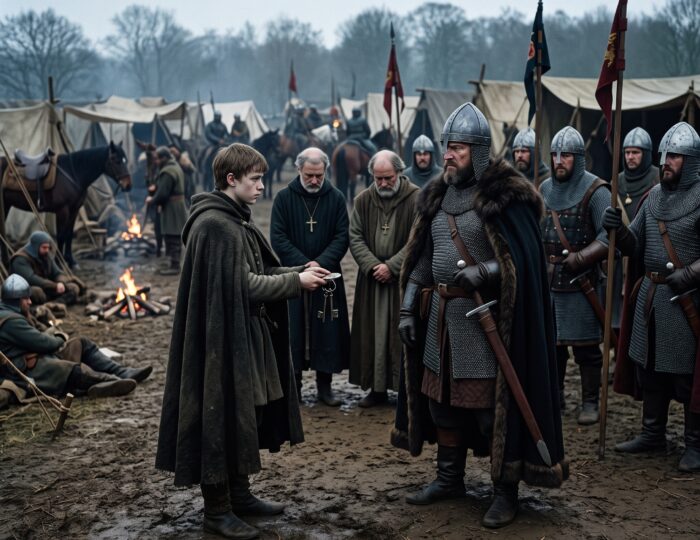
Picture London on a raw Sunday morning, 15 October 1066.
The Thames is the color of greasy pewter. A cold north wind is chewing through the narrow wattle-and-daub alleys of the city, bringing with it the reek of damp woodsmoke, tanning pits, river muck, and sweat. At the eastern gate, riders have been stumbling off lathered, trembling horses since before dawn. Their cloaks are spattered with Sussex clay, their eyes are wild and dilated with shock, and their message has just sheared the floor out from under an entire civilization.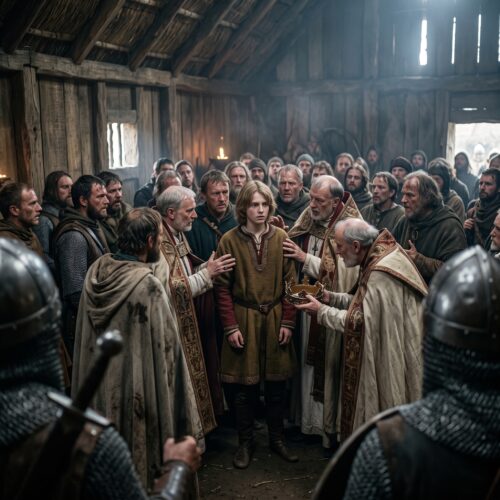
King Harold Godwinson is dead.
Not merely defeated—cut to pieces on the bloody ridge of Senlac Hill near Hastings, his brothers dead beside him, his personal housecarls hacked down to the last man around the fallen Dragon banner of Wessex. The southern shield wall, the military backbone that had held England together for generations, is gone. In the space of nine hours on Saturday, 14 October, the political leadership of an entire kingdom was wiped clean like a slate dumped in a bucket of vinegar.
And now, down by the river and inside the timber-walled halls of London, the men who hold power have to do something.
They do what trapped committees always do: they scramble, they look for a symbol, and they choose a scapegoat to wear the heaviest crown in Christendom. Before the sun has even reached its pale midday apex on 15 October 1066, the surviving members of the Witenagemot—the national council—reach out their trembling hands and lay the realm of England upon the scrawny shoulders of a bewildered fourteen-year-old boy named Edgar the Ætheling.
Edgar did not ask for this. He had not raised an army, bribed an elector, or whispered poison into the ear of a king. He was simply the last legitimate grandson of Edmund Ironside, the final living male seed of the ancient royal house of Cerdic of Wessex. And because the adults in the room had run out of ideas, courage, and coherent logistics, they handed him a burning building, closed the door behind him, and told him he was the landlord.
Most history books mention Edgar the Ætheling as a pathetic footnote—the king who was never crowned, the boy who folded before Duke William’s cavalry even breached the city walls. Modern commentators ignore him because he doesn’t fit the heroic narrative of a warrior-king.
Yet on 15 October 1066, Edgar was dropped into a specific, high-stakes human dilemma: What do you do when you are handed total responsibility for a catastrophic situation you did not create, with zero resources to fix it, while the people who put you in charge are already slipping out the side exits?
Part I: The Anatomy of a Doomed Morning
To grasp the sheer, unadulterated absurdity of 15 October 1066, you have to peel back the tidy romance of the Norman Conquest and look at the logistics of panic.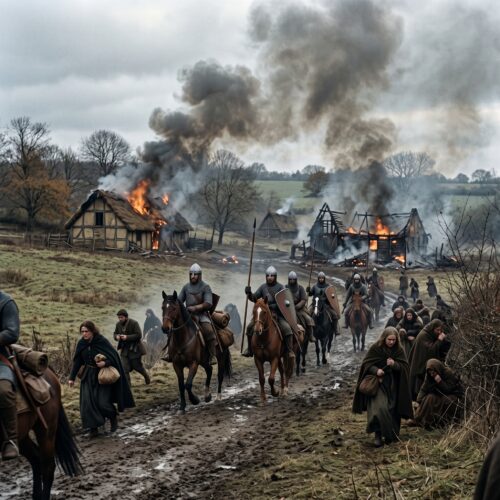
London on that Sunday morning was not an imperial stone metropolis; it was a sprawling, fortified market hub crammed inside crumbling Roman masonry. The city was overflowing with merchants, sailors, frightened monks, and the walking wounded who had survived the frantic march south. Three weeks earlier, Harold Godwinson had marched his army two hundred miles north to Stamford Bridge, smashed a massive Viking invasion under Harald Hardrada, and marched right back down the spine of England without stopping to catch his breath. His men were bone-tired, bleeding, and hollow-eyed before they ever caught sight of Duke William’s Norman archers.
When the news of Harold’s butchery arrived, the men remaining in London held a desperate emergency session of the Witan. The assembly was led by two very powerful, very calculating figures: Archbishop Ealdred of York and Archbishop Stigand of Canterbury. Sitting alongside them were the surviving northern warlords—the teenage brothers Edwin, Earl of Mercia, and Morcar, Earl of Northumbria.
Edwin and Morcar are the patron saints of showing up late to a crisis with great excuses. They had failed to arrive in time for the shield wall at Hastings. Now, standing inside London, they looked at the smoking ruins of Harold’s reign and saw an opportunity to save their own skins while pretending to care about the common good.
The council needed a king immediately to prevent London from devolving into a looting free-for-all. But nobody wanted the actual target on their back. If Edwin took the crown, William would hunt him down first. If Morcar took it, Northumbria would be left open to revolt.
So their eyes turned to Edgar.
The title Ætheling meant “throne-worthy”—a prince of the blood. Edgar had spent most of his early childhood in exile in Hungary, sheltered at the court of King Andrew I, before his father was summoned back to England only to die under mysterious circumstances within days of landing. Edgar spoke English with an exotic accent, had spent his adolescence learning Latin grammar and court etiquette, and had zero field experience in command.
He was fourteen. He had no retainers, no personal fortune, no private army of veteran huscarls, and no territory of his own. In modern corporate parlance, he was the junior analyst appointed interim CEO ten minutes after the board discovered a nine-figure accounting fraud.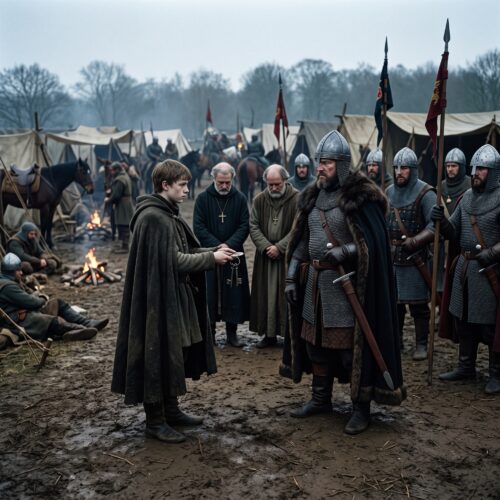
On 15 October 1066, the Witan proclaimed Edgar king.
They promised him everything. Edwin and Morcar stood before the boy, placed their hands over their hearts, and pledged their vast northern levies to defend his throne to the last drop of blood. Archbishop Ealdred promised the anointing oil and the holy blessing of the Church. The Londoners cheered in the muddy market squares, convinced that because an heir of King Alfred the Great was once again on the seat of Wessex, God would surely drop lightning bolts onto the Norman cavalry crossing Kent.
It felt noble. It sounded resolute. It was an utter, coward-ridden farce.
Part II: The Evaporation of Promises
What followed in the hours and days immediately after 15 October reveals the bitter truth of inherited responsibility.
The moment Edgar assumed the mantle, the reality of the situation came calling. Duke William of Normandy did not rush headlong into the teeth of London’s fortifications. He was far too cold a butcher for that. Instead, William led his army in a brutal, sweeping arc through Sussex, Kent, Hampshire, and Hertfordshire, methodically torching every farm, granary, mill, and village in a crescent around London.
William was not trying to scale the Roman walls; he was strangling the food supply. He was demonstrating, with terrifying clarity, that anyone who tied their fortunes to the teenage king in London was going to starve or burn before winter hit.
And how did Edgar’s sworn protectors respond?
Earls Edwin and Morcar—the men who had shouted loudest during the emergency election on 15 October—did some quick arithmetic. They realized that their estates in the north were untouched, while the south was being reduced to cinders. Deciding that dying for an exiled orphan was terrible career planning, they gathered their housecarls and quietly marched out of London, heading north toward the Trent River, leaving the boy king with empty promises and a city full of panicking civilians.
Next went Archbishop Stigand. The man of God slipped through the western gates, rode straight to William’s camp at Wallingford, knelt in the mud, and kissed the hand of the Norman invader.
By late November, Edgar was sitting in London surrounded by a handful of priests and frightened townsfolk. The grand national coalition had evaporated in under six weeks. He was nominally the ruler of England, but he could not even guarantee the delivery of flour to the bakeries across the street.
Part III: The Walk to Berkhamsted
Here is where the true historical weight of Edgar’s story pivots away from farce and into something deeply instructive.
Most teenage boys, puffed up with the vanity of sudden kingship and fed on tales of ancestral glory, would have done one of two predictably disastrous things. They would have thrown a petulant tantrum and locked themselves in a tower, or they would have demanded a suicidal, glory-hound last stand, leading three hundred baker’s apprentices and elderly monks into an open field against Norman heavy cavalry to be slaughtered for the sake of poetry.
Edgar chose neither.
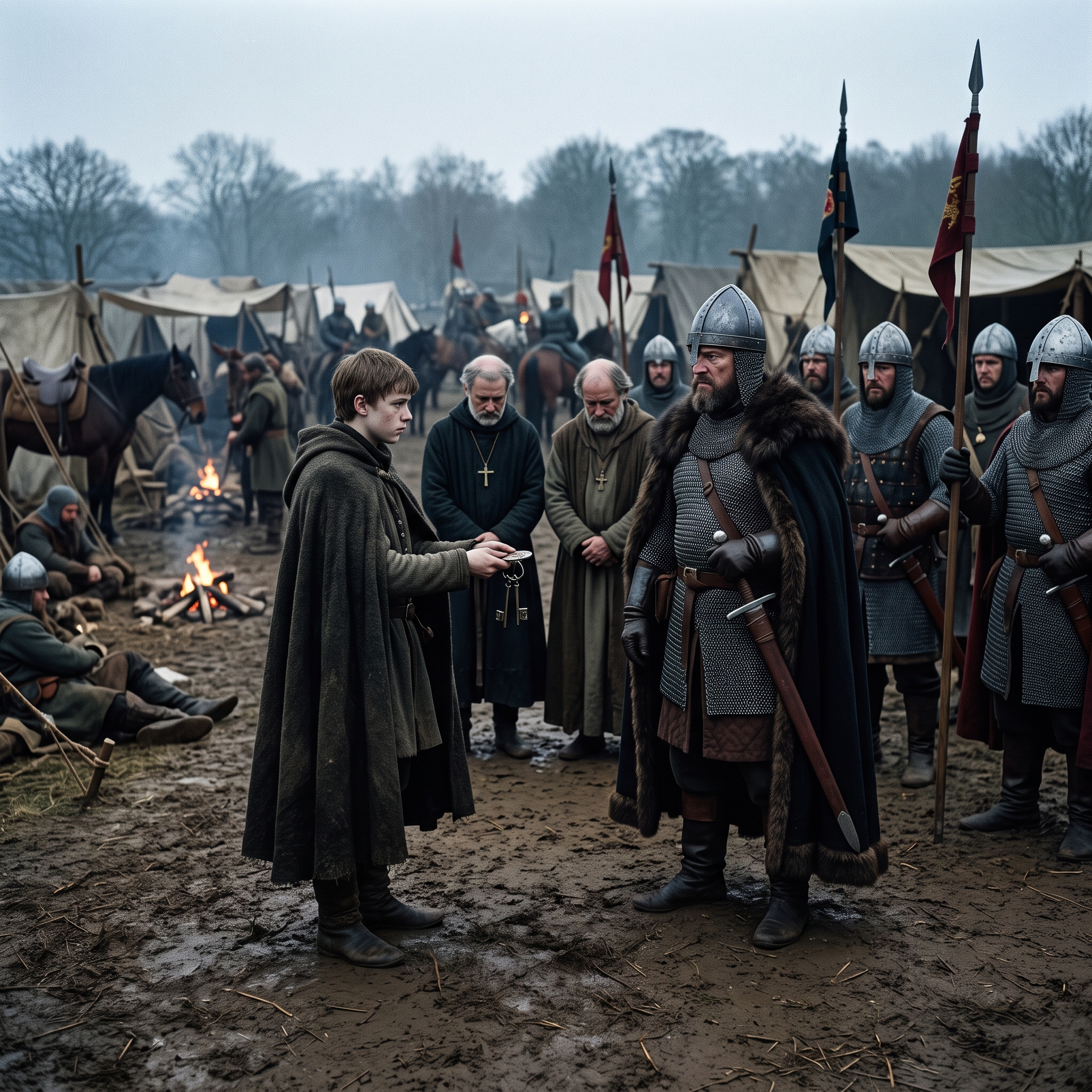
In early December 1066, at Berkhamsted in Hertfordshire, Duke William was resting his cavalry, preparing the final assault on London. The scouts brought word that a small party was approaching from the city. It was not an army. It was Edgar the Ætheling, accompanied by Archbishop Ealdred and the few remaining elders of London.
Edgar walked into the Conqueror’s camp. He looked William in the eye, handed over the keys, laid down his claim, and gave hostages.
He was not crowned. He did not get an epic final monologue. He surrendered an office that was never real in the first place.
And by doing so, Edgar the Ætheling did something almost unheard of for deposed Saxon royalty in the eleventh century: he survived.
Not just for a week or a month. While Harold’s brothers rotted in unmarked pits, while Edwin and Morcar were eventually betrayed and hunted down like wild hogs by Norman mercenaries, and while hundreds of arrogant Saxon thegns had their heads mounted on pikes, Edgar lived.
He lived to lead rebellions in Northumbria. He escaped to Scotland, married his sister Margaret to King Malcolm III (ensuring the blood of Wessex would flow into every British monarch right down to the modern era), rode on crusade to Antioch, became a respected diplomat between Norman kings and Scottish lords, and lived well into his seventies, dying peacefully in bed around the year 1126.
Edgar’s profound, quiet victory began on that insane morning of 15 October 1066. He recognized, with instinctive brilliance, the difference between the role he was handed and the reality on the ground. He accepted the title when he had no choice, refused to internalize the doomed vanity of the men who shoved him onto the platform, and abandoned the burning wreckage the exact second it became clear that defending it was suicide.
Part IV: The Modern Trap of the “October 15th Promotion”
Now let us step out of the muddy lanes of eleventh-century London and look at the wreckage of modern life.
Almost every capable, conscientious human being will eventually face their own personal 15 October 1066.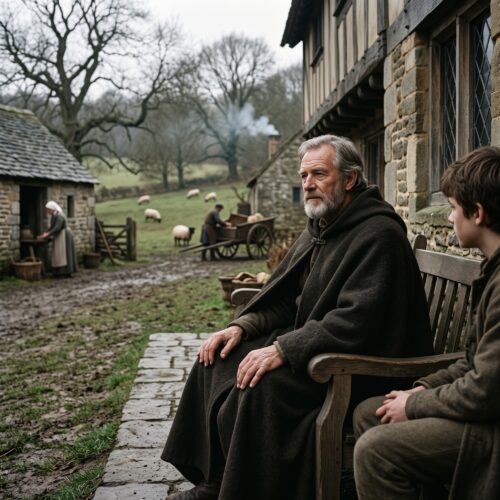
It does not arrive with galloping horses or severed heads, but the underlying mechanics are identical. It happens when:
- A company restructures, your manager quits without warning, and leadership cheerfully hands you the title of “Lead Project Coordinator” on an initiative that is six months behind schedule, eight hundred thousand dollars over budget, and fundamentally broken from day one.
- A toxic family dynamic finally implodes, everyone scatters to their respective corners, and you are quietly nominated to organize the care, settle the debts, mediate the generational feuds, and host Thanksgiving dinner as if nothing happened.
- You step into a relationship or creative partnership where the other party is already sinking beneath emotional or operational debt, and they look at you with wide, desperate eyes and say, “Only you can fix this.”
Online self-help culture has poisoned our brains about these moments. Every motivational podcast, morning-routine guru, and pastel-colored infographic tells you the same relentless lie:
“Never quit! Lean in! Own the room! If they gave you the responsibility, it’s because you were meant to conquer it! Double down, wake up at 4:30 AM, drink cold brew, manifest resilience, and turn this disaster into your personal triumph!”
That is not wisdom. That is the exact advice Earls Edwin and Morcar gave to Edgar before they sneaked out the gate and left him to face the Norman army alone.
When you accept total emotional and operational ownership of an inherited catastrophe, you are not acting like a hero. You are acting like a biological firewall designed to burn so the architects of the disaster can walk away unblemished.
The lesson of 15 October 1066 is brutally simple: Never bleed for an empire that was already dead before they handed you the paperwork.
Part V: The Edgar Audit: How to Dissect an Inherited Disaster
Before you spend one more ounce of adrenaline, pride, or sleep trying to save a situation that is already sliding into the sea, apply this ruthless historical analysis to your circumstances.
- Examine the Origin of Your “Crown”: Did you build this responsibility through deliberate effort, or was it dumped on your desk during an emergency because the people with more seniority were terrified of the fallout? If nobody else wanted the job, it is not an honor; it is an evacuation shield.
- Identify the Real “Edwin and Morcars”: Who cheered your promotion or celebrated your willingness to step up, but suddenly has conflicting meetings whenever actual grunt work is required? Notice who made the grand promises during the emergency session and track their physical presence today.
- Measure the Garrison Against the Horizon: Stop looking at your title and look at your actual supply train. Do you have direct authority over budget, staffing, and final sign-off? Or do you have the “responsibility” to deliver results without the executive authority to enforce the decisions required to achieve them? If responsibility outstrips authority by more than 20%, you are not a leader; you are a hostage.
- Locate the Norman Vanguard: Where is the unavoidable reality that no amount of positive thinking can alter? Is the client contract expiring? Is the partner fundamentally unwilling to change? Is the market shifting away from your product? Name the hard physical boundary that enthusiasm cannot dissolve.
- Separate Your Identity from the Seat: Edgar was an Ætheling before London named him king, and he was an Ætheling after he handed the crown to William. His intrinsic worth was never tied to the broken wooden throne of a ruined city. What part of your self-worth have you mistakenly attached to holding together a failing enterprise?
Part VI: The Sovereign Pivot Protocol (A Unique Strategic Plan)
Most productivity and self-help regimens focus on optimization—how to do more, endure more, squeeze another drop of output from a drained system.
The Sovereign Pivot Protocol operates on the inverse principle: Strategic De-escalation and Sovereign Preservation. It is designed to extract your sanity, career, and resources from a doomed mandate without burning your reputation or committing professional self-immolation.
Phase 1: The Silent Reconnaissance (Days 1–3)
Do not announce that you are pulling back. Do not deliver an emotional ultimatum. Panicked people panic harder when they smell an exit.
- The Obligation Audit: Write down every single responsibility you currently carry in the project or relationship. Beside each item, write who originally generated the deficit. If your name is not on the original error, flag it.
- The Authority Gap Index: For every task flagged, ask: “Can I unilaterally fire, cancel, or reallocate the resources needed to solve this?” If the answer is no, this task is an inherited illusion.
- The Paper Trail Pivot: Cease all verbal assurances. Shift every status update, promise, and risk assessment to clear, objective written form. Do not say, “We’re working hard to make the deadline!” Say, “Based on current resource allocations and missing inputs from Team X, the projected completion date is physically unachievable. Here are the two deliverables that can be met.”
Phase 2: The Tactical Wall-Down (Days 4–7)
Stop doing the work of absent allies. When you cushion the fall of others, you delay the reality check that forces them to act.
- Drop the Unfunded Mandates: Stop working overtime to compensate for other people’s structural failures. Let the deadline that was mathematically impossible from the start miss its mark cleanly and visibly.
- The Neutral Mirror Response: When pressured by stakeholders or family members to “just pull off a miracle,” deploy flat, unemotional clarity: “I can execute Plan A with existing resources, or Plan B if additional budget is provided by Friday. Which do you choose?” Do not offer yourself as the bridge between those options.
- Build Your Berkhamsted Terms: Define your non-negotiables for stepping away or redefining the role. What is your minimum acceptable condition for remaining engaged? Write it down before the crisis peaks.
Phase 3: The Sovereign Surrender (Days 8–10)
Surrender in history is rarely about defeat; it is about ending an unprofitable conflict on terms that allow you to fight another day.
- Step Off the Platform Without Apology: Deliver your terms or your resignation from the task with complete emotional neutrality. No grievance airings, no blaming, no manifestos. Simply: “The current structure cannot support the desired outcome. Effective [Date], I am stepping down from managing this initiative to focus on [Priority Area].”
- Redirect the Burden to the Sponsoring Body: Hand the problem directly back to the people who created it or who possess actual systemic authority to fix it. Do not recommend band-aids. Leave the vacancy visible.
- Secure Your Scottish Border: Redirect all energy that was previously consumed by managing the disaster toward your long-term, compounding assets: your primary skills, your health, your real relationships, and your financial reserves.
The Mud Cleans Off
When Edgar the Ætheling rode away from Berkhamsted in the biting cold of December 1066, he must have looked like the biggest loser in the British Isles. The chroniclers called him Edgar cild—Edgar the Child. He had worn the grandest crown in northern Europe for less than two months, and he walked away with nothing but his horse, his cloak, and his pulse.
Yet six decades later, while the proud Norman barons who had laughed at him were rotting in church vaults or being executed for treason against their own ruthless king, an old man sat in a quiet manor house in the English countryside, listening to the rain tap against the glass, enjoying a warm meal in peace.
Edgar understood what the ambitious idiots around him never learned: A crown that costs your life is just an ornate noose.
Tomorrow morning, when the world tries to hand you a crisis wrapped in flattering words and urgent emergencies, remember 15 October 1066. Look at the burning horizon, look at the men offering you the job, and remember that sometimes the most revolutionary, life-altering, victorious move you can ever make is to set the crown back on the table, walk out of the smoky hall, and let the dead things bury themselves.
Share: