
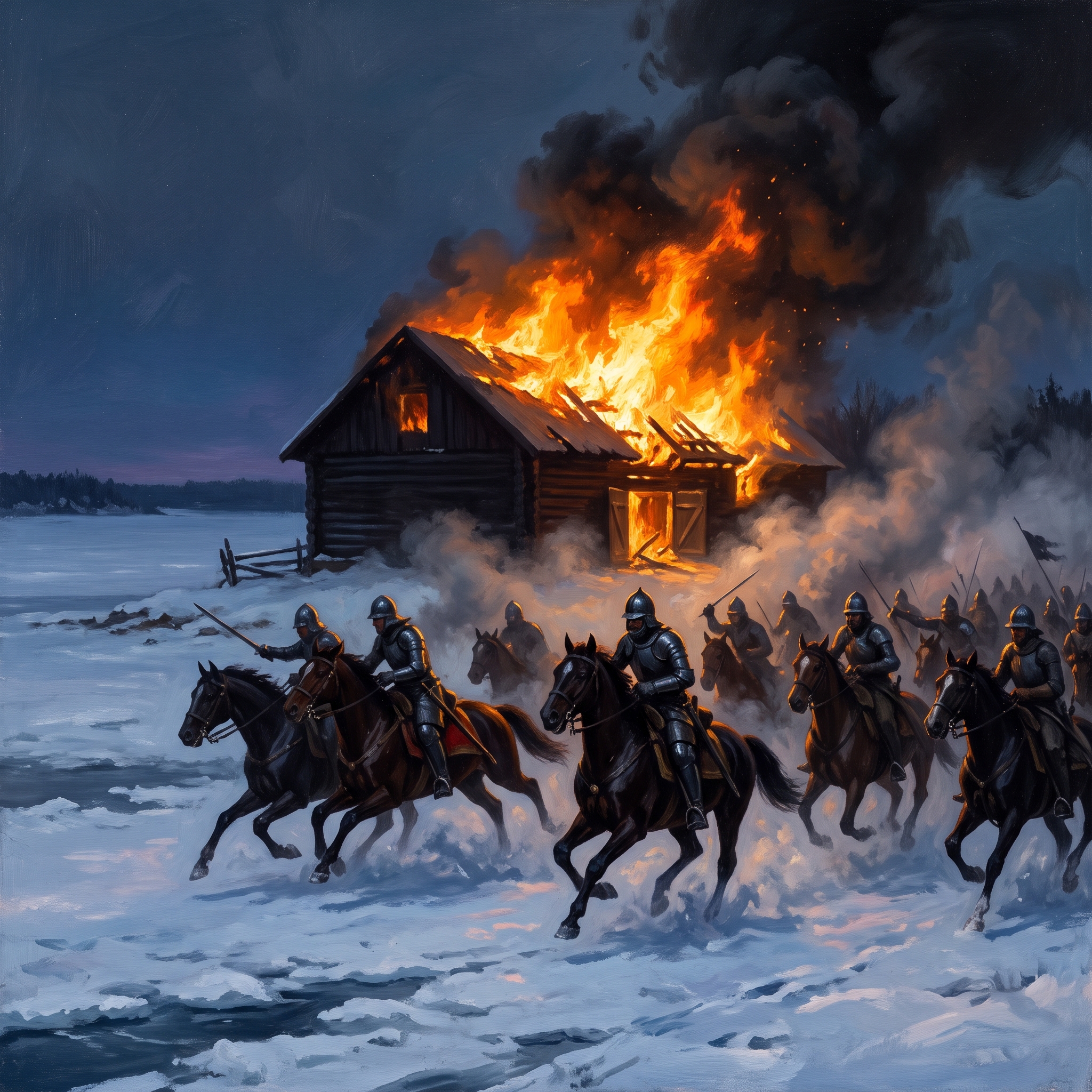
Act I: The Churchyard Riot on St. Catherine’s Day
Picture the scene in the parish of Isokyrö, deep in the flat, wind-whipped agricultural plains of South Ostrobothnia, Finland, on the morning of November 25, 1596. In the late sixteenth century, Finland was not an independent nation; it was the eastern half of the Kingdom of Sweden, functioning largely as a frosty buffer zone, a recruitment pool, and an agricultural pantry for Stockholm’s imperial ambitions. November 25 was the Feast of St. Catherine of Alexandria, a rare bright spot on the bleak Nordic calendar when farmers, merchants, blacksmiths, and local yeomen tramped across frozen mud and early snow to gather at the stone parish church. Ordinarily, St. Catherine’s Day was meant for liturgical solemnity, catching up on regional gossip, and checking the price of butter and salted fish before the Baltic Sea froze solid for the winter.
Instead, the churchyard at Isokyrö turned into the ignition point for the bloodiest, strangest, and most tragically misunderstood peasant uprising in Northern European history: the Cudgel War—known in Finnish as Nuijasota and in Swedish as Klubbekriget.
To understand why hundreds of normally stoic, law-abiding Finnish farmers decided on November 25, 1596, that the most rational course of action was to grab heavy wooden clubs studded with iron spikes, beat a local tax-collecting bailiff to death, and march south with the explicit intention of tearing down Åbo Castle with their bare teeth, you have to understand the absolute masterclass in bureaucratic extortion they had endured for the previous quarter-century.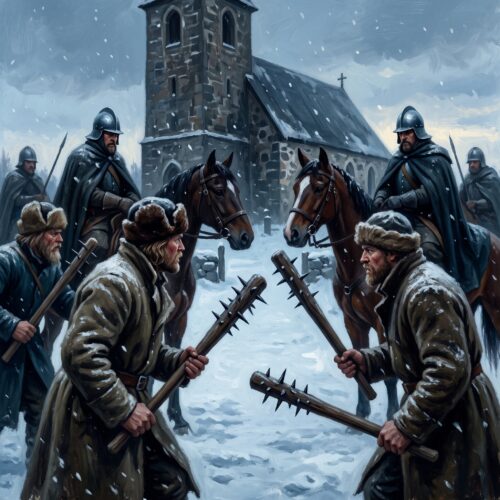
For twenty-five agonizing years, from 1570 to 1595, the Swedish Crown had been locked in a grinding, miserable war against the Tsardom of Russia. Because Finland sat directly on the eastern frontier, Finnish farmers bore the brunt of everything: conscription, scorched-earth border raids, requisitions of grain, and the loss of livestock. Worse still, the cash-strapped Swedish monarchy had invented a tax system so abusive it practically guaranteed a riot. It was called linnaleiri—literally “Castle Camp”. Rather than paying its soldiers out of a central treasury in Stockholm, the Crown granted cavalrymen and infantry detachments the right to billet themselves directly inside private peasant farmhouses and collect their wages straight from the farmers’ pantries.
Imagine having three heavily armed, perpetually bored, chronically underpaid mercenaries move into your living room for the winter, eat your seed grain, slaughter your milk cow, drink your beer, insult your family, and demand silver coins on top of it—all while calling it “national defense.” If a farmer protested, the soldiers beat him. If he hid his grain, they burned his barn.
Finally, in May 1595, Sweden and Russia signed the Treaty of Teusina. The twenty-five-year war was officially over. Across Finland, exhausted farmers breathed a collective sigh of relief, assuming the mercenaries would finally pack up their halberds, vacate the spare bedrooms, and go home.
They did not go home.
Act II: The Two-Headed Royal Soap Opera
The reason the soldiers stayed parked in Finnish farmhouses after the war ended had nothing to do with Russia and everything to do with a dynastic family feud that belonged on a sixteenth-century soap opera.
At the top of the Swedish pyramid sat King Sigismund Vasa. Through a series of royal marriages and religious conversions, Sigismund was simultaneously the Catholic King of the Polish-Lithuanian Commonwealth and the hereditary King of staunchly Lutheran Sweden. Because Poland was richer, warmer, and slightly less obsessed with herring, Sigismund preferred to rule Sweden remotely from Warsaw and Kraków.
Back in Stockholm, Sigismund’s ambitious, fiercely Protestant uncle, Duke Charles of Södermanland (the future King Charles IX), was acting as regent. Charles wanted the Swedish throne for himself, and he spent the mid-1590s positioning himself as the champion of Lutheran orthodoxy and the humble protector of the common Scandinavian yeoman against distant, popish tyranny.
Standing directly between Duke Charles and total control of the realm was the Governor and Lord High Admiral of Finland: Clas Eriksson Fleming.
If you were casting a sixteenth-century villain, you would take one look at Clas Fleming and stop auditioning. Born into the high Swedish-Finnish nobility around 1535, Fleming was a battle-hardened naval commander, a devout royalist fiercely loyal to King Sigismund, and a man whose empathy for the peasantry could comfortably fit inside a thimble. Fleming knew perfectly well that Duke Charles was plotting to usurp Sigismund’s crown. Therefore, Fleming refused to disband his private army in Finland, keeping thousands of hardened cavalrymen and foot soldiers mobilized—and continuing the hated linnaleiri billeting tax—so he would have an instant strike force ready to defend King Sigismund’s interests.
To make matters worse, the mid-1590s coincided with one of the sharpest cold snaps of the Little Ice Age. Crop after crop failed across northern Europe. In Ostrobothnia, frost killed the barley in August, leaving families grinding pine bark into flour just to keep their stomachs from digesting themselves. Meanwhile, Fleming’s soldiers rode from farm to farm, seizing whatever scraps of rye and livestock remained. When Fleming got into a political spat with Duke Charles, he slapped a trade embargo on shipping across the Gulf of Bothnia, choking off the exact coastal cattle and butter trade that wealthier Ostrobothnian farmers relied on to survive.
Desperate, starving, and furious, delegations of Finnish peasants risked freezing to death on winter sea crossings to travel to Stockholm and beg Duke Charles for relief.
Duke Charles received them with theatrical warmth, listened to their tales of woe, and delivered one of the most cynically irresponsible pieces of political advice in history. He told the Finnish delegates that he could not send troops to rescue them right now, so they ought to handle their own problems—specifically advising them that if Fleming’s soldiers came to steal their property, they were so numerous they could easily drive the troopers away with “fence posts and clubs”.
To Duke Charles, this was a cheap, zero-risk rhetorical flourish designed to destabilize Clas Fleming’s rear flank in Finland while Charles consolidated power in Sweden. To the starving men of Ostrobothnia, those words sounded like an official royal commission from the Regent of Sweden.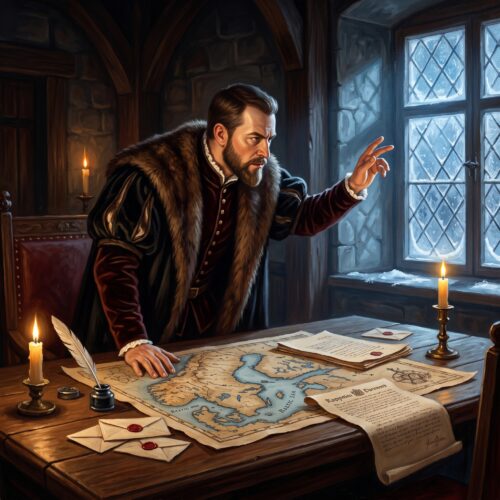
Act III: Enter the Wealthy Horse-Trader with a Grudge
On November 25, 1596, inside and around the churchyard of Isokyrö, the powder keg finally blew.
A detachment of Fleming’s soldiers—specifically the dreaded huovit, mounted men-at-arms and bailiffs—arrived to enforce linnaleiri collections. The gathered farmers flatly refused to pay another copper coin or surrender another bushel of oats. Words turned to shoving; shoving turned to a full-scale brawl. When the dust settled in the snow, a royal bailiff lay dead, and the farmers of Isokyrö, Ilmajoki, and Lapua realized there was no going back. You do not kill a Crown officer in 1596 and simply return to milking your goats on Monday morning.
Within days, the rebellion exploded across Ostrobothnia. And despite the romantic nineteenth-century myth that the Cudgel War was led by dirt-poor serfs in tattered rags, the man chosen to command the peasant army was actually a sharp-witted, prosperous yeoman merchant and former cavalryman named Jaakko Ilkka.
Ilkka was a fascinating figure. Owning a substantial farmstead in Ilmajoki, he had previously served in the Swedish cavalry—meaning he actually understood military discipline, unlike most of his followers—and had built a lucrative side business shipping live cattle across the sea to Stockholm so the Swedish capital could enjoy fresh beef. Clas Fleming’s trade embargo and punitive taxes had hit Ilkka right in the ledger book, and Fleming had even thrown Ilkka into prison at Åbo Castle earlier that year, from which Ilkka had audaciously escaped.
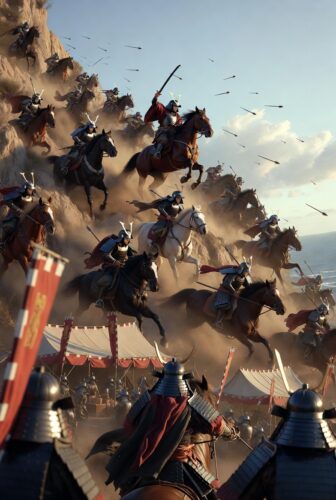
Under Jaakko Ilkka’s leadership, the farmers did not just grab random sticks off the forest floor. They engineered specialized anti-armor weapons. Knowing that Fleming’s cavalry wore steel breastplates and iron helmets that deflected cheap farming knives, Finnish blacksmiths and carpenters crafted heavy birch and oak cudgels fitted with jagged iron spikes, reinforced bands, and hooked blades—brutal, kinetic can-openers designed to crush plate armor and yank horsemen out of their saddles. Alongside these spiked clubs, the rebels carried hunting crossbows, axes, boar spears, a handful of matchlock muskets, and even two small cannons they managed to capture.
Their strategic plan was simple, bold, and wildly optimistic: march south in three converging columns toward Turku (Åbo), storm Åbo Castle, capture Clas Fleming, and hold southern Finland until Duke Charles arrived with the regular Swedish army to reward them. As they marched, the rebels looted the manor houses of Fleming’s noble allies, burned estate records, and—in a touch of dark Nordic engineering—sawed halfway through the roof rafters of absent landlords’ homes so the ceilings would collapse on their heads the moment they returned.
At first, momentum was entirely on the rebels’ side. Local garrisons were caught completely off guard. In one early skirmish, peasant fighters ambushed a squad of Fleming’s troopers, marched them onto a frozen river, chopped holes in the ice, and shoved the soldiers underneath with pikes while village women stood by with wooden buckets and pails to club anyone who tried to surface for air. By mid-December 1596, Ilkka’s main column had pushed deep into southwestern Finland, seizing the sprawling Nokia Manor—located in the exact town that would, four centuries later, give its name to indestructible rubber boots and even more indestructible brick-shaped cell phones.
Act IV: The Frostbitten Collapse at Nokia and Santavuori
If the story ended at Nokia Manor in December 1596, Jaakko Ilkka would be remembered as a Nordic George Washington. Instead, what happened next is a textbook case study in why amateurs fighting on borrowed promises rarely beat professionals fighting for their own survival.
Clas Fleming was no fool. While the peasants celebrated inside Nokia Manor—drinking the absentee landlord’s wine and roasting his livestock—Fleming quietly mobilized his veteran armored cavalry and marched north from Turku through the freezing snow. On December 31, 1596, Fleming’s forces arrived at the ice-bound shore of Lake Pyhäjärvi, right across from the rebel encampment.
Fleming tested the peasant lines with a probing cavalry charge and a blast of artillery, quickly realizing that several thousand desperate men armed with spiked clubs behind barricades would inflict heavy casualties in a frontal assault. So Fleming switched from iron to silver-tongued psychology.
He sent envoys across the frozen lake under a flag of truce with a remarkably simple offer: he promised complete amnesty and safe passage home to every single peasant in the camp, provided they handed over Jaakko Ilkka and the other ringleaders.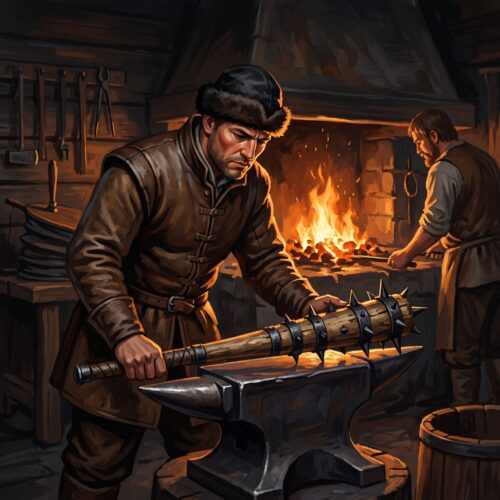
Inside Nokia Manor, the peasant army’s unity evaporated faster than spilled schnapps on a hot sauna stove. Exhausted, freezing, out of rations, and abruptly realizing that Duke Charles’s promised Swedish reinforcements were nowhere on the horizon, groups of farmers began openly debating whether trading Jaakko Ilkka’s neck for their own lives was actually a pretty solid bargain.
Jaakko Ilkka had plenty of flaws, but a lack of situational awareness was not one of them. Overhearing his own troops negotiating the terms of his surrender, Ilkka quietly walked out to the stables in the dead of night, swung onto a fast horse, and vanished into the Finnish wilderness.
When dawn broke on New Year’s Day, 1597, the peasant army discovered their commander had bolted. Panic rippled through the ranks. In the chaotic scramble to pack up and retreat, someone knocked over a lantern or a cooking fire, setting the manor’s massive hay barn ablaze. Seeing the flames and realizing the peasant camp had dissolved into a leaderless mob, Clas Fleming immediately tore up his truce offer and unleashed his heavy cavalry.
What followed was not a battle; it was a slaughter. Fleming’s armored horsemen rode down fleeing farmers across miles of snow-drifted forest trails, cutting down hundreds from behind. Jaakko Ilkka was hunted down at his family farm in Ilmajoki a few weeks later and executed on January 27, 1597, alongside five other rebel commanders—his body broken on the wheel and displayed as a grim warning along the road.
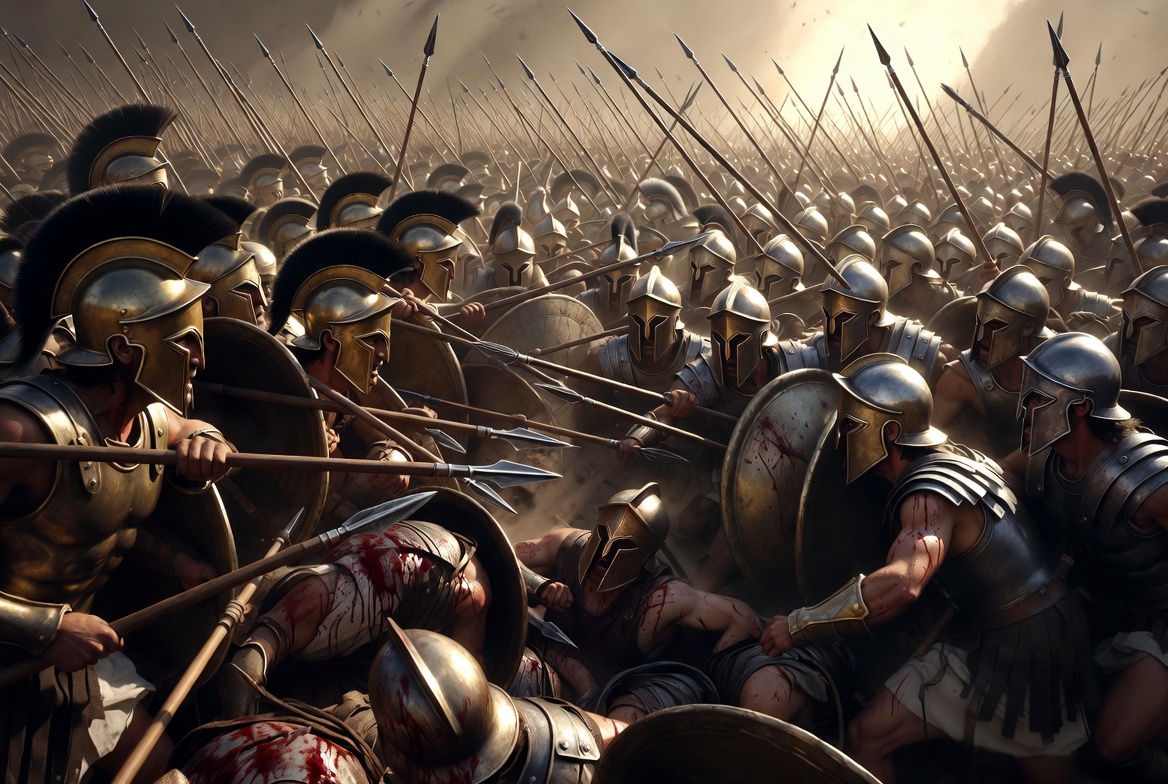
The uprising sputtered on in eastern and central Finland for another month, marked by horrific atrocities on both sides. At Padasjoki, loyalist troops surrounded four hundred peasants inside a church, persuaded them to surrender their weapons in exchange for their lives, and immediately massacred every last one of them. Elsewhere, soldiers tied captured farmers together in bundles of twelve and pushed them beneath the river ice. The final curtain fell on February 24, 1597, at the Battle of Santavuori, where a second wave of poorly organized Ostrobothnian rebels was annihilated in the snow by Fleming’s disciplined infantry and cavalry, leaving over a thousand peasants dead on the field.
In total, roughly 3,000 Finnish peasants perished during the three-month winter war. Out of a total Finnish population of barely 200,000 people, that was the demographic equivalent of the modern United States losing nearly five million citizens in ninety days.
Act V: The Ultimate Insult at Åbo Castle
Here is the kicker that turns the Cudgel War from a regional tragedy into an eternal masterpiece of historical irony.
Clas Fleming barely lived long enough to enjoy his victory. Less than two months after crushing the rebels at Santavuori, while traveling across southern Finland in April 1597, the iron-fisted governor suddenly fell ill and died—rumored by delighted locals to have been poisoned or simply struck down by divine indigestion.
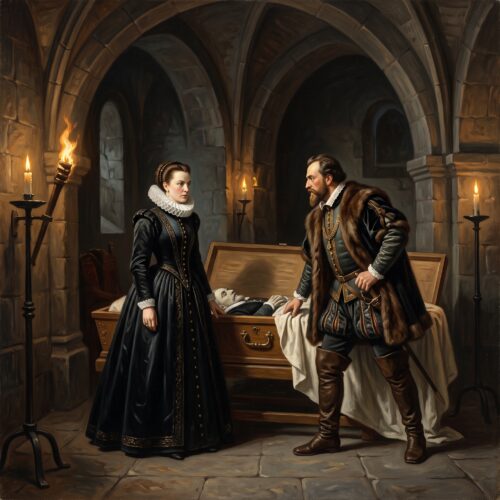
A few months later, in the autumn of 1597, Duke Charles finally sailed across the Baltic Sea with the Swedish army he had refused to send when the peasants actually needed him. Charles besieged Åbo Castle, forced Fleming’s widow, Lady Ebba Stenbock, to surrender the fortress, and marched inside to inspect the corpse of his dead rival, which was still lying in state in a coffin in the castle chapel.
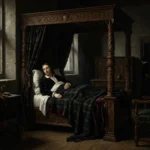
According to famous historical tradition immortalized in Albert Edelfelt’s 1878 painting, Duke Charles pried open the coffin lid, grabbed the dead Clas Fleming by his beard, gave it a petty yank, and sneered, “Hadst thou now been alive, thy head would not have been in great safety”.
Without flinching, Lady Ebba Stenbock looked the future King of Sweden dead in the eye and delivered one of the coldest comebacks in European history: “If my late husband had been alive, Your Grace would never have entered herein”.
Duke Charles eventually overthrew his nephew Sigismund, crowned himself King Charles IX of Sweden, and ruled the empire from Stockholm. And what happened to the surviving Finnish peasants whose spiked clubs and frozen corpses had softened up Finland for Charles’s takeover?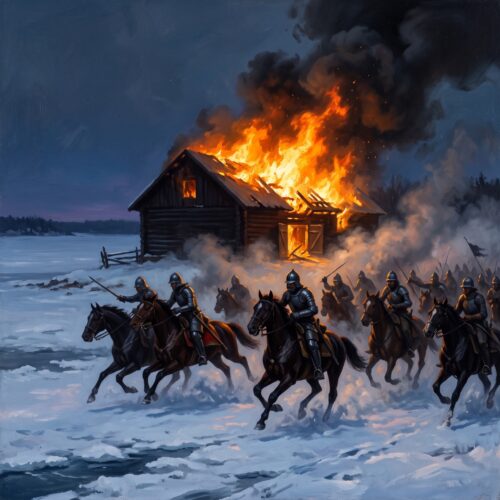
Almost nothing. Aside from returning a few confiscated farms to prominent families like Jaakko Ilkka’s heirs, King Charles IX kept the taxes high, kept the military conscription rolling to fund his new wars in Poland and Russia, and largely forgot the people he had once urged to grab fence posts and clubs. The peasants had bled out in the snow to win a throne for a man who viewed them as expendable chess pieces.
How to Apply the Cudgel War to Your Life Today: The Anti-Proxy Protocol
Most self-help advice on the internet treats you like a fragile houseplant that needs morning affirmations, a gratitude journal, and a color-coded Notion dashboard to survive a Tuesday. It assumes your biggest problem is a lack of “hustle” or “morning routine optimization.”
The Cudgel War of November 25, 1596, diagnoses a far more dangerous—and far more common—modern disease: fighting someone else’s proxy war with a wooden stick.
Every single day, modern humans exhaust their nervous systems, torch their savings, ruin their relationships, and burn out at their jobs because a distant “Duke Charles”—a manipulative boss, a rage-baiting algorithm, a toxic friend group, a status-obsessed culture, or a flashy financial guru—whispered in their ear that they should grab a spiked club and charge an armored cavalry line on their behalf. Meanwhile, the person who wound you up is sitting comfortably across the sea in Stockholm, risking zero skin in the game.
To stop being an expendable foot soldier in battles you didn’t start and won’t profit from, run your current stress, ambitions, and conflicts through The 1596 Anti-Proxy Protocol:
-
Run the “Stockholm Skin-in-the-Game” Audit: Before you lose sleep over an urgent workplace crisis, a heated online argument, or a family drama someone else instigated, ask one cold question: Where is the person who urged me to fight this? If your manager, a political pundit, or an acquaintance is encouraging you to take all the social, financial, or emotional risk while they stay safely insulated from the fallout, drop the club immediately. Never charge armored cavalry for someone who won’t even cross the lake to stand beside you.
-
Outlaw Linnaleiri (Mental Billeting): In 1596, Finnish farmers went broke because they allowed mercenary soldiers to live rent-free in their houses after the war was already over. Look at the grudges, past embarrassments, expired obligations, and doomscrolling habits currently camped out in your living room. If a conflict ended months or years ago, evict the soldiers. Stop paying daily emotional taxes to wars that already signed a peace treaty.
-
Inspect Your Weapon Before You Charge: The Ostrobothnian rebels brought iron-spiked birch clubs to a battle against heavy cavalry, matchlock muskets, and professional artillery—and mistook early local ambushes for strategic superiority. When you try to solve a modern problem—like escaping a dead-end career, fixing chronic debt, or repairing a strained marriage—with brute-force willpower (“working 70 hours a week” or “arguing louder”), you are swinging a spiked stick at plate armor. Pause, upgrade your actual leverage (skills, boundaries, capital, or silence), and refuse to fight asymmetric battles on your opponent’s terrain.
-
Beware the “Nokia Manor” Banquet Trap: After capturing Nokia Manor, the peasant army stopped advancing, threw a feast, got complacent, and let their enemy regroup outside in the dark. Whenever you score an early win—landing a new client, losing ten pounds, saving your first $5,000—do not mistake a captured manor house for winning the war. Celebrate for one evening, post a sentry at the door, and keep moving before reality surrounds your camp at dawn.
-
Never Trade Your Core Principles for a “Truces-Across-the-Ice” Promise: Clas Fleming broke the peasant army not with swords, but by convincing them that if they surrendered their own leader, they would get an easy, painless exit. The moment they compromised their solidarity for short-term comfort, he slaughtered them anyway. Whenever a stressful situation tempts you to sell out your integrity, your health, or the people who actually have your back in exchange for a quick, convenient truce from a bully, remember what happened on the ice at Lake Pyhäjärvi: anyone willing to buy your betrayal will never honor your safety.
Your 15-Minute “Drop the Cudgel” Action Plan
You do not need a 90-day transformational retreat to use this. You need fifteen uninterrupted minutes today, a blank piece of paper, and ruthless honesty:
-
Minutes 1–4 (Identify Your Current Battlefield): Write down the top three things draining your time, money, or emotional bandwidth right now. Be brutally specific (e.g., “Doing unpaid cleanup work for a disorganized coworker,” “Arguing in comment sections,” or “Trying to out-earn a lifestyle I don’t even enjoy”).
-
Minutes 5–8 (Trace the Puppeteer): Next to each of the three items, write down who actually benefits if you keep fighting that battle. If your own name isn’t at the top of the list—or if the person benefiting isn’t sharing the risk—draw a thick line straight through it. That is a proxy war.
-
Minutes 9–12 (Evict One Quartered Soldier): Pick one expired obligation, guilt-trip commitment, or recurring outrage habit that has been billeting inside your calendar rent-free. Send the cancellation text, mute the notification, or decline the invite right now—before your brain talks you into another winter of linnaleiri.
-
Minutes 13–15 (Swap the Club for Leverage): On the single remaining battle that genuinely belongs to you, replace one brute-force habit with one high-leverage move this week—automate a savings transfer, book a skill-building session, or set a hard 6:00 PM boundary. Put your spiked club back in the woodshed, pour a hot drink, and let Duke Charles fight his own wars.
Share: