
Picture the worst Monday morning of your professional life. Now multiply it by an entire nation.
Imagine waking up to discover that every single senior executive, vice president, department head, and experienced manager in your company has simultaneously resigned, packed their bags, and boarded a train out of the country—not because of a scandal, and not because you fired them, but because their parent corporation decided your little startup had grown too ambitious for its own good. You are left with a workforce of twenty-something junior associates, a handful of mid-level team leads who have never run anything larger than a three-person committee, an empty bank account, and an operational footprint pointed entirely in the wrong direction.
Now imagine that before you can even figure out who has the keys to the supply closet, your much larger, heavily funded, battle-hardened competitor across the street kicks down your front door with an army, announces they are annexing your building, and orders catering for their victory parade in your lobby.
That was not a corporate metaphor for the Principality of Bulgaria in the autumn of 1885. That was literally Tuesday.
And on November 19, 1885—the climactic, mud-soaked, cannon-thundered final day of the Battle of Slivnitsa—that decapitated, improvised, chronically underestimated army of junior captains and teenage volunteers did something that made every armchair general in London, Vienna, Berlin, and St. Petersburg choke on their morning brandy. They did not merely survive the invasion of King Milan I of Serbia. They broke the back of the Royal Serbian Army, shattered its flanking maneuvers in the freezing hills west of Sofia, and turned an existential death sentence into one of the most lopsided, hilarious, and consequential upsets in modern European history.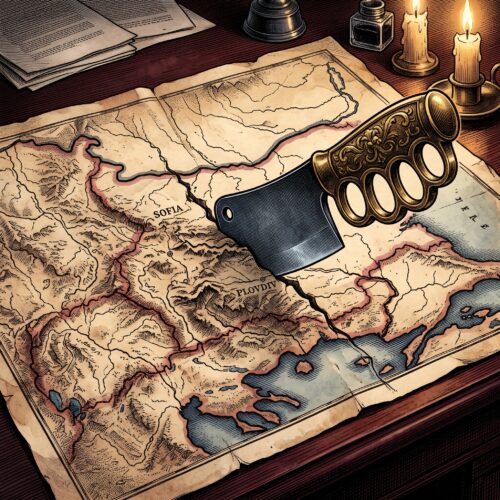
Act I: The Cartographic Practical Joke of 1878
To understand why thousands of young Balkan men were freezing in muddy trenches thirty kilometers northwest of Sofia in November 1885, you first have to appreciate the breathtaking arrogance of nineteenth-century European diplomacy.
In 1878, after the Russo-Turkish War had finally pried much of the Balkans out of the grip of the Ottoman Empire, the Great Powers of Europe—Britain, Germany, Austria-Hungary, Russia, France, and Italy—gathered in Berlin to redraw the map. Like a group of wealthy landlords dividing up an estate they had never actually visited, the statesmen at the Congress of Berlin decided that a unified, independent Bulgaria would be far too large and far too friendly to Tsar Alexander II of Russia.
So, out came the diplomatic meat cleaver.
The Great Powers sliced the Bulgarian people straight down the spine of the Balkan Mountains. The northern half, anchored by the capital city of Sofia, became the Principality of Bulgaria—an autonomous state that still technically owed tribute to the Ottoman Sultan. The southern half, stretching between the Balkan and Rhodope mountains and centered on the ancient, prosperous city of Plovdiv, was given the absurdly bureaucratic name of “Eastern Rumelia” and handed back to the Ottoman Empire as a semi-autonomous province under a Christian governor appointed by Constantinople.
It was a geopolitical arrangement designed to satisfy everyone in Europe except the people who actually lived there.
To run the newly minted Principality of Bulgaria, the Bulgarian Assembly selected a twenty-two-year-old German nobleman, Prince Alexander of Battenberg. Alexander was tall, dashing, brave, and hopelessly caught in the crossfire of imperial politics. On one side stood his cousin and patron, the Russian Tsar, who expected Bulgaria to behave like an obedient little satellite state. On the other side stood the Bulgarian people, who had zero interest in being a satellite state and even less interest in leaving half their families trapped behind an artificial border in Eastern Rumelia.
For seven years, the pressure built like steam inside a welded boiler. Then, on September 18, 1885—September 6 under the old Julian calendar still used in the Balkans—the boiler blew.
In Plovdiv, Bulgarian nationalists and local militia units staged a bloodless, remarkably polite revolution. They surrounded the residence of the Ottoman governor-general, Gavril Krastevich, informed him that his services were no longer required, escorted him out of town in a carriage accompanied by a Bulgarian schoolteacher to make sure nobody was rude to him, and proclaimed the Unification of the Principality of Bulgaria and Eastern Rumelia.
Prince Alexander of Battenberg faced an immediate, career-defining fork in the road. If he rejected the unification to appease Russia, his own subjects would overthrow him before sunset. If he accepted the unification, he would instantly incur the wrath of the Russian Tsar, the Ottoman Sultan, and every Great Power that had signed the Treaty of Berlin.
Alexander chose his throne and his adopted country. He rode into Plovdiv, endorsed the unification, and braced for the blowback.
The blowback arrived from St. Petersburg within days—and it was surgical, vindictive, and designed to guarantee Bulgaria’s destruction.
Act II: The Great Officer Walkout and the “War of the Captains”
Since Bulgaria had only been resurrected as a state in 1878, its fledgling army had been built, trained, and commanded from top to bottom by the Imperial Russian Army. Every single general in the Bulgarian military was Russian. Every colonel was Russian. Every lieutenant colonel and almost every major was Russian. Even the Bulgarian Minister of War was a Russian general.
Furious that Prince Alexander had dared to unify Bulgaria without imperial permission, Tsar Alexander III issued a blunt, devastating order: every single Russian officer serving in Bulgaria was recalled immediately.
Overnight, the Bulgarian military was decapitated.
Imagine an army where the highest-ranking native officer in the entire country holds the rank of captain. Not a single Bulgarian officer had ever commanded a division. Not a single Bulgarian officer had ever commanded a brigade. Only a tiny handful had ever commanded anything larger than a company of a couple hundred men. Suddenly, twenty-five- and twenty-eight-year-old captains—men like Olimpi Panov, Atanas Benderev, Racho Petrov, and Hristo Popov, who had graduated from military academies only a few years earlier—were handed command of entire regiments, artillery corps, and whole flanks of a national army.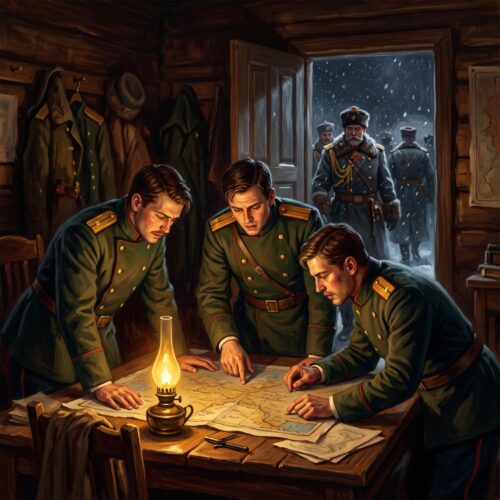
European military attachés watched the spectacle with open amusement. In the salons of Vienna and Belgrade, diplomats mocked Bulgaria’s defense force as an amateur club. Historians would soon dub the coming conflict “The War of the Captains against the Generals”—and nobody in the chancelleries of Europe was betting a single gold coin on the captains.
To make matters worse, the Bulgarian High Command—now operating out of a makeshift headquarters staffed by exhausted young men drinking Turkish coffee by the gallon—made a massive, completely understandable strategic miscalculation.
Because Eastern Rumelia had just been pried away from the Ottoman Empire, every Bulgarian planner assumed the retaliation would come from the southeast. Consequently, Bulgaria packed almost its entire active field army—roughly 30,000 regulars and mobilized militia—onto the southeastern border facing the Ottoman province of Thrace. The western border with the Kingdom of Serbia, separated by rugged mountains and narrow passes, was left guarded by little more than border guards, local peasant militias, and a prayer.
Meanwhile, across that western border in Belgrade, King Milan I Obrenović of Serbia was staring at the map of the Balkans with burning envy and acute political desperation.
King Milan was deeply unpopular at home. His finances were a mess, his marriage to Queen Natalie was a public soap opera, and his Radical Party opponents were constantly scheming against him. When Bulgaria doubled its territory overnight by absorbing Eastern Rumelia, Milan saw his golden ticket. Under the twisted logic of nineteenth-century Balkan “balance of power,” Milan declared that if Bulgaria got bigger, Serbia was entitled to “territorial compensation”—specifically, a juicy chunk of western Bulgaria, including the capital city of Sofia.
Better yet, Milan had the full backing of the Austro-Hungarian Empire, which was thrilled to see a pro-Russian neighbor cut down to size, and he possessed a veteran, Prussian-style army commanded by seasoned generals and colonels who had fought the Turks in 1876 and 1877.
There was just one tiny problem with King Milan’s grand imperial crusade: the Serbian people had zero desire to fight their Bulgarian neighbors.
Serbs and Bulgarians shared the same Orthodox faith, similar Slavic languages, and centuries of shared struggle against Ottoman rule. Milan knew that if he told his conscripts they were invading Bulgaria to steal land for his political ego, half the regiments might mutiny before reaching the border. So, in one of the most audacious acts of state-sponsored gaslighting in military history, King Milan issued a royal proclamation telling his soldiers that they were marching into Bulgaria to help their Bulgarian brothers fight the Ottoman Turks.
Serbian regiments actually crossed the border singing songs of Slavic brotherhood, genuinely expecting to link up with Bulgarian troops against the Sultan—right up until Bulgarian border guards started shooting at them from behind boulders.
Act III: The 95-Kilometer Death March and the Trap at Slivnitsa
On November 13, 1885—November 1 in the Julian calendar—King Milan formally declared war on Bulgaria, and on November 14, the Royal Serbian Army rolled across the frontier in three main columns.
Milan’s operational plan was textbook, arrogant, and seemingly unstoppable. His main strike force—the Nishava Army, comprising the Šumadija, Danube, and Drina divisions, backed by the Morava Division to the south—would smash through the Dragoman Pass, brush aside whatever token border patrols stood in the way, concentrate four full divisions in front of Sofia, and stage a triumphal victory parade down the capital’s main boulevard before the Bulgarian army in the southeast even knew what had hit them. Further north, the Timok Division would besiege and capture the fortress town of Vidin.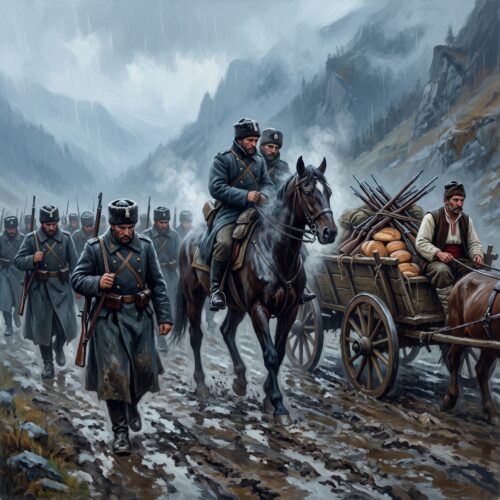
On paper, Bulgaria was finished. Re-deploying an entire army from the Turkish frontier in Thrace across the breadth of the country to Sofia in mid-November—with only a single, primitive, low-capacity railway line stretching part of the way—was supposed to take at least five to six full days. By day six, King Milan planned to be sleeping in Prince Alexander’s palace.
What Milan’s generals failed to account for was what happens when an entire nation refuses to read the timetable.
When the telegraph wires hummed with news of the Serbian invasion, Bulgaria erupted into a frenzy of improvised logistics. Trains were packed until soldiers rode on the roofs of coal cars and clung to the brass handrails of locomotives. Where the railway ended at Sarambey, thousands of infantrymen stepped off the flatcars into freezing autumn rain and started walking.
And they did not walk like a nineteenth-century army. They marched like men possessed.
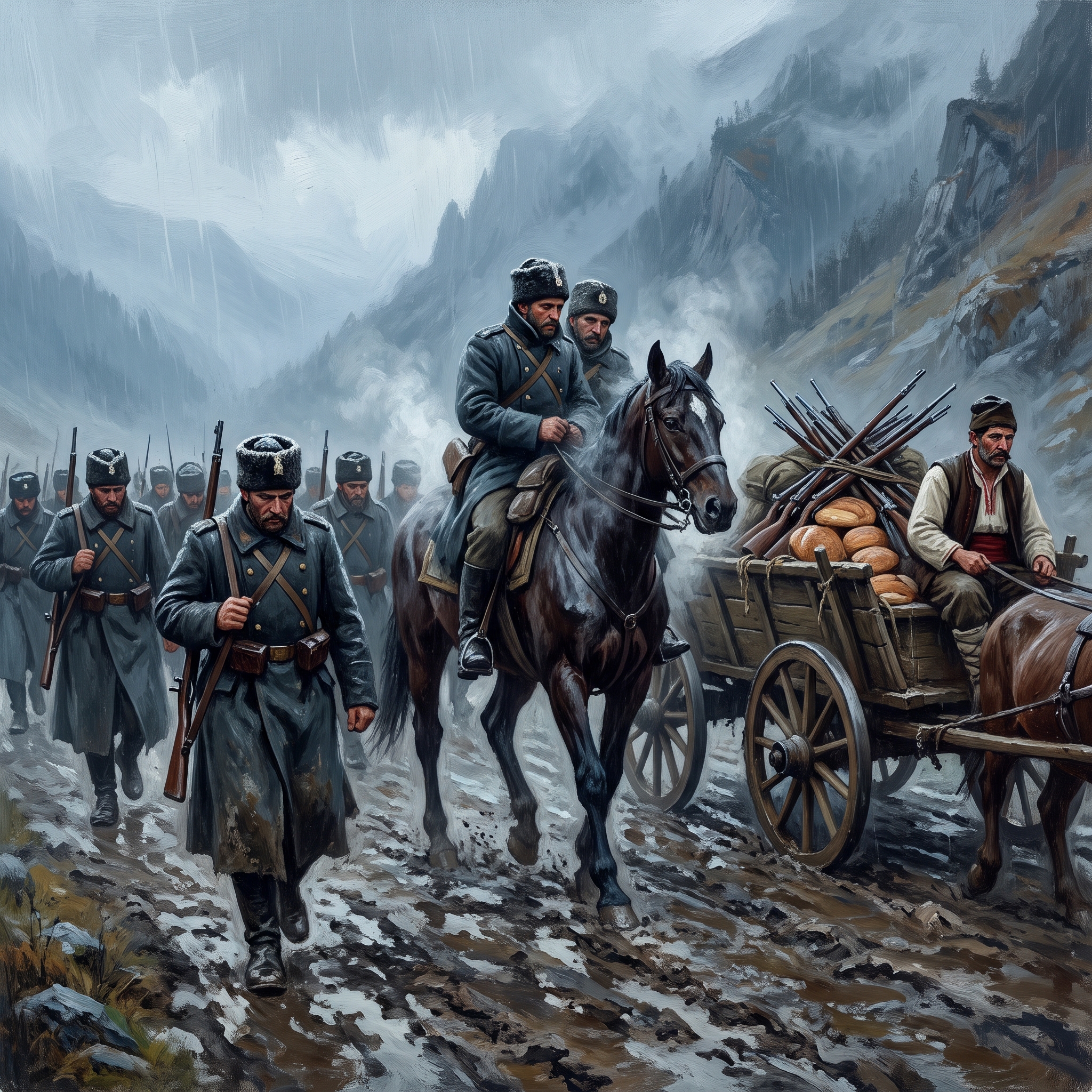
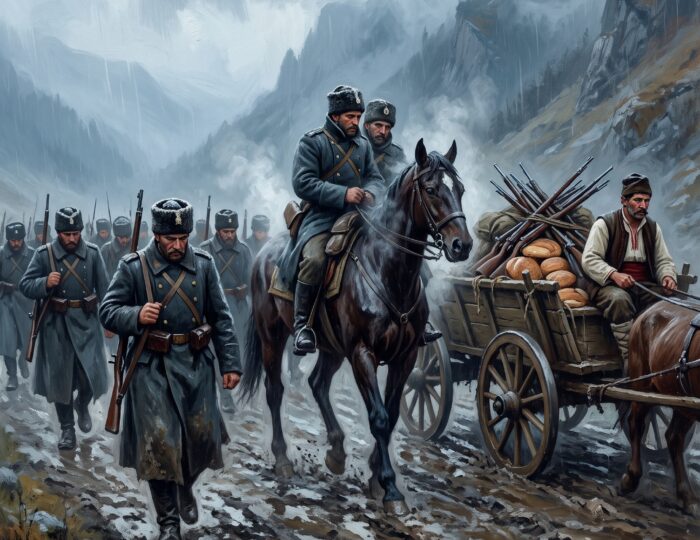
The 8th Primorski Infantry Regiment covered ninety-five kilometers through mud, mountain passes, and freezing sleet in just thirty-two hours—an average pace that would make modern light infantry weep. Battalions marched double-time with two men riding every horse—one in the saddle, one behind—and whenever a soldier collapsed from exhaustion, local villagers materialized out of the mist with oxcarts, warm bread, roasted peppers, and jugs of rakia to haul the men forward so they wouldn’t miss the fight.
While the main army raced westward across the country, a handful of outnumbered Bulgarian frontier detachments fought a brilliant, desperate delaying action in the rocky defiles of the Dragoman Pass and around Tran. Using the jagged limestone crags to their advantage, tiny companies of Bulgarian riflemen ambushed Serbian vanguard columns, forced entire brigades to deploy into battle lines for every narrow gorge, and bled precious hours off King Milan’s clock.
Those stolen hours allowed Captain Olimpi Panov—the twenty-eight-year-old acting commander of the Bulgarian artillery—and Major Stefan Guchev to execute a masterstroke.
Instead of throwing arriving units piecemeal into the border meat grinder, the Bulgarian captains chose a natural choke point roughly thirty kilometers northwest of Sofia: a rolling ridge of hills straddling the main road in front of the quiet agricultural village of Slivnitsa.
Slivnitsa was the last natural defensive barrier before the open plain of Sofia. To the right (north) of the road rose steep, rocky heights that favored entrenched defenders. To the left (south) stretched the gentler, rolling Visker Hills toward the town of Breznik. Working around the clock with shovels, pickaxes, and freezing hands, Bulgarian soldiers and civilian volunteers carved nearly four kilometers of deep trenches and earthen artillery redoubts along the ridge.
And here, Bulgaria possessed one quiet, lethal technological edge that King Milan’s generals had completely overlooked.
While the Serbian infantry carried superior Mauser-Milovanović rifles, their artillery consisted largely of older, shorter-range, bronze-barreled La Hitte cannons. Bulgaria, by contrast, had recently equipped its batteries with brand-new, steel-barreled, breech-loading Krupp cannons imported from Germany. Captain Olimpi Panov’s gunners could hit Serbian infantry formations from hundreds of meters beyond the range where Serbian artillery could effectively fire back.
When Prince Alexander of Battenberg galloped into Slivnitsa on the evening of November 16, he found an improvised fortress manned by roughly 12,000 exhausted men—nine regular battalions, around 2,000 civilian volunteers, and thirty-two Krupp guns—staring down the throat of an approaching Serbian juggernaut that would swell to 40,000 men.
The curtain was about to rise on three days of carnage—and the decisive climax of November 19.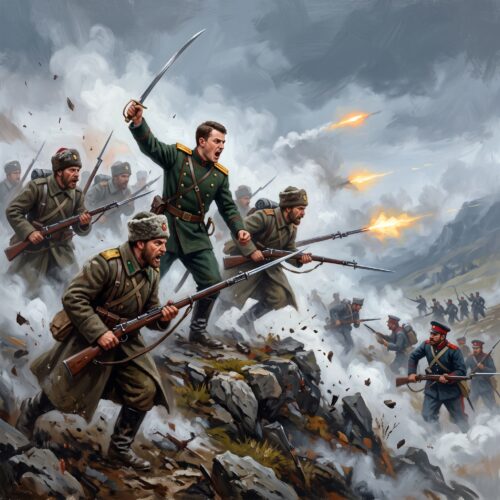
Act IV: Mud, Mist, and Mutiny in the Trenches (November 17–18)
The Battle of Slivnitsa opened on the morning of November 17 under a thick, suffocating blanket of freezing rain and mountain mist.
Across the valley, the Serbian commanders hesitated. Having been bruised and delayed in the Dragoman Pass, the three central Serbian divisions—the Šumadija, Danube, and Drina—paused to regroup and wait for the fog to lift. They assumed the outnumbered Bulgarians would cower behind their earthworks.
They assumed wrong.
At ten o’clock in the morning, Captain Atanas Benderev—a fiery, hyper-aggressive twenty-six-year-old officer commanding the Bulgarian right flank—decided that waiting around in the rain was bad for morale. With Prince Alexander’s authorization, Benderev launched three battalions straight out of the mist against the Serbian Danube Division on the high ridges to the north.
The sheer audacity of the attack stunned the Serbs. The Danube Division reeled backward in confusion before its numerical superiority allowed it to rally and push Benderev’s men down the slopes. Seeing the fight erupt on the right, the Serbian center finally lurched forward against the main Bulgarian trenches along the Sofia road.
It was a slaughter. As dense columns of Serbian infantry marched into the open valley toward the Slivnitsa redoubts, Captain Panov’s steel Krupp cannons opened up with shrapnel and high-explosive shells. The Serbian artillery tried desperately to reply, only for their shells to fall impotently into the mud short of the Bulgarian ridge. Caught in a blistering crossfire of Krupp artillery and rapid rifle volleys, the Serbian central assault stalled and collapsed backward, leaving roughly 1,200 casualties in the churned mud. Before nightfall, Benderev rallied a relief column and clawed back the crucial rocky heights on the right flank.
By dawn on November 18, the battle had become a race against the clock—not just on the battlefield, but along the roads leading into Slivnitsa from the east.
Every hour, dust-caked, mud-splattered Bulgarian reinforcements were stumbling into the rear of the Slivnitsa lines. Regiments that had marched ninety kilometers without sleep dropped their packs, grabbed extra bandoliers of cartridges, and jogged straight into the trenches while military bands played the national anthem, Shumi Maritsa, behind the lines to keep frozen men awake.
Sensing that their numerical advantage was evaporating by the hour, the Serbian high command struck hard at daybreak on November 18 against Bulgaria’s weakest spot: the softer, rolling Visker Hills on the left flank.
For two agonizing hours, the Bulgarian left bent like a green sapling in a hurricane. Serbian brigades surged up the grassy slopes, threatening to roll up the entire Bulgarian line and cut the road to Sofia. Just as the left flank reached the absolute breaking point, two battalions of the Preslav Infantry Regiment—having practically sprinted the final miles from Sofia—arrived on the ridge, fixed bayonets, and slammed into the Serbian vanguard.
The line held. In the center, repeated Serbian frontal assaults were shredded again by Panov’s Krupp batteries, while up on the craggy right flank, Captain Benderev—seemingly running on pure adrenaline and spite—stormed and captured two more fortified Serbian mountain positions.
That night, King Milan I sat in his field headquarters in a state of mounting panic. His invincible invasion had been fought to a standstill by an army led by twenty-somethings. Worse, rumors were swirling through the Serbian camp that Bulgarian cavalry had already slipped behind their lines and was threatening the border town of Tsaribrod. At one point during the night, the King of Serbia actually fled his own headquarters in a panic before his generals coaxed him back.
Milan had one final card left to play—and he staked everything on the morning of November 19.
Act V: The Hammer and the Anvil of November 19, 1885
Dawn on Thursday, November 19, 1885, broke cold, grey, and merciless over the blood-soaked ridges of Slivnitsa.
By this point, the miracle of the Bulgarian forced marches had transformed the balance of forces. Roughly 32,000 Bulgarian troops were now packed into the Slivnitsa sector, facing approximately 40,000 increasingly demoralized Serbs.
King Milan’s generals devised one last, desperate gambit to crack the Bulgarian line before Sofia fell completely out of reach. If they could not punch through the iron wall in the center or dislodge Benderev from the rocky cliffs on the right, they would swing a massive sledgehammer around the southern end of the battlefield.
On the morning of November 19, the Serbian high command concentrated two full divisions for a massive, coordinated assault on the extreme Bulgarian left flank near the village of Karnul (modern-day Delyan). Simultaneously, the Serbian Morava Division—which had been advancing from the south through the Visker Hills—was ordered to drive hard northeastward, link up with the two divisions attacking Karnul, and encircle the entire Bulgarian army from behind.
If that pincer closed, Prince Alexander’s army would be trapped in a pocket, cut off from Sofia, and destroyed.
Everything—the survival of Bulgaria, the legitimacy of the Unification, and the entire political map of the Balkans—hinged on what happened in those rolling hills south of Slivnitsa on November 19.
And standing directly in the path of the Serbian Morava Division was a twenty-seven-year-old Bulgarian captain named Hristo Popov, commanding just three battalions of infantry and a handful of local volunteers rushed out from Sofia.
Popov was outnumbered roughly three-to-one by a full Serbian division. He had no generals to call for advice, no reserves waiting behind him, and nowhere to retreat without exposing the back door to Sofia.
Instead of digging into a passive perimeter and waiting to be surrounded, Captain Popov deployed his three battalions across the ridgelines of the Visker Hills with aggressive, textbook precision. As the vanguard of the Morava Division pushed forward expecting to brush aside a light screening force, Popov’s riflemen poured devastating, disciplined volley fire into their flanks from concealed hilltops. Every time the Serbian commanders tried to maneuver around a ridge, Popov shifted his companies at a dead run to block the pass, launching ferocious local bayonet counterattacks that convinced the Serbian division commander he was facing an entire army corps rather than three isolated battalions.
Hours ticked by on November 19. Over near Karnul, the two Serbian divisions massed for the main flanking blow launched wave after wave against the Bulgarian left, waiting anxiously for the Morava Division to appear on the horizon and complete the trap.
The Morava Division never arrived. Captain Popov had strangled the flanking maneuver in its cradle.
With the southern pincer shattered and the two Serbian divisions at Karnul bogged down in bloody, fruitless frontal attacks against dug-in Bulgarian defenders, the momentum of the entire war flipped in a single afternoon.
Prince Alexander of Battenberg—riding along the front lines on horseback in full view of both armies, dodging shellfire alongside his twenty-something captains—recognized the exact instant the Serbian army’s will broke.
At mid-afternoon on November 19, Alexander ordered a general counterattack across both flanks of the Slivnitsa line.
Bugles blared through the gunsmoke. On the rocky right, Captain Benderev’s exhausted, mud-caked soldiers surged down from the heights with fixed bayonets, rolling up the Serbian left wing. On the southern flank, Bulgarian battalions pushed forward from Karnul, driving the battered Serbian divisions backward across the valley. Only the early November nightfall saved the Royal Serbian Army from total encirclement and annihilation on the field.
As darkness settled over Slivnitsa on the night of November 19, 1885, the silence was broken only by the groans of the wounded—roughly 1,800 Bulgarians and 2,100 Serbs—and the distant rumble of Serbian supply wagons retreating westward in the dark. King Milan ordered a general retreat toward the border.
The invasion was dead.
Act VI: From the Trenches of Slivnitsa to the Gates of Belgrade
What followed November 19 turned European military dogma completely upside down.
The “amateur” army of captains did not stop at the border. On November 22, Bulgarian forces smashed Serbian rearguards at Dragoman. By November 24, every single invading Serbian soldier had been driven out of Bulgaria. Two days later, the Bulgarian Army crossed the frontier into Serbia itself, capturing the strategic city of Pirot on November 27 in fierce street fighting personally led by Prince Alexander, and clearing an open highway straight toward the major Serbian city of Niš.
Panic gripped Belgrade. King Milan, who two weeks earlier had been planning his victory parade in Sofia, was now frantically packing the royal archives and begging Austria-Hungary to save his throne.
On November 28, the Austro-Hungarian ambassador walked into Bulgarian headquarters and delivered an unmistakable ultimatum: halt the advance immediately, or the Austro-Hungarian Army would enter the war on Serbia’s side. Having proven their point beyond a shadow of a doubt, Bulgaria agreed to an armistice.
When the Treaty of Bucharest was signed on March 3, 1886, the borders between Serbia and Bulgaria were left unchanged—because Bulgaria didn’t need a single square inch of Serbian land. By defeating a Great-Power-backed invasion without a single senior officer above the rank of captain, Bulgaria forced the Ottoman Empire and all the Great Powers of Europe to formally recognize the Unification of Bulgaria and Eastern Rumelia. A divided, vulnerable client state doubled its size, forged an unshakeable national identity, and entered the twentieth century as a formidable Balkan power.
And those young twenty-something captains—Panov, Benderev, Popov, Guchev, Petrov—went down in military history as proof that when pedigree, seniority, and bloated bureaucracy collide with raw ownership, speed, and moral clarity, pedigree gets run over every single time.
Why November 19, 1885 Matters to Your Life Right Now
Let’s step out of the mud of Slivnitsa and look at why this obscure nineteenth-century slugfest is pure rocket fuel for anyone navigating modern life, career turbulence, or personal stagnation.
Most people walk around waiting for permission—or waiting for the “senior officers” to show up. We wait until we have the perfect title, the complete certification, the ideal budget, the blessing of the gatekeepers, or the assurance that all our resources are neatly lined up on the right border before we make a move. And when a sudden crisis hits—a layoff, a restructuring, an unexpected competitor, a personal setback—our first instinct is paralysis because the people who were supposed to be in charge walked out the door.
The Captains of Slivnitsa won on November 19 because they stripped away every single excuse modern productivity gurus love to coddle. They didn’t have “executive alignment.” They didn’t have a six-month strategic offsite. They had thirty-two hours to march ninety-five kilometers in the rain, a handful of German cannons that outranged the competition, and the radical realization that nobody was coming to save them.
Here is how the exact operational mechanics of November 19, 1885 translate directly into how you win today:
- Rank is an illusion; execution is the only credential. When Russia pulled every general and colonel out of Bulgaria, conventional wisdom declared the army non-functional. In reality, removing the bloated top layer eliminated bureaucratic hesitation and handed decision-making authority directly to twenty-six-year-olds who actually understood the terrain. In your own life or career, stop deferring to people simply because they hold a grander title or have been in the building longer. If you see the problem clearly and you are willing to take responsibility for the outcome, you are the commanding officer.
- Logistics beat speeches every day of the week. King Milan gave grand, theatrical proclamations to his troops—and lied to them about why they were fighting. Bulgaria’s captains didn’t waste breath on pompous rhetoric; they obsessed over train schedules, oxcarts, marching speeds, and ammunition distribution. Motivation without logistics is just daydreaming. If you want to change your health, finances, or career, stop consuming inspirational quotes and start fixing your supply lines—your calendar, your sleep schedule, your bank transfers, and your daily physical routines.
- Find your “Krupp advantage” and refuse to fight on the enemy’s terms. Bulgaria had inferior rifles and fewer men, so they refused to get drawn into a pure infantry slugfest in the open. Instead, they anchored their entire defense around the one area where they held an asymmetric edge: long-range steel Krupp artillery. You do not need to be better than everyone else at everything. You need to identify the one specific skill, tool, network, or perspective where you outrange the competition, plant it on high ground, and force every challenge to cross your line of fire.
- When a flanking pincer comes for you, become Hristo Popov in the Visker Hills. On November 19, Captain Popov had three battalions against an entire Serbian division trying to encircle his team. If he had curled into a defensive ball, he would have been crushed. By staying mobile, striking the enemy’s flanks, and projecting overwhelming intensity, he convinced a massive force that he was ten times larger than he actually was. When multiple crises hit your life at once, passive worry is fatal. Pick the most dangerous threat, hit it early with focused, disproportionate energy, and disrupt its momentum before it links up with your other problems.
- Never stop at the border when you finally capture momentum. Once the Serbian attack shattered on November 19, the Bulgarians didn’t throw a party and go home—they marched straight across the border into Pirot. Most people sabotage their own breakthroughs because the moment the immediate crisis passes, they relax and slip back into old habits. When you finally break a bad habit, land an opportunity, or solve a major problem, immediately press your advantage into new territory while your momentum is peaking.
The “Slivnitsa 72” Protocol: A Quick, Ruthless Anti-Self-Help Battle Plan
Forget vision boards, five-year manifestation journals, morning gratitude affirmations, and waiting until Monday to “get your head right.” Those are the bronze cannons of King Milan—loud, shiny, and completely useless when reality kicks down your door.
This is The Slivnitsa 72 Protocol: a three-day, zero-fluff tactical reset designed to decapitate your inner bureaucracy and move your life ninety-five kilometers forward in thirty-two hours.
Phase 1: The St. Petersburg Purge (Hours 1–12)
- Fire the “Russian Generals” in your head. Write down the top three excuses you use that rely on external authority—“I need another certification first,” “I’m waiting for my boss/partner/market to change,” “I don’t have the senior title yet.” Cross them out. As of this hour, the senior officers have left the building. Promote yourself to Captain of your own life and assume unilateral command.
- Audit your wrong-border deployments. Look at your calendar and bank statement from the past seven days. Identify one major time-suck or energy drain where you have “massed your troops” fighting a battle that isn’t even happening (pointless arguments, doomscrolling, low-value busywork). Pull 100% of your energy off that front tonight.
Phase 2: The 95-Kilometer Forced March (Hours 13–48)
- Pick your Slivnitsa Ridge. Choose ONE concrete, high-stakes objective you have been delaying—finishing a project, sending the high-stakes pitch, overhauling your budget, or executing a tough conversation. Do not pick five goals. Pick the single ridge thirty kilometers in front of your capital.
- Execute a 32-Hour Logistics Sprint. Strip away every non-essential obligation for the next thirty-two hours. Pre-pack your meals, silence non-emergency notifications, and put two riders on every horse: pair every boring task with immediate execution. Move raw volume toward that single objective faster than your normal self thinks is sustainable.
- Deploy your Krupp Cannons. Identify your single strongest asymmetric advantage—your deepest expertise, your best relationship, your sharpest tool—and use it first. Stop leading with your weaknesses.
Phase 3: The November 19 Counterattack (Hours 49–72)
- Ambush your Visker Hills flank. Expect resistance on day three—fatigue, self-doubt, or an unexpected interruption trying to encircle your focus. Do not negotiate with it. Like Captain Popov with three battalions, hit that distraction immediately with a twenty-minute burst of decisive action so it never gains momentum.
- Cross into Pirot before nightfall. The moment you complete your primary target on Day 3, do not reward yourself by collapsing onto the couch. Use the adrenaline of completion to immediately take one offensive step into next week’s territory—send the follow-up message, schedule the next milestone, or lock in the next commitment before the sun goes down.
The Great Powers of your own doubts will tell you that you don’t have the rank, the backing, or the time to pull it off. Let them talk. Grab your shovel, roll out the Krupp guns, and take the ridge.
Share: