
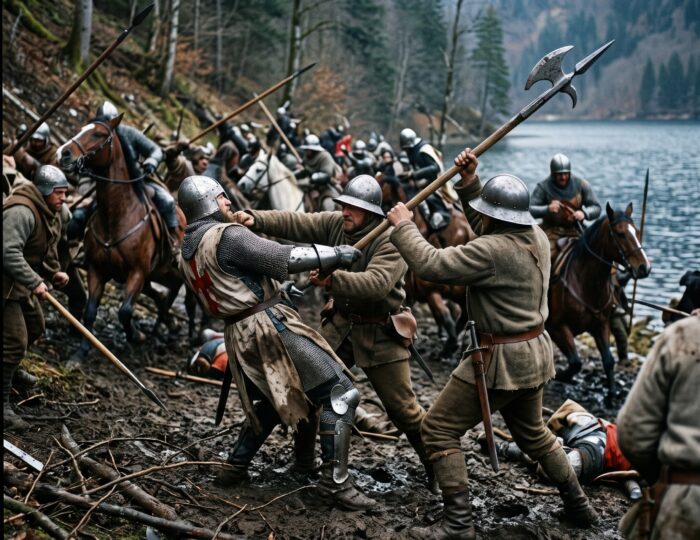
On the brisk, frost-bitten morning of November 15, 1315, Duke Leopold I of Austria sat astride a warhorse so heavily armored it practically needed its own postal code. Surroundings? Picture the narrow, treacherous ribbon of mud and stone squeezed tightly between the freezing, dark waters of Lake Ägeri and the sheer, timber-choked cliffs of Morgarten Mountain in central Switzerland. Leopold was twenty-five years old, dripping in aristocratic entitlement, and leading the fourteenth-century equivalent of a nuclear strike force—between two thousand and four thousand elite, steel-plated Habsburg knights and seasoned men-at-arms—into the rugged alpine valleys of Schwyz, Uri, and Unterwalden. His stated mission was simple, direct, and utterly devoid of humility: to march into the mountains and “trample those audacious peasants beneath his feet.” He had even packed extra wagons loaded with heavy hempen ropes specifically designed to hang the rebel ringleaders as soon as the afternoon’s light cardio was over.
There was just one tiny flaw in Leopold’s grand operational blueprint, and it had been pointed out the night before by the only guy in the Habsburg camp who wore bells on his hat for a living. During a late-night war council at the town of Zug, Leopold’s proud barons spent hours loudly bragging about all the clever routes they could take to break into the rebellious Swiss valleys. When the boasting finally died down, the Duke turned to his court jester, a sharp-tongued fool named Cuoni von Stocken, and asked what he thought of their brilliant invasion plan. Cuoni looked around the tent at the finest military minds of the Holy Roman Empire, adjusted his cap, and delivered a line that still echoes through military academies seven centuries later: “Your Grace, you and your lords have all taken great counsel on how you are going to get into that country, yet not a single one of you has taken a moment to consider how you are going to get out again.”
History does not record whether Leopold laughed, rolled his eyes, or threatened to dock Cuoni’s turnip rations, but within twelve hours, the jester looked like Clausewitz, Sun Tzu, and Machiavelli rolled into one. By lunchtime on November 15, 1315, Leopold’s magnificent feudal war machine was reduced to a panicked, screaming traffic jam of drowning horses, shattered lances, and flailing aristocrats getting systematically dismantled by roughly fifteen hundred local dairy farmers, goat herders, and lumberjacks wielding homemade wooden poles with meat cleavers bolted to the ends. The Battle of Morgarten was not merely a military upset. It was the violent, muddy birth of the Swiss Confederation, the beginning of the end for the armored medieval knight as Europe’s undisputed apex predator, and the ultimate historical case study in what happens when an arrogant Goliath walks straight into a bottleneck designed by a very well-prepared David.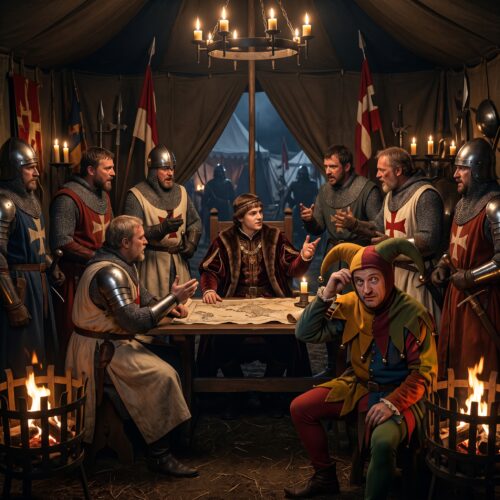
The Real Estate Dispute That Triggered a Geopolitical Earthquake
To understand why a Habsburg duke was marching through a Swiss swamp in mid-November with a wagonload of nooses, you have to trace the drama back to a classic medieval combination of contested pastureland, imperial succession crises, and a midnight monastery heist that went slightly off the rails.
For generations, the three rugged alpine communities—known as the Forest Cantons—of Uri, Schwyz, and Unterwalden had occupied a weirdly privileged slice of real estate in the heart of Europe. In the early thirteenth century, engineers and local laborers had finally tamed the ferocious Schöllenen Gorge by building the Devil’s Bridge across the Reuss River, suddenly turning the St. Gotthard Pass into the shortest, fastest trade artery connecting northern Europe to the wealthy commercial cities of northern Italy. Whoever controlled the approaches to the Gotthard Pass controlled the tolls, the silver, and the strategic arteries of the Holy Roman Empire.
Naturally, the rising House of Habsburg—a ruthless, hyper-ambitious clan originally from a modest castle in northern Switzerland that was busy gobbling up duchies across central Europe—wanted those mountain valleys badly. The mountain folk of Uri, Schwyz, and Unterwalden, however, possessed ancient imperial charters (Reichsfreiheit) granted by previous Holy Roman Emperors. These documents guaranteed that the cantons answered directly to the Emperor himself, bypassing middle-management feudal lords, tax collectors, and Habsburg bailiffs entirely. To protect that autonomy, representatives of the three valleys had sworn an eternal defensive pact—the famous Federal Charter of August 1291—promising to help one another against any outside bully who tried to slap a yoke on their necks.
Then, in October 1314, the Holy Roman Empire suffered a messy double-booking at the top. Two rival claimants were elected King of the Romans simultaneously: Duke Louis IV of Bavaria and Duke Frederick the Handsome of Austria, who happened to be Leopold I’s older brother. The Swiss Forest Cantons immediately threw their support behind Louis of Bavaria, figuring an emperor from Munich was far less likely to annex their backyard than an emperor from Vienna.
Meanwhile, a bitter local turf war was simmering between the fiercely independent farmers of Schwyz and the wealthy, aristocratic monks of Einsiedeln Abbey, an institution firmly under Habsburg protection. For decades, the growing population of Schwyz had been clearing primeval alpine forests and grazing their cattle on high pastures that the Abbot of Einsiedeln claimed belonged to the monastery. Border skirmishes, cattle rustling, and tit-for-tat kidnappings escalated until the Abbot complained to the Bishop of Constance, who promptly slapped the entire canton of Schwyz with a papal excommunication. In fourteenth-century Europe, excommunication was the spiritual equivalent of getting your credit cards frozen, your passport revoked, and your soul blacklisted from heaven—no baptisms, no church weddings, no Christian burials.
The men of Schwyz reacted with zero chill. On the freezing night of January 6, 1314—the Feast of the Epiphany—a landammann (chief magistrate) named Werner Stauffacher led three hundred armed Schwyzers over the snowy ridges straight into Einsiedeln Abbey. They kicked down the doors, ransacked the monastic storerooms, drank the monks’ finest vintage wine, smashed relics, burned legal deeds, and marched several terrified aristocrat-monks back to Schwyz as hostages. The Abbot barely escaped in his nightshirt to a nearby fortress, screaming for Habsburg vengeance.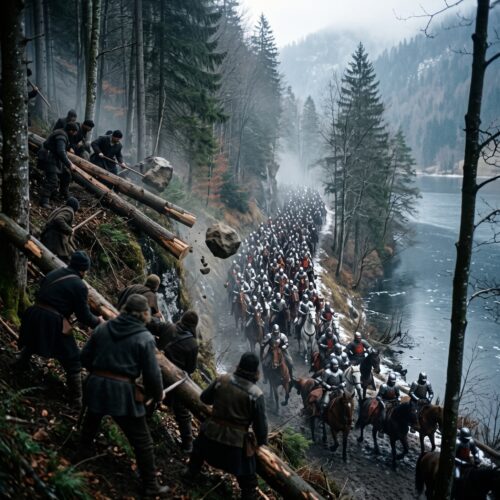
King Louis IV of Bavaria tried to smooth things over by lifting the imperial ban on the Swiss, which only infuriated the Habsburgs further. By the autumn of 1315, Duke Leopold I had gathered a massive punitive expedition at Baden and Zug. To Leopold, this wasn’t a real war; it was pest control. In the rigid social hierarchy of 1315, warfare was an aristocratic sport conducted on open, flat plains by noblemen wearing forty pounds of riveted mail and plate, riding warhorses bred to charge like freight trains. Peasants were supposed to grow turnips, pay tithes, and cower behind wooden fences when the cavalry rode by. Leopold genuinely believed the sight of his gleaming banners and thunderous warhorses would make the mountain farmers drop their pitchforks and beg for mercy before lunch.
Feints, Parchment Arrows, and the Art of Reading the Terrain
To ensure the Swiss couldn’t concentrate their forces, Leopold actually designed a rather sophisticated multi-pronged operational plan. He ordered diversionary columns to rattle the cages along the outer perimeter of the Forest Cantons. Count Otto von Strassberg was dispatched with a force to threaten Unterwalden over the Brünig Pass from the west; troops from Lucerne loaded onto boats to menace the shores of Lake Lucerne; and smaller detachments feinted toward Arth and Entlebuch. While the Swiss militias were distracted chasing shadows on their western borders, Leopold himself would lead the main hammer blow straight south from Zug, skirting the eastern shore of Lake Ägeri, climbing over the Sattel saddle, and crashing directly into the undefended heartland of Schwyz.
It was a textbook military feint—except for one problem. You cannot secretly assemble thousands of armored knights, squires, supply wagons, and camp followers in medieval Switzerland without someone noticing, especially when half the local lesser nobility had quiet business ties or neighborly sympathies with the mountain cantons.
According to the fifteenth-century Bernese chronicler Konrad Justinger, the Swiss received a piece of hyper-specific intelligence that rendered Leopold’s elaborate feints completely useless. A sympathetic local nobleman from the Habsburg sphere—identified in Swiss tradition as Knight Henry of Hünenberg, whose castle sat not far from the staging grounds—quietly rode near the Swiss frontier pickets at Arth a day or two before the march. Rather than risking treason charges by holding a face-to-face meeting, Hünenberg simply notched a handful of arrows wrapped with strips of parchment onto his bow and fired them over the Swiss barricades. When the Swiss sentries pulled the arrows out of the turf and unrolled the parchment, they found five German words scrawled in ink: Hütend üch am Morgarten—”Beware near Morgarten.”
That single intelligence leak flipped the entire strategic equation upside down. Werner Stauffacher and the Confederate captains immediately ignored Leopold’s noisy diversions on the western passes. Leaving only minimal tripwire watches elsewhere, roughly thirteen hundred to fifteen hundred men from Schwyz, joined by six hundred hardened reinforcements who marched swiftly over the mountain trails from Uri and Unterwalden, converged silently on the heights above Sattel and Morgarten.
And what a piece of terrain they chose to defend. In 1315, the shoreline of Lake Ägeri sat noticeably higher than it does today, pushing the water level right up against the steep, forested flank of Morgarten Mountain. The only path connecting Zug to the Sattel pass was a narrow, unpaved bridle track wedged tightly between the icy, marshy lake drop-off on the west and an almost vertical wall of loose scree, dense beech trees, and rocky ledges on the east. Two horsemen could barely ride abreast along this shelf. There was no room to deploy into battle lines, no meadow for cavalry to build up momentum for a lance charge, and nowhere to turn a terrified warhorse around once the column entered the defile.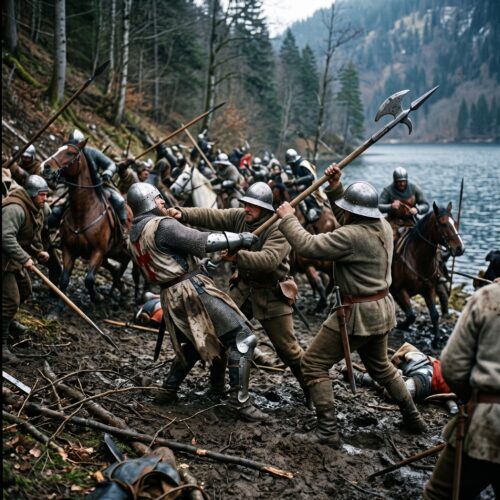
While Leopold’s knights were polishing their breastplates and listening to Cuoni von Stocken roast their lack of an exit plan, the Swiss farmers spent the chilly night of November 14 turning that mile-long mountain shelf into a medieval meat grinder. They felled massive pine and beech trunks, stripping the branches and rolling them to the edge of the cliffs above the trail, wedging them behind temporary wooden chocks. They gathered tons of heavy alpine boulders and jagged stones into neat piles along the upper ridge. Down near the southern exit of the pass at Schafstetten, where the path climbed steeply toward Sattel, they erected a stout timber-and-stone barricade (Letzi) across the road to cork the bottle. Then, wrapped in coarse wool cloaks against the November frost, the Confederate infantry knelt in the pre-dawn mist, offered a traditional alpine prayer with their arms outstretched in the shape of a cross, and waited for the aristocrats to walk into the funnel.
Ninety Minutes of Mud, Boulders, and the Birth of the Halberd
At dawn on November 15, 1315, Duke Leopold’s vanguard clattered onto the narrow path along Lake Ägeri. Riding at the very front of the column were the proudest, wealthiest, most impatient young nobles of Austria, Swabia, and the Aargau—men who had literally argued the night before over who would get the honor of striking the first blow against the rebellious peasants. Behind them stretched a glittering, clanking snake of heavy cavalry, mounted retainers, and foot soldiers nearly two kilometers long, hemmed in on the right by deep, freezing lake water and treacherous bog, and on the left by steep wooded cliffs.
Leopold himself, unusually cautious or simply slowed by the sheer congestion of his own column, was riding further back with the main body of infantry and supply wagons.
Around mid-morning, the lead Austrian knights rounded a bend near Schafstetten and abruptly reined in their horses. Blocking the narrow trail directly in front of them was a chest-high wall of felled timber and piled stone, bristling with grim-faced Swiss pikemen. The vanguard halted. Behind them, unaware of the bottleneck ahead, thousands of horsemen and foot soldiers kept pressing forward along the narrow lakeside track, compressing the entire Habsburg column like an accordion inside a concrete pipe.
That was the cue. High above the trail, invisible behind the timberline and early morning mist, Swiss horns blew a low, echoing blast.
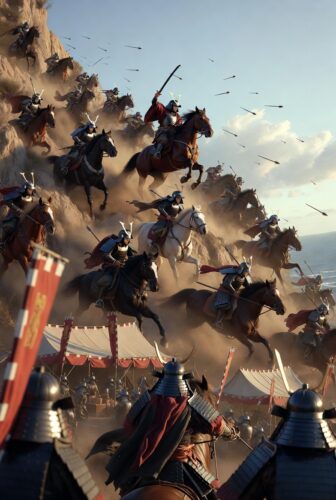
Suddenly, the mountain itself seemed to detach and fall on the Austrian army. Hundreds of Swiss peasants kicked away the wooden chocks holding back the felled tree trunks and heaved thousands of boulders over the precipice. Massive logs bounced down the steep incline like bowling balls, snapping warhorses’ legs, crushing knights inside their own armor, and sweeping entire ranks of horsemen sideways off the path into the freezing waters of Lake Ägeri. Instantly, the disciplined aristocratic vanguard dissolved into screaming chaos. High-strung destriers—warhorses trained to charge straight ahead into enemy shields, not dodge falling pine trees—reared, panicked, bucked their riders into the mud, and bolted backward into the packed ranks behind them.
Before the stunned Habsburgs could even draw their swords or figure out which direction the attack was coming from, the Swiss infantry came pouring down the wooded slopes like a pack of wolves.
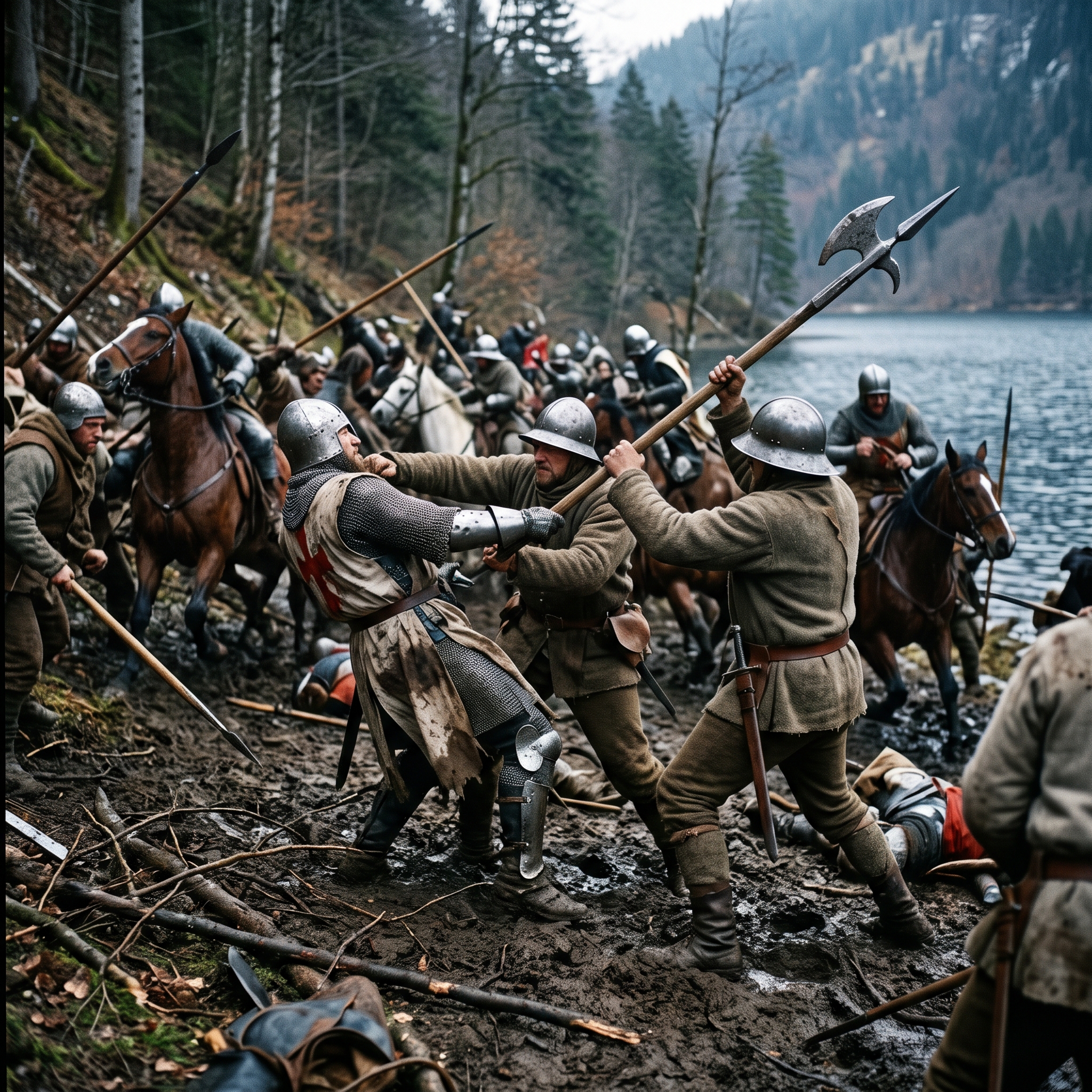
And they brought a terrifying piece of homegrown engineering that fourteenth-century knights had never encountered before: the early Swiss halberd. Born out of basic alpine forestry and farming tools—part heavy axe, part spear, part vicious curved iron hook mounted on an eight-foot ash shaft—the halberd was specifically tailored to solve the exact problem of an armored man sitting high up on a horse. A knight on a warhorse relied on speed, height, and interlocking chainmail to stay alive. At Morgarten, speed was zero, height was useless, and the Swiss farmers worked in coordinated pairs. One man would jam the curved rear hook of his halberd into the gap of a knight’s shoulder plate or saddle cantle and yank the nobleman sideways out of the stirrups; as soon as the armored aristocrat hit the mud like an overturned turtle, a second Swiss fighter brought the heavy axe blade down through his helmet or gorget.
Contemporary chronicler John of Winterthur—whose own father marched in Leopold’s army that day and who watched the survivors limp back into town that evening—wrote a chillingly vivid description of what happened in that narrow gorge: “It was not a battle, but a mere butchery of Duke Leopold’s people; for the mountain folk slew them like sheep in the shambles.”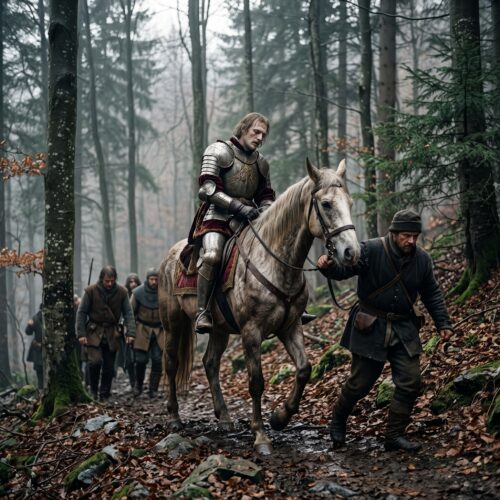
Trapped between the vertical rock wall and the icy lake, unable to turn their horses, unable to swing their long lances, and crushed against their own comrades behind them, the elite chivalry of Austria was slaughtered in less than two hours. Hundreds of knights, realizing that surrendering to furious Swiss farmers who had been excommunicated and insulted for years wasn’t an option, spurred their horses straight into Lake Ägeri in a desperate bid to swim across—only to sink like stones under the weight of forty pounds of iron mail. According to Swiss tradition, fifty local outlaws from Schwyz who had been banished from the canton for minor crimes—and thus weren’t technically allowed to stand inside the official Confederate battle line—stationed themselves just outside the border at the northern end of the pass and inflicted such ferocious damage with hurled rocks and tree trunks that they earned an immediate pardon after the fight.
Duke Leopold himself barely escaped with his life. Trapped near the rear of the column as the rout rippled backward, he was dragged off the lakeside trail by a local guide who knew a hidden goat path through the swamps toward Zug. Young John of Winterthur stood watching the gates of Winterthur that evening and recorded the sight of the mighty Habsburg duke riding in: Leopold looked “half-dead from extreme sorrow,” his face pale and hollowed out, his banners lost, and at least fifteen hundred of his finest nobles, knights, and men-at-arms dead in the mud and water behind him. Total Swiss losses? Roughly a dozen men.
The Shockwave That Redrew Europe
The repercussions of November 15, 1315, went way beyond a bad afternoon for Austrian real estate developers. Less than a month later, on December 9, 1315, the victorious representatives of Uri, Schwyz, and Unterwalden met at Brunnen to renew and strengthen their perpetual alliance, transforming a loose defensive pact into the bedrock of the Old Swiss Confederacy. Within a few decades, neighboring cities like Lucerne, Zurich, and Bern realized that allying with these terrifyingly effective mountain fighters beat paying Habsburg taxes any day of the week, and joined the confederation.
Even more profoundly, Morgarten shattered a five-hundred-year military monopoly. Until November 15, 1315, European warfare operated on the assumption that a handful of wealthy, heavily armored horsemen could effortlessly scatter ten times their number of common foot soldiers. Morgarten proved that disciplined, motivated infantry utilizing superior terrain knowledge, asymmetric tools, and ruthless chokepoint control could obliterate the most expensive aristocratic army on the continent. For the next two hundred years, Swiss pike and halberd squares became the most feared mercenaries in Europe, guarded popes, toppled dukes like Charles the Bold, and forced every royal army from France to Spain to completely rethink how wars were fought.
And Cuoni von Stocken? Legend says that after the disaster, Duke Leopold—humbled beyond belief—actually rewarded his jester for being the only person in the room smart enough to ask how they were going to get out.
How to Apply the Morgarten Chokepoint Strategy to Your Modern Life
Most self-help advice online operates like Duke Leopold I: loud, bloated, obsessed with brute force, and completely oblivious to bottlenecks. Modern productivity gurus tell you to “crush your goals,” buy a dozen expensive productivity apps (the digital equivalent of forty-pound chainmail), wake up at 4:00 AM to fight twenty battles at once, and charge headfirst into an overloaded calendar without ever asking how you’re going to get out of the mess by Friday.
If you want to stop feeling like an exhausted knight sinking in a swamp of endless emails, obligations, and half-finished projects, steal the exact operational playbook that allowed 1,500 farmers to dismantle an empire in ninety minutes.
Key Tactical Takeaways from Morgarten
- Never enter a commitment without mapping the exit first. Leopold spent hours debating how to enter Schwyz and zero minutes planning his retreat. Before saying yes to a new project, a side hustle, a social obligation, or a major purchase, explicitly define your exit criteria—the exact date, budget cap, or measurable trigger that lets you walk away cleanly if things go sideways.
- Ignore the noisy feints on your perimeter. Leopold sent four separate diversionary columns to rattle the Swiss borders so they would scatter their energy. Your phone notifications, breaking news alerts, low-priority Slack pings, and “urgent” favors from disorganized people are diversionary columns. Identify the single narrow pass where your actual life is decided, and let the feints bounce off empty air.
- Weaponize bottlenecks instead of fighting in the open. In an open field, the Habsburgs win every time. In a twelve-foot-wide mountain pass, their massive resources became dead weight. Stop trying to tackle your entire to-do list simultaneously. Force your daily work through a strict, narrow bottleneck—one single task, one closed door, one uninterrupted ninety-minute window—where distractions physically cannot flank you.
- Hire your own Cuoni von Stocken. Every high-status leader surrounds themselves with yes-men who cheer for terrible ideas until the boulders start falling. Cultivate at least one brutally honest friend, mentor, or colleague who has explicit permission to wear the jester’s hat and ask the uncomfortable question everyone else is too polite to voice.
- Trade heavy armor for a simple halberd. When your systems get too complicated—color-coded Notion dashboards, five synced calendars, bloated morning routines—you sink under your own gear. Strip your daily execution down to one simple, multi-purpose tool (a plain notepad, a single timer, one core habit) that hooks the problem and finishes it fast.
The 48-Hour “Cuoni’s Exit & Chokepoint” Reset Plan
Forget thirty-day challenges or vague vision boards. Execute this rapid, two-day tactical audit to clear your calendar’s swamp and take the high ground:
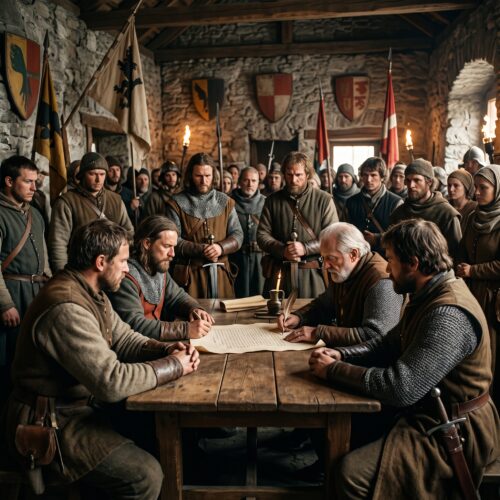
- Hour 1 — The Jester’s Audit (Tonight, 15 Minutes): Grab a blank piece of paper and list every active project, subscription, recurring meeting, and ongoing obligation currently draining your time or money. Next to each item, write down your exact exit strategy—how and when it ends. Any commitment that has no clear finish line, no measurable payoff, and no way out gets flagged immediately as a “Lake Ägeri Swamp.”
- Hour 2 — Cut the Diversionary Columns (Tonight, 10 Minutes): Pick the top three “feints” currently pulling your attention away from your most important personal or career goal—whether that’s checking news feeds first thing in the morning, attending status meetings where you don’t speak, or saying yes to low-stakes errands. Mute, cancel, or decline all three before you go to sleep.
- Morning 1 — Build the Letzi Barricade (Tomorrow Morning, First 90 Minutes): Before opening email, messages, or social media, lock yourself into your personal Morgarten Pass. Put your phone in another room, close every browser tab except the single file you are working on, and spend ninety uninterrupted minutes rolling boulders onto your single highest-leverage priority.
- Afternoon 1 — Drop the Chainmail (Tomorrow Afternoon, 15 Minutes): Identify one overly complex habit, app, or workflow you’ve been dragging around out of guilt and replace it with a bare-bones “farmer’s halberd.” Instead of a complicated meal-prep spreadsheet, eat the same three simple high-protein meals this week; instead of a complex task manager, write three sticky notes for the next day.
- Day 2 — Fire the Parchment Arrow (48 Hours From Now, 5 Minutes): Reach out to one trusted peer, partner, or friend and ask them one specific question about your biggest current plan: “If this blows up in my face six months from now, what is the obvious trap I’m walking into right now that I’m too stubborn to see?” Listen without defending yourself, adjust your route, and take the high ground.
Share: