
The Plain Where Empires Go to Die
Panipat is a flat, dusty stretch of ground in Haryana, roughly fifty-five miles north of Delhi. It has the historical misfortune of being the exact geopolitical funnel where central Asian invaders, Afghan warlords, and indigenous Indian dynasties repeatedly slammed into each other whenever the keys to the subcontinent were up for grabs. If North India were a house, Panipat was the narrow hallway where every home invader encountered the resident with a fireplace poker. By late autumn of 1556, the grass was dry, the harvest had been trampled into loam by tens of thousands of iron-shod hooves, and the ground was prepared for its second catastrophic imperial reckoning.
On the morning of November 5, 1556, the fate of hundreds of millions of people, three vast religions, and the future crown jewel of global trade hung entirely upon a single, ridiculous, improbable variable: a piece of curved wood, a twist of sinew, and a goose-feathered reed whistling through the midday dust.
To understand why this moment is perhaps the most astonishing, high-stakes turning point in pre-modern history, you have to rewind a few decades and look at the ridiculous, razor-thin margins that kept the Mughal dynasty alive in the first place.
The Mughals were not an entrenched imperial powerhouse in 1556. They were precarious squatters. Zahir al-Din Muhammad Babur, a descendant of both Timur and Genghis Khan who possessed an exquisite poetic sensibility and an unyielding penchant for conquest, had ridden out of Fergana, taken Kabul, and descended into Hindustan in 1526. At the First Battle of Panipat, he routed the Afghan Sultan Ibrahim Lodi using Ottoman-style field carts chained together and bronze cannons that made enough noise to terrify both horses and infantry. Babur established a kingdom, wrote an autobiographical masterpiece about how much he missed Central Asian melons, and promptly died in 1530.
Babur passed the fledgling empire to his son, Nasir al-Din Humayun. Humayun was brilliant, cultured, deeply interested in astrology, profoundly fond of opium, and utterly unsuited for the brutal, treacherous business of keeping a cutthroat Afghan aristocracy under his thumb.
Along came Sher Shah Suri, a bureaucratic and military genius of Afghan descent, who essentially ran Humayun out of his own kingdom. Sher Shah chased Humayun across deserts, forced him into a humiliating, destitute exile across Persia, and set up the Sur Empire in Delhi. Sher Shah completely rebuilt North India’s administrative architecture, established the currency system based on the silver rupiya, and laid down the Grand Trunk Road. Had Sher Shah lived a long life, the Mughals would be remembered today merely as a bizarre sixteen-year historical footnote, an exotic Turkish military excursion that flared up and sputtered out.
Sher Shah died in a bizarre gunpowder explosion during the siege of Kalinjar in 1545. His heirs were incompetent, vicious, and constantly stabbing one another over territory. Seeing the Sur dynasty fracture into squabbling principalities, Humayun borrowed an army from the Persian Shah Tahmasp, marched back into India, and reclaimed Delhi and Agra in July 1555.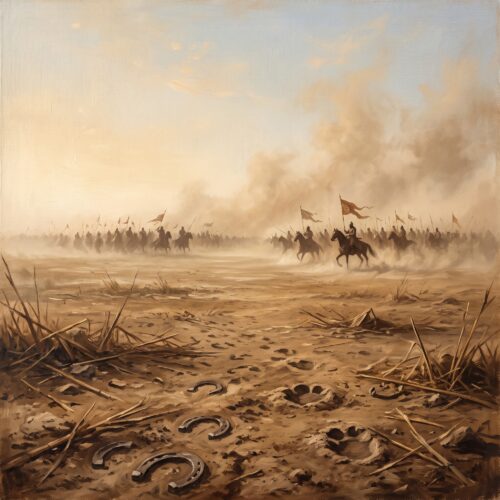
Humayun had his throne back for all of six months.
In January 1556, carrying an armload of heavy astronomical manuscripts down the steep, polished stone steps of his rooftop library at Sher Mandal in Delhi, Humayun heard the call to prayer echoing across the Yamuna River. Ever the devout mystic, he attempted to drop to his knees on the stairway to pray, tripped over the voluminous hems of his silk robes, tumbled headfirst down the masonry steps, cracked his skull, and died three days later.
He left the throne to his thirteen-year-old son, Jalal-ud-din Muhammad Akbar, who was chilling in the dusty expanse of Kalanaur in the Punjab, practicing falconry and swordplay. Akbar was crowned on a crude, hastily assembled brick platform, with his brilliant, fiercely loyal Turkmen guardian and regent, Bairam Khan, holding his hand through the panic.
The Mughals were isolated, outnumbered, and hundreds of miles away from their ancestral base in Kabul. And barreling down upon them was a military juggernaut the likes of which North India had not seen in centuries.
The Rise of Hemu: From Saltpetre Weigh-Master to Chakravartin
The man marching to exterminate the boy-king was not a member of royal royalty. He was not a Timurid prince, nor an Afghan clan chieftain with centuries of noble bloodlines.
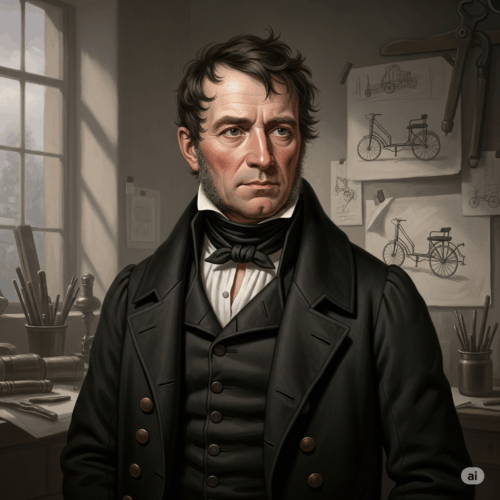
His name was Hem Chandra, known to history simply as Hemu.
Hemu was born in Rewari, in modern-day Haryana, into a modest family belonging to the Dhusar caste, traditionally involved in trading, mercantile administration, and local commerce. In his youth, Hemu did not train in princely academies or study the Persian classics of statecraft. He began his professional life as a humble weigh-master, selling brass, grain, and saltpetre (the crucial chemical ingredient for gunpowder) out of small market stalls.
In any traditional, caste-rigid feudal structure, a saltpetre merchant remained a saltpetre merchant until he died. But the Sur Empire was a meritocracy of survival. Sher Shah’s successor, Islam Shah Suri, quickly noticed this short, physically unassuming merchant who had an unnatural, savant-level genius for logistics, supply chains, and market auditing. If an army needed 50,000 maunds of grain transported through flooded rivers without rotting, Hemu got it done. If a regional governor was embezzling silver from tax revenues, Hemu tracked the ledger irregularities and ruined him.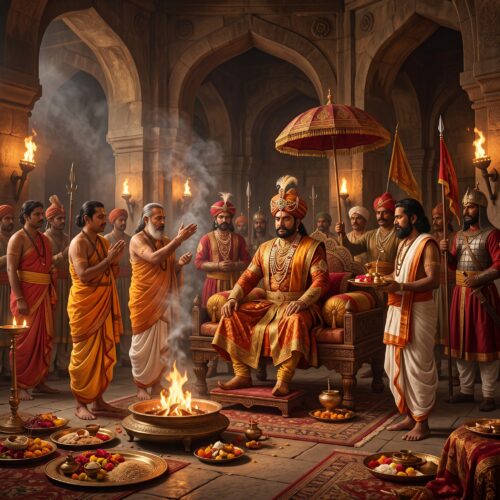
Islam Shah made Hemu the superintendent of Delhi’s markets, then the head of intelligence and postal networks, and finally an intimate military advisor.
When Islam Shah died, his brother-in-law seized the throne as Adil Shah Suri, a monarch so pathologically devoted to wine, women, dancing boys, and debauchery that he literally could not be bothered to read a dispatch. Adil Shah took one look at the administrative machinery crumbling around him, handed the royal seal and absolute executive power to Hemu, made him Chief Minister (Wazir), and went back to his private quarters.
Hemu was suddenly the de facto ruler of the Sur state.
The Afghan nobility was incandescent with rage. Fierce, proud Afghan generals with names that rattled like iron sabers found themselves taking tactical orders from a former grocer who rode into camp carrying account books. But their resentment evaporated when they saw him fight.
Hemu was, by all contemporary accounts—including those of his mortal Mughal enemies—an absolute military prodigy. He possessed physical courage that bordered on suicidal indifference to danger, combined with a chilling, predatory grasp of operational timing. He did not direct battles from the safety of an imperial pavilion miles behind the front. He put on heavy lamellar armor, climbed onto the back of an immense, legendary war elephant named Hawai (The Wind), and drove himself directly into the thickest, bloodiest melee of the battle line.
Between 1553 and 1556, Hemu fought twenty-two major pitched battles against various rebel Afghan princes, rival claimants, and regional warlords.
He won every single one of them. Twenty-two consecutive victories. He was undefeated. He was the Alexander the Great of the Indo-Gangetic plain, operating with an aura of total supernatural invincibility.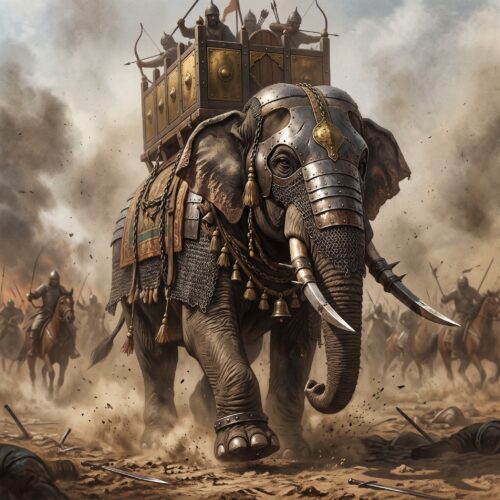
When news reached Bengal that Humayun had tumbled down his library stairs and broken his neck, Hemu saw an opportunity that occurs once in a millennium. He realized the Mughals were decapitated, ruled by a child in the Punjab whose commanders were bickering over retreat routes back to Afghanistan.
Hemu launched a lightning blitzkrieg up the Doab. He swept through Bayana, Etawah, Sambhal, and Kalpi. When his vanguard approached Agra, the Mughal governor, Iskandar Khan Uzbeg, took one look at the billowing dust clouds raised by Hemu’s war elephants and abandoned the city without swinging a single sword.
Hemu rolled straight toward Delhi.
Outside the old walls of Delhi, at Tughlaqabad, the Mughal governor of the capital, Tardi Beg Khan, assembled the elite forces of the empire to make a stand. On October 7, 1556, Hemu crashed into the Mughal army. In a brilliant operational maneuver, Hemu held back his best shock cavalry and his heavy armored elephants while the Mughals overextended themselves chasing his skirmishers. Once the Mughal lines were stretched thin and broken into disorganized pursuit, Hemu personally unleashed his heavy elephant brigade directly into Tardi Beg’s flank. The Mughal army shattered. Over 3,000 Mughal elite cavalry were cut down, and Tardi Beg fled for his life toward the Punjab.
Hemu walked into Delhi in triumph.
Here, the merchant-general made a historic, earth-shaking break with protocol. He did not proclaim the restoration of his lazy Afghan master, Adil Shah Suri. Hemu decided that after centuries of foreign Turkish and Afghan rule, the imperial canopy belonged to him.
In the ancient fortress of Purana Qila, Hemu underwent a formal Vedic coronation. He assumed the ancient, legendary imperial Sanskrit title of Samrat Hem Chandra Vikramaditya—the Sun of Valor, the ideal Hindu emperor who drives out invaders and re-establishes cosmic order. He issued coins in his own name, appointed his own governors, and redistributed wealth throughout Delhi.
In the Mughal camp up in Jalandhar, absolute terror reigned. When Tardi Beg and the shattered survivors stumbled into the camp, Akbar’s most experienced commanders fell to their knees and pleaded with Bairam Khan to abandon India entirely. They urged the regent to pack up the baggage train, abandon Delhi and Agra, retreat beyond the Indus River, and hole up safely inside the mountain fortresses of Kabul.
Bairam Khan had other ideas.
To demonstrate that retreat was not on the table, Bairam Khan invited Tardi Beg to his tent under the guise of an evening meal, had his guards step out from behind the carpets, and summarily beheaded Tardi Beg for cowardice without asking the young Akbar’s permission. The message to the remaining Mughal generals was delivered with breathtaking clarity: you can march south and face Hemu’s war elephants, or you can stay here and have your head removed with a curved scimitar before dinner.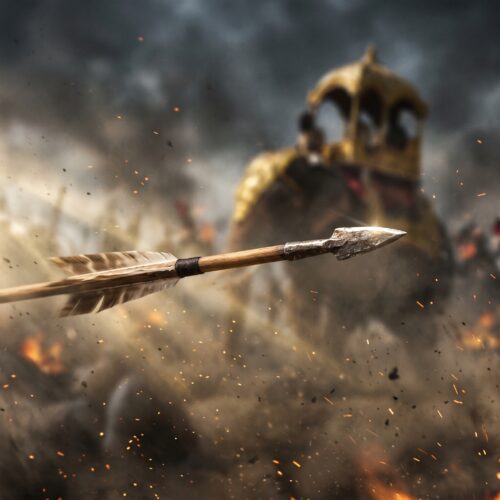
The Mughals marched south toward Delhi.
The Prelude to Catastrophe: The Stolen Guns
As the two armies advanced toward Panipat in early November 1556, Hemu committed his first and only significant logistical error.
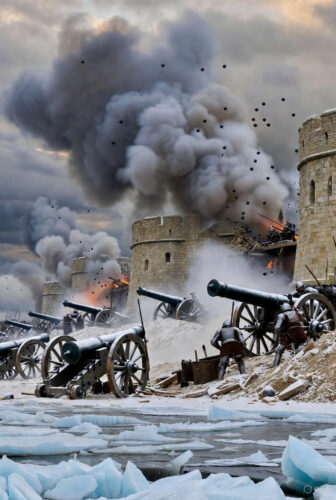
Accustomed to moving fast and crushing demoralized garrisons, Hemu had purchased an enormous, state-of-the-art train of heavy artillery from Turkish traders. These bronze cannons were immense, devastating siege guns capable of obliterating cavalry formations. But they were slow, hauled by teams of hundreds of bullocks.
Hemu sent his entire artillery train forward along the highway under a light, careless Afghan cavalry escort, while he followed a day’s march behind with his main body.
Bairam Khan had dispatched an advanced reconnaissance screen of roughly 10,000 elite horsemen under the command of Ali Quli Khan Shaibani (a ferocious warrior later known as Khan-i-Zaman). While prowling the scrub forest near Panipat, Ali Quli Khan’s scouts stumbled upon Hemu’s artillery train lumbering through the dust with almost no defensive perimeter.
Ali Quli Khan did not hesitate. The Mughal cavalry struck like lightning. The surprised Afghan guards dropped their weapons, abandoned the bullocks, and scattered into the tall grass. Without losing a dozen men, the Mughals captured the entirety of Hemu’s heavy artillery park.
When the dispatch reached Hemu, it was a bitter, stinging blow. But Hemu was not a man who relied on gunpowder. He had won twenty-two battles without relying on siege cannons. He possessed the ultimate battlefield shock weapon of the Eastern hemisphere: the war elephant.
The Morning of November 5, 1556: Clash of the Giants
On the historic field of Panipat, fifty miles north of the Red Fort, the two armies drew up their battle lines on the cold, clear morning of November 5.
The visual contrast between the two forces was staggering.
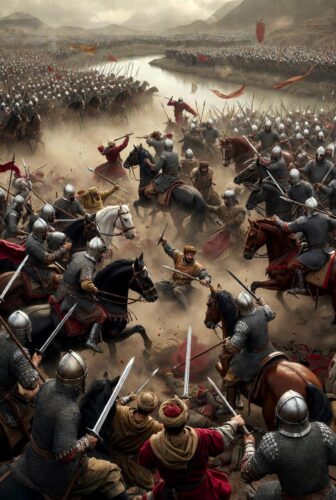
The Mughal army was modest, exhausted, and desperately aware that their backs were against the wall. They numbered roughly 10,000 to 12,000 veteran cavalrymen—mostly Central Asian Turks, Uzbeks, Persians, and Badakhshanis who had grown up in the saddle, firing composite recurve bows at full gallop. Bairam Khan, knowing that the entire dynastic enterprise rested on the physical survival of thirteen-year-old Akbar, refused to let the boy anywhere near the front line. He stationed Akbar eight miles to the rear under an elite detachment of heavy cavalry, with explicit instructions: if our lines collapse, do not look back, do not fight, run like hell for Kabul.
Bairam Khan arranged his front line with defensive precision. Ali Quli Khan commanded the center; Sikandar Khan commanded the right wing; Abdullah Khan Uzbeg commanded the left. Crucially, knowing the terrain, the Mughals positioned their central ranks behind a deep, dry nullah—a natural ravine or drainage ditch that crisscrossed the Panipat plain.
Opposing them was Hemu’s colossus.
Hemu commanded an army of over 30,000 elite Rajput and Afghan cavalry, accompanied by a disciplined infantry force, and—most terrifying of all—a shock division of 1,500 armored war elephants.
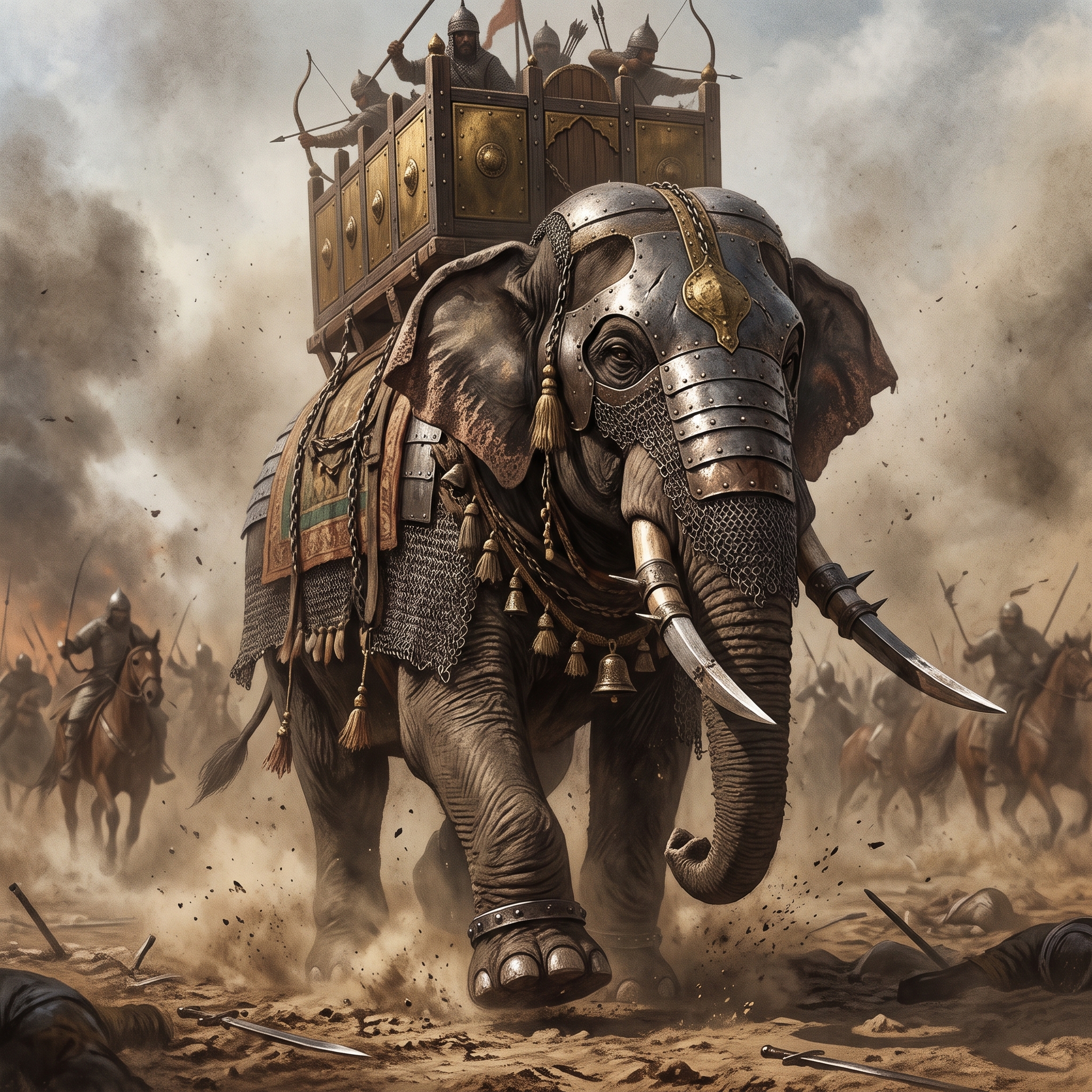
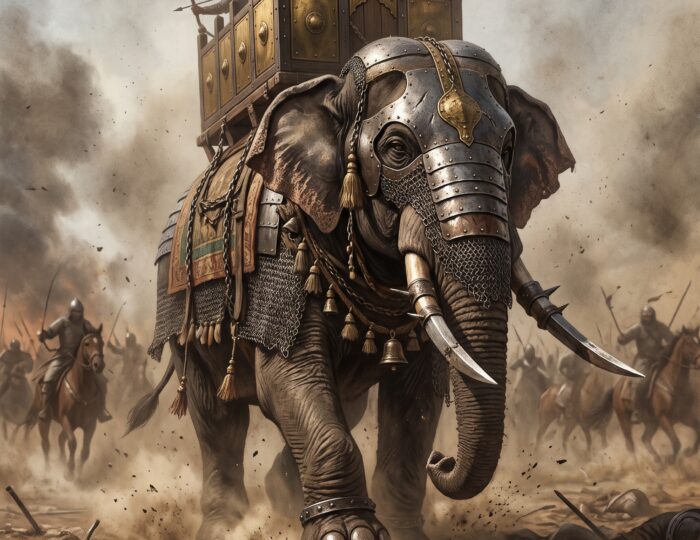
These were not circus animals. These were prime, tusked male Asian elephants, pumped full of liquor and opium to deaden their fear, sheathed from trunk to tail in plates of hammered steel and chainmail. Their tusks had been lengthened and sharpened with steel broadsword blades bolted to the ivory. In sixteenth-century warfare, an elephant charge was the psychological and kinetic equivalent of a modern armored division of tanks rolling through infantry lines. Each elephant was commanded by its mahout on the neck, while an enclosed wooden howdah on its back carried seasoned archers, crossbowmen, and spear-throwers.
At the dead center of this rolling wall of gray leather and iron was Hemu himself.
He was mounted atop Hawai, a massive bull elephant known throughout northern India for its terrifying size and aggression. Hemu was wearing an intricately worked suit of gold-inlaid mail, his face shadowed by a heavy iron helmet. His position was unmistakable. He sat elevated twelve feet above the battlefield in his gilded howdah, overseeing every shift in the lines, acting as the absolute brain, pulse, and nerve center of his army.
Around noon, the trumpets, kettledrums, and bronze gongs sounded. Hemu gave the order for a general assault.
The Iron Avalanche
The earth literally shook under the impact of fifteen hundred elephants thundering across the dry Haryana dirt. Hemu launched his wings forward like a closing vise.
The elephant charge hit the Mughal flanks with apocalyptic force. The Mughal left wing, under Abdullah Khan Uzbeg, was immediately mauled. Horses went mad with fear at the smell and sight of the towering beasts; they reared, threw their riders, and bolted. Tusks tipped with steel blades sliced through mounts and men alike. The Mughal right wing, commanded by Sikandar Khan, bent backward, buckled under the sheer mass of Hemu’s Afghan riders, and began to disintegrate.
Mughal veterans who had survived decades of fighting in the mountains of Badakhshan were routed. Hemu’s army was not merely pushing them; they were chewing through their formations.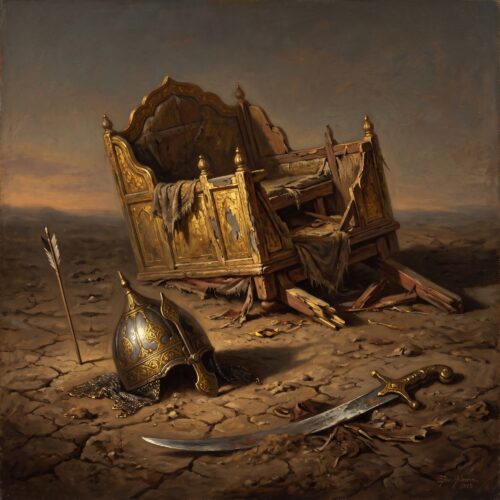
Yet, in the center, Ali Quli Khan held his nerve. As Hemu’s heavy cavalry tried to storm the center, they ran headlong into the deep drainage ditch the Mughals had fortified. The ravine prevented the war elephants from gathering momentum. The massive beasts balked at the edge of the steep drop, their mahouts unable to drive them through the trench under a ferocious hail of Mughal arrows.
Mughal archers were using composite recurve bows made of laminated horn, wood, and sinew. These bows were technological marvels capable of punching an armor-piercing bodkin arrow through plate mail at close range. Realizing they could not stop the armored hides of the elephants, the Mughal archers shifted their targeting: they aimed exclusively upward, sniping the mahouts off the necks of the animals and picking off the officers in the howdahs.
Hemu saw the center holding. He decided to end the war right then and there.
Directing Hawai with ferocious urgency, Hemu personally led his reserve division of five hundred elite elephants directly into the Mughal center. It was an awe-inspiring, terrifying spectacle. Hemu smashed through the Mughal perimeter, rallying his men with his raised scimitar, shouting orders over the deafening din of war horns and screaming men.
Even when two of his top lieutenants—Shadi Khan Kakkar and Bhagwan Das—were cut down in front of him, Hemu did not blink. He pressed the attack with terrifying fury. He rolled over the Mughal barricades. He broke through the center.
By two o’clock in the afternoon, the Second Battle of Panipat was, for all tactical purposes, over.
The Mughal flanks were broken and fleeing. Their center was surrounded, backed against a ditch, fighting hand-to-hand in desperate pockets of survival. The eight miles between the battlefield and thirteen-year-old Akbar were about to become an open sprint. The Mughal Empire in India was dead. The lineage of Babur and Humayun had reached its absolute end. Hemu was ten minutes away from an unbroken reign over the whole of North India.
And then came the arrow.
The Blind Fluke of Destiny
Out of the boiling vortex of dust, smoke, and blood, an unknown Mughal archer drew his bow. History has not preserved his name. He was likely a simple conscript or an anonymous Turkish cavalryman firing blindly into the surging mass of enemy soldiers.
The arrow arced high into the afternoon sky, tumbling down along a parabola determined by wind speed, humidity, and the chaotic trajectory of battle.
Hemu was standing tall in his howdah, waving his sword, scanning the field for the Mughal commander to deliver the coup de grâce.
The steel-tipped arrow plummeted downward and struck Hemu directly in the center of his right eye.
The impact was catastrophic. The iron bodkin punched through the eye socket, destroyed the optic nerve, pierced the thin bone of the orbital wall, and exited out through the base of his skull.
In that single, sickening microsecond, the entire history of South Asia bent on a hinge.
Hemu did not instantly die. In an act of incomprehensible, superhuman willpower, the grocer-emperor reached up, seized the wooden shaft protruding from his bloody face, and ripped the arrow out of his own eye. He wrapped a strip of cloth around his shattered, bleeding head and tried to continue shouting orders to his men. But the trauma was too vast. Massive cranial bleeding and neurological shock took over. His vision failed, his knees went weak, and he collapsed unconscious into the floor of his howdah.
From the perspective of the 30,000 soldiers in Hemu’s army, the effect was instantaneous and fatal.
In sixteenth-century Indian warfare, the army did not fight for a nation, an abstract constitution, or a flag. They fought for the man paying their daily wages. The emperor was the living sun around which every soldier revolved. If the emperor was visible atop his elephant, you fought. If his elephant stood empty, or if his howdah was abandoned, it meant only one thing: the leader is dead.
The mahout of Hawai, panicked by the sight of his master drenched in blood and lying lifeless on the wooden floorboards, turned the great beast around to flee the melee.
A ripple of horror surged through the victorious ranks. An Afghan cavalryman looked up, saw the royal howdah drifting aimlessly without Hemu standing in it, and screamed: “Hemu is down!”
The whisper became an infectious, paralyzing roar. The psychological collapse of an ancient army was not a slow retreat; it was an explosive chain reaction. Within ninety seconds, thirty thousand men who were literally on the verge of claiming the imperial capital dropped their swords, broke their formations, and fled in blind, shrieking panic.
The winning army evaporated into a hysterical mob.
Ali Quli Khan and the Mughal cavalry, who seconds before were preparing to sell their lives dearly, looked around in utter bewilderment. The enemy was running away from an empty field. Recognizing the miracle, the Mughal cavalry wheeled around, couched their lances, and launched a merciless, pursuit-phase massacre across miles of the Panipat plain. Over five thousand of Hemu’s retreating soldiers were slaughtered.
Hawai was hunted down and captured by a Mughal officer named Shah Quli Khan Mahram. Inside the howdah, they found Hemu, soaked in blood, comatose, barely clinging to life.
The Aftermath at Saudhapur
The captured elephant was led directly to the royal camp at the village of Saudhapur, where young Akbar and Bairam Khan waited.
The bloody, unconscious body of the formidable Hindu emperor was dumped onto the carpet before the thirteen-year-old Mughal prince. Bairam Khan drew his sword, turned to the young Akbar, and urged him to strike off the head of the captive infidel so that he might earn the honorary, holy title of Ghazi (Slayer of the Infidel).
According to the royal court historian Abul Fazl, Akbar looked down at the ruined, breathing shell of his rival and refused, stating that it was unchivalrous and cowardly to strike a man who was already dead or unconscious. Frustrated by the boy’s hesitation and determined to make sure this terrifying commander never woke up, Bairam Khan drew his own heavy blade and severed Hemu’s head from his shoulders with a single sweep.
To ensure that the psychological terror of Hemu was permanently eradicated across North India, the Mughals engaged in gruesome imperial public relations. Hemu’s severed head was packed in salt, sent across the mountains to Kabul, and hung outside the Delhi Gate of the Kabul fortress to reassure the Afghan mothers that the monster was dead. His torso was hung in chains from a gibbet outside the Purana Qila in Delhi, the very palace where he had been crowned Chakravartin just four weeks earlier.
The Second Battle of Panipat was over.
Because of a single, un-aimed arrow on November 5, 1556, the boy Akbar marched into Delhi and Agra unopposed. He went on to rule for forty-nine years, becoming Akbar the Great. He built the most opulent, religiously syncretic, culturally dazzling, and militarily formidable empire on the face of the earth.
Without that arrow, there is no Taj Mahal. There is no Peacock Throne. There is no British East India Company pivoting into the vacuum of a fracturing Mughal dynasty, because there would have been no Mughal dynasty to fracture. The entire political, cultural, linguistic, and architectural history of modern Asia was redirected by the millimeter-path of a bronze arrowhead through an eye socket on a Thursday afternoon in 1556.
The Strategic Post-Mortem: Why the Salt Merchant Lost
Hemu was a tactical savant. He had superior numbers. He had superior morale. He had superior shock weaponry. He had outflanked, outmaneuvered, and smashed the enemy.
Yet he suffered total, irreversible obliteration. Why?
Because Hemu built an enterprise with a fatal structural flaw that kills modern people every single day: The God-King Single Point of Failure (SPOF).
Hemu was the sole architect, the sole strategist, the sole morale-generator, the sole treasurer, and the sole visible symbol of his movement. He created a machine that could not function for ninety seconds without his conscious biological presence. He climbed into the most visible, elevated chair in the region, painted a target on his chest, and assumed that raw personal momentum would insulate him from entropy.
Contrast this with the Mughal strategy. Bairam Khan was ruthless, but he understood structural redundancy. The critical sovereign asset—thirteen-year-old Akbar—was held eight miles back behind layers of defense. The command structure on the field was distributed among autonomous commanders (Ali Quli, Sikandar, Abdullah) who were given clear operational boundaries. If Ali Quli Khan took an arrow to the eye, Sikandar would have stepped into his role. The Mughals were an institution; Hemu’s army was a charismatic cult.
Most modern personal development advice tells you to be Hemu:
- “Be the hardest worker in the room!”
- “Hustle until you drop!”
- “Lead from the front, put everything on your back, and crush the competition!”
That works wonderfully right up until the universe fires a stray arrow through your eye socket.
When your business, your health, your personal finances, or your creative career relies 100% on your manual, daily, high-stress presence inside the howdah, you are not an empire builder. You are an accident waiting to happen.
How to Benefit Today: The Anti-Panipat Protocol
To translate this 470-year-old battlefield massacre into your life today, you do not need generic mindfulness apps, morning affirmations, or ice baths. You need a brutal, tactical audit of your personal and professional architecture to eliminate the catastrophic vulnerability that ruined Hemu.
Here are specific, non-obvious ways to apply the lesson of November 5, 1556, to your actual reality:
- De-Couple the Ego from the Howdah: Hemu rode Hawai because it made him look majestic and inspired his men. It also made him the biggest bullseye in a fifty-mile radius. If your company, your workflow, or your family routines require you to be the visible hero solving every crisis, you have intentionally designed your own assassination. Build anonymous processes that work without your face attached.
- Build “Eight-Mile Rear Guards” for Your Life: Bairam Khan kept Akbar far behind the lines. Your foundational assets—your emergency cash reserves, your legal protections, your core intellectual property, your psychological sanity—must never be dragged onto the front line of daily risk. Separate your daily operational stress from your survival bedrock.
- The “Eye-Socket Metric” for Daily Work: Look at your project management. If you get hit by a stray illness, an emotional burnout wave, an unexpected family emergency, or a sudden technological shift tomorrow morning, does your output instantly scatter like Hemu’s Afghans, or does it keep marching? If it scatters, you haven’t built a business; you’ve built an exhausting performance.
The 48-Hour “Arrow-Proofing” Execution Plan
This is a rapid, unorthodox framework designed to run over the next 48 hours. It rejects the generic advice of “work smarter, not harder” and replaces it with cold military systems design.
Phase 1: The “Hemu Audit” (Tonight, 45 Minutes)
- Identify Your Hawai: Write down the single biggest project, client, or daily habit that consumes 80% of your personal energy and gives you a massive ego boost, but relies entirely on you never having a bad day.
- Identify the Stray Arrow: What is the single, low-probability, catastrophic event that would kill that project dead in under an hour? (e.g., losing access to an email account, a key client canceling, a physical injury, a software platform banning your profile).
- The Panic Test: If you were physically unable to touch your phone or laptop for seven days starting right now, list the exact three things that would collapse first.
Phase 2: Decapitation Simulation (Tomorrow Morning, 90 Minutes)
- Draft the Emergency Sub-Commander Manual: For the top two critical tasks that only you know how to do, write a ruthless, jargon-free, step-by-step document that an average person could follow to keep the engine turning.
- Automate the Center: Replace one high-friction manual check-in you do every single morning with a hardened rule, a scheduled automated script, or a permanent delegation. Remove your fingers from the gears.
- Retreat the Crown Jewel: Take your baseline savings, your critical data passwords, or your most vital portfolio backups, and move them into a cold, locked, untouchable tier that cannot be liquidated or lost during daily operational stress. Put your Akbar eight miles behind the battlefield.
Phase 3: The Redundant Advance (Tomorrow Afternoon, 30 Minutes)
- Distribute Decision Rights: Give someone else—a teammate, an assistant, a partner, or an automated system—the authority to make a specific choice without consulting you first. Let the wings advance without waiting for the howdah.
- Lower Your Elevation: Stop broadcasting your every move. Hemu died because he was the only man sitting twelve feet in the air. Work with less public vanity and far more private structural leverage.
When you charge into the world tomorrow, remember Hemu. You can win twenty-two battles in a row, possess all the talent in the province, and have victory within your grasp. But if your entire existence hinges on dodging every arrow the world shoots at you, the plain of Panipat is waiting. Build the system, distribute the command, protect the core, and step down from the elephant.
Share: