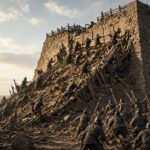

On the morning of 14 October 1322, the air above the Hambleton Hills in Yorkshire carried the smell of wet heather, horse sweat, and the distant smoke of burning English villages. Sutton Bank rose like a wall. The escarpment drops nearly 140 meters in places, a near-vertical scarp of limestone and grit that has stopped armies and cattle drovers alike for centuries. At its top sat several thousand English soldiers under John of Brittany, Earl of Richmond. They held the heights. They controlled the narrow track that climbed the bank. From their position they could see the Vale of Mowbray stretching west toward the Pennines. They expected a frontal assault up the steep path. They did not expect what arrived instead.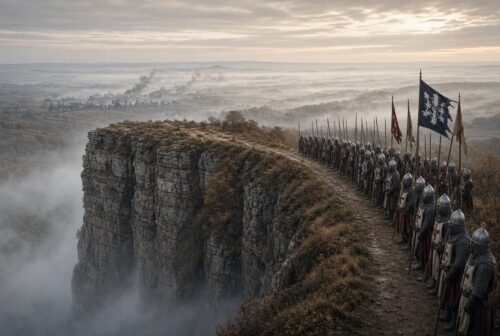
Robert the Bruce, King of Scots, had marched his men overnight from Northallerton. His army, drawn from the lowlands and stiffened by Highlanders from Argyll and the Isles, numbered somewhere between 6,000 and 8,000, though only a few thousand would press the fight that morning. The English force facing them was larger on paper—estimates run from 8,000 to 10,000, with only a fraction fully engaged—but they were tired, poorly coordinated, and defending a position that looked impregnable until it was not. Bruce did not send everyone straight up the track. He split the effort. James Douglas and Thomas Randolph, Earl of Moray, pressed the front. A detachment of Highlanders, men used to vertical ground, found a less obvious route along the cliffs to the south, a place later called Scotch Corner. They climbed. They reached the English rear. The line broke.
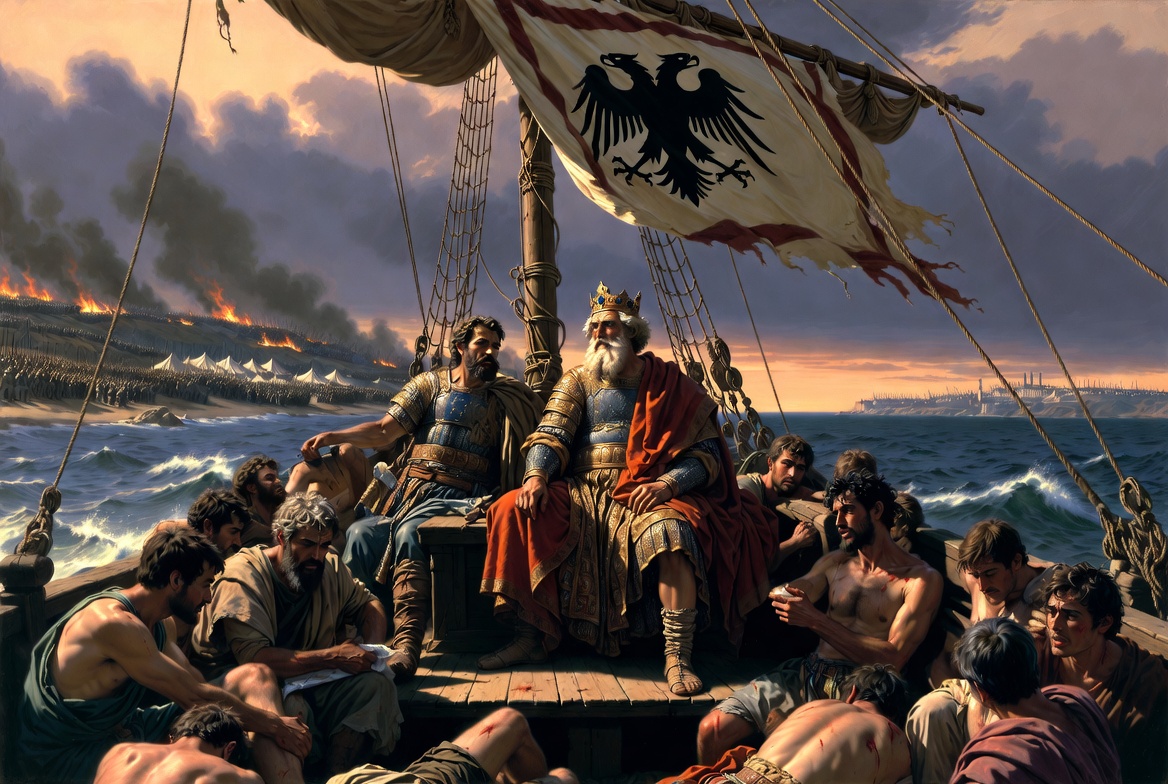
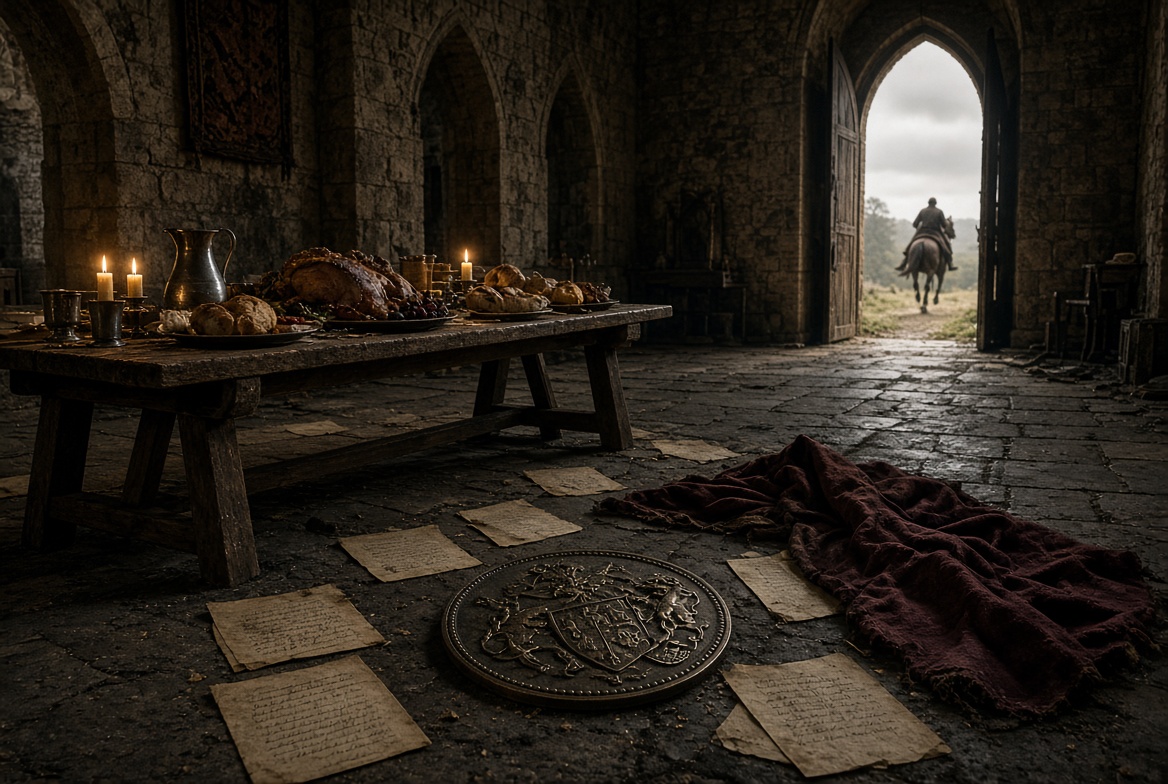
By the end of the day the Earl of Richmond was a prisoner. So was Henri de Sully, Grand Butler of France. Sir Ralph Cobham, called by contemporaries “the best knight in England,” was taken. Sir Thomas Ughtred was among the captured. English dead littered the slope and the ground toward Old Byland and Scawton. King Edward II of England, who had been staying at Rievaulx Abbey a short ride away, was not among them. He fled toward Bridlington looking for a ship, leaving behind his personal treasure, his baggage, and the Great Seal of England. Contemporary accounts say he left his dinner as well. One chronicle called him “ever chicken-hearted and luckless in war.” Sir Thomas Grey, writing later in the *Scalacronica*, summed up the psychological result: after Byland the Scots were so fierce and their chiefs so daring, and the English so cowed, that it was no otherwise between them than as a hare before greyhounds.
This was not a large battle by medieval standards. It was not Bannockburn. Yet it was the most significant Scottish success since 1314, fought deep inside England, and it came close to ending the First War of Scottish Independence by the simple expedient of bagging the English king. The war did not end that day. It ended formally six years later, after Edward II had been deposed and his son Edward III, still under the influence of his mother and Mortimer, signed the Treaty of Edinburgh–Northampton in 1328. That document recognized Scotland as fully independent, Robert the Bruce and his heirs as its rightful rulers, and the border as it had stood under Alexander III. In exchange the Scots paid £20,000 sterling and arranged a marriage between Bruce’s young son David and Edward III’s sister Joan. English nobles called it the “Shameful Peace.” It lasted only five years before Edward III overturned it and the Second War began. Still, for a brief window the independence that Bannockburn had asserted was written into a treaty. Byland helped make that window possible.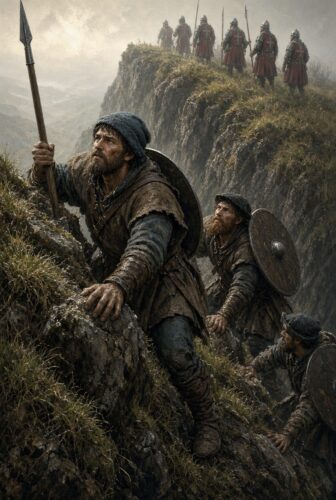
The road to that morning began years earlier. After Bannockburn in 1314, Bruce did not sit still. Scottish raids into northern England became routine. Edward II spent much of his reign fighting his own barons; the murder of Piers Gaveston and the later conflict with Thomas of Lancaster kept English attention divided. Truces came and went. In early 1322 the truce of 1319 expired. Bruce sent raiding columns: Douglas to Hartlepool, Moray to Darlington, Walter Stewart toward Richmond. Lancaster, who had flirted with the idea of dealing with the Scots and even styled himself “King Arthur” in some correspondence, did nothing useful. Edward turned first on his own rebels and defeated them at Boroughbridge in March 1322 under Andrew Harclay. Then, in August, he launched what would be his last invasion of Scotland.
Bruce’s response was classic scorched earth. Crops were burned or removed, livestock driven north of the Forth, the army kept out of reach. The English reached Edinburgh and found almost nothing. The Earl of Surrey reportedly said of one meager find, “This is the dearest beef I ever saw. It surely has cost a thousand pounds and more.” Sickness and famine set in. Grey recorded that the common soldiers were forced to retreat for want of food, that light horse under Douglas harassed them constantly, and that a murrain struck the army before it staggered back to Newcastle. On the way south the English burned Holyrood Abbey and damaged Melrose and Dryburgh. The invasion achieved nothing strategic and damaged English morale almost as badly as Bannockburn had.
Bruce then launched the Great Raid of 1322. He crossed the Solway, moved southeast, picked up additional men from the west, and drove deep into Yorkshire. Edward, returning from the failed campaign, had settled at Rievaulx Abbey with Queen Isabella. On 13 October he learned the Scots were close and ordered Richmond to hold the Hambleton Hills escarpment, especially Sutton Bank. The Scots marched through the night from Northallerton. At first light on the 14th they arrived at the foot of the bank and found the heights occupied. Frontal pressure alone would have been costly. The Highlanders’ climb around the flank turned a strong position into a trap. Resistance collapsed into a rout. Richmond tried to stand and was overwhelmed. Edward rode for the coast, found no ship at Bridlington, continued to York, then Burstwick, and eventually back to London. The Scots took the seal, the treasure, and what remained of the royal dinner. They then spent time extracting money from towns and monasteries, burning what could not pay, and rendering certain castles unusable before withdrawing.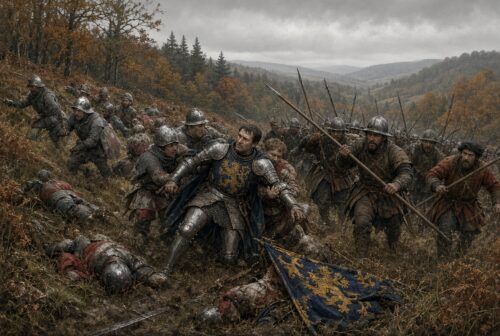
The political consequences were immediate. Andrew Harclay, the same man who had won Boroughbridge for Edward months earlier, concluded that England could no longer sustain the war and opened unauthorized negotiations with Bruce. He was arrested, tried for treason, and executed in 1323. Edward’s position at home continued to weaken. By 1327 he was deposed. The new government, seeking stability, negotiated the 1328 treaty. Bruce died the following year. His heart, according to tradition, was eventually buried at Melrose Abbey—the same abbey the English had damaged in 1322 and that he had helped rebuild.
Modern archaeology has refined the picture. Earlier accounts placed the main fighting on Scawton Moor between Rievaulx and Byland abbeys. Work by the Battlefields Trust, using topography and limited finds, shifted the principal action to Sutton Bank itself, where the medieval track climbs the escarpment. A memorial stone and panel were unveiled there on the 700th anniversary in 2022 by a descendant of Bruce. The landscape still matches the descriptions: steep, narrow approaches, opportunities for flanking climbs, and long sightlines that would have made surprise difficult once the Scots were in the open—but not once part of them was already behind the English line.
Numbers remain approximate, as they often do for medieval actions. Scottish strength is commonly given as 6,000–8,000 for the raid overall, with fewer committed at the decisive moment. English figures range higher but include many who never reached the fighting. Casualties on the Scottish side appear light. English losses in killed and captured were significant relative to the size of the engaged force, and the moral effect was larger still. The capture of senior commanders, the loss of the Great Seal, and the public flight of the king mattered more than raw body counts.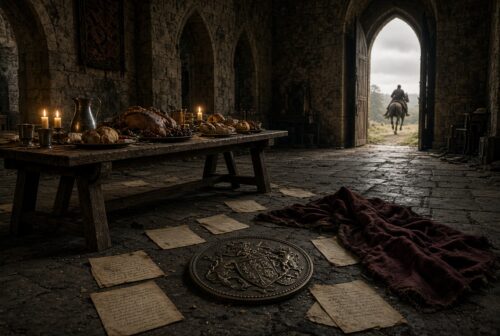
What made the outcome possible was not superior numbers or better equipment. It was mobility, the willingness to march overnight, the decision to divide effort rather than commit everything to the obvious path, and the use of men whose ordinary experience prepared them for the non-obvious route. Bruce had practiced versions of this before, notably at the Pass of Brander, where a flanking force had also broken a strong position. At Byland the same logic applied on a larger stage and closer to the English political center. The high ground looked decisive until the flank was taken. Once it was taken, the position became a liability. The king who had assumed Rievaulx was safe discovered it was not. The seal that symbolized royal authority ended up in Scottish hands. The dinner that had been about to be eaten became a minor but memorable detail in the chronicles.
That sequence—overnight preparation, split effort, frontal pressure paired with a difficult flank, collapse of an apparently strong position—offers a concrete historical pattern rather than a vague metaphor. Most modern advice about obstacles reduces to “try harder,” “stay consistent,” or “visualize success.” Those statements are not wrong; they are also not specific. They do not tell you when to stop pushing the steep track and when to look for the less obvious climb. They do not distinguish between preparation done in ordinary hours and the concentrated, low-visibility effort that corresponds to an overnight march. They rarely require you to name the actual people or resources that will take the flank while another part of your attention holds the front.
The Byland pattern suggests a different sequence. First identify the actual escarpment—the obstacle that currently sits on high ground and looks as though it can only be taken by direct assault. That might be a stalled project whose next steps all run through one overloaded person, a skill gap that every available course treats as a linear climb, a recurring financial leak whose obvious fixes have already failed, or a relationship or habit whose frontal reminders produce only temporary compliance. Name it in one sentence. Measure its height in concrete terms: hours per week it consumes, money it costs, decisions it blocks, or days it has already delayed something else.
Second, conduct the overnight march. This is not “work harder.” It is a bounded, high-intensity preparation block performed outside ordinary working or social hours, focused solely on mapping the flank. Spend one evening or early morning—ninety minutes to three hours—listing every route around the obstacle that does not require the same front-door effort. Who else already possesses the relevant skill or access? What existing tool, dataset, or relationship has not been applied? What smaller version of the outcome could be reached by a different sequence? Write the list on paper. Do not stop until you have at least five non-obvious options, even if some look improbable. This is the equivalent of identifying Scotch Corner before the main force arrives.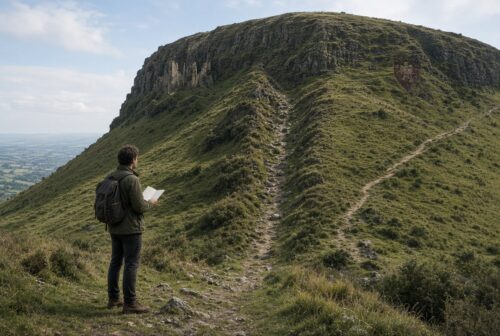
Third, split the force deliberately. Assign one limited stream of effort to the frontal pressure: the regular, visible actions that keep the obstacle from advancing further. That might be a daily fifteen-minute check, a standing weekly message, or a small automatic transfer. Assign a second, separate stream to the flank. The flank stream gets its own time block, its own success metric, and its own person or tool if possible. It does not compete for the same attention as the frontal stream. If the flank requires learning a narrow skill, schedule three short sessions that week rather than hoping the frontal reminders will somehow produce the skill. If it requires asking someone for a specific piece of information or access, make the request on a fixed day and follow it once. The historical parallel is clear: Douglas and Moray held the track while the Highlanders climbed. Neither effort was diluted by trying to do both.
Fourth, set a short decision window. After seven days of the split effort, review only three numbers: whether the frontal pressure held the current line (the obstacle did not worsen), whether any flank action produced a measurable change, and whether a further flank route has become visible. If the flank produced even a partial result—new information, a reduced step, an unexpected ally—double the flank allocation for the next seven days and keep the frontal stream unchanged. If nothing moved, abandon that particular flank route and return to the overnight-march list for the next one. Do not increase the frontal effort as a first response. The English position looked strong until the rear was taken; more men on the track would not have changed the outcome once the climb succeeded.
Fifth, record the seal. At the end of each seven-day cycle, note one concrete item that has left the obstacle’s control and entered yours: a completed sub-task, a reduced cost, a confirmed appointment, a documented process that no longer depends on the original blocker. Treat this the way the Scots treated the captured Great Seal—not as the entire victory, but as visible proof that the high ground is no longer absolute. Keep the record in one place. After four cycles, review whether the original escarpment still requires the same height of effort. Most will have lowered. Some will have been bypassed entirely.
This sequence is narrow by design. It does not require a vision board, a gratitude journal, a morning routine of ten items, or a commitment to “become the kind of person who.” It requires naming one current high-ground obstacle, performing one concentrated mapping session outside normal hours, splitting effort into a holding stream and a climbing stream for seven days, and measuring only whether the flank moved anything. It can be repeated on a new obstacle once the first has been reduced. It works for a stalled work deliverable, a fitness plateau whose obvious training has stalled, a household system that keeps failing in the same place, or a skill that every standard path treats as a long linear climb. The historical result was not the total destruction of the English army; it was the collapse of one strong position, the capture of key figures, the flight of the king, and a measurable shift in the larger war. The personal result is the same scale: one position that no longer blocks progress the way it did, one item of authority or capability transferred, and a clearer map of the next possible climb.
The landscape of Sutton Bank has not changed much. The drop is still steep. The track is still narrow. Visitors can walk the area and see why a frontal assault would have been expensive and why a climb around the southern cliffs would have been decisive once achieved. The same geometry appears in ordinary obstacles. The direct path is visible and defended by habit, limited time, or the assumption that more of the same effort is required. The flank is usually less obvious, requires a different kind of preparation, and only becomes usable once someone has taken the time to locate it and assign effort to it separately. On 14 October 1322 that separation of effort turned a defended escarpment into a rout and left an English king explaining why his seal and his dinner were no longer where he had left them. The same separation, applied to a named obstacle for a fixed number of days, produces a smaller but measurable version of the same result: the high ground loses its automatic advantage, and progress no longer depends on charging straight up the steepest available track.
Share: