
On the morning of October 13 in the year 645, the greatest military commander the Tang dynasty had yet produced stood below the walls of a fortress he could not take and ordered the withdrawal of an army that had already swallowed multiple Goguryeo strongholds, crushed a relief force reported at 150,000 men, and spent more than two months laboring on a man-made mountain of earth intended to carry Tang soldiers over the ramparts. Emperor Taizong—Li Shimin, the man who had seized the throne by force of arms in the Xuanwu Gate Incident, who had broken the Eastern Turks, who had personally ridden into battle more times than most of his generals, and who had directed the campaign into the Liaodong peninsula with his own banners visible from the walls—looked at the unfinished work, the thinning grass, the first real cold of the northern autumn, and the garrison that still answered every assault with crossbow fire and repaired every breach by night, and he gave the order to leave. The fortress commander, whose name the Chinese chronicles never properly recorded and whom later Korean tradition called Yang Manchun, mounted the heights of the wall once the Tang ranks had formed for departure, made a formal bow toward the imperial standard, and received in return one hundred bolts of silk left as a mark of respect for a defense that had been both stubborn and, in the emperor’s eyes, correctly loyal to its own lord. The army that had come with the intention of ending the kingdom of Goguryeo turned and began the long march back toward the Liao River. Many of the men who started that march would not finish it. Winter arrived early on the Liaodong peninsula that year. Grass dried. Water froze. Horses and soldiers died of cold and exhaustion on the roads they had taken in the opposite direction only months earlier.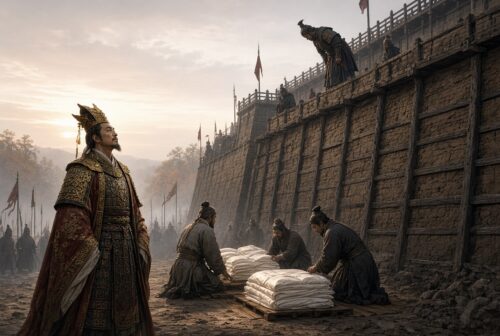
The campaign that ended with that order had begun with every appearance of success. In the spring of 645 Taizong had led the main land force across the Liao while a separate naval contingent under Zhang Liang moved by sea. Border fortresses fell in sequence. Liaodong itself, the great city whose loss had been so costly in earlier wars, was taken. Baegam followed. By the middle of July the Tang host stood before Ansi, a fortified city of perhaps a hundred thousand people whose walls commanded the routes that any further advance toward the Goguryeo capital of Pyongyang would have to use. Advisers had told the emperor that Ansi could be bypassed; its garrison was not large enough, they argued, to threaten a major supply line once the army had moved deeper into the peninsula. Taizong rejected the advice. A fortress left intact behind an advancing army was a knife in the back. Ansi had to fall.
It did not fall. The garrison, reported in later accounts at roughly five thousand effectives for the core fighting force, refused every demand for surrender. When Li Shiji, the veteran general who had served Taizong since the earliest campaigns, asked permission to massacre the male population if the city were taken, the emperor granted it. Word of the threat reached the defenders. They fought harder. Tang assault parties attacked the western face of the walls six or seven times a day with scaling ladders, battering rams, and the fire of siege engines. Each time the ladders were thrown down or burned. Each time the breaches that appeared in the wooden and earthen ramparts were closed again by night. One night a force of several hundred Goguryeo soldiers sallied from a gate and struck the nearest Tang camp. Taizong’s own emergency counterattack drove them back, but the sortie demonstrated that the defenders still possessed both the will and the organization to leave the walls when they chose.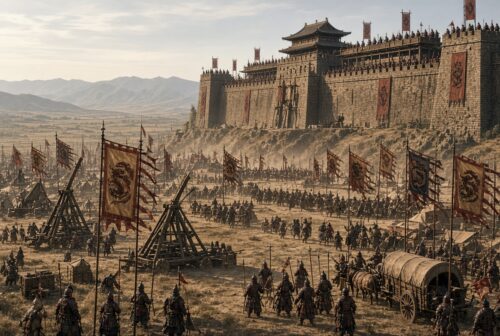
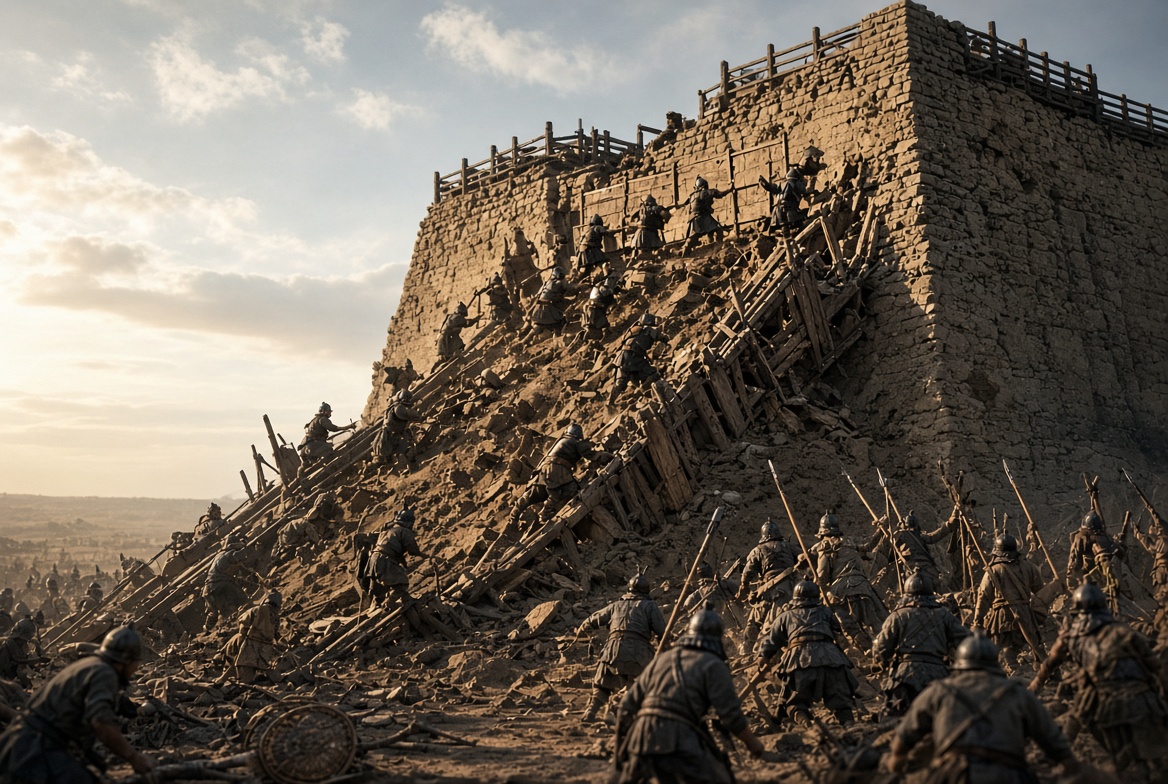
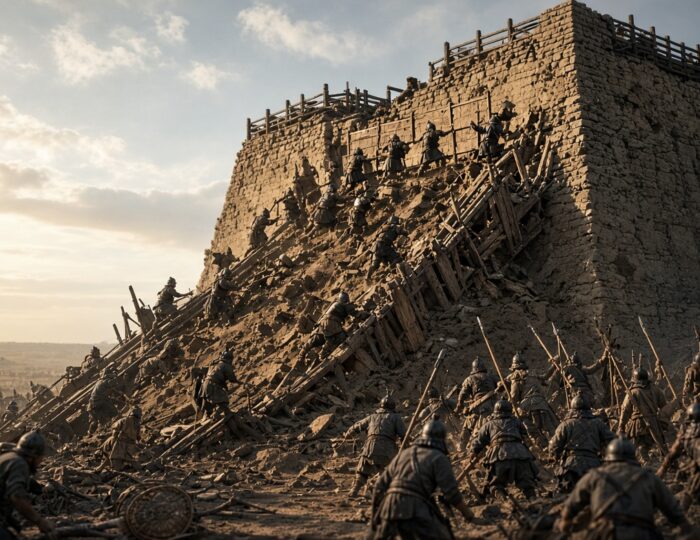
While these direct assaults continued, the engineering solution that was supposed to end the siege took shape on the southeastern corner. Under the direction of the prince Li Daozong, thousands of laborers—soldiers and captured civilians—spent roughly sixty days building a massive earthen ramp that rose toward the wall. The work went on day and night. When the ramp was nearly finished, a man standing on its crest could look down into the interior of the fortress. The plan was simple and ancient: once the ramp was complete, Tang troops would surge across it and over the wall before the defenders could concentrate enough force to stop them. An officer named Fu Fuai was placed in charge of the troops stationed on the finished section of the ramp. He left his post for reasons the chronicles do not fully explain. The ramp, already under stress from its own weight and from the rains that had fallen during construction, partially collapsed. Sections of the fortress wall came down with it. For a moment the Tang army had the opening it had labored two months to create. The defenders seized the collapsed ramp instead. They occupied the wreckage, raised their own barriers on it, and held it against three days of frantic attempts to retake the ground. Fu Fuai was executed. Li Daozong, who had been wounded earlier in the campaign, bared his feet and asked for punishment. Taizong pardoned him. The ramp was lost.
By early October the calculation had changed. Reinforcements for the fortress were reported on the move. More important, the grass that fed the horses was drying. The nights were already cold enough that water left standing froze. Provisions that had been calculated for a shorter campaign were running low. The same Liaodong weather that had destroyed earlier Sui armies was arriving on schedule. On October 13 Taizong ordered the withdrawal. Before the army left he staged a formal demonstration of the Tang host beneath the walls so that the defenders could see the force that was choosing to depart. The fortress commander appeared on the rampart, bowed, and was answered with the gift of silk. The Tang columns then turned south and west. They carried with them large numbers of civilians who had been gathered from the territories already overrun. Many of those civilians, and many of the soldiers, died on the return march when the full winter set in.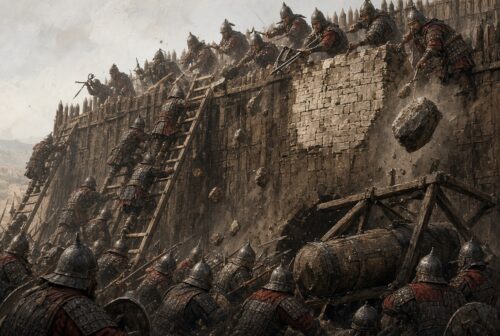
The failure at Ansi did not end the war. Tang and its ally Silla would return in later years. Goguryeo would fall in 668. But the 645 campaign, the one the emperor had led in person, had been stopped by a single fortress that refused to open and by a decision, made on a specific October day, to stop spending men and horses against a wall that the weather and the calendar were already beginning to reinforce. The chronicles note that the name of the man who commanded that wall was not preserved in the official Tang records. The *Samguk Sagi*, the Korean history compiled centuries later, lamented the loss. Later popular tradition supplied the name Yang Manchun and added the story that he personally wounded the emperor with an arrow. What the contemporary sources preserve is narrower and more precise: a garrison that repaired its walls every night, a ramp that collapsed at the worst possible moment for the attackers, a formal bow from the heights, one hundred bolts of silk, and an imperial order issued on the thirteenth day of the tenth month that sent the greatest army then operating in East Asia back the way it had come.
The same logic that governed the order of October 13 still governs any long effort whose costs rise faster than its returns. A person facing a project, a relationship, a job, or a habit that has already consumed months of labor, money, or attention can treat the Ansi decision as a concrete audit rather than a vague encouragement to “know when to quit.”
– On the evening of the thirteenth day of any month in which a major effort has already run past its original calendar, sit with a single sheet of paper and list every resource that has been spent since the effort began: hours, money, sleep, relationships that have been postponed, skills that have not been practiced. Write the numbers without commentary.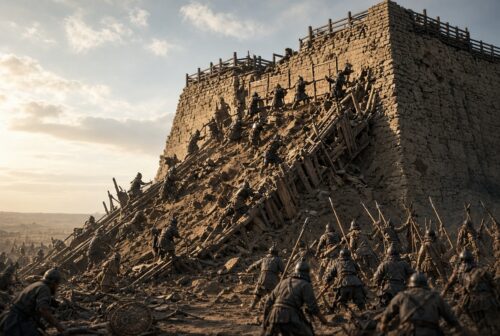
– On the same sheet, list every concrete result that has been produced in the last thirty days and only in the last thirty days. If the list is empty or consists of preparations for future results rather than results themselves, mark the line.
– Compare the two lists to the original plan that was written when the effort started. If the plan assumed that a “ramp” of additional work would be finished by a certain date and that ramp is now incomplete, damaged, or occupied by the problem it was meant to overcome, note the exact date the plan first diverged.
– If the grass is drying—if the external conditions that made the effort viable (funding, energy, market timing, physical health, the cooperation of other people) are measurably worse than they were thirty days earlier—write the single sentence: “The weather has changed.”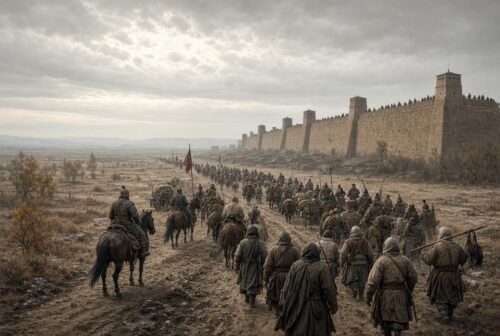
– The next morning, before any further work begins, make one binary choice and write it at the bottom of the sheet: continue with a fixed end date no more than fourteen days away, or issue the withdrawal order and spend the next fourteen days extracting whatever useful material can still be recovered. Do not add a third option.
The sheet is discarded or filed after the fourteen days. The choice is not revisited until the next thirteenth. The method requires no external coach, no vision board, and no redefinition of success. It requires only the same arithmetic Taizong performed when the ramp collapsed, the nights turned cold, and the fortress commander still stood on the wall.
Share: