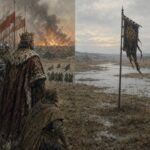

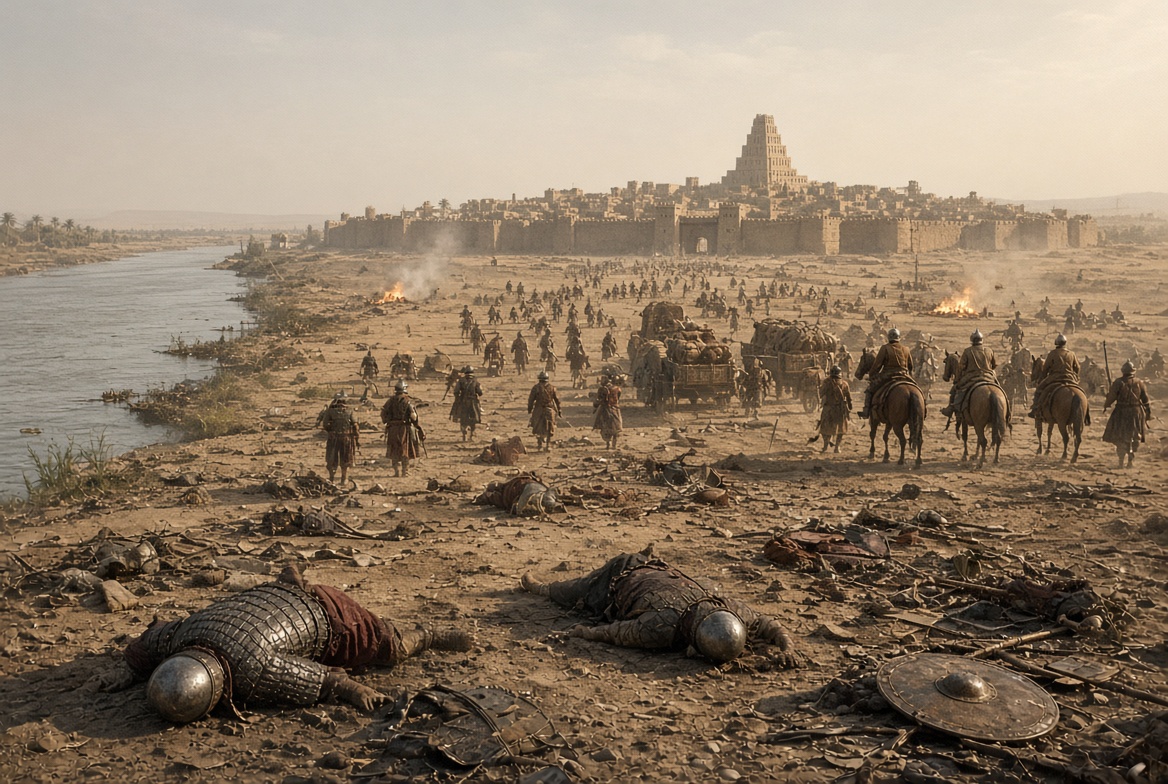
On the evening of the sixteenth day of the month Tašrītu in the seventeenth year of Nabonidus—October 12, 539 BC by the Julian calendar—the Euphrates River, which normally ran through the middle of Babylon like a liquid spine, was lower than it had been in living memory. The massive walls of the city, built by Nebuchadnezzar II out of baked brick and bitumen, still stood. The Ishtar Gate still gleamed with its blue glazed bricks and processions of dragons and bulls. The ziggurat of Etemenanki, the temple tower that later storytellers would call the Tower of Babel, still rose above the rooftops. Inside the palace, according to both the Greek historian Herodotus and the Book of Daniel, a feast was underway. Belshazzar, the crown prince and de facto ruler while his father was elsewhere, had called for the gold and silver vessels taken decades earlier from the Temple in Jerusalem. Wine was poured. The nobles drank. Outside, in the riverbed that ran under the walls, men in unfamiliar armor were walking.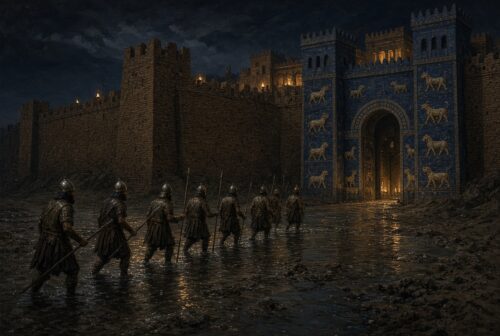
The Babylonian sources do not describe a siege of the city itself. The Nabonidus Chronicle, a clay tablet that records events year by year in the dry style of official annals, says that Ugbaru (called Gobryas in Greek sources), the governor of Gutium and an ally of Cyrus the Great of Persia, entered Babylon with the army of Cyrus “without battle.” The Cyrus Cylinder, a barrel-shaped foundation deposit written in Akkadian cuneiform and placed in the walls of the city after the takeover, has Marduk, the chief god of Babylon, choosing Cyrus as his instrument and delivering the city to him “without fighting or battle.” The Greek accounts add drama: Cyrus’s engineers diverted the Euphrates into a side channel or an old marsh so that the water level under the walls dropped enough for soldiers to wade in. Guards who should have been watching the river gates were instead at the festival. The gates were open or weakly held. By morning the city belonged to the Persians.
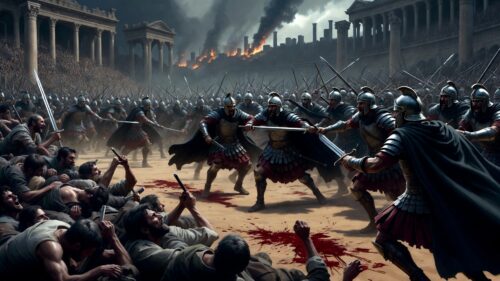
This was not a random raid. It was the culmination of a short, brutal campaign that had begun weeks earlier on the Tigris. In the same month of Tašrītu, Cyrus had fought the Babylonian army at Opis. The Chronicle is blunt: the people of Akkad retreated, Cyrus carried off the plunder, and he slaughtered the inhabitants. Two days later, on the fourteenth of the month, the city of Sippar surrendered without a fight. Nabonidus fled. On the sixteenth, Babylon itself opened. Nabonidus was later captured in the city. The temples were left undisturbed. The regular rites continued. Shield-bearing Gutian troops stood at the gates of Esagil, the great temple of Marduk, but “nobody carried arms in Esagila and its buildings.” The correct time for ceremonies was not missed. Seventeen days later, on the third day of the month Arahsamna (roughly October 29), Cyrus himself entered the city, was greeted, and began the work of presenting himself as the restorer rather than the destroyer.
The man who had been ruling Babylon while this happened was not the energetic conqueror his father had once been. Nabonidus had spent years of his reign in the oasis of Tayma in the Arabian desert, promoting the cult of the moon god Sin over the traditional worship of Marduk. He had neglected the Akitu New Year festival that required the king’s presence. He had ordered the gods of other cities brought into Babylon for safekeeping, which many Babylonians saw as a violation of the proper order. The priesthood of Marduk was alienated. Parts of the population were ready for a change. When Cyrus’s army appeared after the victory at Opis, enough people inside the city preferred a new arrangement to continued resistance that the gates did not need to be forced.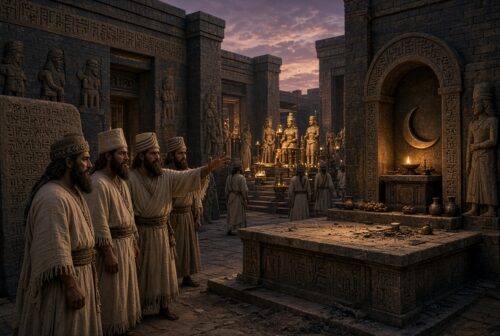
Cyrus understood the politics of the moment. The Cylinder, written after the fact in the language and form of a traditional Babylonian royal inscription, has Marduk searching the lands for a righteous king, taking Cyrus by the hand, and calling his name. Cyrus claims he entered Babylon as a friend, that his troops walked about undisturbed, that he did not allow anyone to terrorize the land of Sumer and Akkad, that he soothed the weariness of the people and freed them from an unbecoming yoke. He returned the gods that Nabonidus had gathered to their own sanctuaries. He allowed displaced peoples, including the Jews who had been taken into captivity by Nebuchadnezzar decades earlier, to return home and rebuild their temples. The biblical Book of Ezra records a decree attributed to Cyrus authorizing the reconstruction of the Temple in Jerusalem. Whether every detail of the Cylinder is propaganda is beside the point; the policy of allowing local cults and returning exiles was real enough that the city did not rise in sustained revolt in the immediate aftermath. Gobryas, the man who had walked in on the sixteenth, died a few weeks later. Cyrus installed governors and continued the administration. Babylon remained a major city under Persian rule for two centuries.
The discrepancies between the sources are instructive. The Babylonian Chronicle and the Cylinder emphasize the lack of fighting inside the city and the continuity of cult. Herodotus and Xenophon, writing later and for Greek audiences, describe a siege, a diverted river, and a surprise entry during a festival. The Book of Daniel focuses on Belshazzar’s feast, the mysterious writing on the wall that announced the end of his kingdom, and his death that same night. Modern historians note that the Chronicle records a real battle and massacre at Opis before the bloodless entry into Babylon, so the takeover was not entirely peaceful. What the different accounts share is the speed of the collapse once the field army had been beaten and the internal discontent had been exploited. The oldest continuous urban civilization in the region changed hands because the people who controlled the gates decided, for reasons that included religious grievance and political calculation, that resistance was not worth it.
Nabonidus had spent years away from the capital. He had elevated a secondary god. He had disrupted the normal circulation of divine images. He had left his son in charge while the professional army was defeated on the Tigris. The Persians did not need to dismantle the walls brick by brick. They needed one hard fight elsewhere, a lower river or open gates, and enough people inside who already disliked the current arrangement. On the night of October 12 the festival continued, the wine was poured, and the city changed owners.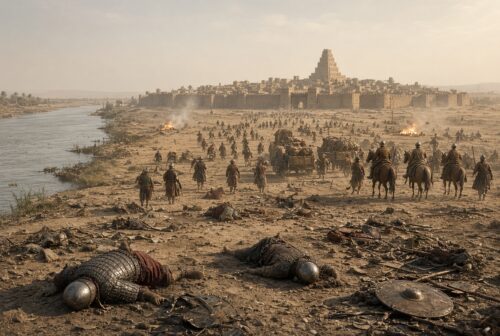
That sequence—defeat the concentrated force in the open, divert or lower the resource that feeds the obstacle, enter the protected space while the defenders are occupied with their own ritual, and then present the new arrangement as the restoration of neglected order—contains a usable pattern. Most modern advice about difficult goals treats the obstacle as a wall that must be scaled or smashed. The October 12 pattern treats the wall as secondary. The primary work is done on the river that runs under it and on the people who hold the keys.
**The Euphrates Diversion Protocol**
The protocol is built for one concrete, previously resistant goal. It runs for twenty-one days. It does not require new habits of journaling, affirmations, or morning routines. It requires three specific measurements, two deliberate diversions, and one quiet entry. The measurements are taken on paper or in a single note file that is not shared. The diversions are physical or digital actions that reduce the flow of attention, money, or social energy into the current arrangement. The entry is a single action taken on a day when the usual defenses are occupied.
**Day 1–3: Map the river and the neglected god.**
Write down the single goal that has resisted direct effort for at least six months. Name the “city walls”: the people, rules, schedules, or self-imposed standards that currently block entry. Name the “Euphrates”: the continuous flow of time, money, attention, or emotional energy that keeps the current arrangement alive. For most people this is a specific recurring activity or relationship that consumes hours each week and produces little progress toward the goal. Measure it for three days with a timer or a bank statement. Do not optimize it yet. Record the exact hours or dollars. Also name the “Marduk”: the core capacity or standard that has been neglected while attention went elsewhere. This is usually a skill, a relationship, or a physical condition that was once central and has been treated as optional. Write one sentence describing what “returning the god to its sanctuary” would look like in practice.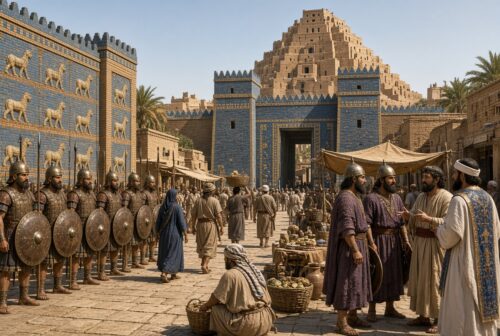
**Day 4–7: Create the Opis.**
Identify the single concentrated resistance that must be beaten in the open before the city can be entered. This is not the goal itself. It is the smaller, external obstacle whose defeat removes the excuse that “the timing is wrong.” Examples: finish the one document that a decision-maker has been waiting for; complete the certification that a client requires; clear the specific debt or inventory item that blocks the next step. Schedule the work for three focused blocks of ninety minutes. Do not discuss the larger goal during these blocks. Treat the smaller obstacle as the only battle. When it is finished, record the date and the exact result. This is the modern equivalent of the fight at Opis: costly, limited, and decisive enough that the larger structure no longer has a field army in the way.
**Day 8–14: Lower the water.**
Divert the measured flow for seven consecutive days. If the Euphrates is evening television or social media that consumes two hours, the diversion is a hard cutoff at a fixed time and the physical removal of the device from the room. If it is a recurring social obligation that produces no progress, the diversion is a temporary, explicit reduction in frequency with a stated end date. If it is a financial leak, the diversion is an automatic transfer of that exact amount into a separate account that can only be used for the neglected capacity. The point is not permanent deprivation. It is a temporary drop in the level of the resource that has been supporting the status quo. During these seven days, spend the freed resource only on the neglected capacity identified on Day 1. Track the hours or dollars that actually moved. At the end of the seven days, the river is measurably lower.
**Day 15–18: Watch the festival.**
Do not attempt the main entry yet. Observe the ordinary schedule of the people or systems that normally defend the walls. Note the recurring events—meetings, family routines, reporting cycles—during which attention is elsewhere. Choose one specific window of two to four hours in the next three days when those defenses will be occupied with their own ritual. Prepare the single action that constitutes entry: the email that proposes the new arrangement, the physical move of equipment into the space, the conversation that states the changed terms, or the submission of the completed work product. Write the action in one sentence. Do not send it or perform it yet.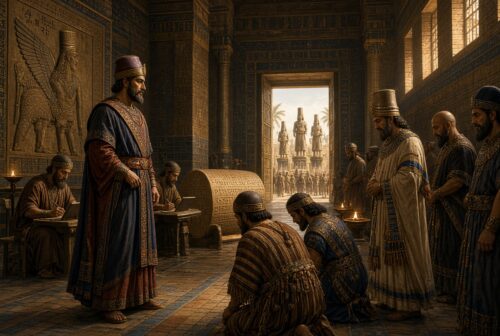
**Day 19–21: Enter without battle.**
On the chosen window, perform the prepared action. Do not announce a campaign. Do not list the previous failures. State the new arrangement in the language of restoration: the neglected capacity is being returned to its proper place, the diverted resource is now supporting that capacity, and the smaller obstacle has already been cleared. If the response is neutral or positive, continue the reduced flow for another seven days while the new arrangement stabilizes. If the response is resistance, return to the Opis step with a smaller external obstacle rather than escalating the direct confrontation. The protocol ends when the new arrangement has survived one full cycle of the previous schedule without requiring a second direct assault.
The pattern does not guarantee success. The Chronicle records that Nabonidus was captured and that Gobryas later died. Cyrus still had to govern. What the pattern does is remove the requirement that every obstacle be treated as a wall that must be climbed while the river continues to run at full height underneath it. On October 12, 539 BC, the oldest city in the region changed hands because the people who controlled the gates had already decided that the current king’s arrangement was no longer worth defending, the field army had already been beaten, and the water level was low enough that walking in was possible. The same sequence—clear the open fight, lower the sustaining flow, enter while the usual defenses are occupied, and present the change as the return of something that had been neglected—remains available whenever a goal has resisted direct assault for longer than the defenders have been willing to stay awake.
Share: