
Picture a dusty coastal road ten Roman miles south of Carthage. The milestone is not a monument. It is a number. Ad Decimum. The tenth. On one side the Mediterranean glitters like a cheap coin. On the other a salt flat called Pedion Halon lies white and empty, a place so hostile that even weeds refuse to live there. Between them runs the only decent road a large army can use if it wants to walk into the old capital of Roman Africa without drowning in dunes or getting pinned against the sea.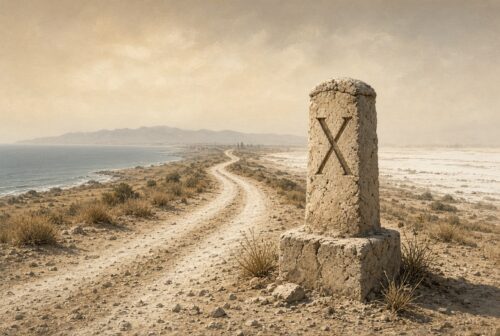
On the morning of 13 September 533, three Vandal columns were supposed to close on that milestone like the fingers of a fist. One from the city to the north. One across the salt from the west. One from the south, behind the invaders, to slam the lid. If the timing had been clean, the Eastern Roman army of Belisarius would have died in a bottle. Instead a king found his brother’s body on a hill, sat down inside his own victory, and forgot to give the last order.
That is the day. Not a slogan. A specific failure of clocks and nerves on a specific piece of North African dirt, 1,493 years ago today.
## The Kingdom That Should Not Have Been There
A century earlier the Vandals had done the unthinkable. In 429 they crossed from Spain into Africa under Geiseric. In 439 they took Carthage. In 455 they sacked Rome itself and carried the bronze roof tiles home. They were not a horde of tent-dwellers. They were a maritime warrior aristocracy sitting on the grain basket that had once fed the city of Rome. Their kings minted coins. They kept a fleet. They persecuted Nicene Christians when it suited them and tolerated them when it did not. They were Arians, which in the sixth century was not a theological footnote. It was a reason to hate a neighbor and confiscate his church.
By 530 the kingdom looked comfortable and brittle at the same time. King Hilderic, grandson of Geiseric and, through his mother, of the old Roman emperor Valentinian III, leaned toward Constantinople. He stopped persecuting Catholics. He let imperial portraits back into circulation. He was, in the eyes of many Vandals, going soft in the exact way a Germanic warrior elite is not supposed to go soft. In 531 his cousin Gelimer deposed him, locked him up, and took the throne. Gelimer was the better fighter and the worse diplomat. He had the blood and the horsemen. He did not have the friendship of the man in the palace on the Bosporus.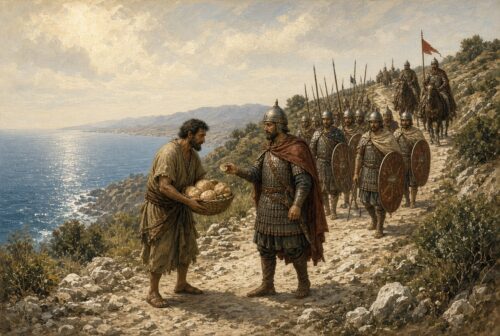
Justinian I had been looking for a pretext since he put the diadem on. The Western Empire was gone. Italy was Ostrogothic. Spain was Visigothic. Africa was Vandal. Justinian’s lawyers could recite a hundred justifications. The useful one was simple: Hilderic was a friend of the empire and a Catholic-leaning king, and Gelimer had no right to cage him. When Gelimer answered imperial letters with contempt, the expedition was commissioned.
This was not a casual raid. The last great attempt to break the Vandals, in 468, had been a catastrophe of fire ships, bad coordination, and ruinous expense under Basiliscus. The memory sat in every staff meeting like a ghost at the table. Justinian still sent the fleet. The man he chose to command it was Flavius Belisarius, already blooded in the East against the Persians, already trusted enough to be given an independent army far from home with a wife, Antonina, on the flagship and a secretary-historian named Procopius riding in the dust.
The force that left Constantinople was not a nation in arms. It was a surgical instrument. About 10,000 infantry. About 5,000 cavalry. Six hundred Hunnic horse-archers, Massagetae in Procopius’s old-fashioned language. Four hundred Heruls. Allied foederati. Belisarius’s own household bucellarii, the professional killers who ate his bread and fought as if the general’s reputation were a second shield. The fleet was large enough to frighten a coastline and small enough that one storm or one night of indiscipline could end the war before it started.
They landed in early September at Caput Vada, far south of Carthage, on a beach the Vandals had not bothered to watch. That choice was the first quiet brilliance of the campaign. Everyone in Carthage expected an attack on the harbors they knew. Belisarius came in where the maps were boring.
## The March That Refused to Loot
From Caput Vada the army walked north. This is the part modern summaries skip, and it is the part that made 13 September possible. Africa in 533 was not empty. It was full of Roman-speaking farmers, African cities that still thought of themselves as Roman under a German king, and a countryside that remembered what imperial armies did when they were hungry. Belisarius issued the order that separates a reconquest from a raid: the people of the land were Romans. They were not to be robbed. Supplies would be paid for. A soldier who stole from a villager would answer for it in front of the standards.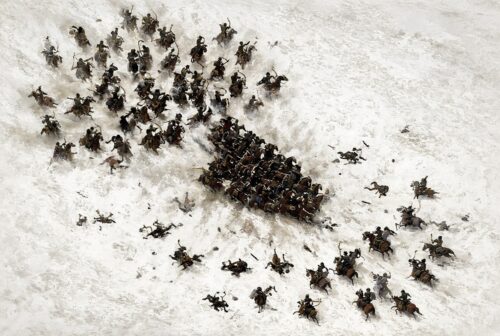
Procopius, who was there, makes the point with the glee of a man who knows how rare such an order is. The locals started bringing food. Guides appeared. The road to Carthage began to feel less like enemy country and more like a province waiting to see which flag would still be standing at the end of the week.
They halted at a place Procopius calls Grasse, a Vandal pleasure park with water, fruit trees, and the sort of idle luxury that makes an invading officer both grateful and suspicious. Four days from there to Ad Decimum. Seventy stades — roughly eight to ten modern miles — from the milestone to the walls of Carthage. The fleet hugged the coast where it could. Then the road bent inland enough that the sails disappeared. That inland stretch was the killing ground Gelimer had chosen.
Gelimer was not in Carthage when the landing news arrived. He was inland, dealing with a Moorish problem, the way Vandal kings always had a Moorish problem. He sent two letters that tell you everything about the man. To his brother Ammatas in Carthage: kill Hilderic and the rest of the imprisoned royal house immediately, then arm every Vandal in the city and march south to the tenth milestone. To his nephew Gibamund: take two thousand riders and swing wide to the left of the coastal road, across the salt country, and hit the Roman column in the flank when it bunches at the defile. Gelimer himself would bring the main army up from the rear and close the bag.
Kill the old king. Block the road. Smash the flank. Crush the rear. On a slate it is beautiful.
Hilderic died in his cell. That part of the plan worked.
## Three Arrows, One Clock
Understand the geometry or the day makes no sense.
The coastal road near Ad Decimum narrows. An army marching in column is long, tired, and half blind. Ammatas, coming south from Carthage with the city levy — modern estimates put his potential strength in the thousands, perhaps six or seven if he had waited for all of them — was the cork. He was supposed to pin the Roman head in place. Gibamund’s two thousand were the blade from the west, across Pedion Halon, the salt plain forty stades off the milestone, a blank white sheet where cavalry can see forever and infantry has nowhere to hide. Gelimer’s own column was the hammer from the south. Three forces. One hour. One place.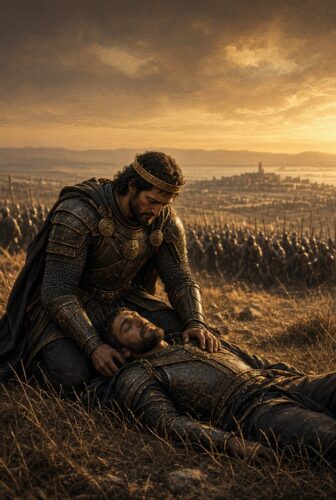
Belisarius, who had not read Gelimer’s letters but had read every disaster in Roman military memory, arranged his own army as if he expected to be ambushed even when the country looked friendly. John the Armenian, one of his best officers, took a small cavalry vanguard up the road. The Hunnic horse rode on the left — the inland side, the dangerous side. Belisarius kept the bulk of the cavalry and the infantry back, close enough to intervene, far enough not to stumble into a prepared killing ground with the whole expedition.
Procopius says it outright: if Belisarius had not screened left and front that way, they would never have escaped. He also says the other half of the truth. If Ammatas had arrived on time with the whole Carthage host, the screening would not have been enough.
Ammatas did not arrive on time. He arrived at about midday, a quarter of a day early, and he did not bring the host. He came ahead with a handful of men, the impatient brother, the man who wanted the glory of first contact. He ran into John’s vanguard.
What followed was small, vicious, and decisive. Ammatas killed twelve of the best men in the Roman front rank with his own hands. Then he went down. The little Vandal party broke. The fugitives, running north toward Carthage, met the rest of their own army coming the other way, still strung out on the road, not formed, not ready. Panic is contagious in a column. The men coming from the city saw their own people fleeing and turned around. John the Armenian, who had just survived a fight he was not supposed to win, did the unfashionable thing. He chased them. He chased them for miles. He killed stragglers all the way to the shadow of Carthage’s walls. The cork that was supposed to hold the bottle had become a stampede back into the city.
At roughly the same hour, forty stades to the left, Gibamund’s two thousand rode onto the salt.
They expected to find the flank of a marching Roman army. They found six hundred Huns.
The numbers look lopsided until you remember what Hunnic cavalry were for. They were not decorative. They were professional horse-archers whose grandfathers had terrified half of Europe. The Vandals had heard of them. They had not met them. On a flat, treeless, waterless sheet of salt there is no clever terrain trick. There is only who shoots first and who holds. The Huns did not break. Gibamund’s command was destroyed. Procopius’s language is absolute: they were all killed. The western arrow snapped off in the air.
Two of Gelimer’s three arrows were gone before he arrived.
## The Hill and the Body
Gelimer came up from the south with the main Vandal army and did what a competent commander does when he hits a confused enemy screen. He hit it hard. The Roman detachments at the milestone were driven. For a stretch of that afternoon the battle looked like the plan on the slate. The invaders were staggered. The road behind them was not secure. A king with his blood up could have ridden through the gap, finished John’s isolated chase parties, rolled up the Huns while they were still wiping salt off their blades, and met Belisarius’s main body while it was still trying to understand which direction the disaster was coming from.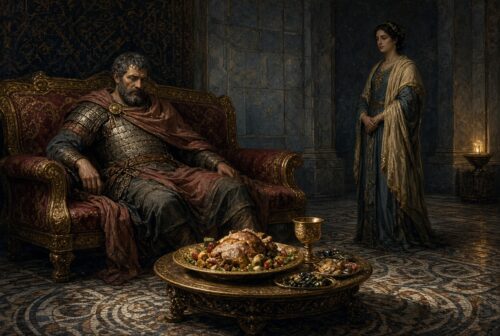
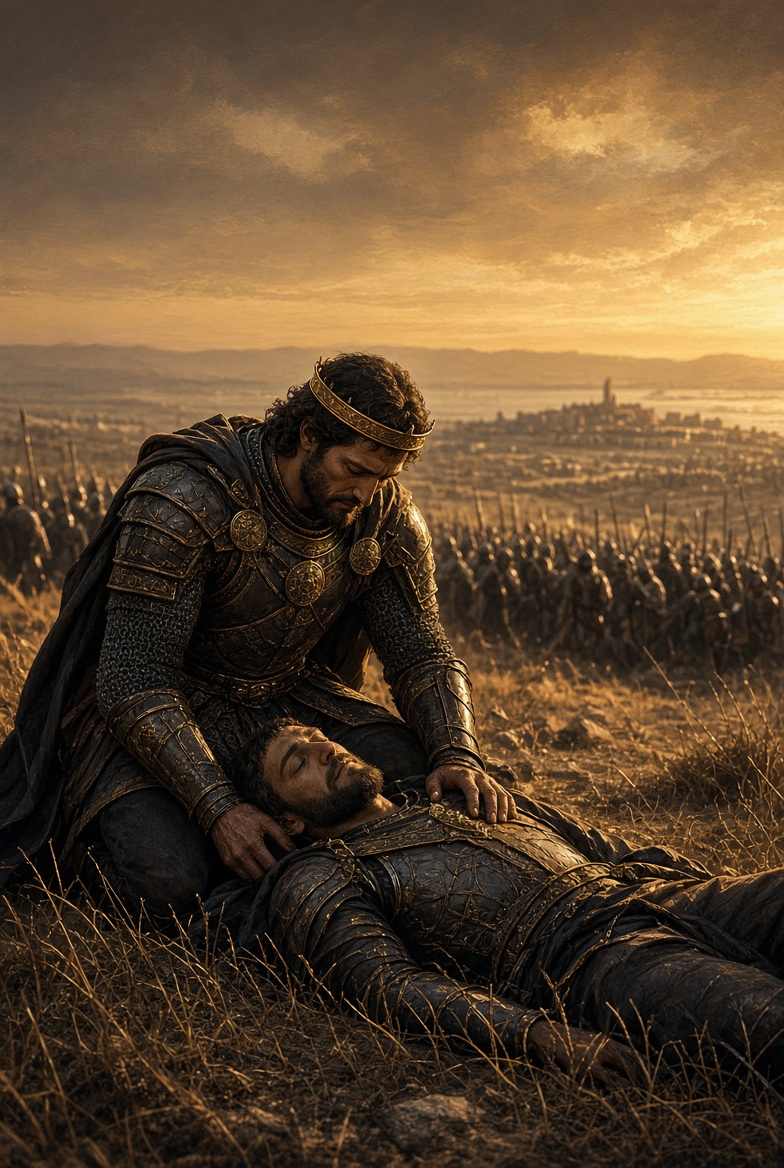
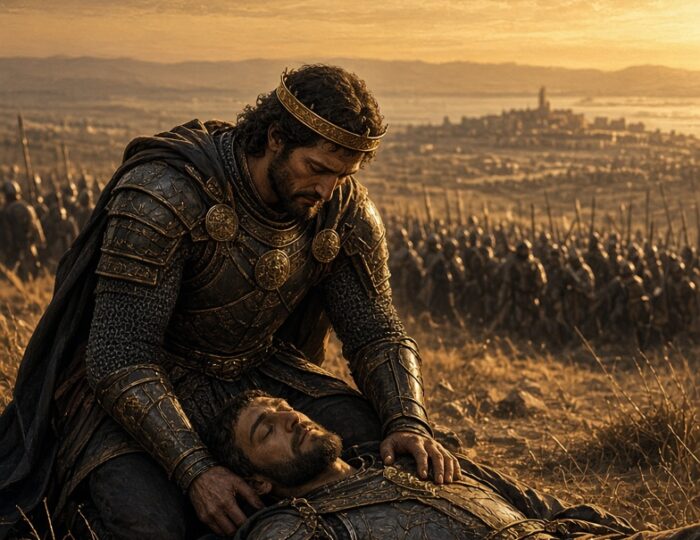
Gelimer reached the high ground. He found the body of Ammatas.
Procopius, who disliked theatrical kings and loved a moral, says the king was overcome. He stopped. He delayed the pursuit. He occupied himself with the corpse of his brother — in some later retellings even composing a lament — while the one hour that still belonged to him leaked into the dust. Historians have argued for centuries about how much of that scene is literary dressing. The military fact underneath the dressing is not in dispute. At the moment when the Vandal main body had local superiority and the Roman army was still in pieces, the Vandal command paused.
Belisarius used pauses the way other men use swords.
He had kept his nerve all morning. He had not flung the infantry into an unseen defile. He had not let the whole expedition chase a rumor. When the reports from front and left finally painted the real picture — Ammatas dead, Gibamund erased, Gelimer on the hill and not moving like a man who still had a plan — Belisarius brought the cavalry up and hit the Vandal center while it was emotionally unemployed.
The Vandal line, which had been winning a meeting engagement, became a crowd. Crowds do not hold against household cavalry that still has a general giving verbs. Gelimer left the field. He did not fall back on Carthage. He ran west, toward Numidia, toward the interior, toward the hope that his other brother Tzazo, who was off the map with a separate force in Sardinia putting down a revolt, might someday come home and make the world make sense again.
The Romans took the Vandal camp. They took the money in it. They took the women and the baggage. They pursued into the night. Procopius, counting with a staff officer’s coldness after a later related fight, would note tiny Roman losses against hundreds of Vandals; the exact butcher’s bill for Ad Decimum is argued, but the shape is not. The field army of the kingdom had been cracked in an afternoon by a force that had no business winning a coordinated three-sided ambush.
## The Dinner Cooked for Someone Else
Belisarius did not roll into Carthage in the dark. That is the second unfashionable decision of the week. Night entries into rich cities are how expeditions turn into riots and how “liberators” become the next occupying barbarians. He camped. He waited for the infantry. He let the city look at his fires and decide whether it wanted to be stormed.
On 15 September — some reconstructions say the 14th, the day after the battle — he walked in. The gates were open. The population, Roman in language and habit after a century of Vandal overlay, did not fight. Belisarius gave the same order he had given on the road: these people are Romans. Do not enslave them. Do not sack the houses. The fleet under Calonymus, which had been circling toward the harbors with the usual nautical ideas about portable wealth, had to be watched like a second enemy.
Belisarius went to the palace and sat on Gelimer’s throne. The detail Procopius could not resist, because it is too perfect to invent and too mean to omit, is the lunch. The cooks had prepared a meal for the Vandal court. The Vandal court was in the hills or in the ground. The Eastern Roman officers ate it. Same plates. Same kitchen. Different king.
Then Belisarius did the unglamorous work that keeps a miracle from evaporating. He repaired the walls Carthage had let crumble during the fat years. He put the fleet into the Lake of Tunis. He treated the city as a recovered province, not a prize. Gelimer still had a kingdom in the west and a brother at sea. In December, at Tricamarum, the Vandals would try once more, Tzazo would die, and Gelimer would end up a hunted man on a mountain. In 534 he surrendered. Justinian gave him an estate in Galatia and the polite fiction of rank. The Vandal name, language, and court style lasted about as long as a generation of mixed marriages and confiscated Arian churches. Africa became an imperial prefecture again. The grain and the tax registers and the old Roman roads belonged to Constantinople.
Ad Decimum was not the last fight. It was the fight that made the last fight possible. Without 13 September there is no open gate on the 15th. Without the open gate there is no repaired wall, no secure harbor, no winter base, no second battle on Roman terms. A century of Vandal sea power ended because a blocking force showed up early, a flanking force met the wrong six hundred men on a salt flat, and a king gave his afternoon to a corpse.
## What the Milestone Actually Teaches
Strip the purple and the lances and the story is still ugly and useful. Gelimer’s plan was better than Belisarius’s plan. Three-axis convergence on a choke point is how you destroy a column that out-disciplines you. The Vandals had the home ground, the extra horses, the shorter interior lines, and a capital ten miles behind the cork. They lost because the three axes did not share a clock, and because the man who still had a reserve spent the reserve’s hour on grief.
Belisarius did not win by being the most passionate man on the field. He won by refusing to feed his whole army into a defile he could not see, by putting a mean little screen on the inland flank, by keeping a decision-maker uncommitted until the other side’s decision-maker became a mourner, and by walking into the city the next day as if the lunch in the palace had always been his.
That is the usable wreckage of 13 September 533.
## How a Person Turns That Afternoon Into a Life
The benefit is not “be brave” or “never feel sad.” Those slogans would have gotten Belisarius killed at noon and would have made Gelimer a tragic hero instead of a cautionary one. The benefit is narrower and meaner and therefore more valuable.
A life, like that road, has choke points. A job change, a health scare, a debt cliff, a conversation that will split a family, a project that only works if three moving parts arrive at the same hour. Most people build a beautiful three-column plan and then either launch one column early out of anxiety or freeze the main column when the first piece of bad news arrives. The field is lost in the pause, not in the planning.
Specific applications:
– Treat every important move as a three-column problem. Name the cork (the thing that must hold the line), the flank (the unglamorous protection nobody wants to fund), and the hammer (the reserve you do not spend until you know which of the first two actually broke). If you cannot name all three, you do not have a plan. You have a hope with a calendar invite.
– Never let the cork leave home early with a handful of favorites. Ammatas died because he wanted first contact more than he wanted the army. If your “blocking force” is a contract, a savings buffer, a second skill, or a person who is supposed to stall a crisis, it only works at full strength and on the agreed hour.
– Put Huns on the salt flat. The left flank is the side of the road nobody writes poems about: the boring insurance, the extra rehearsal, the friend who will tell you the truth, the small daily practice that looks like overkill until the day the nephew with two thousand riders comes over the white ground. Six hundred professionals in the right empty place beat two thousand aristocrats in the wrong one.
– Write the order before the body is on the hill. Gelimer’s disaster was not love of his brother. It was the absence of a pre-written next verb. Grief is guaranteed. Command during grief is not. The person who benefits from Ad Decimum is the person who, in a calm week, writes the sentence that will still be valid when the worst message lands: “If X dies / fails / leaves, I do Y within one hour, then I mourn.”
– Do not sack the province you came to recover. Belisarius’s no-loot rule is the difference between a short thrill and a durable win. In a modern life that means not torching relationships, health, or reputation for a single afternoon of being right.
– Eat the lunch, then fix the walls. When a competitor, a former version of yourself, or a stalled project leaves resources on the table — tools, a slot in a schedule, a half-finished system — take them the next morning and immediately spend the first hours on unglamorous fortification. The throne is a chair. The walls are why you still have the chair in December.
## The Tenth Milestone Protocol
This is not a morning routine, a gratitude journal, a vision board, or a thirty-day challenge. Those already litter the road. This is a field drill stolen from one afternoon in 533 and run on paper, on a timer, and on a physical object.
Get a cheap stone, a bolt, a coin, or a piece of scrap wood. Mark it X / 10. That is your milestone. It lives in one pocket or on one desk and nowhere else. It is not décor. It is a trigger.
Once a week, on the same weekday, sit for twenty-two minutes — the length of a short ancient watch — and run the protocol in writing, in ink, on one page.
- Name the live campaign in one sentence. Not a life purpose. The thing actually in motion this month.
- Draw three arrows and label them Cork, Flank, Hammer. Assign a person, a sum of money, a block of time, or a concrete asset to each. If an arrow has no assignment, the protocol has already failed and you stop there and fix the assignment before you do anything else.
- Write the early-arrival rule: “The cork does not move until the hammer is inside one day’s range.” Then write the name of the person or mechanism that is allowed to restrain you when you feel like Ammatas.
- Write the body-on-the-hill order. One sentence. Condition, then verb, then time limit. Example shape: “If the main plan collapses, I contact N and execute move Y before sundown, then I take forty-eight hours off the field.” Do not decorate it. Do not add feelings. The feelings will attend whether invited or not.
- Write the lunch-and-walls pair. What abandoned resource will you claim within twenty-four hours of a win or a lucky break, and what boring reinforcement will you complete before you celebrate? Both lines required.
- Fold the page around the milestone object. Put it back. Do not reread old pages during the week. The protocol is a pre-commitment, not a diary.
When real fire starts — a call, a letter, a diagnosis, a betrayal, a sudden opening — you do not invent a personality. You take the stone out. You unfold the current page. You do the sentence you already wrote. Then, and only then, you are allowed to sit with the dead.
That is the opposite of the internet’s favorite advice, which is to process the feeling until the feeling issues a strategy. Gelimer processed. Belisarius issued. The city changed hands.
Run the protocol for thirteen weeks, one for each century the Vandal kingdom lasted after it first took Carthage, or simply thirteen because the date on the milestone is the thirteenth. At the end of the thirteenth week, burn the pages. Keep the stone. The stone is not a relic of motivation. It is a reminder that the tenth mile is where elegant plans go to be timed, and that the man who still has an unspent hammer at 4 p.m. owns the road at dawn.
Africa did not return to the empire because destiny missed Gelimer. It returned because a brother was early, a nephew met the wrong six hundred, and a king gave away the only hour that still mattered. The milestone is still out there in the dust south of Tunis, or it is in your pocket. Either way the afternoon of 13 September 533 is not a costume drama. It is a clock. Use it.
Share: