

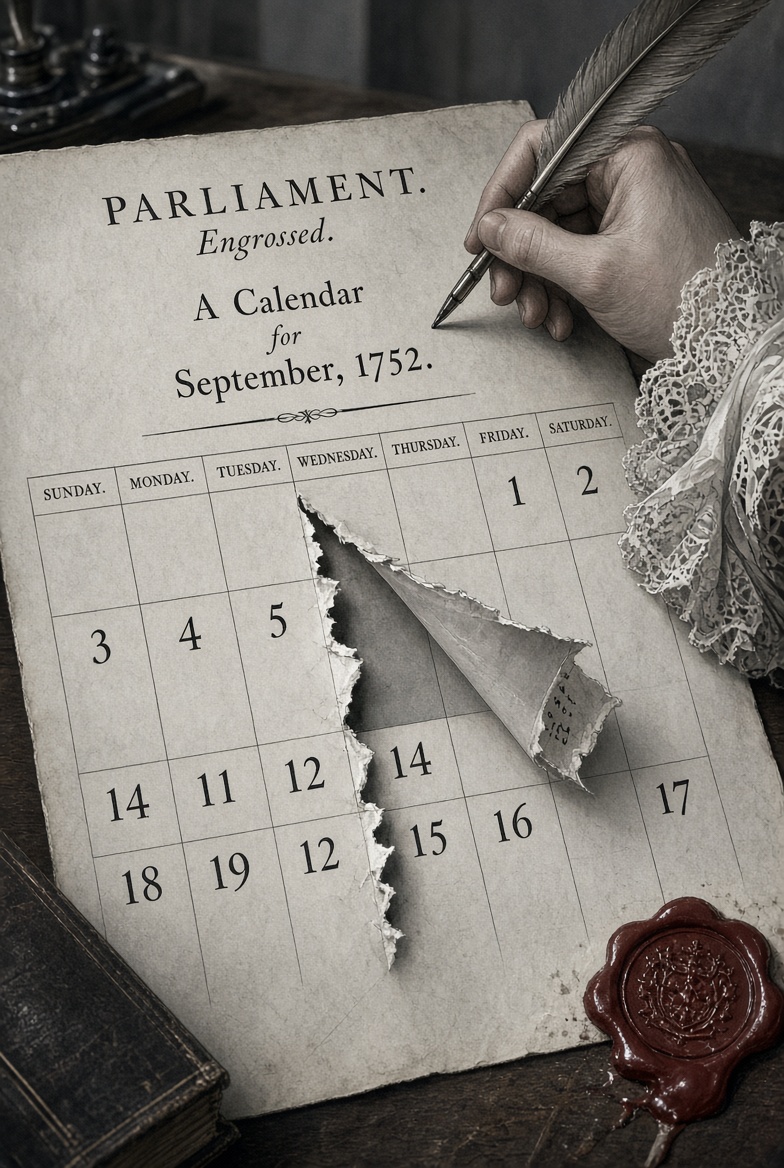
On the evening of Wednesday, 2 September 1752, a farmer in Virginia banked his fire, a printer in Philadelphia locked his type cases, a merchant in Boston checked the tide table in his almanac, and a Quaker in Pennsylvania wrote the date in the numbered style his meeting preferred. They went to sleep in the British Empire’s American colonies on a calendar that still belonged, in its bones, to Julius Caesar. They woke on Thursday, 14 September 1752. Eleven nominal days had been omitted by statute. September 3 through 13 simply did not occur. The sun rose on schedule. The cows still needed milking. The Chesapeake still smelled of mud and oyster. But the paper world in which contracts, rents, feast days, apprenticeships, and birthdays lived had jumped forward as if a clerk had taken a knife to the month and thrown the middle away.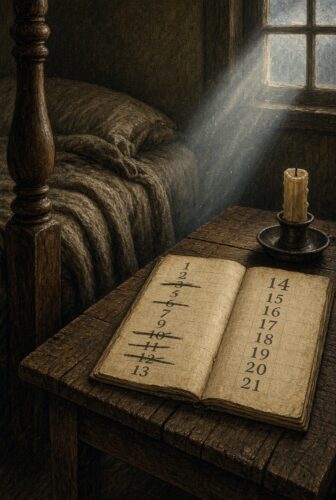
That is the event. It is not a battle. No general fell at a gap. No flag was raised over a fort. It is quieter than that and, in its way, more permanent. Every date written in the future United States after that morning is a descendant of the skip. George Washington’s birthday moved. The British tax year still ends on 5 April because Lady Day was shoved eleven days. Genealogists still argue over double-dated wills. Almanacs had to reprint the year. The colonies that would become a nation spent one night on the Julian calendar and woke on the Gregorian, aligned at last with the Catholic kingdoms England had spent a century and a half refusing to copy.
The story begins not in 1752 but in 46 BC, when Julius Caesar, advised by the Alexandrian astronomer Sosigenes, replaced the wandering Roman lunar muddle with a solar year of 365 days and a leap day every fourth year. The Julian year was 365.25 days. The actual tropical year is closer to 365.2422 days. The difference is about eleven minutes. Eleven minutes is nothing in a single lifetime. Over centuries it is a slow theft of the seasons. By the late sixteenth century the calendar had drifted ten days relative to the equinox. Easter, calculated from the spring equinox, was wandering. Pope Gregory XIII, advised by the Jesuit astronomer Christopher Clavius and the physician Luigi Lilio, issued the bull *Inter gravissimas* in February 1582. Catholic states skipped ten days that October. Thursday, 4 October 1582, was followed by Friday, 15 October. The new leap-year rule was more precise: century years would not be leap years unless divisible by 400. 1600 would leap. 1700 would not. The drift slowed to roughly one day in 3,300 years.
England did not follow. The Reformation was only two generations old. A papal bull looked like a theological trap. Elizabeth I’s astronomers understood the math. The court did not want the optics. Protestant German states and the Dutch eventually moved. Sweden tried a gradual scheme and made a mess of it. Russia held the Julian calendar into the twentieth century. Britain and its Atlantic colonies kept Caesar’s year, and by 1750 the error had grown to eleven days because 1700 had been a leap year in the old system and not in the new.
The inconvenience was no longer theoretical. Merchants corresponding with Amsterdam or Lisbon had to keep two dates in their heads. Diplomatic letters carried dual headings. Astronomers and navigators needed a common sky. Lord Chesterfield, who had lived on the Continent and found the English calendar embarrassing, introduced a bill in the House of Lords in February 1751 (the year still legally beginning in March). The Earl of Macclesfield, a serious astronomer, seconded it and supplied the technical scaffolding. James Bradley, the Astronomer Royal, revised the Easter tables. The Act received royal assent in May 1751. Its official title is the Calendar (New Style) Act 1750, because the legal year of passage was still counted the old way. It applied, in so many words, to “all His Majesty’s dominions and countries in Europe, Asia, Africa, and America.”
Two changes arrived together. First, after 31 December 1751 the legal year would begin on 1 January instead of 25 March, Lady Day, the Feast of the Annunciation, which had been the English new year since the twelfth century. Scotland had already switched to 1 January in 1600. The rest of the empire now followed. The year 1751 became a short year of 282 days, running from 25 March to 31 December. Second, in September 1752 the eleven extra days would be omitted. “The natural Day next immediately following the said 2nd Day of September, shall be called, reckoned and accounted to be the 14th Day of September, omitting for that Time only the 11 intermediate nominal Days of the common Calendar.”
The Act was not careless about money. Section VI is the part lawyers still quietly admire. Rents, annuities, salaries, wages, and debts would not accelerate. Payments due under old agreements would remain due on the same *natural* days as if the Act had never been passed. A quarter-day that had been 25 March would, in practice, land on 5 April and stay there. That is why the United Kingdom’s tax year still ends on 5 April: Old Lady Day, eleven days after the old new year. Fairs tied to the agricultural season were shifted so they still met the harvest. Fixed church feasts stayed on their nominal dates, which meant they arrived eleven days earlier in the solar year. Christmas remained 25 December. Some country parishes simply kept celebrating on what was now 5 or 6 January and called it Old Christmas. The distinction the statute drew between *nominal* days and *natural* days is the sharpest idea in the whole document. Paper time and sun time were acknowledged to be different things, and the law chose, case by case, which one to honor.
News crossed the Atlantic in the usual slow way. Colonial newspapers reprinted extracts through the winter of 1751–52. The *Boston Evening-Post* ran the rent-and-wage clauses in December 1751. The *Boston Post-Boy* printed a large portion of the Act a week later. The *Virginia Gazette* noted the bill’s passage and then, when the skip actually arrived, simply dated issue No. 87 28 August and the next number a week later as if nothing supernatural had occurred. Almanacs did more work than newspapers. They were cheaper, printed in larger runs, and sat in kitchens. Nathaniel Ames’s New England almanacs reached tens of thousands of copies. Benjamin Franklin’s *Poor Richard Improved* for 1752 sold on the order of ten thousand. Franklin printed the complete text of the Act, not merely a summary, and added a short history of why years had been altered before. He told his readers it was pleasant for an old man to lie down on the second of September and not have to rise until the fourteenth. The Quaker Yearly Meeting in London recommended conformity: omit the eleven days, begin the year in the month called January, and number the months accordingly, so that September became Ninth Month instead of Seventh. American meetings followed.
There were no documented riots in the colonies. The famous “Give us our eleven days” cry lives mostly in a 1755 Hogarth painting of an Oxfordshire election and in later textbooks that treated satire as reportage. People grumbled about wages and leases. Some insisted on Old Christmas. A few diarists ignored the new style for a season. Hannah Heaton in Connecticut kept writing dates her own way. Most people did what people usually do with a rule that arrives from far away and does not immediately starve them: they adjusted the heading on the next letter and went back to work. Virginia, according to later local memory, made the change without fanfare. Boston’s printers explained it and sold the almanacs that explained it again. Philadelphia’s Quakers numbered their months and moved on.
The personal effects were oddly intimate. Anyone born before the skip had a birthday that now sat eleven days later on the civil calendar if they chose to keep the same numbered day, or eleven days earlier in the solar year if they kept the same season. George Washington was born 11 February 1731 Old Style. After the reform the date was written 22 February 1732 New Style. That is the date Americans later put on the calendar. Thomas Jefferson’s gravestone at Monticello still says “2 April 1743 O.S.” because he, or the family, wanted the old reckoning visible in stone. Double dating — 1722/23 for days between 1 January and 24 March — had been a colonial habit for decades precisely because the legal year and the popular year disagreed. After 1752 the fraction disappeared from new documents, but the old papers remained, a trap for every later clerk and every modern genealogist.
The scientific reason was simple and a little humiliating. Eleven minutes a year is not drama. It is erosion. Caesar’s year was good enough for an empire that measured time by tax collection and legionary pay. It was not good enough once Easter had to stay near the equinox and ships had to meet in ports that used a different count. England’s 170-year delay was theology wearing the mask of independence. By 1752 the mask had become expensive. Trade wanted one sky. The Act gave it to them and, almost as an afterthought, gave the American colonies the same sky the rest of the commercial Atlantic already used.
The morning of 14 September 1752 did not feel like a founding. There was no speech on a balcony. There was a date line that jumped and a set of almanacs that had been printed in advance with September containing only nineteen days. Farmers still watched the moon. Sailors still needed high-water tables. Ministers still announced the next feast on its nominal day. The significance is retrospective and total. The United States inherited a calendar that had been forcibly synchronized with Europe eleven years before the Stamp Act and twenty-four years before the Declaration. Every contract, every newspaper, every ship’s log, every birthday after that Thursday sits on the far side of a gap that Parliament cut into September and that the colonies accepted because the alternative was to stay eleven days behind a world that had already moved.
The drift that forced the cut is worth sitting with. Eleven minutes does not announce itself. It accumulates while everyone is busy. The Julian year was a rounding error with a crown on it. Gregory’s correction was a better rounding error with a tiara on it. Chesterfield’s Act was a Protestant admission that the better rounding error had won. The American colonies, which had not been consulted, woke up inside the admission. That is the fact of 14 September 1752 on this side of the ocean: a night in which time itself was edited by statute, and the edit held.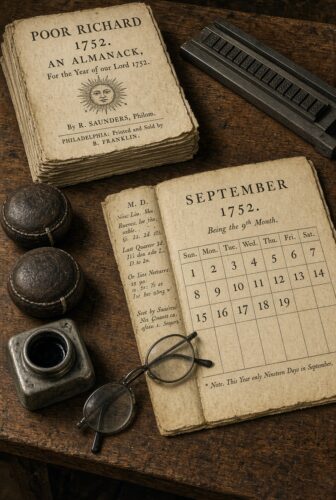
The outcome was alignment. Not moral alignment. Not political alignment. Chronological alignment. The paper world and the solar year were brought within a few minutes of each other, and the financial world was protected from being cheated by the paper. Nominal time and natural time were named as separate creatures, and the law was forced to choose, obligation by obligation, which creature to feed.
That choice is the part that still has teeth.
**What a person does with a vanished fortnight**
The useful residue is not “seize the day.” The useful residue is the statute’s own machinery: omit eleven *nominal* days, keep the *natural* days of existing obligations intact, and stop pretending the two clocks are the same.
– List eleven recurring blocks in the coming month that exist only on paper — meetings that produce no decision, subscriptions that survive by inertia, scrolling windows that open because the device is in the hand, obligations accepted because the date was already printed. These are the September 3–13 of a private calendar. They have names and they consume hours. They are not the rent. They are the extra days the old system kept inserting.
– Write the omission in one sentence, dated, the way an almanac printer announced that September would have nineteen days. “The eleven blocks named below will not be reckoned for one cycle.” Do not negotiate with them during the cycle. The point is the cut, not a debate about the cut.
– Protect the natural days. Anything that was already due — a payment, a care task, a skill that actually compounds — stays on its original solar schedule. Do not accelerate it because the paper calendar suddenly looks emptier. Section VI exists so that a reform does not become a pretext for collecting early. Apply it to your own ledger.
– For eleven days, double-date every commitment the way colonial clerks wrote 1722/23. Put the nominal date and the natural date on the same line. “Tuesday meeting / actual work block is Thursday morning when the energy is present.” The fraction makes the lie visible. After eleven days, drop the ones that only exist on the left side of the slash.
– Move one anniversary the way Washington’s birthday moved. Pick a personal date that has drifted — a habit started in another decade, a goal still wearing last year’s number — and rewrite it eleven days later or earlier so that it sits on the season it actually belongs to. Keep the old date in parentheses once, the way Jefferson kept O.S. on the stone, then stop using it.
– Keep a one-page almanac for the cycle: not a productivity app, a single sheet with the moon phase, the real wake time, and a mark for whether the day was nominal or natural. Almanacs outsold newspapers in 1752 because they sat in the kitchen and told the truth about tides. One sheet will do.
The plan is short because the Act was short on ceremony and long on clauses. Skip the invented days. Do not let the skip become an excuse to collect early on what you already owe. Write both clocks until one of them looks ridiculous. That is what the colonies did on the morning of 14 September 1752, and the date line never jumped back.
Share: