
On the feast day of St. Mary Magdalene, July 22, 1227, near a modest rise of ground called the Königsbarg outside the village of Bornhöved in Holstein, two armies met in a fight so savage that later chroniclers claimed the combatants stood knee-deep in blood. One side was led by Valdemar II, King of Denmark, the man already nicknamed “the Victorious,” who had spent two decades turning the Baltic into a Danish lake. The other was a patchwork coalition of counts, free-city merchants from Lübeck and Hamburg, Holstein knights, and the notoriously independent free peasants of Dithmarschen. By nightfall the king had lost an eye, several horses, a large portion of his army, his most important German ally, and almost every scrap of territory south of the Eider River. The border that was redrawn that day would last, with only minor interruptions, until 1806. The political vacuum it created helped clear the path for the merchant cities that would later form the core of the Hanseatic League. And the decisive moment belonged not to any glittering knight but to a contingent of free farmers who simply changed sides at the critical hour.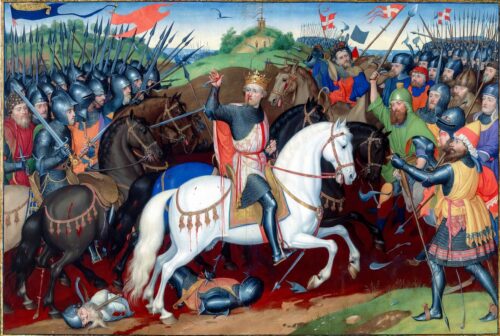
This is not a famous battle. It does not appear in the usual lists of medieval “world-changing” clashes. Yet its consequences were durable, concrete, and still visible on maps of northern Europe centuries later. What follows is the story of how a king who once held everything from the Elbe to Estonia watched his continental empire evaporate in a single afternoon because the people he thought he owned decided they preferred their own local overlords—or no overlords at all.
### Valdemar the Victorious Builds an Empire
Valdemar II came to the Danish throne in 1202 after the death of his brother Canute VI. The kingdom he inherited was already aggressive. Under the two brothers the Danes had pushed south across the Eider, the traditional boundary between Danish and German spheres, and into the lands of the counts of Holstein and the Slavic principalities along the Baltic coast. Valdemar continued the work with energy and skill. In 1201–1202 Danish forces defeated Count Adolf III of Holstein; by 1203 Lübeck had fallen under Danish control. Hamburg followed. Mecklenburg and parts of Pomerania became vassals or direct holdings. In 1219 Valdemar led a crusading army into Estonia, won the Battle of Lindanise (near modern Tallinn), and, according to later tradition, received the Dannebrog—the white-cross-on-red flag that remains Denmark’s national banner—as a miraculous gift from the sky. Whether the flag story is legend or embroidery, the territorial fact is solid: by the early 1220s Danish power stretched from the North Sea to the Gulf of Finland.
Valdemar was no mere raider. He issued charters, founded towns, and began the long process of replacing older regional law with more uniform codes. He understood the value of free cities as long as they paid him and accepted his overlordship. Lübeck and Hamburg were useful cash cows and naval bases. He also understood the value of alliance with the shifting factions inside the Holy Roman Empire. At various moments he backed Otto IV against the Hohenstaufen and later reached accommodations with Frederick II. For a generation it looked as though Denmark might permanently annex the entire southern shore of the Baltic.
Then came the hunting trip on the island of Lyø in May 1223.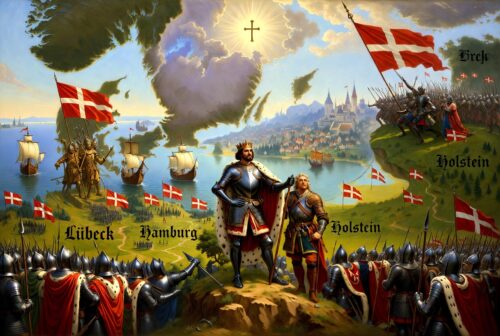
### The Capture That Unraveled Everything
While hunting on Lyø, Valdemar and his eldest son were seized by Count Henry I of Schwerin, known as Henry the Black. The count’s motives mixed personal grievance, opportunity, and imperial politics. He demanded the return of the German territories Denmark had seized and a formal recognition of imperial overlordship. Danish envoys refused. War followed. While the king sat in captivity, the carefully constructed Danish position in northern Germany began to crack. Local lords and cities that had accepted Danish rule under duress or for convenience now saw a chance to throw it off.
In 1225 a Danish army under Albert of Orlamünde was defeated at Mölln. Valdemar was forced to accept harsh terms for his release: a huge ransom in silver, the formal renunciation of the lost territories, and an oath not to seek revenge. He paid, he swore, and he went home. Then Pope Honorius III helpfully declared the oath extracted under duress and therefore non-binding. Valdemar began preparing a reconquest.
By 1226–1227 he had assembled a new coalition of his own, including Otto the Child of the Welf house (Otto of Brunswick-Lüneburg). The goal was straightforward: restore Danish control south of the Eider, reimpose authority over Holstein, Lübeck, Hamburg, and the surrounding counties, and remind the north German princes that the king of Denmark was still the strongest power on the Baltic. The coalition that formed against him was equally straightforward in its own way. Count Adolf IV of Schauenburg and Holstein wanted his county back. The merchants of Lübeck and Hamburg wanted the freedom to trade without Danish tolls and governors. The free peasants of Dithmarschen, a marshy coastal region with a long tradition of resisting outside lords, preferred their own rough self-rule under the distant and usually light hand of the Archbishop of Bremen. Various other northern German nobles joined because a strong Denmark on their doorstep was more dangerous than a collection of local rivals.
### The Field at Bornhöved
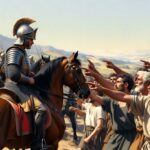
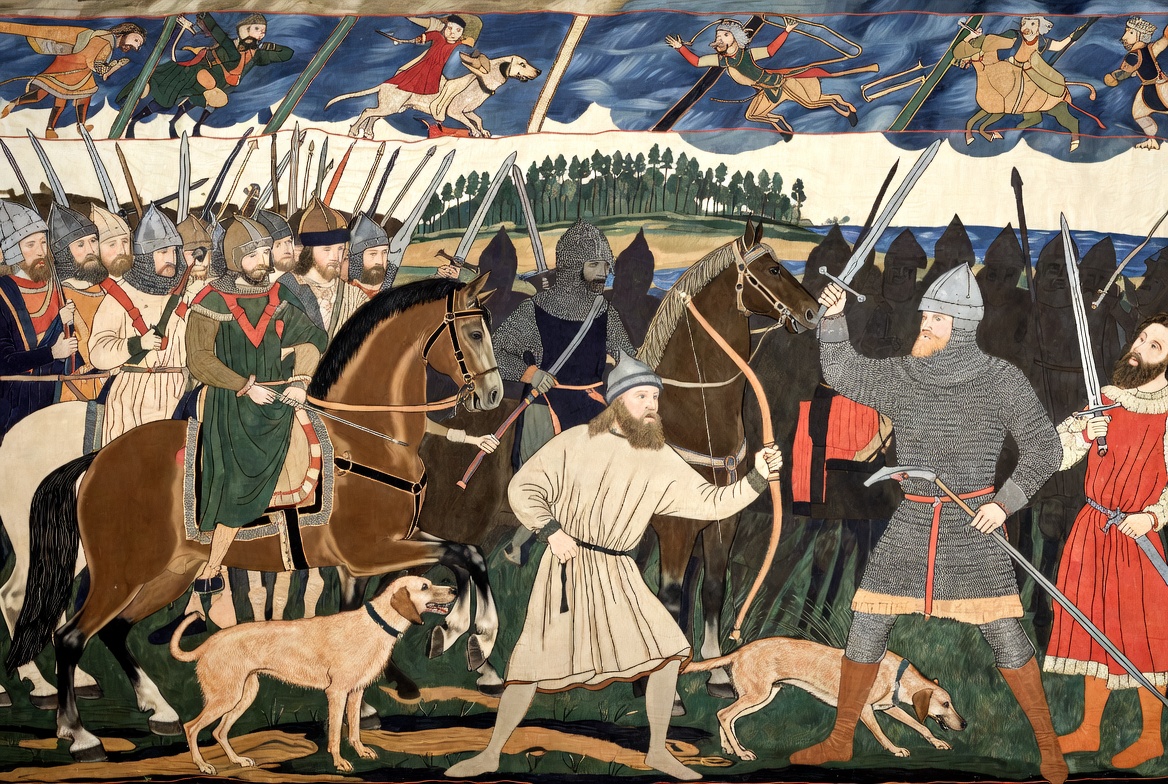
The two armies met on open ground near Bornhöved on July 22. Contemporary and near-contemporary accounts are thin on precise numbers and order of battle; later chronicles supply color that must be treated carefully. What seems solid is that the fighting was prolonged and extraordinarily bloody. Valdemar fought in the thick of it. He had multiple horses killed under him. At some point an arrow or a blow cost him the sight of one eye. Despite the losses, the Danish and Welf forces held and even pressed their opponents hard enough that victory seemed possible.
Then the Dithmarschen contingent changed sides.
These were not professional knights. They were free farmers from a region that had spent generations defending its autonomy against counts, bishops, and kings alike. Whether they had been levied by Valdemar under some earlier arrangement or had simply been present as opportunistic allies, at the decisive moment they turned on the Danish rear. The sudden attack from behind, combined with the exhaustion of a long fight, broke the Danish line. Otto the Child was captured. The Bishop of Ribe was taken. Valdemar himself escaped only with the help of a German knight who got him off the field. The carnage was remembered in the phrase that the fighters stood knee-deep in blood—an image of medieval hyperbole that nevertheless conveys the intensity.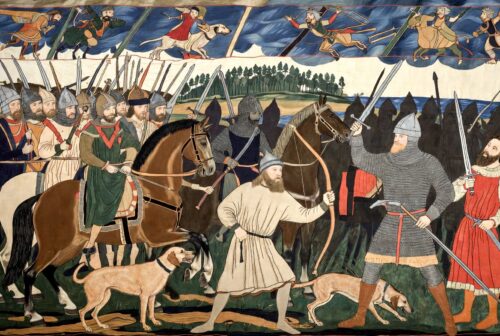
### What the Victory Actually Changed
The immediate results were territorial and political. Adolf IV recovered Holstein. The Danish border was pushed back to the Eider River, the old line that would remain the southern limit of the Duchy of Schleswig for centuries. Lübeck moved toward the status of a free imperial city. Hamburg returned to more local control. Dithmarschen kept its practical independence under the archbishopric of Bremen and would remain a peasant republic of sorts until the mid-sixteenth century. Otto the Child was eventually ransomed. Valdemar retained Rügen and his Estonian possessions, but the great continental empire he had built was gone.
The longer consequences were structural. With Danish military pressure removed from the Elbe–Eider corridor, the north German cities and princes had room to expand their own commercial and political networks. Lübeck in particular, already an important trading center, now operated with fewer external constraints. The conditions that later allowed the formal emergence and growth of the Hanseatic League—secure Baltic trade routes, relatively independent city governments, and a balance of power that prevented any single kingdom from dominating the southern shore—were strengthened by the vacuum left after Bornhöved. Denmark did not disappear as a Baltic power; it remained formidable. But the dream of a permanent Danish dominion stretching deep into northern Germany died on that July afternoon.
Valdemar himself turned inward. The later years of his reign produced the Code of Jutland, an important legal unification, and a more thorough feudalization of Danish society. He never again mounted a serious campaign to recover the lost German lands. The king who had once been called the Victorious spent his final decades as a successful domestic ruler whose greatest foreign achievement had been permanently reversed.
### The Peculiar Mechanics of the Defeat
Several features of Bornhöved repay close attention. First, the decisive force was not the most glamorous. The free peasants of Dithmarschen were not the armored elite. Their decision to switch sides—or to attack the rear of the side they had been expected to support—decided the day. Second, the coalition that won was temporary and heterogeneous. Counts, merchant cities, and free farmers did not share a common long-term ideology; they shared a common short-term interest in limiting Danish power. Once that interest was served, they returned to their usual rivalries. Third, the personal cost to the defeated king was visceral and permanent. Losing an eye on the field is the sort of detail that sticks in memory precisely because it is so concrete. Medieval warfare produced many such injuries; few of them coincided with the permanent redrawing of a major political boundary.
The battle also illustrates how quickly an overextended position can collapse once the central figure is removed or distracted. Valdemar’s captivity in 1223–1225 had already loosened the Danish grip. The reconquest attempt of 1227 was an effort to restore a structure that had been built on personal authority, military success, and the temporary acquiescence of local elites. When that authority was challenged by a sufficiently broad local coalition, the structure did not bend; it snapped.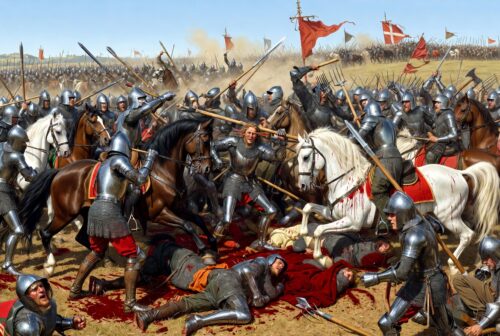
### A Different Kind of Legacy
Most medieval battles are remembered for the winners’ glory or the losers’ tragedy. Bornhöved is more interesting for the quiet, durable rearrangement it produced. No single dynasty rode the victory to imperial greatness. Instead, a collection of medium-sized powers and free communities gained breathing room. Borders stabilized. Trade routes became less contested by a single royal power. The political map of the western Baltic became more plural. That plurality, messy and competitive as it was, proved more fertile for commercial growth than the earlier Danish hegemony had been.
The chroniclers who later illustrated the battle—placing Valdemar on the Königsbarg, showing the press of knights and the sudden disorder—were working with limited sources and a taste for drama. Yet the core facts survive scrutiny: a powerful king lost an eye and an empire on the same day because the people at the edge of his system decided the cost of loyalty had become higher than the cost of defection.
### The Outcome Applied: The Dithmarschen Switch Protocol
The historical fact is simple. An overextended central power was broken by a temporary, locally rooted coalition whose decisive member was the least glamorous contingent on the field. A person living today can extract a concrete, non-generic method from that sequence without turning it into the usual motivational wallpaper.
The method is called the Dithmarschen Switch Protocol. It is deliberately narrow, time-bound, and mechanical. It is not about positive thinking, vision boards, or finding your passion. It is about identifying the specific overlord in your current situation, assembling a short-term coalition of overlooked local resources, and executing a timed reallocation of effort at the moment of maximum pressure.
Here is the protocol in exact steps:
– Map your personal Eider. Draw a single sheet of paper with two zones: the territory you currently control and the territory an external force (debt schedule, institutional demand, habitual pattern, distant expectation) claims. Mark the current border. The goal is not inspiration; it is to make the overclaim visible and finite.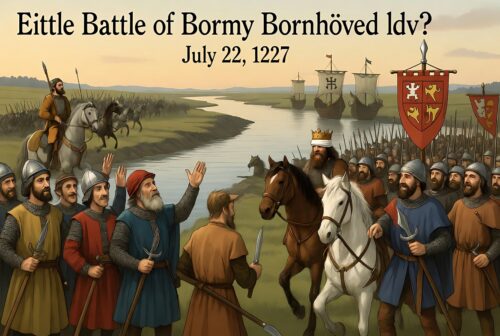
– Identify your Dithmarschen. List three concrete, low-status, locally available resources you have been treating as secondary or invisible—skills you underuse, relationships you have neglected because they seem small, physical spaces or tools that sit idle. These are the free peasants. They are not glamorous. They are the ones who can change the rear of the fight.
– Schedule the feast-day review. Choose one fixed day in the next fourteen days that carries no other major obligation. On that day, for a continuous three-hour block, review only the map and the three resources. No new plans, no motivational reading. Only the inventory.
– Stage the switch. When the external pressure reaches its next measurable peak (a deadline, a recurring demand, a moment of high friction), reallocate one of the three overlooked resources directly against the pressure for a minimum of seventy-two continuous hours. The reallocation must be visible and irreversible for that period. The point is not permanent transformation; it is the sudden rear attack that breaks the previous equilibrium.
– Redraw the border once. After the seventy-two hours, adjust the original map to reflect whatever concrete ground was gained or released. Do not expand the claim. Stabilize the new line. Then stop. The historical lesson is not endless conquest; it is the restoration of a sustainable border.
This sequence is deliberately unromantic. It borrows the structure of Bornhöved—local coalition, overlooked contingent, timed defection under pressure, permanent but limited territorial adjustment—without the blood or the medieval pageantry. It treats the “king” in any personal situation as an overextended system rather than an enemy to be hated, and it treats the switch as a tactical act rather than a moral awakening. Most self-help systems promise continuous upward momentum. The Dithmarschen Switch Protocol aims only at breaking one overclaim and fixing a new, defensible line. That is what the free farmers of 1227 actually delivered, and it is still the most durable result the battle produced.
The eye Valdemar lost that day never returned. The empire he lost never returned either. The free cities and local powers that gained room to breathe used that room for generations. On July 22 the calendar still quietly marks the anniversary of the afternoon when a king’s vision and a peasant contingent’s decision redrew the map of the western Baltic. The rest is application.
Share: