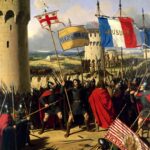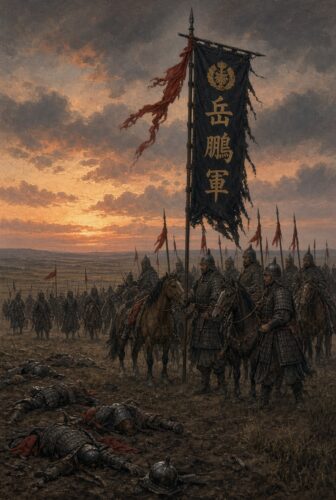

On July 11, 1302, in a marshy, ditch-crossed field just outside the Flemish town of Kortrijk (then Courtrai), the impossible occurred. A force composed mostly of urban craftsmen — weavers, fullers, butchers, and other guild members — decisively defeated one of the finest knightly armies in Europe. The French had arrived with the cream of their nobility: heavily armored men-at-arms on powerful warhorses, led by the experienced Robert II, Count of Artois. They carried golden spurs as marks of their status. By the end of the day, hundreds of those spurs had been stripped from the dead and carried as trophies to the nearby Church of Our Lady.
This was not a fluke or a lucky skirmish. It was a calculated stand on deliberately chosen ground, executed with discipline, improvised but effective anti-cavalry weapons, and a refusal to break even when the “superior” force charged. The Battle of the Golden Spurs (or Battle of Courtrai) became one of the most symbolically potent victories of the Middle Ages. It demonstrated that disciplined infantry could shatter the myth of knightly invincibility under the right conditions, influenced tactics for generations, and gave the Flemish towns a lasting sense of what organized commoners could achieve against royal power.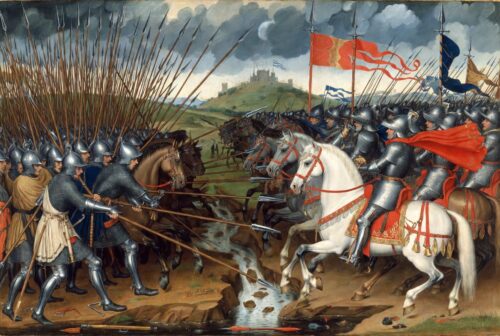
To understand why this mattered then — and why its mechanics still offer one of the sharpest, least generic playbooks available for anyone facing stacked odds today — we need to walk the full ground: the economic and political pressures that made Flanders a prize, the spark that turned simmering resentment into open revolt, the armies that faced each other, the terrain that decided everything, the brutal three-hour clash itself, and the ripples that followed.
Flanders in the late 13th and early 14th centuries was no sleepy backwater. It was one of the most urbanized and commercially dynamic regions in Northern Europe. Its cities — Bruges, Ghent, Ypres, and others — thrived on the wool trade. English wool came in; high-quality cloth went out across the continent. The towns were wealthy, proud, and fiercely protective of their privileges. They had their own militias organized through powerful guilds, and the burghers who ran them often clashed with both local nobles and distant kings who wanted a share of the revenues.
King Philip IV of France (“the Fair”) needed money and control. He was fighting expensive wars, including against England, and viewed the semi-autonomous County of Flanders as both a strategic buffer and a taxable resource. Over the 1290s he maneuvered to bring it more firmly under royal administration. He found allies among some Flemish patricians and nobles who preferred French protection or opportunity. He found determined opposition from Count Guy of Dampierre and from the broader urban populations who saw French governors, garrisons, and tax demands as an existential threat to their way of life.
By 1300 the French had effectively occupied Flanders. Guy was imprisoned. French officials ran key towns. Tensions simmered. Then, on the night of May 18, 1302 — an event remembered as the Matins of Bruges — the situation exploded. Rebels who had slipped back into Bruges, led in spirit by the weaver and guild spokesman Pieter de Coninck, launched a coordinated massacre of the French garrison and anyone associated with the occupation. Hundreds, perhaps over a thousand Frenchmen were killed in their beds or as they tried to flee. It was brutal, personal, and irreversible. The rebels knew they had crossed a line that made compromise impossible. They had to win or face terrible retribution.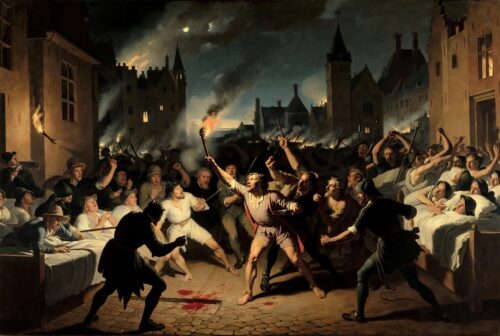
Word spread. Other towns rose. Most of Flanders joined the revolt, though Ghent held back at first. Leadership fell to Guy of Namur and his allies, including William of Jülich. The rebels quickly moved to besiege the remaining French strongholds, including the castle at Kortrijk.
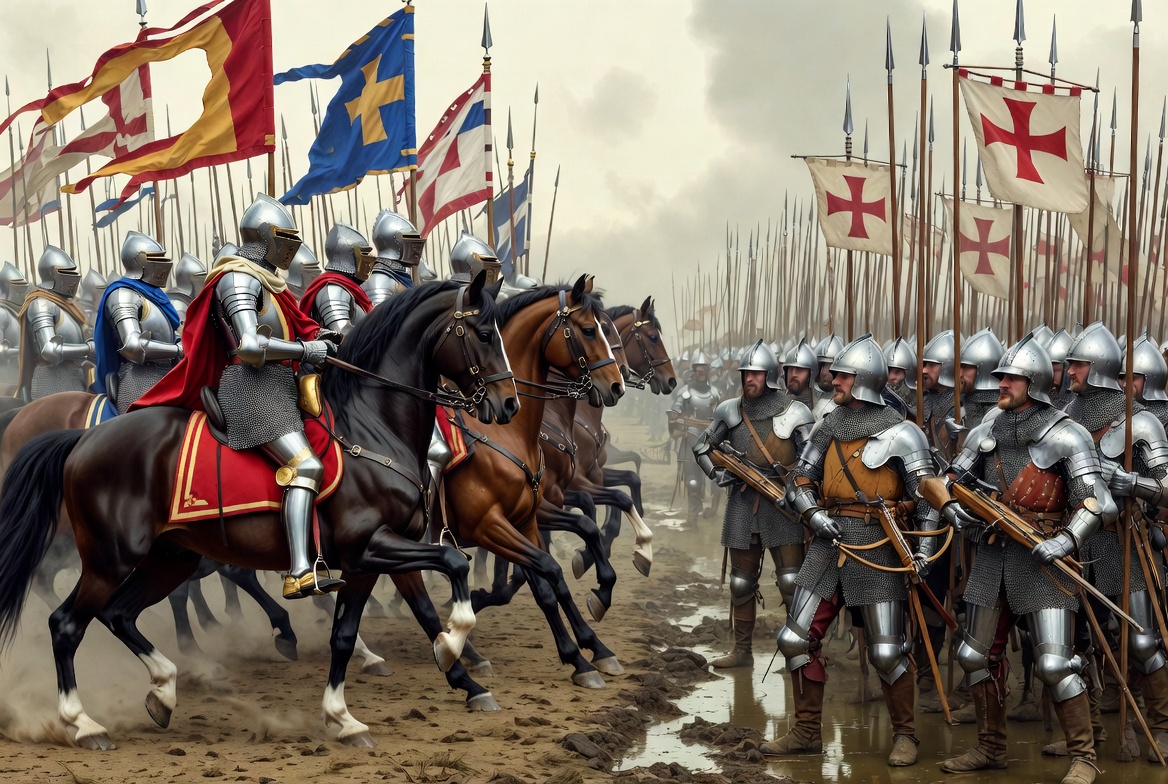
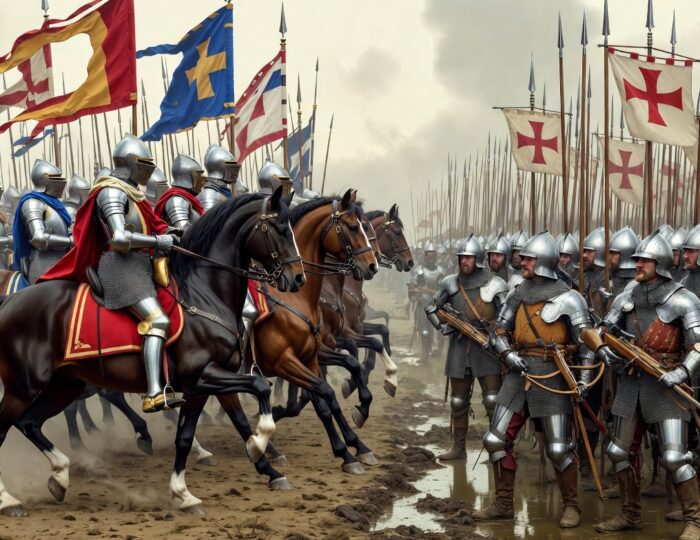
Philip IV responded with characteristic decisiveness. He assembled a powerful relief army under Robert II, Count of Artois — a veteran commander, uncle to the king, and a man with a reputation for both competence and a certain eccentricity (one chronicler mentions a pet wolf). The French force numbered roughly 8,000–8,500 men. Its core was 2,500–3,000 heavily armed and armored men-at-arms and knights — the famous “flower of French chivalry.” These were supplemented by crossbowmen (including skilled contingents from Italy and elsewhere), spearmen, and other infantry. In the military thinking of the time, a single well-equipped knight was theoretically worth ten foot soldiers. The French expected to ride down the Flemish “rabble” with shock and prestige.
The Flemish army that gathered to meet them was different in almost every respect. Estimates put it at 8,400–10,400 men, the overwhelming majority of them infantry drawn from urban militias, especially from Bruges and surrounding areas. There were perhaps only a few hundred mounted men-at-arms. The bulk were guild members: weavers, fullers, and other craftsmen who had drilled together and knew how to move in formation. They wore practical armor — steel helmets, mail hauberks or at least neck and hand protection, iron gloves — and carried pikes, spears, bows or crossbows, and the distinctive *goedendag*. The goedendag was a simple but brutally effective weapon: a stout wooden shaft about 1.5 meters long topped with a heavy iron spike or head. It could be used to thrust, hook a rider’s leg or armor, or smash downward with crushing force. In the hands of a disciplined man on foot against a mounted knight struggling in soft ground, it was devastating.
The Flemish chose their ground with care. They positioned themselves on the Groeninge field outside Kortrijk, with the town and castle to one side and the Leie (Lys) River influencing the flanks. The field was already cut by streams, rivulets, and marshy patches. The Flemings dug additional ditches and may have concealed some obstacles. Their formation was compact and deep — essentially a large infantry block or series of blocks with pikes and goedendags presenting a wall of points and spikes. Crossbowmen screened the front. The position was deliberately difficult for heavy cavalry to charge across at full speed and in good order. The French would have to funnel through or across broken ground, losing momentum and cohesion.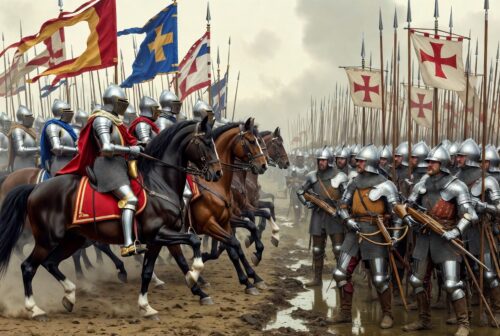
On the morning of July 11 the two armies faced each other. The French had the numerical edge in quality cavalry and overall professionalism on paper. The Flemish had numbers, preparation, terrain, and burning motivation. French crossbowmen opened the action and drove the Flemish skirmishers back, but the main Flemish lines held steady. Robert of Artois, confident in his mounted arm, recalled his infantry and prepared the cavalry for the decisive charge. Contemporary accounts suggest some French leaders recognized the dangers of the ground and urged caution or a more methodical approach. Artois reportedly overruled them. The banners unfurled. The knights advanced.
What followed was less a classic medieval battle than a series of failed assaults into a prepared killing ground. Horses floundered in the soft earth and hidden ditches. Knights in heavy armor, already at a disadvantage once unseated, found themselves surrounded by men who had no intention of taking noble prisoners for ransom. The goedendags did their work — hooking, thrusting, clubbing. The Flemish formation did not break. When one French “battle” (division) was repulsed or bogged down, the Flemings maintained discipline. Robert of Artois himself led a personal charge into the thick of it and was killed, along with many of the highest-ranking French nobles present: constables, marshals, counts, and lords whose names read like a roll call of the French aristocracy.
Casualties were lopsided. Flemish losses were relatively light — perhaps 100 to 300 killed. French losses among the men-at-arms and knights ran into the hundreds, possibly 1,000–1,500 total dead when including the pursuit. Over 500 pairs of golden spurs were collected from the fallen French horsemen. These were taken to the Church of Our Lady in Kortrijk and hung there as a permanent votive offering and symbol of the victory. The church became, for a time, a shrine to the idea that common resolve could humble the mighty.
The French survivors fled. Some drowned trying to cross the river. The Flemish pursued for several kilometers. Kortrijk castle surrendered two days later. In the immediate political aftermath, guild power in the Flemish cities increased. Patrician regimes that had collaborated with the French were overthrown in several towns. The weavers and other crafts gained a stronger voice in urban governance. Flanders had bought itself breathing room and a powerful myth of resistance.
The French were not finished. They won subsequent engagements, including a naval victory at Zierikzee in 1304 and a hard-fought land battle at Mons-en-Pévèle the same year. The Peace of Athis-sur-Orge in 1305 imposed heavy financial penalties on Flanders. Yet the Battle of the Golden Spurs had lasting effects that no later French victory could erase. Militarily, it was an early and dramatic demonstration of the “infantry revolution” of the 14th century. Disciplined foot soldiers using terrain, dense formations, and purpose-built weapons could neutralize the traditional advantages of heavy cavalry. Scottish forces at Bannockburn in 1314 consciously or unconsciously echoed Flemish tactics with their schiltrons. English armies in the Hundred Years’ War learned to fight on foot effectively and to use terrain and stakes to break French charges at Crécy and elsewhere. The psychological prestige of the mounted knight never fully recovered its unchallenged dominance.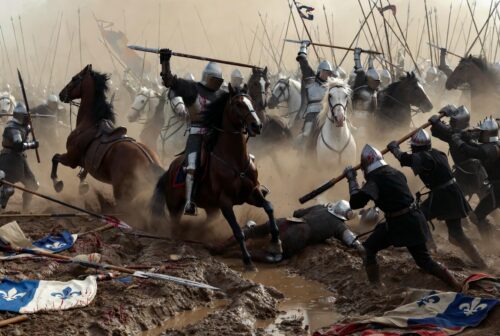
Culturally and politically, the battle became a cornerstone of Flemish identity and later Belgian national memory. It proved that organized townsmen could defy a king and survive — at least long enough to force a reckoning. The spurs themselves eventually disappeared (taken or lost in later conflicts), but the story endured: ordinary people, using what they had, on ground they knew, refusing to break, could change the balance of power.
That is the historical fact. Now consider what it actually offers anyone facing long odds today.
The Flemish victory was not primarily about superior numbers, better equipment, or even raw courage — though all played roles. It was about four interlocking elements executed under pressure: deliberate choice and shaping of terrain (or positioning); disciplined formation and refusal to be drawn into the enemy’s preferred fight; adaptation and weaponization of available tools and skills into something the “superior” force was not prepared for; and decisive follow-through once the overconfident charge had spent its force. The French came expecting a quick, glorious ride-over. They met a prepared wall that turned their own momentum and status symbols against them. The collection of the spurs was both practical trophy-taking and the creation of a lasting symbol that reinforced identity and resolve for those who came after.
Translate those mechanics into modern life and you get something far more useful than generic motivational slogans. Here are specific, concrete ways the outcome of July 11, 1302, can benefit a person right now:
– You stop meeting every challenge on the challenger’s preferred open-field terms. Instead, you deliberately audit and shape your environment — your schedule, physical space, information diet, or workflow — to create friction that slows or breaks up “cavalry charges” of demands, distractions, or competitors who rely on speed and volume.
– You build and maintain a small number of non-negotiable, interlocking habits or boundaries that function like a pike wall. These are not scattered resolutions; they are a compact, mutually reinforcing formation that presents a united front so that when pressure hits, you do not have to improvise from zero.
– You take one existing strength, tool, or even past difficulty you already possess and deliberately adapt it into a targeted countermeasure for a recurring problem. You do not wait to acquire shiny new resources; you forge what you have into something the problem is not designed to handle.
– You treat disparate parts of your life or small networks as a potential “guild” that can be aligned around a common objective. Isolated individual effort is vulnerable to being flanked or isolated. Coordinated or integrated effort multiplies resilience.
– You practice the discipline of holding position rather than launching premature counterattacks or fleeing. Many “superior” forces overextend when they expect easy victory. Your job is to remain intact until their momentum falters on your prepared ground, then respond with precision.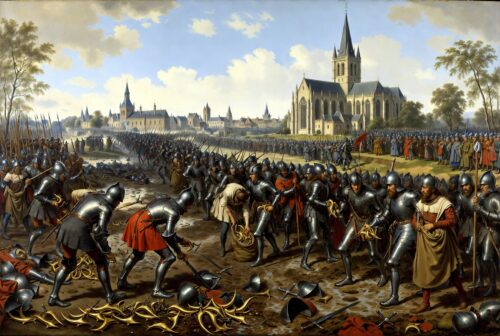
– When a threat or opportunity does stumble or expose a weakness, you move decisively to claim the full advantage instead of hesitating out of misplaced politeness or fear of seeming aggressive. The Flemish did not negotiate ransoms mid-battle; they finished what the situation required.
– You create tangible, visible reminders of wins — however small — and place them where you will see them regularly. These function like the spurs in the church: not mere trophies for ego, but ongoing evidence that the wall held and that the charge can be broken. Over time this compounds belief and identity more effectively than abstract affirmations.
– You accept that even a clear local victory may be followed by counter-pressure or costly “peace terms.” The point is not to win every skirmish forever but to shift the structural balance and the story you tell yourself about what is possible.
These are not abstract virtues. They are engineering principles drawn from a specific, well-documented medieval battle.
Here is a practical, time-bounded implementation that turns those principles into a repeatable system. It is called the **Goedendag Protocol** — a 7-day forge designed to be completed in 25–40 minutes on most days, with one slightly longer session on the final day. It builds your terrain awareness, forges one targeted countermeasure, establishes a minimal viable formation, practices holding under pressure, aligns resources, harvests evidence of progress, and ends with a symbolic dedication plus one proactive move. It is deliberately short, cumulative, and tied to battle mechanics rather than generic productivity theater.
**Day 1 – Scout and Shape the Marsh (Terrain Audit, ~30 minutes)**
List your three most persistent “cavalry charges” — recurring situations where you feel outmatched or overwhelmed. For each, identify two controllable friction points or buffers you can introduce or strengthen this week (examples: a recurring meeting that could be shortened or moved; an information channel that could be batched or filtered; a physical workspace adjustment that reduces context-switching). Implement the easiest one immediately and note the effect by evening.
**Day 2 – Forge the Goedendag (Weaponize One Existing Asset, ~25 minutes)**
Choose one skill, habit, or resource you already have that is under-leveraged against one of your listed challenges. Adapt it into a simple, repeatable countermeasure. Examples: turn a writing habit into a pre-written response template that disarms a common objection; convert a short daily movement routine into a 5-minute “reset” protocol used before high-stakes interactions; repurpose analytical skills into a quick scoring system for incoming opportunities or demands. Test the adaptation once the same day.
**Day 3 – Assemble the Phalanx (Formation Drill, ~20 minutes)**
Define a minimal “pike wall” of three to five non-negotiable daily or weekly actions or boundaries that support each other. These should be specific and measurable (e.g., “deep work block from 8–10 a.m. with notifications off,” “no reactive email before noon,” “one 10-minute review of wins and terrain at end of day”). Write them down. Perform a quick mental or physical rehearsal of moving through them in sequence.
**Day 4 – Practice the Hold (Patience and Observation Under Pressure, ~25 minutes)**
Identify or create one low-stakes situation today where a minor “charge” is likely. Your only job is to maintain your formation without immediate counterattack or collapse. Observe exactly where and how the pressure weakens or overextends. Note one precise moment where a small, prepared response would have been more effective than reaction. Do not force drama; simply collect data on your own ground.
**Day 5 – Unite the Guilds (Integration or Alliance Step, ~30 minutes)**
Connect two areas of your life or resources that usually operate separately in service of one of your challenges. Or reach out to one person or small group for a specific, mutual micro-collaboration. The goal is to experience the difference between solo effort and even minimal coordinated strength. Keep it small and actionable.
**Day 6 – Harvest the Spurs (Win Collection Ritual, ~25 minutes)**
Review the previous days and document at least three concrete instances where you held position, created friction, or adapted a tool effectively — no matter how small. Write or record them with enough detail that future-you can understand the context and result. Add them to a dedicated, visible location: a physical notebook or jar, a pinned digital note, a folder of screenshots or tokens, or a simple running list. This is your growing collection of spurs. Name at least one after an element from the battle (e.g., “Groeninge Buffer,” “Goedendag Template”).
**Day 7 – Dedicate and Advance (Symbolic Commitment + Proactive Counter, ~45 minutes)**
Review your collected spurs and choose one that represents the biggest shift in how you see a recurring challenge. Perform a short “dedication” ritual — write a brief note to yourself or a future version of you, share one insight with an accountability partner, or simply place the note in your visible collection with a one-sentence statement of what it proves is possible. Then select your single biggest remaining challenge and design one proactive counter-move that incorporates at least two elements from the week (terrain shaping + adapted tool, or formation + decisive follow-through). Schedule or execute the first step.
After Day 7, maintain the system with a weekly 15–20 minute “spur harvest” on the same day each week and a monthly 30-minute terrain re-audit. The protocol is designed to be rerun or refreshed whenever a new major charge appears.
The Battle of the Golden Spurs did not end French ambitions or make Flanders permanently independent. It did something more useful: it proved that a prepared, disciplined, and united force on its own chosen ground could break the momentum of a far more prestigious and heavily equipped opponent — and that the memory of doing so could itself become a source of renewed strength. The weavers and guildsmen of 1302 did not need to become knights. They needed to stop fighting like victims and start fighting like people who had already decided the marsh belonged to them.
On July 11, 1302, the jingle of golden spurs turned into the sound of mud sucking at expensive armor and the thud of practical clubs doing work the lances could not. That same shift in sound — from the noise of overwhelming force arriving to the quieter, more decisive noise of it being dismantled on ground it never expected — is available whenever you stop meeting every charge on its own terms and instead do the unglamorous work of shaping your marsh, forging your club, holding your line, and collecting the evidence that the wall held.
The spurs are waiting to be gathered. The only question is whether you will be the one who plants the obstacles, keeps the formation intact, and walks the field afterward.
Share: