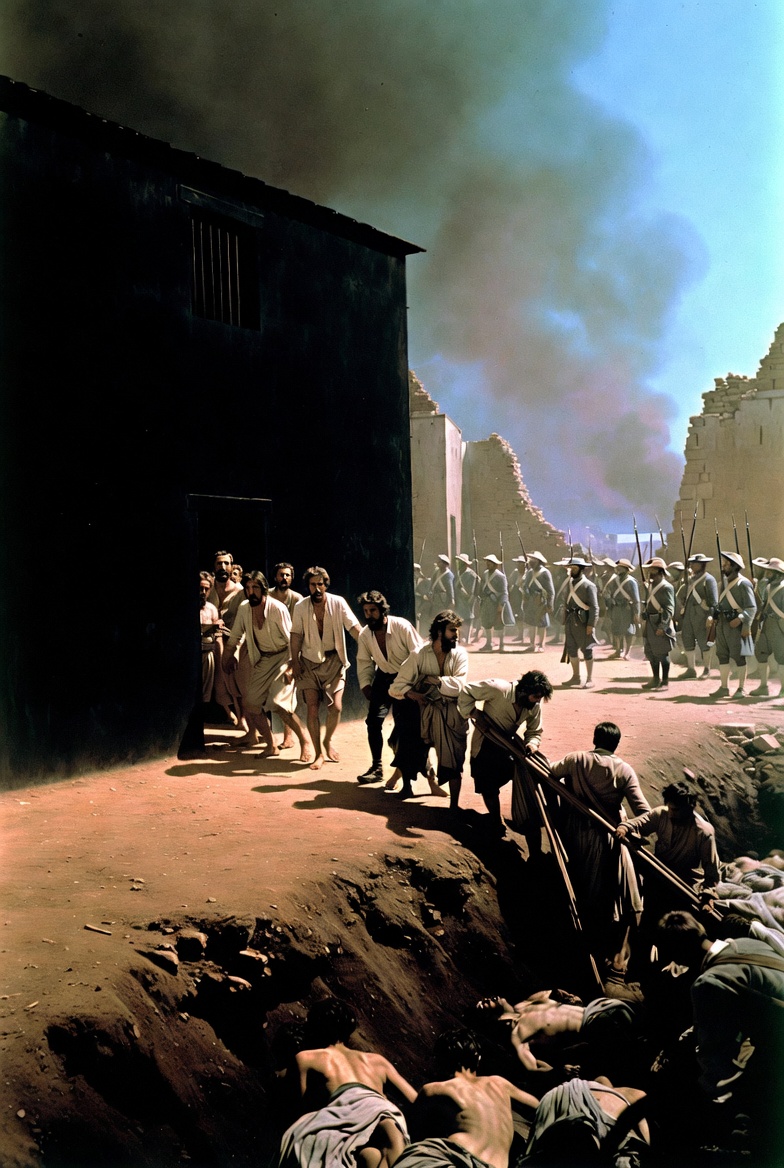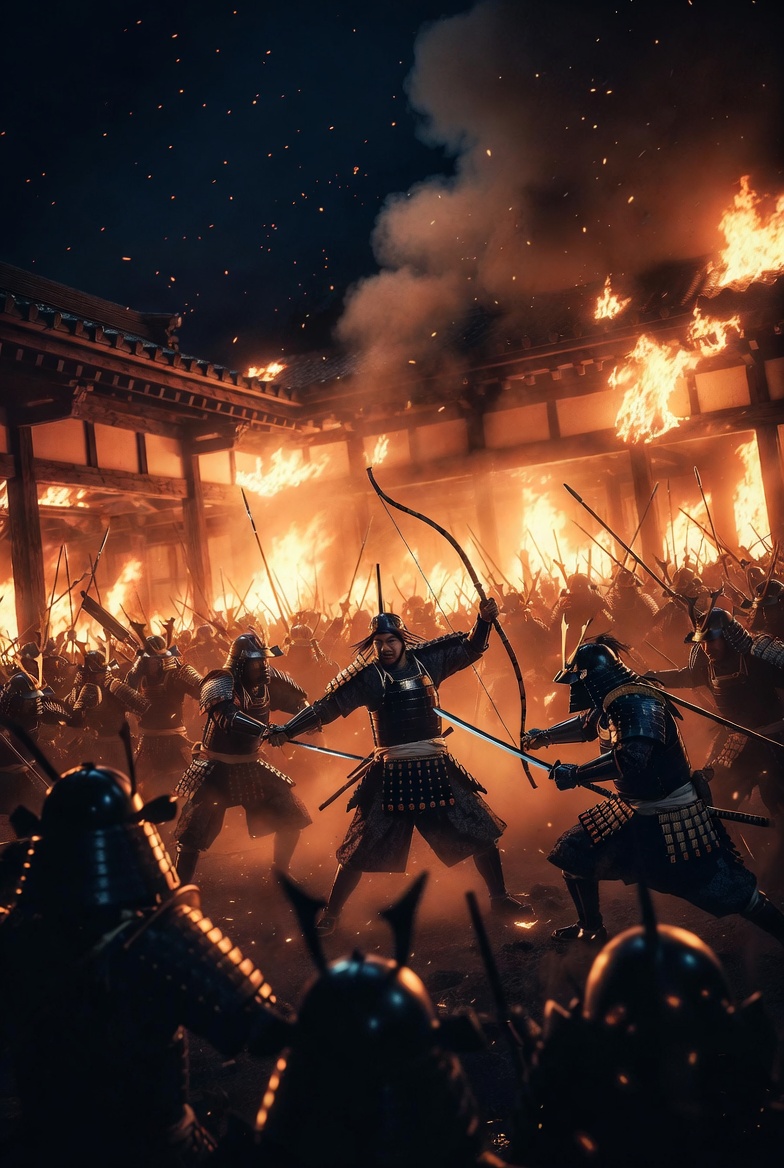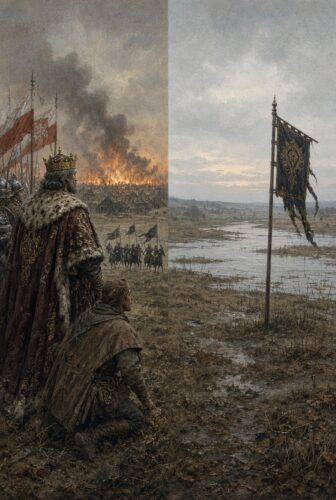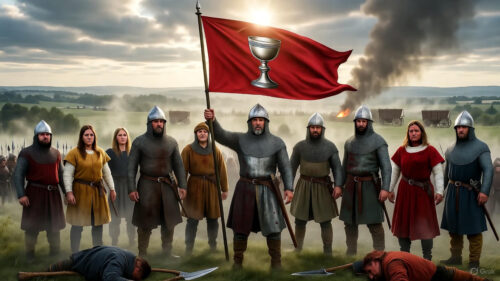

On a June day in 1306, in a quiet wood near the village of Methven in Perthshire, Scotland, a newly crowned king learned the hardest lesson medieval warfare could teach: never trust that tomorrow’s battle means today is safe. Robert the Bruce, who had placed the Scottish crown on his own head just three months earlier, watched his small army get torn apart in a surprise attack while many of his men were still unarmored, foraging, or lounging in camp. The grass turned red. Spears shattered. Nobles were captured or fled. Bruce himself fought like a cornered lion, but the day ended in rout, humiliation, and a desperate flight into the woods with a handful of loyal followers. This was no minor skirmish. It was the moment the Wars of Scottish Independence nearly ended before they truly began for Bruce. And yet, from that bloody nose came the tactical genius, iron patience, and asymmetric warfare that would culminate eight years later at Bannockburn — one of history’s great underdog victories. The story of June 19, 1306, is not just medieval drama. It is a masterclass in what happens when big plans meet brutal reality, and how the survivors who adapt instead of despair can rewrite the map of nations — or their own lives.To understand why Methven mattered so much, step back into the brutal chessboard of early 14th-century Scotland. The death of Alexander III in 1286 had left no clear heir. The Scottish nobility invited Edward I of England — already known as the “Hammer of the Scots” for his ruthless campaigns — to arbitrate between claimants. Edward chose John Balliol, then promptly treated Scotland as a vassal state, demanding military service and humiliating Balliol until the Scottish king rebelled. Edward crushed the resistance, stripped Balliol of the crown in 1296, and carried the Stone of Scone south to Westminster. Scotland was occupied. Castles flew English banners. Resistance simmered under leaders like William Wallace, whose victory at Stirling Bridge in 1297 and defeat at Falkirk in 1298 showed both the power and limits of Scottish defiance. Into this mess stepped Robert the Bruce. His family had ancient claims to the throne through descent from David I. Bruce had played both sides for years — supporting Edward at times, resisting at others — a common survival strategy among border nobles. But in early 1306, everything changed. Bruce met his chief rival for the Scottish crown, John “the Red” Comyn, in the Greyfriars church in Dumfries. The two men argued violently over strategy and claims. Accounts differ on the exact spark, but Bruce (or his men) struck Comyn down inside the church. Killing a rival in consecrated ground was not just murder — it was sacrilege. Bruce was excommunicated by the Pope. Edward I, already furious at ongoing Scottish trouble, now had a personal vendetta. “He has broken the peace in our land,” Edward reportedly raged. He ordered no quarter for Bruce or his supporters. Bruce’s response was audacious and desperate. On March 25, 1306, at Scone Abbey, he was crowned King Robert I of Scots by a handful of supporters, including the Countess of Buchan who performed the traditional ceremony in place of her captured husband. It was a tiny, almost pathetic coronation compared to the grand affairs of other kings. Bruce had perhaps a few hundred fighting men at most. Most Scottish nobles either supported the Balliol/Comyn faction, had submitted to Edward, or were hedging bets. English garrisons controlled key strongholds. Bruce’s position was militarily absurd. Edward I, though old and ill, moved fast. He dispatched Aymer de Valence, Earl of Pembroke — a capable, experienced commander and brother-in-law to the murdered Comyn — north with a professional force heavy in armored men-at-arms and cavalry. Valence’s orders were clear: hunt down the new “king” and crush the rebellion before it spread. Bruce, meanwhile, tried to rally support, moving through the central Lowlands and into the Perth area. His army remained small and lightly equipped compared to English heavy cavalry. Many of his followers were tenants, kin, or local levies rather than trained knights.
By mid-June, the two sides maneuvered near Perth. Some chroniclers, drawing on the near-contemporary epic poem *The Bruce* by John Barbour, suggest there was talk of a formal battle or even a temporary understanding that fighting would occur the next day. Whether it was a genuine truce, a stalling tactic, or simply Bruce assuming the English would follow chivalric norms, the result was the same: on the evening of June 18 or early on the 19th, many of Bruce’s men camped in the Park of Methven — a wooded area outside the village — believing they had time to rest, forage, and prepare. Some took off their armor. Others scattered to gather supplies. The classic mistake of assuming the enemy would play by your rules. Valence did not play by those rules. At some point on June 19, 1306 — the date confirmed across multiple historical records — Pembroke’s forces struck hard and fast. Barbour’s vivid account describes the English riding “in a randoun richt” (a full charge) straight at the disorganized Scottish camp. The surprise was total. Men scrambled for weapons and horses. Bruce, still unarmored or only partially equipped according to some tellings, heard the alarm and immediately began rallying his troops with shouts of “To arms!” and displays of his royal banner. He fought personally with desperate courage, cutting down enemies and trying to hold a line as his men formed up in the chaos. The fighting was savage and brief. Lances shattered on impact. Swords and axes came out. Blood soaked the grass. Barbour describes knights on both sides performing great feats of arms, but the English advantage in preparation, armor, and numbers told quickly. Scottish formations broke. Men fled into the surrounding woods. Several important supporters were captured, including a young Thomas Randolph (Bruce’s nephew, who would later become one of his best commanders after switching sides back). Others were killed or scattered. Bruce himself escaped the melee with a small core of followers, but his army as a fighting force was shattered for the moment. The aftermath was grim. Edward I’s policy was brutal: captured Scottish nobles and knights who had supported Bruce were often executed or imprisoned. Bruce’s own brothers met terrible fates in subsequent months. His wife Elizabeth, daughter Marjorie, and sisters were eventually captured and treated harshly — one sister imprisoned in a cage hung from a castle wall as a public spectacle. Bruce himself became a hunted fugitive, moving through the glens and forests of Scotland with a shrinking band of loyal men, sometimes reduced to a handful. He hid on islands, slipped through enemy lines, and survived on the charity of supporters who risked everything. For a time, it looked as though the Bruce cause was finished. Yet this is exactly where the story turns from disaster into legend — and where the real historical lesson emerges. Methven did not destroy Robert the Bruce. It stripped away every illusion. The romantic notion of chivalric pitched battles against a superior, prepared enemy died in that wood. Bruce learned, through blood and humiliation, that survival and victory required different tools: intimate knowledge of terrain, lightning raids instead of set-piece fights, patient accumulation of small advantages, and iron loyalty from a tight inner circle rather than broad but unreliable alliances. He stopped fighting the English on their terms and started fighting on Scotland’s — using hills, bogs, forests, and local knowledge as weapons.
Over the next months and years, the fugitive king conducted what modern strategists would recognize as classic guerrilla and asymmetric warfare. He won small but morale-boosting actions, such as the skirmish at Glen Trool and the victory at Loudoun Hill in 1307, where he used terrain to neutralize English cavalry. He rebuilt support among ordinary Scots who saw him share their hardships. He conducted diplomacy abroad while his brother Edward Bruce and lieutenants like James “the Black” Douglas raided deep into English-held territory, keeping the enemy off balance. By 1314, when Edward II (son of the Hammer) marched north with a massive army to relieve Stirling Castle, Bruce was ready. He chose the ground near the Bannock Burn carefully — narrow front, protected flanks, hidden pits for cavalry — and used disciplined schiltron formations (tight pike-and-shield hedgehogs) that turned English knights into sitting targets. The result was one of the most decisive defeats ever inflicted on English arms in Scotland and the effective end of the Wars of Scottish Independence in Bruce’s favor. The Methven defeat was the necessary pivot. Without that shock, Bruce might have continued gambling on big battles he could not win. The loss forced adaptation. It burned away overconfidence. It taught him that sometimes the smartest move is to lose the battle but win the long war by refusing to die and refusing to fight stupidly again. Now consider what that ancient, specific June 19 disaster offers anyone facing their own crushing setbacks today — whether in career, creative work, health recovery, finances, or personal goals. The historical outcome was not abstract inspiration; it was a concrete change in method that turned probable failure into improbable success. Here is how those lessons translate into immediate, practical advantage in individual life, stripped of fluff and focused on results. **The core benefits, applied directly:** - You stop romanticizing “fair fights” or “level playing fields.” Bruce learned that assuming the other side will honor agreements or wait for your preparation is suicide against a stronger opponent. In modern terms, this means auditing every area where you are exposed because you trusted process, timing, or goodwill that may not exist. Job interviews, negotiations, content launches, health routines — if you are “camped unarmored,” you are vulnerable to sudden shifts.
- Defeat becomes diagnostic data rather than identity. Methven revealed exactly where Bruce’s assumptions failed: over-reliance on a small force without proper scouting or security, underestimating the enemy’s willingness to strike early, and lack of contingency for chaos. A modern parallel is treating a failed project, health flare, financial hit, or rejected pitch as a precise map of weak points instead of proof you are doomed. - You shift from “all-in pitched battles” to asymmetric, low-risk accumulation. After Methven, Bruce avoided repeating the mistake. He raided, harassed, consolidated, and only committed when conditions favored him. This is the difference between burning out trying to force one big win and building compounding small wins that create unstoppable momentum. - Loyalty and core capability matter more than numbers or polish. Bruce escaped with a tiny band of committed people. In today’s terms, this means ruthlessly protecting and strengthening your “warband” — the 2–5 key skills, relationships, habits, or resources that actually move the needle — while shedding distractions and fair-weather supporters. - Terrain mastery beats raw power. Bruce turned Scotland’s landscape into a weapon. Today that means deeply mapping the specific environment of your goal: market realities, personal energy constraints, hidden opportunities, competitor blind spots. The person who knows the ground wins more often than the one with bigger resources. - Patience plus persistent small pressure eventually forces the decisive moment. It took Bruce eight years from Methven to Bannockburn. The modern version is rejecting both despair and frantic overreach in favor of disciplined, repeated action that compounds until a major opening appears. These are not generic motivational slogans. They are tactical translations of what actually worked after a real historical catastrophe. **The Methven Maneuver: Your 19-Day Tactical Comeback Protocol** This is not another vague self-help framework. It is a compressed, military-derived operating system designed for rapid implementation after a setback. It treats your current situation like Bruce’s post-Methven reality: limited resources, hostile environment, need for quick adaptation without suicidal risk. The goal is to move from “routed in the park” to “ready for your Bannockburn” in under three weeks. Execute it sequentially. Track everything on paper or a simple note app. No vision boards. No affirmations. Only actions and metrics. **Days 1–3: The Valence Audit (Intelligence Gathering)** Spend two focused hours each day reconstructing your “Methven.” Write the timeline of your recent setback in brutal detail: What truce or assumption did you rely on that proved false? Where exactly were you unarmored or dispersed (skills gap, no cash buffer, weak network, poor timing, ignored warning signs)? Identify the three biggest exposed vulnerabilities. This is not therapy — it is reconnaissance. Output: a one-page “enemy capabilities” document. Metric: at least five specific, previously unacknowledged weak points listed.
**Days 4–7: Fortify the Core Warband (Resource Consolidation)** Identify your non-negotiable “knights” — the 3–5 elements that must survive and strengthen (key skill, health baseline, 1–2 relationships, emergency fund minimum, core creative or professional output). Cut or deprioritize everything else ruthlessly for these four days. Bruce did not try to hold every castle; he kept his mobile fighting core alive. Daily action: one concrete strengthening move per warband member (e.g., 30 minutes deliberate practice on the skill, one high-value conversation, one health non-negotiable). Metric: zero erosion of the core by day 7. **Days 8–12: Terrain Scouting Raids (Environmental Mapping)** Bruce knew every glen and bog. You map your battlefield. For 60–90 minutes daily, research and document the real landscape of your goal: competitors’ actual moves (not assumptions), timing realities, hidden advantages (local networks, unique angle, timing windows), and natural obstacles (seasonal energy dips, platform changes, cash flow patterns). Conduct one tiny “raid” test each day — a low-risk probe like sending one targeted message, testing one micro-offer, or trying one 10-minute version of a habit. Output: a simple terrain map with 5–7 actionable features noted. Metric: at least three previously unknown opportunities or dangers identified. **Days 13–16: Guerrilla Pressure Campaign (Momentum Building)** Launch daily small raids that harass problems and accumulate ground without committing your full force. Think Black Douglas-style hit-and-run: one focused 25-minute deep work block on your highest-leverage task, one networking or relationship touch, one defensive habit (sleep, movement, or financial). Keep score like a medieval chronicler — number of “raids” completed and micro-wins logged. No big launches yet. The point is volume of disciplined, low-risk action that makes you harder to knock over. Metric: minimum 80% raid completion rate across the four days. **Days 17–19: Bannockburn Preparation (Decisive Engagement Setup)** Now choose one contained “decisive action” for day 19 or shortly after — a project launch, important conversation, health milestone, or pitch — but only after the previous phases. Apply everything learned: chosen ground (timing and conditions you control), schiltron discipline (prepped systems and habits), and refusal to fight on the enemy’s favorite terms. Execute cleanly. Then immediately document what worked and what still needs adjustment. Metric: the action is completed with the preparation checklist from days 1–16 visibly applied. This protocol is deliberately short, tactical, and historically grounded. It rejects the modern self-help addiction to feeling motivated in favor of behaving like someone who has already survived a rout and refuses to repeat it. Bruce did not win because he was the strongest or the luckiest. He won because June 19, 1306, taught him exactly how to stop losing stupidly and start winning methodically. The grass at Methven turned red with Scottish blood that day. But the man who escaped that wood eventually forced an English king to recognize Scottish independence. The same principle applies now. Your setback — whatever its scale — is not the end of the campaign. It is the moment the old assumptions die and the real strategy begins. The only question is whether you will use the lesson or repeat the mistake of camping unarmored, waiting for a tomorrow that never comes on your terms. History does not repeat, but it rhymes. June 19, 1306, is still rhyming for anyone willing to listen and then act differently. The crown that looked ridiculous in 1306 ended up secured by 1328. Your version of that crown is still available — but only if you treat today like the day after Methven, not the day before. Now go scout your terrain. Strengthen your warband. Launch the first raid. The long game belongs to those who learn fastest from getting surprised in the park.
Share: