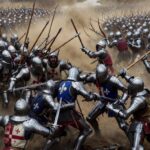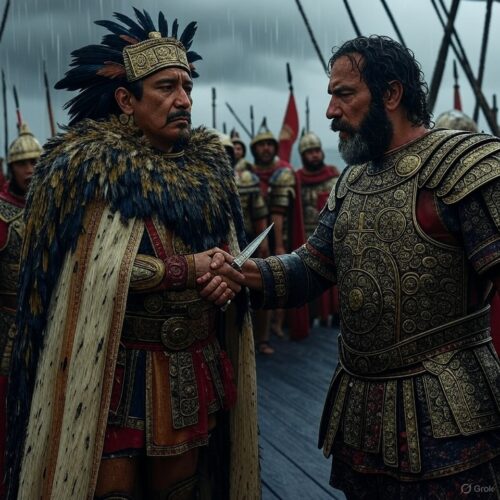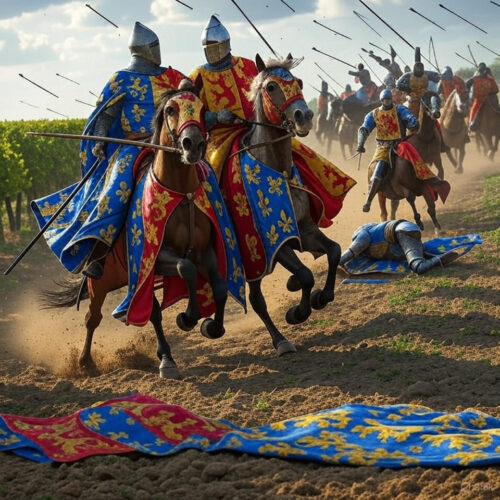

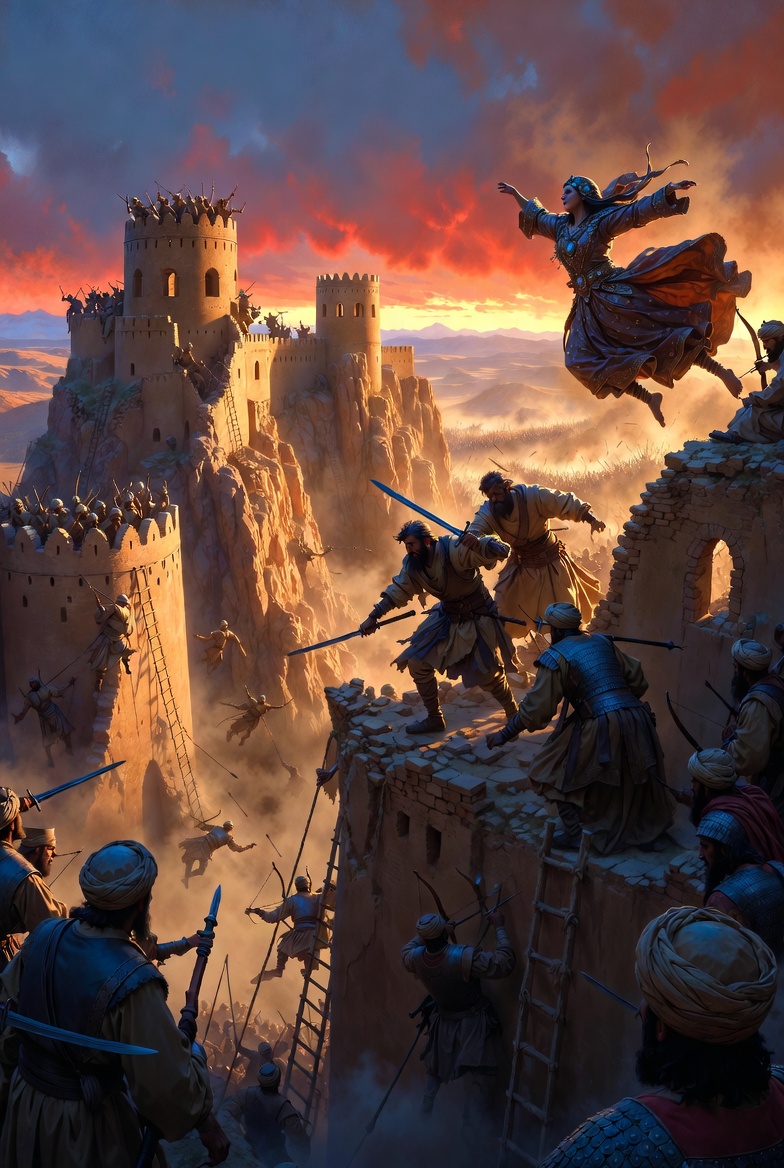
Picture this: April 2, 1107, in the rugged foothills south of Isfahan, the glittering heart of the vast Seljuk Empire. Dust swirls under the hooves of thousands of Turkish cavalry, Persian infantry, and allied levies. Tents ripple in the desert wind like a sea of canvas and silk banners bearing the black eagle of the Seljuks. At the center of it all stands Sultan Muhammad I Tapar, son of the legendary Malikshah, a man forged in civil war and driven by pious fury. Before him rises Shahdiz—also called Dizkuh—the “Fortress of Isfahan,” perched defiantly on a subpeak of Mount Soffeh, eight kilometers from the capital’s gates. It is no ordinary castle. It is the dagger at the throat of Sunni orthodoxy, held by a handful of fanatical Nizari Ismailis, the group later mythologized as the Assassins. On this very day, Tapar gives the order: begin the siege. What follows is not a quick storming of walls but a grinding, year-long drama of theology, betrayal, heroism, and gruesome victory that reshapes medieval Persia. This is no dusty footnote. It is a raw, blood-soaked tale of power, infiltration, and relentless patience that 90 percent of history books gloss over in favor of Crusades or kings in Europe. Today, on the anniversary of that first encampment, we dive deep into the forgotten siege that cracked an “impregnable” stronghold—and discover how its hard-won outcome can hand you a blueprint for storming the hidden fortresses sabotaging your own life.To understand why April 2, 1107, mattered, we must rewind the clock through the chaotic 11th century, when nomadic Turks burst onto the world stage and a secretive Shiite sect turned mountain hideouts into revolutionary bases. The Seljuk Empire itself was a whirlwind creation. These Oghuz Turks, originally pagan steppe warriors from Central Asia, swept into the crumbling Abbasid Caliphate in the 1040s under leaders like Tughril Beg. By 1055 they had seized Baghdad, nominally restoring Sunni authority while ruling as military sultans over the puppet Abbasid caliphs. Alp Arslan, Tughril’s nephew, crushed the Byzantine army at Manzikert in 1071, opening Anatolia to Turkish settlement. Then came Malikshah I, Tapar’s father, who ruled from 1072 to 1092 in a golden age of Seljuk might. Isfahan became his dazzling capital—mosques, madrasas, gardens, and observatories bloomed under vizier Nizam al-Mulk’s genius administration. Poetry, astronomy, and Sharia scholarship thrived. But beneath the surface, cracks formed. Malikshah’s death in 1092 (possibly poisoned) triggered a brutal succession war among his sons and nephews. Berkyaruq, the eldest, clawed his way to the throne in a decade of fratricidal bloodletting, but his reign was weak, marked by revolts, economic strain, and growing tolerance of heterodox groups. Enter Muhammad Tapar—born January 20, 1082, nicknamed “Tapar” meaning the one who obtains or conquers. He had been sidelined with provinces in Azerbaijan and Armenia, but by 1104, exhausted Berkyaruq agreed to a power-sharing deal. When Berkyaruq died in 1105, Tapar emerged as sole sultan in the west, with his brother Sanjar holding the east. Tapar was no mere warlord. Contemporary chroniclers like Imad ad-Din al-Isfahani called him “the perfect man of the Seljuk dynasty and their strongest steed.” He was a devout Sunni, a friend to ulama (religious scholars), a suppressor of taxes not sanctioned by Islamic law, and a ruler obsessed with restoring order and orthodoxy. His first priority? Crushing the internal threat that had metastasized while his family fought: the Nizari Ismailis. Who were these Nizaris, the so-called Assassins? Their story is pure 11th-century thriller. Ismailism itself was a branch of Shiite Islam believing in a line of imams descending from the Prophet’s daughter Fatima and Ali. The Fatimid Caliphate in Cairo had ruled a rival Shiite empire since 969, but in 1094 everything exploded. Fatimid Caliph al-Mustansir Billah died. Vizier al-Afdal engineered a coup, installing the younger son al-Musta’li as caliph-imam and sidelining (then executing) the elder designated heir, Nizar. Supporters of Nizar, led by the brilliant Persian missionary (da’i) Hassan-i Sabbah, rejected the coup. Hassan, who had studied in Egypt and received secret knowledge of Nizar’s claim, returned to Persia and launched an independent da’wa—missionary call. In 1090 he pulled off one of history’s greatest infiltrations: bribing or converting guards, he seized the mountain fortress of Alamut in the rugged Alborz range north of modern Tehran. From there he built a decentralized network of castles across Persia and later Syria, operating like a medieval shadow state. The Nizaris practiced taqiyya (religious dissimulation) to survive in hostile lands. Their fidais—devoted young men trained in disguise, languages, and combat—became legendary for targeted killings of tyrants, though the “hashish eater” myth (origin of “assassin”) was later Sunni propaganda; the real etymology likely comes from “asāsiyyūn,” meaning “followers of the foundation” or the imam’s cause. They weren’t mindless drugged killers; they were ideological guerrillas fighting what they saw as illegitimate Sunni rule.
By 1100, the Persian Nizaris under Hassan’s lieutenants were expanding aggressively toward Seljuk heartlands. The chief da’i of Persia and Iraq, Abd al-Malik ibn Attash, had long operated from Isfahan. His son, Ahmad ibn Abd al-Malik ibn Attash, proved even bolder. Posing as a humble schoolmaster, Ahmad infiltrated the region’s Daylami garrison—tough highlanders from northern Persia with lingering Shiite sympathies. He converted them quietly, then one night in around 1100 the garrison flipped. Shahdiz fell without a major fight. Ahmad re-fortified the castle on its dramatic rocky spur, turning it into a mirror of Alamut: cisterns for water, granaries, armories, and hidden tunnels. From Shahdiz he collected taxes from surrounding districts, preached openly, and reportedly converted up to 30,000 locals in Isfahan itself. The fortress guarded the main southern approaches to the capital. It was a dagger pointed at Tapar’s jugular—literally and ideologically. Ismaili sympathizers could now subvert officials, spread “heresy,” and potentially assassinate the sultan or his viziers. For Tapar, fresh from stabilizing his fractured empire, this was intolerable. He framed the campaign as jihad against innovation (bid’ah) and heresy, rallying Sunni clerics and amirs. In 1106 he had already tested the waters by ordering local rulers like the Bavandid prince Shahriyar IV in Mazandaran to join anti-Ismaili efforts. Shahriyar, annoyed by the imperious tone, refused and even defeated a Seljuk force sent against him. But Tapar persisted. By early 1107 his massive army—chroniclers speak of “a large force” including cavalry, infantry, siege engineers, and camp followers—marched on Shahdiz. On April 2 the tents went up, the encirclement began, and the siege that would define Tapar’s reign and weaken the Nizaris’ Persian heartland was underway. The siege itself was no Hollywood charge. It was a masterclass in medieval patience, psychological warfare, and gritty endurance. Shahdiz was no flimsy stockade; its location on a steep subpeak made direct assault suicidal. Steep cliffs, strong walls rebuilt by Ahmad, and a small but elite garrison of perhaps a few hundred at peak (down to about 80 in the final stand) favored the defenders. The Nizaris had stockpiled supplies and water. Tapar’s strategy was classic Seljuk: total encirclement to starve them out, combined with political pressure. He personally oversaw operations, signaling his commitment. For nearly a year the siege dragged on. Ahmad ibn Attash, a master orator and theologian, played his trump card: intellectual sabotage. He engaged Ismaili sympathizers inside the Seljuk camp and the ulama of Isfahan in prolonged religious debates. His argument was cunning and dangerous: “We Ismailis are true Muslims. We differ only on the question of the imamate—who the rightful successor to the Prophet is. Politically, we accept the sultan’s authority. There is no justification for attacking fellow believers over doctrinal nuance.” These debates sowed doubt, delayed assaults, and bought precious time. Sympathizers in Tapar’s own ranks argued for restraint. Sunni hardliners pushed back, but the theological stalemate frustrated the soldiers. Imagine the grumbling in the Seljuk camp: “We came to fight, not attend seminary!” One dramatic incident broke the tension—a fidai (devoted assassin) slipped through lines and wounded a key anti-Nizari amir, reminding everyone of the Ismailis’ lethal reach even under siege. Negotiations followed, messy and treacherous. One proposal involved trading Shahdiz for another distant fortress; it collapsed. A second deal seemed promising: allow most of the garrison safe passage to other Nizari strongholds in Arrajan and Quhistan in exchange for surrender of the remaining wing of the fortress. About 80 men, including Ahmad and his family, would hold out until confirmation that their comrades had arrived safely, then proceed to Hassan-i Sabbah’s Alamut. Messengers confirmed the safe passage. Most complied and left. But Ahmad refused to abandon his post. In a moment of defiant heroism straight out of epic poetry, he and his small band chose a last stand. The Seljuks attacked. The Nizaris fought “from tower to tower,” chroniclers record, selling their lives dearly in close-quarters combat with swords, arrows, and perhaps Greek fire or boiling oil from the ramparts. Most of the 80 were cut down. A few escaped into the mountains. Ahmad was captured, paraded through Isfahan in humiliation, then executed—some accounts say skinned alive, his head sent as a trophy to the Abbasid Caliph al-Mustazhir in Baghdad. His wife, dressed in her finest jewels, chose suicide by leaping from the fortress walls rather than capture. The Seljuks demolished Shahdiz stone by stone to prevent any future recapture. They also razed the nearby Ismaili outpost at Khanlanjan. The victory was total in the Isfahan region. Nizari influence there collapsed overnight. Tax revenues flowed back to the sultan. Sunni orthodoxy breathed easier.
Yet the broader Nizari story did not end. Hassan-i Sabbah remained secure in distant Alamut. Other fortresses in Rudbar, Quhistan, and later Syria held firm. The decentralized network—castles separated by hundreds of miles, linked by da’is and fidais—proved resilient. Tapar tried again in 1109, sending forces under Ahmad and Chavli Saqavu against Alamut and Ostavand, but they achieved nothing decisive and withdrew. The Nizaris survived attrition, famine, and annual raids because their mountain strongholds were logistical nightmares for large armies. Tapar died in Baghdad on April 18, 1118—ironically, just 11 years after starting the Shahdiz siege—leaving a fragmented empire. His campaigns had checked the Nizaris in the west but never eradicated them. The Syrian branch later tangled with Crusaders, inspiring Marco Polo’s tall tales of drugged paradise gardens and suicidal leaps. In reality, the Nizaris were sophisticated political actors: they collected tithes, ran efficient administrations inside their domains, and used targeted violence as a force multiplier against vastly superior foes. Their survival until the Mongol holocaust in 1256 is a testament to asymmetric warfare centuries before the term existed. The siege of Shahdiz was significant far beyond one fortress. It marked the high-water mark of Tapar’s anti-heretical drive, restored Seljuk prestige around the capital, and demonstrated that even the cleverest infiltration could be reversed by sustained pressure and orthodox unity. It highlighted the fragility of empires built on military conquest when ideology undermines loyalty from within. For the Nizaris, the loss taught the value of decentralization—no single stronghold was fatal. For historians, it offers a window into 12th-century Persia: the interplay of Turkic military power, Persian administrative genius, Arab religious scholarship, and Shiite revolutionary fervor. Daily life inside Shahdiz before the siege must have been tense yet purposeful—prayers following the Nizari rite, weapons drills for fidais, da’wa lessons for converts, water rationing, and constant watch for Seljuk scouts. Outside, Tapar’s camp buzzed with horses, cooks roasting lamb, mullahs reciting Qur’an, and engineers pondering siege engines (though the terrain made catapults less useful than starvation). The theological debates were not sideshows; they were weapons as sharp as any sword, revealing how ideas could paralyze armies.
Fast-forward nine centuries, and the outcome of that April 2, 1107, beginning still echoes with practical power for your individual life. Tapar did not win by genius tactics alone or quick victory. He won through patient encirclement of a hidden threat, refusal to accept ideological compromise, alliance-building (even when imperfect), and the willingness to endure a long, unglamorous grind until the final decisive assault. The Nizaris showed the danger of underestimating subtle infiltration and the strength of decentralized resilience. Applied personally, this history hands you tools sharper than any self-help cliché. Here is how the outcome benefits you today, translated into concrete individual advantage: - **You learn to spot and encircle “internal traitors” before they seize your personal capital.** Just as Ahmad posed as a harmless schoolmaster to flip Shahdiz, small excuses or habits (endless scrolling, procrastination disguised as “research,” toxic relationships masked as networking) infiltrate your goals unnoticed. The siege teaches you to identify these early, encircle them with awareness, and starve them of time and energy rather than hoping they self-destruct. - **You master the art of intellectual siege warfare against your own doubts.** The year-long debates delayed Tapar’s army; in your life, internal monologues (“I’m not ready,” “It’s too late,” “What if I fail?”) do the same. Tapar’s victory came from rejecting compromise with heresy. You reject compromise with self-sabotage by arming yourself with counter-arguments rooted in evidence and past small wins, turning doubt into a negotiable foe you eventually outlast. - **You build decentralized resilience so one lost “fortress” never ends your campaign.** The Nizaris survived Shahdiz’s fall because Alamut and other outposts endured. You stop putting all eggs in one basket—whether a single job, relationship, or business idea—and create multiple strongholds: side skills, backup networks, parallel income streams, emotional support systems. Loss becomes a tactical retreat, not total defeat. - **You embrace prolonged commitment over viral quick fixes.** Modern culture sells 7-day miracles; Tapar’s siege lasted over a year. The benefit is real transformation through sustained pressure. Your fitness, finances, or creative projects improve not from one heroic effort but from daily encirclement until the walls crack. - **You weaponize alliances and orthodoxy against chaos.** Tapar rallied clerics and amirs around shared Sunni values. You recruit mentors, accountability partners, and non-negotiable personal principles to counter the chaos of modern life’s distractions and “gurus” promising easy paths. These are not vague inspirations. They are direct outcomes of the historical fact that patient, principled pressure toppled a fortress others thought unassailable.
Now, the part you have been waiting for: a detailed, quick, unique plan that no other self-help guru online is peddling. Forget vision boards, gratitude journals, or 75 Hard challenges. This is the **Shahdiz Siege Protocol**—a 14-day anti-cliché assault modeled precisely on Tapar’s 1107 campaign but adapted as a ruthless, funny, battle-tested system for conquering your own hidden strongholds. It is quick (two weeks), detailed (exact daily actions), and unique because it treats your bad habits or stalled goals like a medieval fortress defended by clever infiltrators. You become the sultan, your excuses become the Nizaris, and victory is demolition of the old to build the new. Do this once for one specific “Shahdiz” in your life (procrastination on a big project, toxic spending, fitness plateaus—pick one). Repeat quarterly for others. No fluff, just siege engines. **Days 1-2: Scout and Encirlce (Identify the Fortress and Cut Supply Lines)** Map your target like Tapar scouted Shahdiz. Write down the exact “fortress” (e.g., “my Netflix binges that kill evening productivity”). List every infiltration point (triggers, rationalizations) and cut one supply line immediately—delete the app, move the device to another room, or block the website. Recruit one “amir” ally (a friend who checks in daily via text). Laugh at yourself: “Like Ahmad the schoolmaster, my excuses have been posing as ‘self-care.’ Not today.” **Days 3-5: Launch Theological Debate (Intellectual Warfare Phase)** Every morning debate your own excuses out loud for 10 minutes, mirroring Ahmad’s delay tactics—but this time you are the hardliner winning. Record voice memos arguing both sides then crush the weak one with evidence (“Last time I ‘rested’ I regretted it”). Starve the garrison by replacing one daily trigger with a positive ritual (e.g., 5-minute walk instead of scroll). By day 5 the walls feel shakier. **Days 6-9: Negotiate and Test Loyalty (Pressure and Alliance Building)** Offer your “garrison” a false surrender deal: “If I complete one micro-task today, I get a small reward tonight.” Then break the deal on yourself when the 80 holdouts (core excuses) refuse to leave—double down instead. Contact two more allies for public commitment (post on a private group or tell family). Use Tapar’s piety: enforce one non-negotiable “Sharia” rule for your life (e.g., no screens after 9 p.m.). Watch the defenders fracture. **Days 10-12: Final Stand Simulation (Heroic Last Push)** Mimic Ahmad’s refusal: go all-in on three consecutive “tower-to-tower” days where you attack the stronghold relentlessly (e.g., three hours blocked work on the project, no excuses allowed). Track every small casualty (each avoided trigger). Celebrate grimly like a Seljuk soldier: “They fought well, but the fortress is cracking.” **Days 13-14: Demolition and Occupation (Total Victory and Rebuild)** Demolish publicly—delete old apps permanently, donate the junk enabling the habit, or publicly announce completion of the micro-goal. Occupy the ruins by planting your flag: install a new positive habit in the freed space (e.g., reading instead of scrolling). Measure the win quantitatively (hours reclaimed, money saved). Send your own “head to the caliph”—journal the before/after and share with your amirs. The fortress is gone; the region is yours. Complete the protocol and you will feel the same rush Tapar’s troops felt watching Shahdiz’s towers collapse. It is not magic. It is medieval siege logic applied with modern precision—patient, ruthless, alliance-driven, and gloriously effective against the cleverest internal saboteurs. The April 2, 1107, siege proved that even the most cunning stronghold falls when a determined sultan refuses to negotiate with subversion. Your life is no different. Start your own encirclement today. The dust of victory awaits. History did not happen in a vacuum—it happened so you could wield its lessons like a Seljuk sword. Go claim your Isfahan.
Share: