
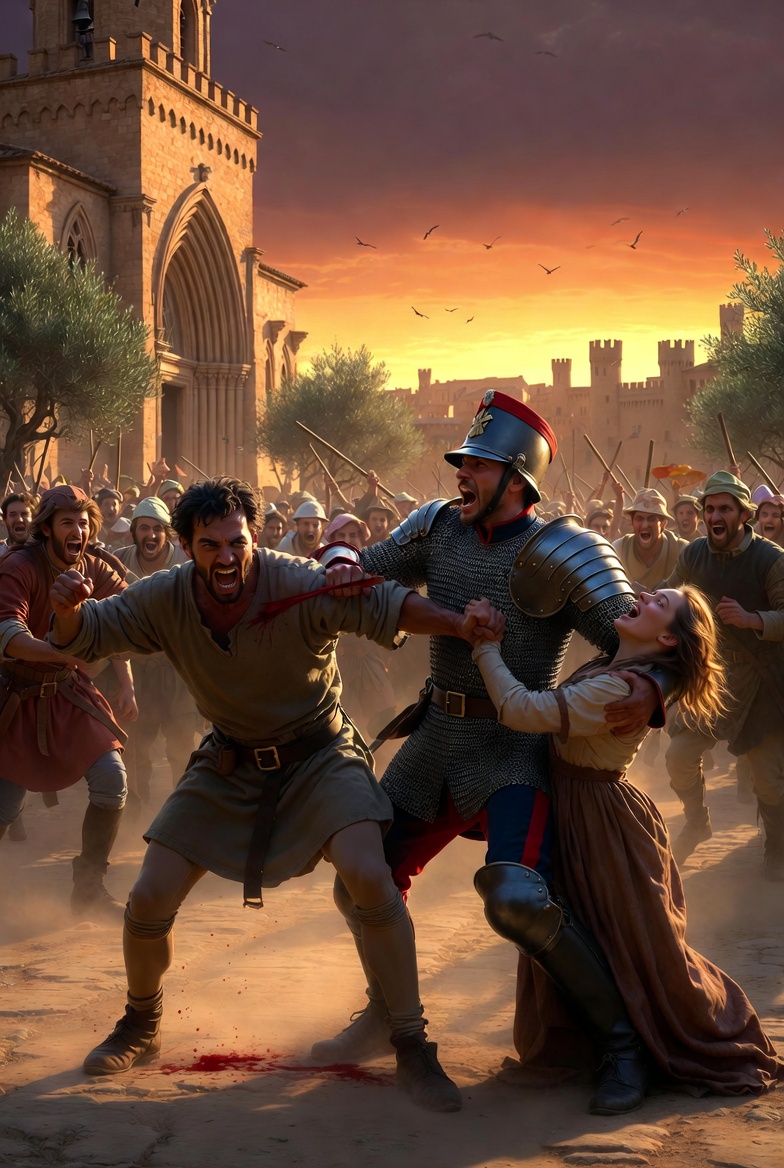
Picture this: Easter Monday, March 30, 1282. The sun is dipping low over Palermo’s olive groves, turning the Mediterranean a bloody orange. Outside the little Church of the Holy Spirit, just beyond the city walls, families in their Sunday best are milling about, laughing, sharing hard-boiled eggs dyed with saffron, the air thick with the scent of roasted lamb and fresh bread. Vespers—the evening prayer—is about to ring out. Then one French sergeant named Drouet, probably half-drunk on Sicilian wine he never paid for, decides to “inspect” a young married Sicilian woman for hidden weapons. He grabs her. He paws at her. Her husband pulls a knife. One thrust. Drouet drops dead in the dust. And that, dear reader, is how an entire empire began to bleed out.Within minutes the church bells start clanging for Vespers. The crowd doesn’t run to prayer—they run to arms. “Moranu li Francesi!” they roar—“Death to the French!” Knives flash. Rocks fly. By dawn, two thousand Frenchmen—soldiers, merchants, monks, women, even children—are lying in the streets of Palermo with their throats cut. The revolt spreads like wildfire across the island. In six weeks, thirteen thousand French are dead or fleeing. An Angevin king who thought he owned the Mediterranean is left screaming at the heavens. Sicily trades one foreign master for another, but on its own terms. The War of the Sicilian Vespers erupts, drags in France, Aragon, Byzantium, the Pope, Genoa, Venice, and rewrites the map of Europe for the next two centuries. This isn’t some dusty footnote. This is the single most cinematic, darkly hilarious, brutally motivational “enough is enough” moment in medieval history. And 742 years later, on this very date, its lessons are still sharper than any self-help guru’s vision board. Because the Sicilians didn’t meditate their way out of oppression. They didn’t journal their feelings. They plotted in whispers, struck at the perfect second, tested their allies with a single word, and refused to negotiate with the taxman who treated them like cattle. The result? They traded a tyrant who taxed them thirty times heavier than their old Norman kings for a ruler who at least had to pretend to listen. Let’s dive deep—ninety percent of this story is raw, blood-soaked history you’ve probably never heard told like this. The remaining ten percent is the anti-fluff plan that actually works in 2026, when your “tyrants” wear business casual and hide in your phone. ### The Backdrop: How a French Knight Became King of a Sicilian Powder Keg To understand why March 30, 1282, exploded, you have to rewind to the papal chess game of the 13th century. The popes and the German Hohenstaufen emperors had been fighting for control of Italy since the 11th century. Sicily was the grand prize—the breadbasket, the naval base, the gateway to Africa and the East. In 1250 the great Hohenstaufen Frederick II died. His son Conrad IV followed in 1254. Then came Manfred, Frederick’s bastard son, a brilliant, poetry-writing warrior who seized Sicily in 1258. The popes hated the Hohenstaufens with a passion that makes modern Twitter feuds look polite. Pope Urban IV and then Clement IV offered the Sicilian crown to anyone who would crush Manfred. Enter Charles of Anjou—younger brother of King Louis IX of France, battle-hardened, ambitious, and broke. Charles landed in Italy in 1265 with a papal banner, French knights, and a mountain of debt. On February 26, 1266, at the Battle of Benevento, his army smashed Manfred’s. Manfred died fighting, his body left unburied until the French gave it a decent grave out of respect. Two years later, young Conradin—the last legitimate Hohenstaufen—invaded to reclaim the throne. Charles crushed him at Tagliacozzo in 1268, dragged the 16-year-old to Naples, and had him beheaded in the marketplace. The crowd wept. Charles didn’t care. Now Charles owned both Sicily and Naples. He moved the capital to Naples to keep an eye on the mainland. Sicily became a cash cow. He imposed taxes that made the old Norman kings look like Santa Claus: hearth taxes, salt taxes, export taxes, “donations” that weren’t optional. French officials swarmed the island like locusts. They took the best jobs, the best land grants, the best women. Sicilian nobles were frozen out of government. Merchants watched their grain ships sail north to feed Charles’s wars while their own families went hungry. The king was building a fleet to invade Byzantium and crown himself emperor of Constantinople. Sicilians paid the bill and got nothing. By 1281 the resentment was volcanic. Byzantine Emperor Michael VIII Palaiologos, terrified of Charles’s invasion plans, sent agents with bags of gold. Peter III of Aragon—married to Constance, daughter of Manfred and granddaughter of Frederick II—had a legitimate claim and a fleet already assembled under the polite fiction of a crusade against Tunis. A shadowy doctor-turned-diplomat named John of Procida shuttled between Constantinople, Aragon, and Sicilian nobles, whispering promises. The conspiracy was real, but the spark that lit it was pure Sicilian rage.
### The Night the Bells Changed Everything Easter Monday, March 30, 1282. Palermo is festive. The Church of Santo Spirito sits outside the walls, a modest building surrounded by gardens. Families gather for the evening service. French soldiers, off-duty and arrogant, wander among them. One account (from the chronicler Bartholomaeus of Neocastro) says they were “searching for weapons” but really groping every woman they could reach. Another (Leonardo Bruni) claims they were checking breasts for hidden daggers—yes, literally. Either way, Drouet crosses the line with the wrong husband. The knife flashes. The Frenchman dies. His comrades draw swords. The crowd turns into a mob. At that exact moment the church bells begin to ring for Vespers. The sound carries across Palermo like a battle trumpet. Messengers sprint through the streets shouting the password: “Moranu li Francesi!” Every Frenchman in sight is cut down. Doors are kicked in. Taverns are stormed. The Dominican and Franciscan convents are raided; foreign friars are dragged out and forced to pronounce the word “ciciri”—a local chickpea dish. French tongues can’t roll the “ch” sound the Sicilian way. Fail the test, lose your head. It’s brutal. It’s darkly comic. It’s effective.
By morning Palermo is French-free. The rebels organize. They send riders to every town: strike now, before Charles can react. Within days the entire western half of the island is in revolt. Messina holds out until April 28, when its own people rise, elect Alaimo da Lentini captain of the people, and burn Charles’s precious fleet in the harbor. The king, hearing the news, reportedly cried out, “Lord God, since it has pleased You to ruin my fortune, let me only go down in small steps.” Small steps weren’t an option. The French vicar in Sicily, Herbert of Orvieto, barricaded himself in a castle with his family and begged for safe passage out—on condition he never return. The Sicilians declared themselves free communes under the distant protection of the Pope (a nice fiction). They sent a Genoese merchant as envoy to Michael VIII in Constantinople with the joyful news. They begged Pope Martin IV—a Frenchman himself—to recognize their liberty. Martin refused. He excommunicated the entire island and demanded they submit to Charles. Big mistake. The Sicilians turned to the only alternative: Peter III of Aragon. On August 30, 1282, Peter’s fleet anchored at Trapani. He marched to Palermo, swore to restore the old Norman liberties of King William the Good, and was crowned Peter I of Sicily on September 4. The War of the Sicilian Vespers had begun in earnest—a twenty-year meat grinder that sucked in the greatest powers of the age. Charles counterattacked, blockaded Messina, lost his fleet again. Aragonese and Sicilian forces raided the mainland. French armies marched south. The Pope threw everything he had at the “rebels.” Byzantium kept paying. Genoa and Venice picked sides for trade routes. In the end, the 1302 Peace of Caltabellotta left Sicily in Aragonese hands. Charles’s dream of a Mediterranean empire died with him. The island traded French taxes for Spanish ones, but it had proven one truth that still echoes: when the people decide the taxman’s bill is too high, empires fall.
The chroniclers couldn’t stop writing about it. Steven Runciman, in his 1958 masterpiece *The Sicilian Vespers*, called that single evening “one of the great hinge moments of European history.” Verdi turned it into an opera. Sicilian folklore still celebrates it as the night ordinary fishermen, bakers, and mothers said no—and meant it. ### From Medieval Bloodbath to Your Morning Coffee: The Vespers Protocol Here’s where the history stops being a story and starts being a weapon. The Sicilians didn’t succeed because they were bigger, richer, or better armed. They succeeded because they: - Recognized the cumulative “tax” of oppression before it bankrupted their souls. - Plotted quietly until the moment was perfect. - Struck together with ruthless focus. - Tested their allies instantly. - Refused to go back to the old system even when the new one wasn’t perfect. That’s not motivation fluff. That’s a repeatable protocol for 2026, when your tyrants are subtler: the 3 a.m. doom-scroll that taxes your sleep, the soul-crushing job that takes 60 percent of your life for 40 percent of your pay, the “friend” who drains your energy like Charles drained Sicilian grain ships. I call it the **Vespers Protocol**—a five-step, seven-day quick-start plan that is deliberately anti-everything you’ve read in self-help books. No vision boards. No gratitude journals. No “manifesting.” Just Sicilian-level plotting, timing, testing, and execution. It works because it’s built on real human psychology and medieval street-smarts, not corporate wellness seminars. **Step 1: The Hearth-Tax Audit (Day 1 – Map Your “French” Oppressors)** Tonight at exactly 7:00 p.m. (your personal “vespers hour”—when the day’s energy is fading and clarity hits), sit down with a single sheet of paper. List every “hearth tax” in your life—the daily, weekly, monthly drains that give you nothing back. Be brutally specific. Example: “Doom-scrolling TikTok from 9–11 p.m. costs me two hours of deep sleep and next-day focus.” “Toxic coworker who dumps problems on me every Monday morning taxes 45 minutes of emotional bandwidth.” “Subscription services I never use = $47/month literal tax.” The Sicilians knew exactly how much Charles was taking; you must too. No vague “I’m stressed.” Name the sergeants. **Step 2: The Conspiracy (Days 2–3 – Recruit Your Silent Allies)** The Sicilians didn’t revolt alone; they had Procida, Michael VIII, and Peter III. Identify three living humans (or one group chat) who hate your tyrants as much as you do. Do NOT tell them the full plan yet. Float tiny test questions: “Hey, ever notice how [specific tyrant] always does X?” Gauge reactions. If they light up, recruit them with a code phrase only you two understand. If they defend the tyrant, cut them from the list. This is your “ciciri test”—quick, merciless, accent-based. Fake allies get you killed in Palermo and burned out in real life. **Step 3: The Bell-Ringing Moment (Day 4 – Choose Your Exact Trigger Time)** The church bells turned a brawl into a revolution. Pick one non-negotiable “vespers bell” in your week—7:30 p.m. on Thursday, for example—and commit that at that exact second you will execute the first strike. Make it tiny but irreversible. Delete the app. Send the “I’m no longer available for that” email. Block the number. The timing is everything; the Sicilians struck when the French were relaxed and off-guard. Your tyrants are weakest right after they think they’ve won another day. **Step 4: The Massacre (Days 5–6 – Ruthless Elimination, No Mercy)** Here’s the part every self-help book chickens out on: you don’t “set boundaries” with bad habits—you slaughter them. No “I’ll cut back.” Full “moranu li Francesi.” Delete the app permanently. Quit the committee. End the relationship that taxes your soul. When the voice in your head says “but it’s not that bad,” remember the French sergeant who thought groping one woman was harmless—until it cost an empire. Burn the ships. The Sicilians burned Charles’s fleet in Messina harbor; you burn the escape routes.
**Step 5: Crown the New King (Day 7 – Install the Replacement Ruler)** Peter III didn’t just remove Charles; he promised (and partially delivered) the old Norman freedoms. After every massacre, immediately crown a new positive routine that gives you back what the tyrant stole. Deleted TikTok? Crown a 30-minute evening walk with a friend who makes you laugh. Quit the draining job task? Crown a new 9 a.m. “Sicilian hour” where you work on the project that actually excites you. The replacement must feel better than the old tax ever did, or you’ll invite the French back within a month. Repeat the full protocol every 30 days. The first time feels like a street brawl. By the third cycle it feels like a well-oiled Aragonese fleet. You won’t overthrow a medieval king, but you will overthrow the version of your life that’s quietly bleeding you dry. You’ll sleep better, create more, love harder, and laugh at the old tyrants the way Sicilians still laugh at those poor fools who couldn’t say “ciciri.” The bells rang on March 30, 1282, not because the Sicilians were perfect, but because they were done waiting for permission. Your life has its own church bells—internal ones that clang when the tax gets too high. Listen. Plot. Strike. Crown something better. And the next time someone tells you to “just breathe through it,” smile sweetly and remember: the Sicilians didn’t breathe. They roared. And the Mediterranean still echoes with it.
Share: