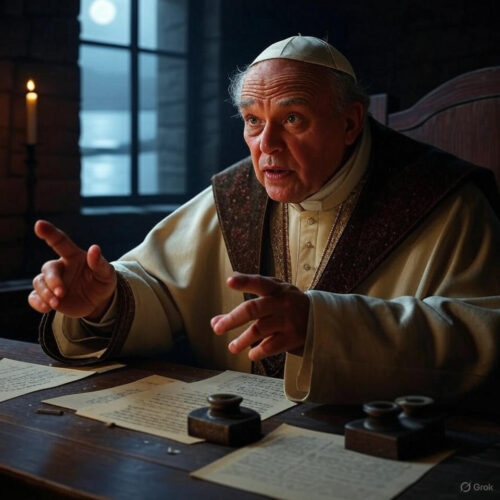

On March 25, 1306—Palm Sunday in the Christian calendar, a day of processions with palms and hymns of triumph—a small, rain-lashed gathering assembled at the ancient abbey of Scone in Perthshire, Scotland. No golden throne waited; Edward I of England had carted the legendary Stone of Destiny south to Westminster years earlier. No vast army cheered. Instead, a handful of bishops, a few loyal earls, and a defiant noblewoman performed one of the most audacious acts in medieval history. They crowned Robert the Bruce, Earl of Carrick, as King Robert I of Scots. A gold circlet was placed on his head. The Scottish banner snapped in the wind. And with that single, hastily arranged ceremony, Bruce launched a guerrilla war that would outlast kings, shatter English supremacy, and forge a nation’s independence against impossible odds.This was no fairy-tale crowning. Just six weeks earlier, Bruce had stabbed his rival John Comyn to death inside a Dumfries church, an act of sacrilege that earned him papal excommunication and the undying hatred of half the Scottish nobility. His family would soon be hunted, his brothers executed, his wife and daughter caged like animals. Yet from that low point—hunted outlaw in a land occupied by the most powerful army in Europe—Bruce built a comeback that still echoes through history books, battlefields, and the stubborn Scottish soul. The story of March 25, 1306, and the decade that followed is 90 percent raw medieval grit: betrayals in candlelit monasteries, desperate flights through Highland mists, innovative tactics that turned peasants into pike-wielding terrors, and one legendary spider that refused to quit. The remaining 10 percent is the payoff for you today: a razor-sharp way to apply Bruce’s blueprint so you can crown your own life with the same unyielding freedom. Let’s rewind the tape properly, because the coronation did not happen in a vacuum. Scotland in the late 13th century was a kingdom unraveling at the seams. Alexander III, the last strong king of the old line, died in 1286 after a drunken fall from his horse on a stormy night near Kinghorn. His heir, the Maid of Norway, perished at sea in 1290. Suddenly, thirteen claimants fought for the throne. Edward I of England—Longshanks, the Hammer of the Scots, a man who had conquered Wales and built the most formidable castles in Britain—offered to arbitrate. In 1292 he chose John Balliol, a weak puppet who promptly became “Toom Tabard” (Empty Coat) after Edward treated Scotland like a vassal state. When Edward demanded Scottish troops to fight his wars in France, the Scots refused and signed the Auld Alliance with France instead. Edward’s rage was biblical. In 1296 he invaded, sacked Berwick-upon-Tweed with a massacre so savage that blood ran in the streets, crushed the Scots at Dunbar, stripped Balliol of his kingship, and hauled the Stone of Destiny south as a trophy. Scotland was now an English province, governed by English sheriffs and garrisons. Enter William Wallace. In 1297 this giant outlaw from Lanarkshire slaughtered an English sheriff and lit the fuse of open revolt. With Andrew de Moray he won the stunning victory at Stirling Bridge, where Scottish spearmen funneled the English knights into a bottleneck and turned the River Forth red. Wallace became Guardian of Scotland, but Edward returned in 1298 with a massive host and crushed him at Falkirk. Wallace was betrayed, shipped to London, and executed in 1305 with the full medieval horror show: hanged, drawn, quartered, his head displayed on London Bridge. The nobility largely submitted. Robert the Bruce, whose grandfather had also claimed the throne during the Great Cause, had played both sides—rebelling with Wallace one year, submitting to Edward the next. He even served as joint Guardian briefly before resigning in frustration over rivalries with the Comyn faction, who backed Balliol’s line. By late 1305 Bruce was done with half-measures. He met secretly with Bishop William Lamberton and made a blood pact: they swore mutual support “against all men” on pain of 10,000 pounds forfeit. Then came the fatal encounter with John “the Red” Comyn, Lord of Badenoch, the most powerful noble in Scotland and Bruce’s deadliest rival. On February 10, 1306, in the Greyfriars monastery at Dumfries, the two men argued over the throne. Comyn had allegedly betrayed a secret agreement to support Bruce’s claim in exchange for lands. Bruce drew his dagger and stabbed Comyn before the high altar. As Comyn lay dying, Bruce’s companion Roger de Kirkpatrick burst in and finished the job with the immortal line, “I mak siccar!”—I make sure. Blood stained the church floor. Bruce and his men seized Dumfries Castle from its English garrison. Bishop Robert Wishart absolved him on the spot, but Pope Clement V would excommunicate him anyway. The Rubicon was crossed. There was no going back.
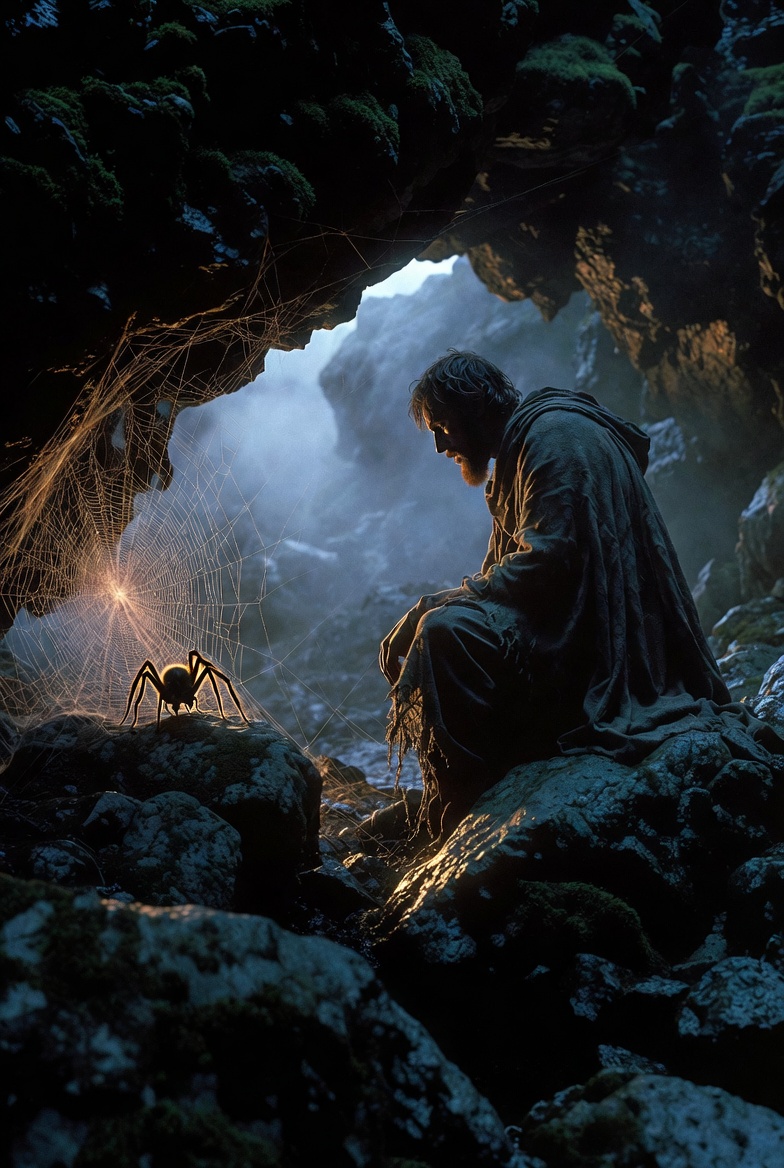
Six weeks later, on March 25, 1306, the coronation. It was rushed, almost comically improvised. Scone Abbey, the traditional crowning place of Scottish kings, still echoed with English boots. The Stone of Destiny was gone, so a simple gold circlet did the job. Bishop Lamberton of St Andrews presided, supported by the bishops of Glasgow and Moray. Earls Atholl, Menteith, Lennox, and Mar stood witness. The next day—or perhaps the same, accounts blur in the haste—Isabella MacDuff, Countess of Buchan, arrived. Her husband was a Comyn ally and English supporter, yet she defied him to perform the ancient MacDuff ritual: placing the crown on Bruce’s head a second time, affirming the royal bloodline. The ceremony was brief, the weather miserable, the crowd tiny. Yet it was legal enough in Scottish eyes. Bruce was now King Robert I. Edward I’s response was volcanic. He dispatched Aymer de Valence, Earl of Pembroke, with an army. On June 19, 1306, at the Battle of Methven, Bruce’s forces were surprised while resting. The English charged out of the woods at dusk. Bruce fought like a demon, rescued three times by loyal knights, but his army disintegrated. He fled into the western highlands and islands with a tiny band that included his brother Edward, James Douglas (the Black Douglas, soon to become a terror to the English), and Gilbert Hay. His wife Elizabeth de Burgh, daughter Marjorie, sisters, and the brave Countess of Buchan were sent to Kildrummy Castle for safety under Neil Bruce and the Earl of Atholl. Betrayed by a blacksmith who set fire to the castle stores, they were captured. The women were paraded through England in cages hung from towers—Elizabeth at Burstwick, Marjorie at the Tower of London, the Countess at Berwick. Neil Bruce and the Earl of Atholl were executed. Bruce’s brothers Thomas and Alexander, landing at Loch Ryan to raise men, were captured and beheaded. Bruce himself became a hunted fugitive, his head priced at 500 marks. This was the rock bottom. Legend says Bruce hid in a cave on Rathlin Island or somewhere in the Hebrides. Depressed and ready to quit, he watched a spider try six times to spin a web across the cave entrance and fail. On the seventh attempt it succeeded. Bruce supposedly muttered, “If at first you don’t succeed…” and resolved to try again. Apocryphal? Probably. But the story has stuck for seven centuries because it perfectly captures the man’s spirit. He returned to the mainland in early 1307 with just a few hundred men. Small victories followed. At Glen Trool in April he ambushed an English force in the narrow glen, rolling boulders down the slopes. In May at Loudoun Hill he faced Aymer de Valence again. Bruce dug trenches to funnel the English cavalry into his schiltrons—tight formations of spearmen that turned knights into pincushions. The English charge broke. Bruce was winning. Then fate smiled. Edward I, the Hammer, died on July 7, 1307, at Burgh by Sands while marching north for one last campaign. His son Edward II was no soldier. Bruce seized the moment. He swept through the north, “harrying the Buchan” in 1308—systematically destroying Comyn strongholds, burning crops, and breaking the power of his rivals so thoroughly that the region never recovered. He captured castles with ingenuity: at Linlithgow a farmer’s hay wagon jammed the gate; at Edinburgh a one-eyed acrobat scaled the rock face with a rope ladder. Perth fell in January 1313 when Bruce himself led the wade across the moat in the dead of night. By 1313 only Stirling Castle remained in English hands. Bruce’s brother Edward besieged it and agreed to a foolish truce: if not relieved by midsummer 1314, it would surrender. Edward II could not ignore the challenge. In June 1314 he marched north with the largest English army ever to invade Scotland—perhaps 15,000–20,000 men, including heavy cavalry, longbowmen, and supply trains stretching for miles. Bruce had maybe 5,500–6,500 spearmen. The two armies met at Bannockburn, just south of Stirling, on June 23–24. Bruce chose the ground masterfully: narrow, boggy, with the Bannock Burn and its tributaries creating natural barriers. His men dug pits covered with brush and caltrops to lame horses. On the first day a young English knight, Henry de Bohun, spotted Bruce riding ahead of his lines on a small horse. De Bohun charged with lance couched. Bruce swerved, rose in his stirrups, and brought his battle-axe down with such force that it split de Bohun’s helmet and skull in two. The axe shaft snapped. Bruce looked at the broken weapon and calmly remarked, “I have broken my good battle-axe.” The Scots roared. Morale soared.
The next day the English crossed the burn in disarray. Bruce’s schiltrons advanced like iron hedgehogs, spears leveled. English archers tried to shoot over their own cavalry but were ridden down. The Scottish reserve under the Earl of Mar charged at the perfect moment. Edward II fled the field on a swift horse, barely escaping to Dunbar Castle. The English left 4,000 dead and their royal standard behind. Stirling surrendered. Bannockburn was not just a battle; it was a annihilation that broke English prestige forever.
Bruce did not rest. He raided northern England repeatedly, extracting “protection money” that funded his kingdom. In 1315 he sent his brother Edward to Ireland to open a second front; Edward was even crowned High King of Ireland in 1316 before dying in battle in 1318. In 1318 the Scots retook Berwick. The Declaration of Arbroath in 1320—sent to Pope John XXII by the Scottish nobles and almost certainly drafted with Bruce’s input—remains one of the most stirring documents in history: “For as long as but one hundred of us remain alive, never will we on any conditions be brought under English rule. It is in truth not for glory, nor riches, nor honours that we are fighting, but for freedom—for that alone, which no honest man gives up but with life itself.” The Pope recognized Bruce as king. Edward II was deposed in 1327 by his own wife and barons. The new English regime finally sued for peace. In the Treaty of Edinburgh–Northampton of 1328, England acknowledged Scottish independence and Bruce’s kingship. Bruce’s son David married Edward III’s sister Joan. The war was over. Bruce himself died on June 7, 1329, at Cardross, probably of leprosy contracted during the campaigns. His heart was taken on crusade by James Douglas and eventually buried at Melrose Abbey. His body lies at Dunfermline. Scotland’s independence, bought with blood and cunning, lasted until the Union of the Crowns in 1603—long enough to prove the point. The outcome of March 25, 1306, was nothing less than the birth of a sovereign nation through sheer bloody-minded persistence. Bruce turned personal risk, tactical brilliance, and refusal to quit into freedom. Here is how that same outcome benefits you today when applied to your individual life, distilled into very specific, actionable ways: - You learn that one irreversible “Comyn moment”—a decisive break from a toxic situation, job, or habit—can be the spark that ends years of half-measures, just as Bruce’s churchyard dagger ended his double game and forced him onto the throne. - You discover that early defeats are not endings but intelligence-gathering missions; Bruce’s flight after Methven taught him guerrilla tactics that later won Loudoun Hill and Bannockburn. - You master the art of asymmetric warfare in everyday life: instead of matching strength against strength, you choose the terrain—your schedule, your environment, your unique skills—and force obstacles into narrow chokepoints where your smaller force multiplies in power. - You build unbreakable alliances the Bruce way: loyalty forged in shared risk rather than empty promises, turning a handful of outlaws into a kingdom. - You weaponize patience and observation, whether it is the spider legend or the careful scouting before every raid; small, repeated tests of will compound into victories no one sees coming. - You accept that true sovereignty sometimes requires ruthless “harrying of the Buchan”—burning old bridges, destroying self-sabotaging patterns, and refusing to let past rivals regain footing. Now the plan. Most self-help online is vague positivity or generic habit-stacking. This is different. Call it the **Bruce 14-Day Guerrilla Sovereignty Protocol**—a quick, battlefield-tested campaign to claim your personal independence. It is not a journal prompt or vision board. It is a tactical military operation against mediocrity, using Bruce’s actual methods in miniature. Commit fully or do not start; half-measures get you Methven.
**Days 1–3: The Coronation Phase – Declare Your Kingship** Choose your “Scone.” On Day 1 write a single, public declaration of the one freedom you will claim (financial independence, creative sovereignty, health autonomy—whatever your throne is). Post it where allies and rivals will see it, exactly as Bruce’s banner flew at Scone. Assemble your council: three real people or one ruthless inner circle of accountability partners who swear the 10,000-pound pact with you. On Day 2 perform the MacDuff ritual—have someone independent “crown” you with a physical symbol (a ring, a key, whatever) while you state your claim aloud. Day 3: destroy one major rival alliance—quit the soul-sucking commitment, delete the app, cut the cord that keeps you vassal to someone else’s agenda. No negotiation. I mak siccar. **Days 4–7: The Methven Retreat Phase – Go into Strategic Exile** Accept temporary defeat as data. Identify your three biggest “English armies” (distractions, energy drains, false priorities). Send your “family to Kildrummy”—temporarily isolate non-essential people and projects. Spend these days in literal or metaphorical hiding: no social media, no news, only scouting reports. Study the terrain. Map every obstacle on paper like Bruce mapped the Bannock Burn. Dig your metaphorical pits—create tiny systems that will lame future attacks (auto-debit savings, blocked websites, pre-planned meals). At the end of Day 7 you must have a list of three schiltron formations: tight, unbreakable daily blocks of 90 minutes each where you advance your goal with spear-like focus. **Days 8–11: The Loudoun Hill Campaign Phase – Small, Decisive Strikes** Return from exile like Bruce in 1307. Launch three guerrilla raids. Each raid must be asymmetric: use your schiltrons to attack one weakness of each major obstacle. Example: if your goal is writing a book, raid by producing 2,000 words in one protected block while everyone else is still checking email. Harass the Buchan—ruthlessly eliminate one old habit per day by burning it publicly (trash the junk food, cancel the subscription). Celebrate each win with a Bannockburn toast—something small but symbolic. By Day 11 you will control the north of your personal Scotland; momentum is yours. **Days 12–14: The Bannockburn Assault Phase – Deliver the Killing Blow** Now the decisive battle. Choose one make-or-break action that will force surrender of your biggest remaining English garrison (the final boss habit, project, or fear). Use terrain: schedule it when your energy and environment favor you. Bring your full schiltron—every ally, every system you built. Charge with the axe: commit so completely that retreat is impossible. When the axe breaks (and it will—expect resistance), laugh and keep swinging. On Day 14 sign your own Declaration of Arbroath: a one-page manifesto stating your independence and the price you will never again pay. Mail or post it. Complete the protocol once and you will have tasted Bruce’s freedom. Repeat the cycle every quarter when new invaders appear. It is quick (14 days), unique (themed entirely on medieval tactics rather than modern fluff), and brutally effective because it treats your life like a battlefield instead of a spa day. Scotland is free because one man on March 25, 1306, refused to stay a vassal. Your kingdom is waiting. Pick up the axe. The spider is watching. Crown yourself today.
Share: